Pizza, Beer and Cheap Gas
January 18, 2026 – Weekly Comment
****************************************
It’s somewhat ironic that Trump is shifting domestic policy priorities to pizza and beer (or bread and circuses) with a flurry of pronouncements attempting to quell the affordability crisis, which he initially attempted to shrug off: “The word ‘affordability’ is a con job by the Democrats”
At the other end of the socio-economic spectrum, the champagne and caviar World Economic Forum in Davos takes place this week, humorously titled ‘A Spirit of Dialogue’. The global subtext is more appropriately articulated by Conan: “To crush your enemies, see them driven before you, and to hear the lamentations of their women” Or of Klaus Schwab.
From the WEF ‘Risks’ paper prepared for the meeting:
Uncertainty will remain the defining theme for the near future. Half of the respondents expect 2026 to be either “turbulent” or “stormy” in the next two years. Yet, as we take a 10-year risk perspective, this share expands to 57%, with nearly a fifth anticipating ‘global catastrophic’ risks in the offing.
Another fast riser was the risk of the asset bubble bursting, which jumped up seven places. This highlights the volatile combination that might result from the interplay between mounting debts, economic downturn, and uncertain returns on investments in frontier technologies (AI, quantum). Add geoeconomic confrontation into this mix, and the impact could destabilize not only businesses but entire societies, the report warns.
https://www.weforum.org/stories/2026/01/global-risks-2026-top-10-two-and-ten-year-horizon
The TACO shift to capped credit card rates, MBS purchases, 401k taps for home downpayments, delaying student loan garnishments, meeting with Elizabeth Warren, lowering gasoline prices, stopping Blackstone from buying neighborhoods, etc, might be part of the reason treasury yields rose this week. (If that previous sentence reads somewhat awkwardly, it’s supposed to). There is little suggestion of fiscal discipline or restraint. The logical extension, of course, is that the President wants control over the crown jewel (no, not Greenland): monetary policy. Trump in January: “I think I know interest rates much better than they do, and I think I know it certainly much better than the one who’s primarily in charge of making that decision” [Could Rieder really be seriously considering that job?]
Another theme that dovetails with the above is what Ben Hunt might call the narrative of government fraud escalating into common knowledge. Last week Bessent said that up to 10% of the US budget is lost to fraud each year. Reports of malfeasance in Minnesota are breathtaking. Jeff Gundlach in his last presentation ‘Clue’ outlines billions and billions in government waste, mostly in California: $24 billion spent to combat homelessness to no effect, and the 17 yr old high-speed rail plan, in which $30 billion has been spent with not one inch of track having been laid. That project has now been downsized to just one-quarter of the original distance, with a new up-sized budget of $128 billion. (19 minute mark) https://www.youtube.com/watch?v=0LXU2YxbW84
From David Rosenberg’s last presentation: “In the past six years, for the first time ever, the US government has run deficits of 5% of GDP or higher… Over that span we’ve had cumulative budget deficits of $13 trillion but that’s only managed to coincide with expansion in nominal GDP of $9 trillion. So I ask the question: has anyone ever thought of the scenario in which this massive ongoing gov’t support ever reverses course?” https://www.youtube.com/watch?v=6cZX242uDCg
Note that this week, US fives and tens broke out of a four-month base with the highest yields since early September. Fives ended at 3.824%, up 6.9 bps on the week (Sept to mid-Jan range 3.55 to 3.78). Tens ended at 4.227% (3.95 to 4.19). Cumulative 75 bps of Fed rate cuts in the basing period.
More on yields below, but first, this interesting comment on X by EndGameMacro regarding UK banks tapping Bank of England for sterling liquidity.
Initial GBP stress has a habit of evolving into dollar funding pressure. That’s because UK and European banks hold massive USD assets funded through currency mismatches and FX swaps. When markets tighten, banks first shore up domestic liquidity. The dollar problem shows up later.
That’s what makes the timing notable. UK banks just borrowed a record £99.3 billion from the BoE’s short term repo facility. On its own, this can be explained by quantitative tightening draining reserves. But set against a backdrop of rising political pressure on the Fed, it starts to look precautionary. If confidence in Fed independence weakens, so does confidence in unconditional access to dollar swap lines. Banks don’t wait for that risk to materialize..they prepare for it.
European banks hold roughly $3.5 trillion in dollar assets and liabilities. Any hint that swap access could become politicized or conditional and tied to trade disputes or policy demands forces banks to rethink liquidity management.
Is this concept of international swap lines perhaps being weaponized another catalyst for dollar rates to increase?? Will swap lines be questioned as part of the criminal investigation into the Fed?
I believe that the main purpose of the Fed is to be lender of last resort, to guard against a self-reinforcing loop of asset fire-sales (in some cases supported by questionable debt). Perhaps the Fed has carried out that mission with reckless vigor in recent episodes. But what if the bedrock premise frays?
I’m just noting this next item as a curiosity, tangled up in gov’t schemes, mortgage rates, and Fed policy. Fannie Mae (FNMA) settled on its low on Friday, 8.51. On September 12, just before the first Fed cut of the year, it hit 15.99. In late October of 2023, it was 1.43. Trump’s election translated into hopes of a welcoming regulatory environment and potential public offering to unlock the value of the agencies. It took off like silver. No, wait a second, I only wish silver had that sort of percentage gain! Now, even with Fed cuts, the public offering has been delayed, and agencies have been retaining mortgages rather than selling into the market. Fun to watch.
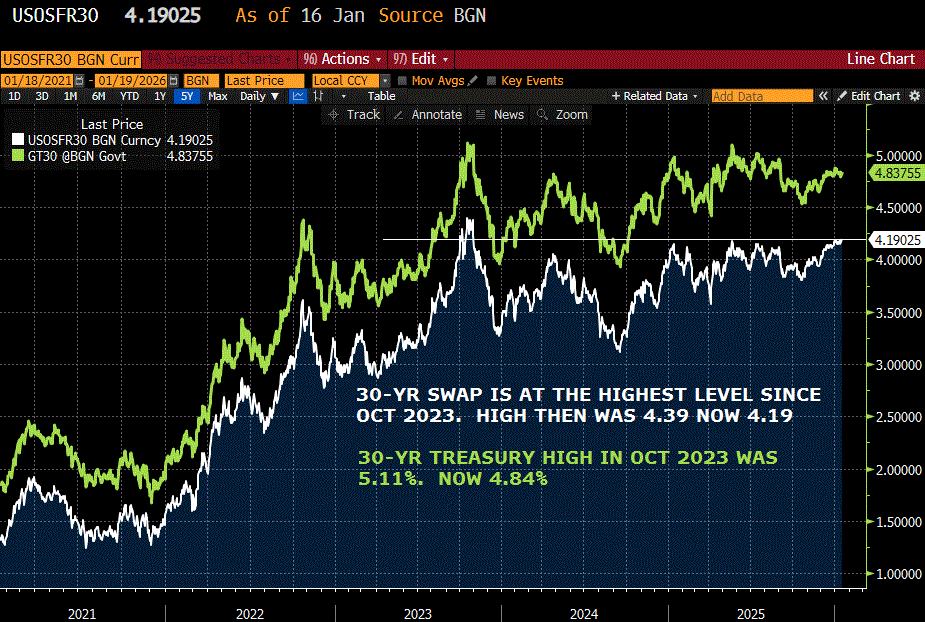
I’m not sure if this next topic is related to the swap line discussion above, but since September, the 30Y swap spread has rallied from -83 bps to -64. Attached is a chart showing the 30y treasury in green and 30y swap in white. Note that while neither yield is above October 2023 highs, the swap rate has made a new two-year high of 4.19 (only bested by the 2023 high of 4.39).
Not a lot of economic news this week, which should be dominated by Davos.
PCE Prices on Thursday. YOY headline and Core both expected 2.8%
| 1/9/2026 | 1/16/2025 | chg | ||
| UST 2Y | 353.6 | 359.7 | 6.1 | |
| UST 5Y | 375.5 | 382.4 | 6.9 | |
| UST 10Y | 417.2 | 422.7 | 5.5 | |
| UST 30Y | 482.0 | 483.8 | 1.8 | |
| GERM 2Y | 210.5 | 210.9 | 0.4 | |
| GERM 10Y | 286.2 | 283.4 | -2.8 | |
| JPN 20Y | 306.1 | 315.6 | 9.5 | |
| CHINA 10Y | 186.9 | 183.6 | -3.3 | |
| SOFR H6/H7 | -41.0 | -35.5 | 5.5 | |
| SOFR H7/H8 | 18.5 | 17.5 | -1.0 | |
| SOFR H8/H9 | 19.5 | 19.5 | 0.0 | |
| EUR | 116.37 | 115.98 | -0.39 | |
| CRUDE (CLH6) | 58.94 | 59.34 | 0.40 | |
| SPX | 6966.28 | 6940.01 | -26.27 | -0.4% |
| VIX | 14.49 | 15.86 | 1.37 | |
| MOVE | 61.55 | 58.05 | -3.50 | |