Barbaric Relic
October 15, 2023 – Weekly comment
***************************************
One hundred years ago John Maynard Keynes wrote, “In truth, the gold standard is already a barbarous relic.” (page 172, A Tract on Monetary Reform). Keynes was talking about the gold standard, but over time gold itself has been tagged as a relic.
Here are a couple of clips from the same treatise:
Consequently gold now stands at an “artificial” value, the future course of which almost entirely depends on the policy of the Federal Reserve Board of the United States. The value of gold is no longer the resultant of the chance gifts of Nature and the judgment of numerous authorities and individuals acting independently.
And – most important of all – in the modern world of paper currency and bank credit there is no escape from a “managed” currency, whether we wish it or not; convertibility into gold will not alter the fact that the value of gold itself depends on the policy of Central Banks.
Another tie-in to this theme is the book, Barbarians at the Gate, which documents “The fall of RJR Nabisco”. This story covers the LBO craze of the 1980’s which saddled the target company with unmanageable debts. (Also made into a great 1993 movie).
The focus on gold this week is a result of barbarism in Israel/Gaza, leading to a jump of 3.4% in spot gold on Friday to $1933/oz, just above the 200 dma. On the week gold gained $100. Of course, in terms of commodity rallies this one is tame for now.
The Keynes commentary is perhaps a precursor to Friedman’s “Inflation is always and everywhere a monetary phenomenon…” and it’s clear that Federal Gov’t spending is linked to monetary growth. The core problem is beginning to resemble the same one RJR had: huge Federal Government debts without enough cash flow for smooth servicing. An LBO of the Federal Gov’t.
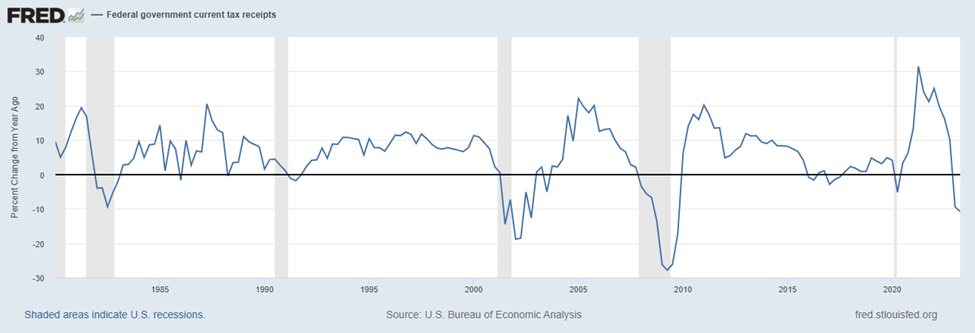
There have been a lot of stories about the size and growth of the Federal deficit, and the chart below gives a sobering view of the year/year percentage change in Federal tax receipts. (Thanks YZ). In Q2 tax receipts were falling at a yoy rate of -10.8%. [chart is a bit hard to see so here’s a link https://fred.stlouisfed.org/series/W006RC1Q027SBEA# The link may take you to the “billions of dollars” setting, which needs to be edited for yoy % change]. By the way, the billions of dollars measure equals $2.8b, which seems insignificant in relation to Federal spending. When the growth rate of income severely lags the growth rate of spending, the difference is borrowed and the interest rate demanded should increase. A bullet point summarizing Waller’s comments last week says the same thing: “When the deficit is 6% with low unemployment, it’s hard to see that as sustainable. Clearly issuance has to have an impact on yields.”
What about the “real” yield?
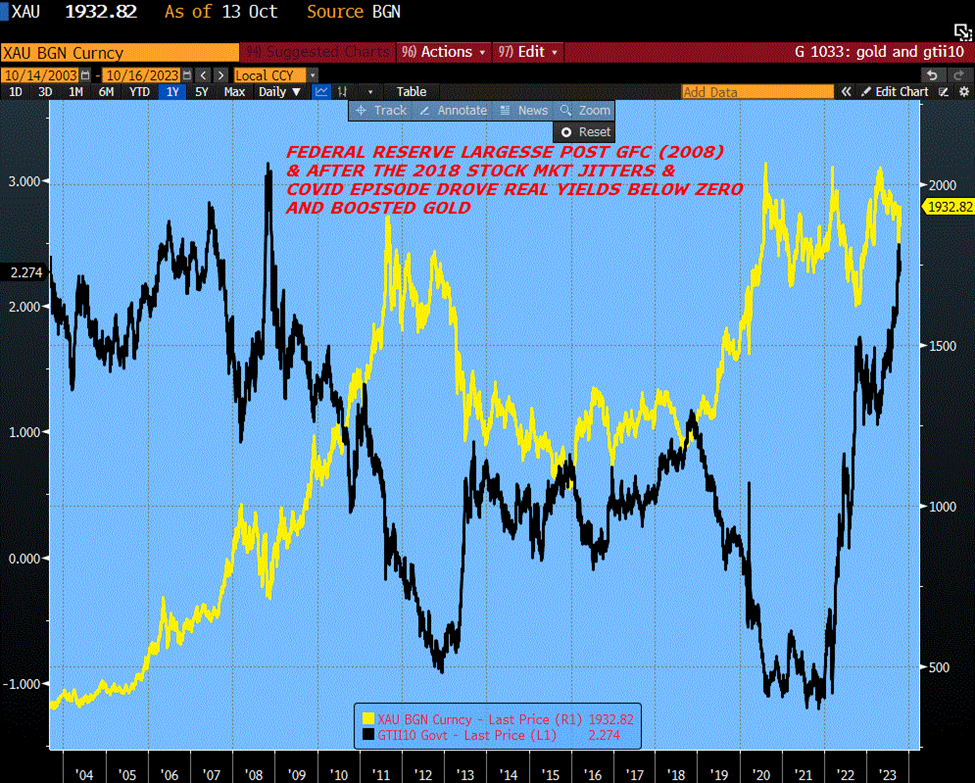
After the GFC the real rate, as portrayed by the ten year inflation-indexed note yield, went from over 2% (positive) to nearly 1% negative. As the next chart shows, gold surged. Again, after the stock market swoon in Q4 of 2018, and the Covid episode, the tip rate went from +1% to -1% and gold surged. Now the tip yield is near a new recent high at positive 225 bps. Gold is not pulling back. And THAT is the canary in the coal mine.
It’s often said that the real rate is a huge impediment to the gold price because gold has no yield. I have a small investment in a company run by friend Keith Weiner, Monetary Metals, that actually pays an interest rate on physical gold, with physical gold. I’m not saying that Keith’s company has single-handedly squashed the “positive real rates kill gold” narrative. (Or am I?). What I am saying is that rising nominal rates and a rising real rate coupled with a rise in the price of gold give an unsettling picture of the economic environment which is likely unfavorable to most financial risk assets. Perhaps the economic landscape was appropriately captured by Citigroup CEO Jane Fraser, who said, “September is always a busy month seeing clients, and I’m struck how consistently CEOs are less optimistic about 2024 than a few months ago.”
For a somewhat different view, I’ll cite James Fishback from an Axios article: “…the average duration for investment-grade corporate debt has doubled from four to eight years… companies are paying less in debt now than a year ago. US corporate net interest payments have fallen for the past five quarters, according to BEA data. At the same time, businesses are earning 4-5% on their cash holdings. Many companies have actually benefited from higher rates.” [Recession deferred?]
https://www.axios.com/newsletters/axios-macro-bf4a058b-5001-48d8-ae4f-c52c52e61bc2.html?chunk=0&utm_term=twsocialshare#story0
But maybe it’s not a different view. Current issues are driven more by government than by the corporate sector. Perhaps the rising gold price is a true reflection of that dynamic.
OTHER THOUGHTS/ TRADES
The curve flattened this week as officials continue to indicate that the Fed is on hold for the time being as financial conditions have tightened, but that rates aren’t being lowered any time soon. The 2/10 treasury spread went from -30 bps to -42 (5.05%/4.63%) as the flight-to-quality was more of an influence on longer maturities (despite poor auction results). This week’s 20y auction is on Wednesday, and it is at the high point of the curve outside of the 2y. 20y yield 4.963% on Friday. Not looking for stellar results on this one.
FFX3 settled 9465.0 (+5.5 on the week) or 5.35% vs Fed effective 5.33%. FFF4 settled 9459.0 (+4.0 on the week) further squeezing out perceptions of another hike prior to year end. FFF5 settled 9539.0 a spread of -80 to FFF4, indicating about 3 Fed eases over next year. This spread hit a recent low of -140 in August, so in the last two months the Fed’s higher for longer mantra has lessened the magnitude of perceived easing.
There were several SFRH4 call flies traded through the week, but I especially favor this one: SFRH4 9550/9600/9637.5 broken call fly bought for 1.25. Settled 1.5 (10.5/7.25/5.5). Max loss is premium paid. Breakeven is 9551.5 but on the upside any settle above the top strike makes 11.0 as the lower call spread is 50 and the upper is 37.5 wide. Max value of 50 occurs with the unlikely settled of exactly 9600. The 9550/9600/9650 c fly traded and settled at 1.0 and has the same max value at 9600, but a close above the upper strike will mean a loss of the initial premium spent.
********************************
Monetary Metals info at https://monetary-metals.com/ On twitter or X: @RealKeithWeiner
Also, for those from the CME floor, I saw a great movie this weekend by Mike Tamarkin’s (HWK) son, Blake Tamarkin! Poignant and funny treatment of an age-old story, fine acting, fabulous soundtrack, superb location shots in Chicago. Really impressive.
THIRD WHEEL. Watch for it at upcoming film festivals. I highly recommend it not just for the old floor community, but for all.
https://www.eventcreate.com/e/thirdwheel
| 10/6/2023 | 10/13/2023 | chg | ||
| UST 2Y | 508.1 | 505.2 | -2.9 | |
| UST 5Y | 474.8 | 464.2 | -10.6 | |
| UST 10Y | 478.3 | 462.7 | -15.6 | |
| UST 30Y | 493.8 | 477.7 | -16.1 | |
| GERM 2Y | 313.3 | 313.9 | 0.6 | |
| GERM 10Y | 288.4 | 273.7 | -14.7 | |
| JPN 20Y | 159.2 | 151.7 | -7.5 | |
| CHINA 10Y | 268.1 | 268.0 | -0.1 | |
| SOFR Z3/Z4 | -85.5 | -83.5 | 2.0 | |
| SOFR Z4/Z5 | -50.5 | -57.0 | -6.5 | |
| SOFR Z5/Z6 | 4.5 | -3.0 | -7.5 | |
| EUR | 105.90 | 105.11 | -0.79 | |
| CRUDE (CLZ3) | 81.28 | 86.35 | 5.07 | |
| SPX | 4308.50 | 4327.78 | 19.28 | 0.4% |
| VIX | 17.45 | 19.32 | 1.87 | |
https://delong.typepad.com/keynes-1923-a-tract-on-monetary-reform.pdf