We have some ground to cover
November 3, 2022
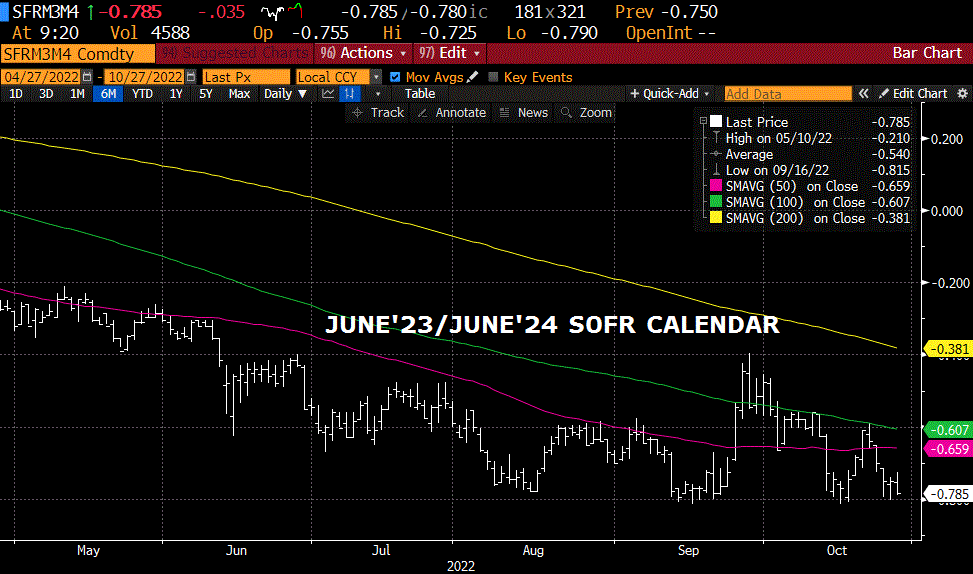
–Powell’s catchphrase was “we have some ground to cover”. EDH3/M3 settled at a new high of -0.5, having recently been as low as -10.5, and SFRH3/M3 at 0.0; pricing for possible easing in Q2 is getting squeezed out. On the other hand, more deferred calendars made new lows. For example, SFRM3/SFRM4 settled -83.5, so while Powell says more to come, the market is interpreting that to mean that easing will surely follow. Powell repeated these messages a couple of times: “…very premature to be thinking about pausing”… “ongoing rate increases are still appropriate”. He also said that it’s tough to make the case that the Fed is too tight [but a new low in 2/10 at -51 is making exactly that case]. Timiraos asked, “…with Core CPI at or near 5%, does the Fed have to move FF above that rate?” Powell deftly sidestepped that one…but emphasized “we will stay the course until the job is done.” Stocks were shellacked, SPX -2.5% and Nasdaq Comp -3.4%.
–On Monday there was a buyer of 20k 0QZ3 9500p for 9.5 on a block ref 9548-ish. Yesterday those puts were exited, sold at 7.0 to 5.5 covered 9548.5, 40k. With SFRZ3 final settle 9532.5 yesterday, the puts settled at the original buy price, 9.5, a harsh Indication of vol being smoked. On Monday the atm 0QZ2 9550 straddle settled 51.5, yesterday the atm 9531.25^ settled 44.75.
–Today, Jobless Claims expected 220k, Productivity, and ISM Services, expected 55.5.
What’s priced
November 2, 2022
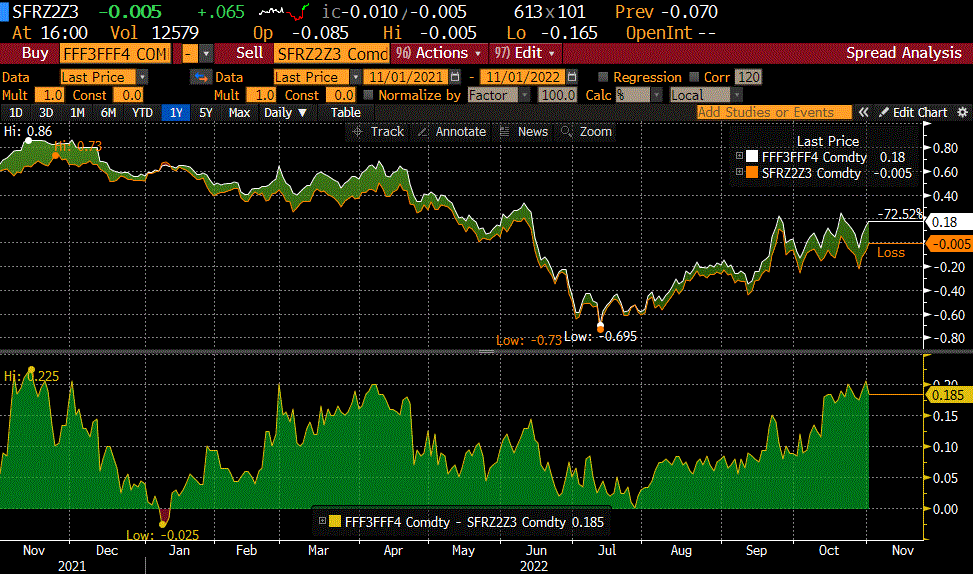
–Is the market that good on pricing? Previously, I had thought that one-year calendars on the euro$ strip were great guideposts for pricing the extent of hiking. Not this year. Early in the year, the peak one-yr spreads came nowhere close to capturing the aggressiveness of this year’s hikes. More below, but first, with a 75 bp hike, EFFR should go to 383 bps. FFX2 should be pegged at 9622 (given the first two days of the month at 308 and the rest at 383). Indeed, FFX2 yesterday settled 9621.5. The next meeting is December 14. January is a ‘clean’ month, though the first 2 days of Jan will be set at the turn rate. In any case, FFF3 settled yesterday at 9556 or 444 bps. If the new EFFR is 383, then the FFF3 rate is 61 bps higher, about halfway between a hike of 50 and 75 for the December meeting. That all seems reasonable. Here’s what doesn’t seem to be appropriately priced in terms of yesterday’s settles (Nov 1):
EDZ2/EDZ3 -27.0
SFRZ2/SFRZ3 -2.5
FFF3/FFF4 +19.5
FFG3/FFG4 -26.5
EDH3/EDH4 -73.0
SFRH3/SFRH4 -68.0
It’s like the children’s question in school, ‘which of these spreads doesn’t look like the others?’ That would be the POSITIVE one, FFF3/FFF4 at 19.5. All of these spreads cover one-year forward periods, and all are staggered by only a few months. Is the market that good that it has a hike priced for the Feb 1, 2023 FOMC (FFF3/FFG3 is 36.5, 9556/9519.5) and then prices about 3/4% easing from mid-March 2023 to mid-March 2024? In terms of the December based spreads, EDZ2/Z3 is priced as negative as it is because of ‘turn’ and credit concerns embedded in EDZ2. Indeed, SFRZ2/EDZ2 settled at a new high of 50.5 bps. This dynamic has also tended to pull SFRZ2/SFRZ3 lower, to -2.5. Does it seem reasonable for the difference between FFF3/F4 and SFRZ2/Z3 to be 22 bps? Probably not.
–The point here, without making specific recommendations, is that many spreads have become quite volatile. Consider EDM3/EDU3, just a three month period, made a new low of negative 21 yesterday (9472/9493). So, a hike is priced for Feb 1, but then a couple of months later the market leans toward ease! The other spreads which made new lows for the cycle yesterday were EDM3/M4 at -90.5 and SFRM3/M4 at -85.5. Weak hands (longs in EDH3 and EDM3) have been washed out in front of today’s FOMC.
–My personal guess is that the last hike of this cycle will occur this year. However, it would almost be unthinkable for Powell to guide that way. It was only two months ago at Jackson Hole that he said the Fed has to stick with restraint ‘until the job is done’. He has since said it would be appropriate to reduce the pace of hikes at some point. That message will likely be repeated at today’s presser. Also beware of a treasury buyback announcement this morning, which is likely to help with liquidity issues in treasuries for just about the same amount of time as raiding the SPR lowered gas prices at the pump.
Mission accomplished by June
November 1, 2022
–Weakness in interest rate futures being reversed this morning. At futures settle, the ten year yield was up 7 bps at 4.08% with TYZ2 110-19. Current TYZ2 is 111-06. The Treasury’s refunding announcement was initially met with selling as 4th quarter borrowing needs rose to $550 billion, $150b higher than the initial estimate. However, a brief sell-off in futures was quickly erased.
https://home.treasury.gov/news/press-releases/jy1063
–In short term rates, SFRZ2/EDZ2 spread settled at a new high of 50 bps, and was 50/50.5 late. This spread is nearly double the 26 bp transition SOFR to ED fallback level. The lowest one-year eurodollar calendar spread is EDM3/EDM4, which posted a new low for any 1-yr calendar this cycle at -85.5. In SOFR. M3/M4 is also the lowest, trading -82 late in the session. Some notable new buys in 0QZ2 puts (Dec midcurves on SFRZ3). The 9500p was bought on block at 9.5 21k, settled 9.0 vs 9546.0. 0QZ2 9512.5p 12.0 paid 15k covered 9548; settled 12.25. The 9550 atm straddle settled 51.5. Appears to have been some expensive FOMC downside insurance. The RBA hiked 25 bps to 2.85% (expected) and raised the inflation estimate for this year to 8%. The Fed is expected to hike 75 tomorrow, but the inversion of 2023 to 2024 contracts indicates that the market is just as certain that eases are eventually coming. It was just over 2 months ago at Jackson Hole that Powell vowed to stay tight until the job is done. The market is pegging that window of time to be in the middle of next year.
–USD is weaker this morning, supporting stocks and commodities. News today includes JOLTS expected 10m. ISM Mfg expected 50, but could easily print lower which would indicate contraction. ISM Mfg Prices expected 52.5.
No Day
October 28, 2022
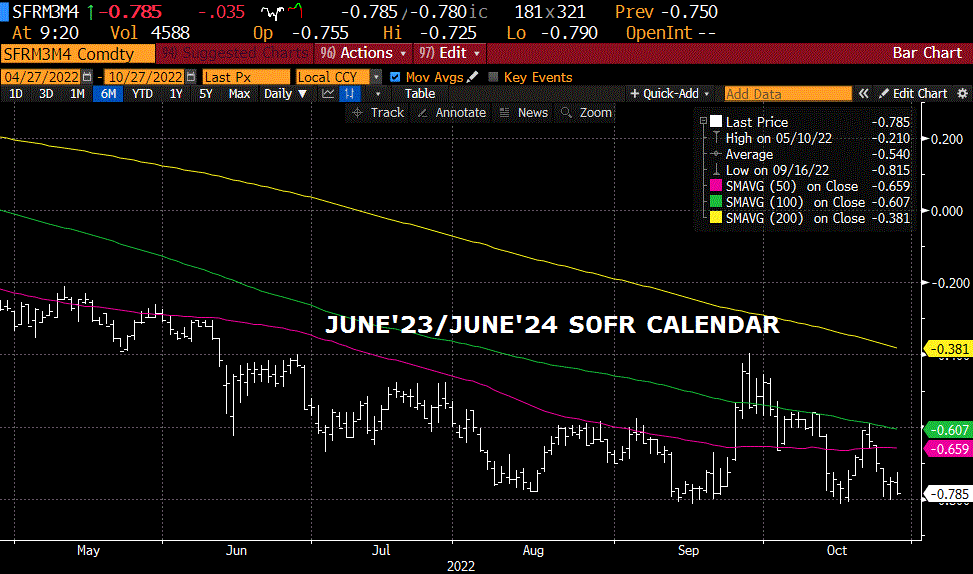
–The ten year yield fell back below 4%, easing 7.2 bps to 3.941% as anticipation of a Fed pause into next year grew. A change to the QT schedule could also occur at next week’s FOMC meeting. My bias is for a long pause rather than pivot to actual ease, but short end curves are telling a different story. For example, FFF3/FFF4 went from being positive to -5 as of yesterday’s close. More dramatic than that were new lows being posted in both EDM3/EDM4 at -83.5 (9503/9586.5) and SFRM3/M4 at -81.0 ( 9531.5/9612.5 chart attached). These are new low settles and at the lows for any one-yr calendars in this cycle. While FFX2 is fully priced for a 75 HIKE next week, these deferred calendars indicate a slightly larger EASE over the last half of next year. FFF3 settled 9560; closer to another 50 bp hike (9567) than 75 (9542) for the Dec 14 FOMC.
–Heavy buying of treasury calls yesterday, including 10k TYZ 113.0c for 35; settled 40 with OI +12k and TYZ 112.75/114cs bought in upper teens, settled 23 and added about 19k. In all, TYZ calls added 56k positions yesterday and TY futures rose another 74k in open interest, up 170k on the week. TYZ puts +19k. FV futures added 14k yesterday. Certainly feels like some sort of announcement is coming…
–ECB hiked 75 but signaled data dependence. It was AMZNs turn yesterday to disappoint the market by providing weak forward guidance; ESZ immediately dropped from 3820 to 3760. FT reports that big tech stocks have wiped out $800 billion in market cap.
–News today includes ECI expected 1.2%. PCE deflator yoy expected 6.3 with Core 5.2.
–I will not be at the desk today; back Monday.
Solid demand for treasuries
October 27, 2022
–Bank of Canada hiked only 50 bps vs expected 75 to 3.75%. ECB today. Nov Fed Funds (FFX2) settled 9621.0, fully priced for a 75 bp hike by the Fed next week.
–Ten year yield flirting with 4%; closed 4.013% down 9.3 bps on the day. Yesterday featured large new buying of TYZ2 112.5c; settled 0’37 vs 111-03 with open interest +10k. TYZ 112.75/114c spd also bought in good size; settled 0’17 with open interest +18k in both strikes. About 5k TYZ 110.5 straddles sold early 2’24 to 2’22, atm vol nearly unchanged on the day. Open interest in futures continues to grow with TU +66k, FV +36k and TY +23k. Seven-yr auction today, following a stellar 5y.
–Following Tuesday’s post-close earnings reports, GOOGL closed -9% and MSFT -7.7%. Yesterday META was -5.6% but the earnings call was met with another 20% slashed from the price. AAPL and AMZN today. Used to be called FAANGs, perhaps [negative] GAMMA is more appropriate now.
–DXY fell yesterday though the dollar has firmed slightly this morning. My feeling is that the dollar has put in a short-term top, with positive implications for commodities, especially WTI, which I think could test 98-99 sometime in November.
Fulcrum word
October 26, 2022
–Ten year yield fell 12.4 bps yesterday to 4.106%. Fives fell nearly 10 bps to 4.26% in front of today’s auction. Consumer Confidence was lower than expected, housing prices are easing. Open interest gives a strong clue as to the power of the FI rally: TY added 96k contracts, TU +26k, FV +44k, UXY +4k, WN +0.5k. The only contract that declined was US, which shed 3k. Implied vol fell, especially in ED contracts, where most straddles lost 2 to 3 bps. SFRZ2 9575/9587.5c spread continued to be bought, around 30k yesterday for 0.75. (140k cumulative). Flows in options featured put sellers and call buyers, though there was a buyer of 40k SFRH3 9550/9500/9450 p fly 5.5 which settled 5.25 ref 9511.0. Can be thought of as selling the iron at 44.5…the trade looks for SFRH3 to languish at the middle 5% strike.
–There was a block seller of FFF3/FFK3 yesterday. Spread settled 46.5 (9554.5 and 9508.5). There are 2023 FOMC announcements on Feb 1, March 22 and May 3. FFF3 at 9554.5 suggests an end-of-year EFFR of 4.455%. If we get a 75 bp hike in Nov (fully priced), EFFR will go to 3.83%, the FFF3 price is right in the middle of another 50 (4.33) and 75 (4.58). The F3/K3 spread seller is looking for Dec to be the last hike; the spread is currently pricing cumulative hikes over the first three meetings of 2023 of less than 50 bps.
–SPX rallied 1.6% yesterday, Naz Comp +2.2%. GOOGL and MSFT post-close results have stocks trading lower this morning, but the indexes have only given back a small chunk of yesterday’s gains. The dollar index is lower, and there are reports of China banks selling, taking USDCNY from a high of 7.3 yesterday to 7.18 today.
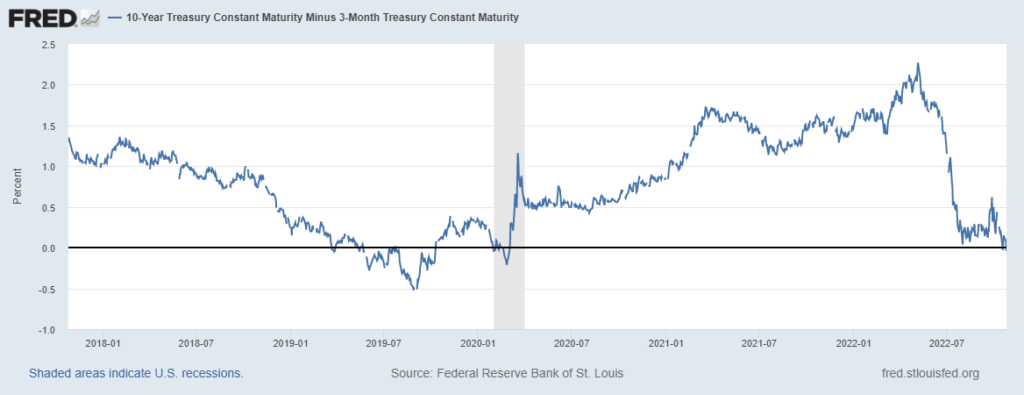
–The spread between 3m T-bills and tens got some press yesterday as it appears ready to invert (again). I would just mention that SFRZ2 at 95.39 represents repo at 4.61% with the 10y yield 4.11%; negative carry is a headwind on the entire market and does NOT help the liquidity issues facing treasuries. It’s not until the June’24 SOFR contract at a price of 95.91 (4.09%) that we see a contract with a yield below the current 10y.
***************
–Elon Musk tweeted this yesterday:
Elon Musk @elonmusk
διαλεκτική
Translate Tweet
8:25 PM · Oct 24, 2022·Twitter for iPhone
–From Zen and the Art of Motorcycle Maintenance (Robert M Pirsig):
“Dialectic generally means ‘of the nature of the dialogue’ , which is a conversation between two persons. Nowadays it means logical argumentation. It involves a technique of cross-examination, by which truth is arrived at. It’s the mode of discourse of Socrates in The Dialogues of Plato. Plato believed the dialectic was the sole method by which the truth was arrived at. The only one.
Also from Zen…
“Phaedrus began to wonder if “dialectic” had some special meaning that made it a fulcrum word…one that can shift the balance of an argument, depending on how it’s placed.”
–Logical argumentation seems to have fallen by the wayside. I suppose if we’re to extend that idea to markets, then unrelenting volatility is a natural outcome.
Fed…stops short?
October 25, 2022
–Composite PMI was just 47.3 vs expected 49.2. Ten year yield +1.3 bps to 4.23%. News today includes Consumer Confidence, Richmond Fed, 2y auction. GOOGL, MSFT, Visa report today. USDCNY is 7.309 this morning, a new low for the Chinese ccy.
–SFRZ2 9575/9587.5cs bought yesterday for 0.75 in size of 100k. Looks to be a new position though prelim open interest sheets have volume of 103k in 9575c and open int increasing by 116k, so something might be off. Call sp settled 0.5 (2.25/1.75) vs 9537.5. Also a new buyer of 20k SFRF3 9512.5/9525/9562.5/9625 c condor. The lower 12.5 wide c spd settled 5.25, while the 9562.5/9625 settled 4.25 vs SFRH3 9510. There is a theme of trying to find cheap call plays for an early end to Fed hikes (as Yellen frets about stability in the treasury market).
–In a related development, the ED curve steepened from reds (2nd year) back: reds +3.0, greens +2.125, blues -1.875, golds -4.375. The 7.375 gain in red/gold pack spread took it to the highest level since early August. The spread is still inverted, at -37.875, but flatteners have been pared back. 5/30 treasury spread settled just above zero. 2/10 is still -27.
Bad reaction to China
October 24, 2022
–China GDP 3.9% but CNY hits 7.26, a new low for the yuan. (Have to go back to the start of 2008 for a lower print). JPY currently 149.40; prior to Friday’s intervention, it had reached 150.29 on Thursday, and is nearly back to that level. Chinese stocks were crushed, with SHCOMP down around 2%. Hang Seng currently 15180, down 6% on the day and less than half its level from February 2021 when it was over 31k. Apparently common prosperity means less for everyone.
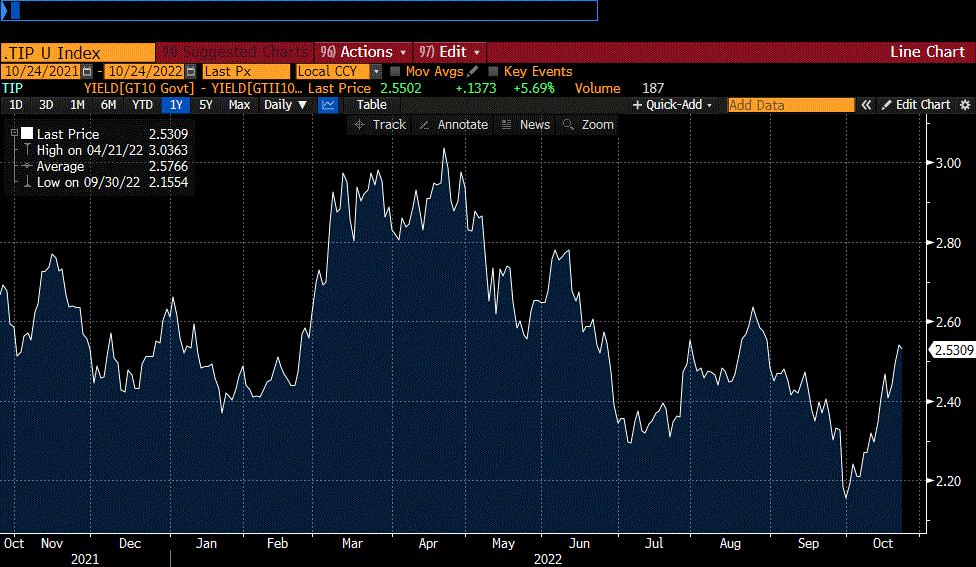
–Friday featured a much steeper US curve as a Nick Timiraos WSJ article suggested the Fed would downshift hiking plans. The 2y note fell 13.2 bps to 4.47% while 30s rose 12.2 to 4.335%. Ten year inflation breakeven ended at a new high for October at 254.6 bps. In July it hit a low of 229, in August it popped up to 263.5 and then fell to a low of 215.5 by the end of September. In October it has gone straight up, though still below August high. Today’s news includes Mfg and Service PMIs.
–A lot of earnings reports out this week, including: Tuesday: GOOGL, Visa. Wed: MSFT, META. Thurs: AAPL, AMZN. Fri: XOM. ECB meeting Thursday. Interesting CNBC interview with Frank Luntz on Friday warning markets that election results from Nov 8 may not be clear. “I’m scared to death…we’re going to have a problem in this country…”
Signals
October 23, 2022- Weekly comment
A WSJ article by Nick Timiraos on Friday about the Fed stepping down the size of Fed rate increases symbolized a change in policy as surely as Hu Jintao being publicly shuffled out of China’s Party Congress cemented Xi’s control. Of course, hints were already in place. Powell at the August 26 Jackson Hole Conference said that it would be appropriate to slow down the pace of tightening at some point. Brainard in her October 10 speech noted the Fed was attentive to the risk of adverse shocks [from global tightening]. On Friday SF Fed’s Mary Daly was more direct, saying “I think the time is now to start talking about stepping down.”
Markets responded with large moves which were accentuated by intervention in $/yen by the BOJ. The strong USD has represented a tightening in global financial conditions; the range in DXY Friday engulfed the previous ten day’s ranges with a close at 112.01, near the low of the day. While FFX2 settled 9620.5 just 1.5 bps away from what the final settle should be on a 75 bp hike at the November 2 FOMC (9622.0), FFF3 rose 8 bps in price to 9556.0. If the Fed Effective (EFFR) moves from 308 bps to 383 on Nov 2, then another 50 bp hike on Dec 14 would take it to 433 and 75 to 458. FFF3 at 444 (9556.0) leaves it much closer to the former. The November 2 FOMC, now just one and a half weeks away, will be an important event for Fed communication.
In terms of a specific market-based message on Fed policy, I will focus on the 5/30 treasury spread, and relate that to the death of MMT. Chart of 5/30 below, covering the past two years.
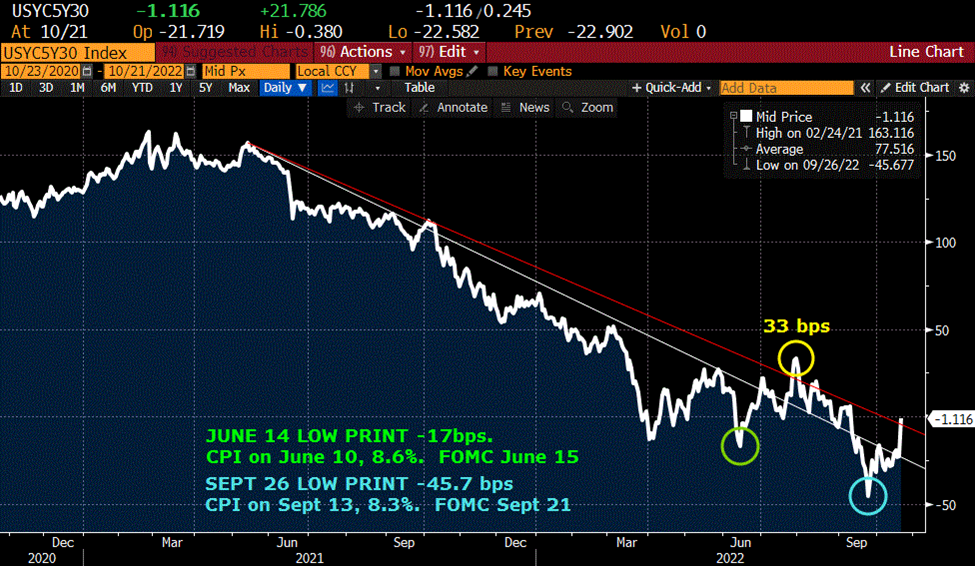
This week the 5/30 spread rallied 28.4 bps to end just above zero. On the chart I have noted recent lows which corresponded to June and September FOMC meetings and CPI releases. The CPI release on June 10 for May was 8.6%. On June 14, 5/30 spread hit the low for the cycle at -17 bps. On June 15, the Fed hiked 75 bps from 0.75-1.0% to 1.5-1.75%, as expected. The ensuing move from June 14 to the end of July took the spread from -17 to +33, or 50 bps in total. Labor market strength and the Fed’s laser message on stopping the scourge on inflation sparked a leg to new lows. CPI on September 13 was 8.3%, the Fed hiked another 75 on Sept 21, and the spread made its ultimate low on Sept 26 at -45.7. Note that last CPI print of 8.2 on October 13 corresponded with a spread price of -28, well above September’s low.
When one views this chart from a longer term perspective, and notes that the lowest price in recent history was -67.5 in May 2000. It’s tempting to say it’s an easy buy, with a stop at new lows. I have fallen into that particular trap many times. Consider red/gold ED pack. Low in 2000 of -8 bps, low towards the end of the hike cycle in 2006, +10.25, low at the end of the hike cycle in 2018, -6. In February of this year, one might have been tempted to pay -10. (how much risk can there be? It’s at ALL TIME lows!). By the end of March it was -72, and extended the low to -87 in April.
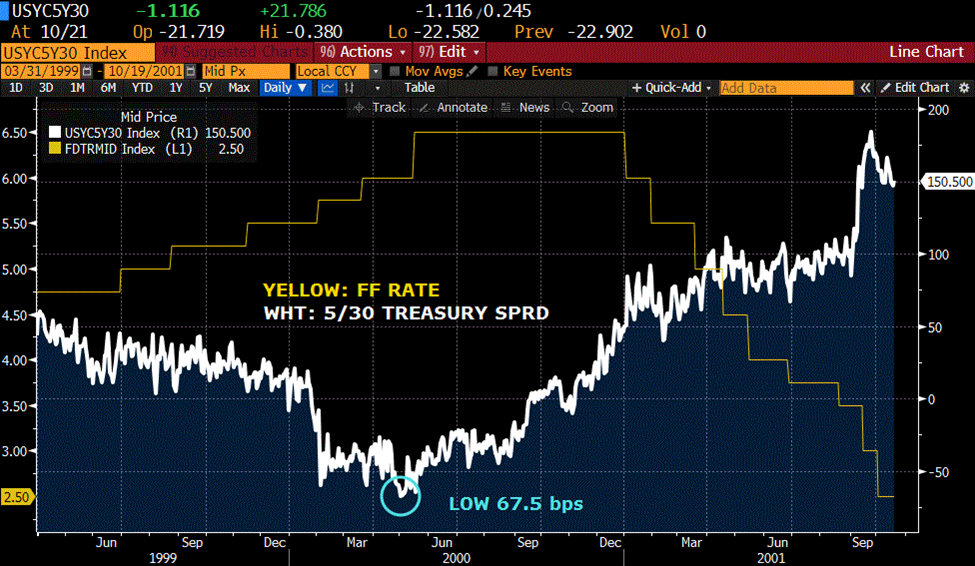
Below I isolate the 5/30 spread over the timeframe from April 1999 to October 2001. The low of -67.5 was in May 2000. I have included the FF target rate in yellow. Note that the spread bottomed just prior to the last (outsized 50 bp) hike in mid-May. The spread tends to foreshadow the final tightening by the Fed. Currently, my inclination would be to buy on any dip back towards the June low, with an initial objective to 33, which was the high in late June and is the 38% retrace from the high in Feb of +161 to Sept low -46.
The idea of exiting flatteners and initiating steepeners has been gaining currency. A friend mentioned that MS put out a piece either last week or early this week suggesting that flatteners be exited. If the Fed’s done, curve’s gonna steepen. I believe it’s likely that after December we’re in for a long pause as occurred from June-06 to August-07 at 5.25%. Near term spreads give some credence to that view. SFRZ2/SFRZ3 settled zero. In July it had hit a low of -73. FFF3/FFF4 settled +18. In July the low was negative 69.5. EDZ2/EDZ3 made its low -84 in July, rallied to zero on Sept 26. But is now -23 as turn-of-year concerns are priced into the EDZ2 contract which will still settle to libor.
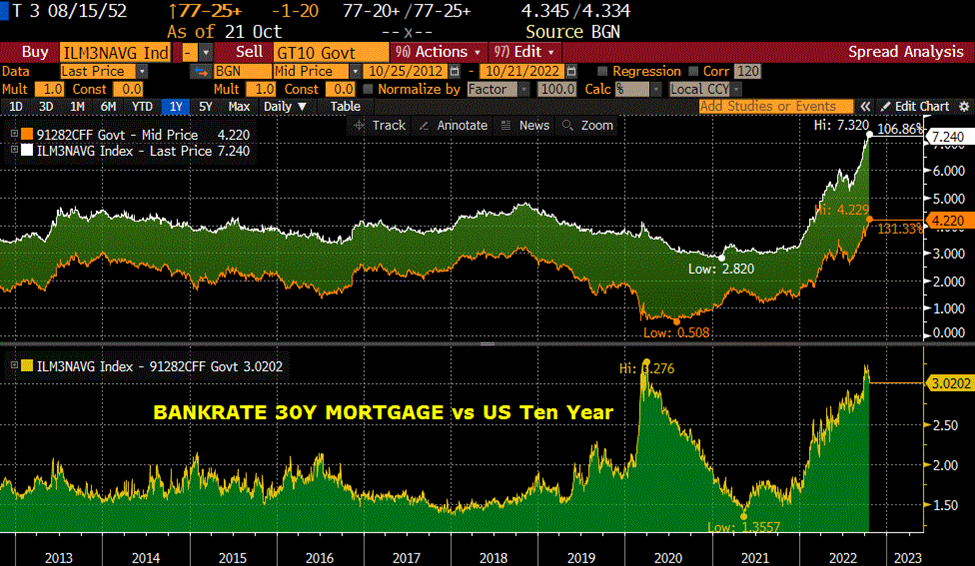
One last bonus chart, the 30yr mortgage to ten year treasury spread nearly reached the Covid high. Another sign of stress that the Fed is surely attentive to.
*********************************
This week (with the resignation of Liz Truss) decisively drove the wooden stake through the heart of Modern Monetary Theory. I am including a link of Stephanie Kelton’s TED talk address ‘The big myth of Government deficits’ which is 13 minutes long and is from August 2021. The message is seductive. Salient clips are at 3:25 and 12:00.
https://www.ted.com/talks/stephanie_kelton_the_big_myth_of_government_deficits?language=en
Around 3:25 “MMT provides an accurate description of how a fiat currency like the US dollar or GBP actually works. It reminds us that we’re no longer on a gold standard, so finding the money to pay for the things we need is never an issue for countries like the US or the UK.”
Around 12 min mark: If resources are already being used…”if the gov’t suddenly tried to make all of these investments at once, it would quickly discover that it doesn’t have the people or the building materials to do the work. To get the resources it needs it would have to compete with the private sector, bidding up wages and prices. THAT would be inflationary and it would be fiscally irresponsible. We are a long way from full employment…”
It’s so godawful stupid in hindsight that it’s almost funny. It’s like saying, “Drive your car just as fast as you want, but if you reach a sharp curve and can’t make the turn and plunge through the guardrail into the ravine, well, then you know you’ve gone too far.” Stephanie Kelton, prophetically referring to the UK in this talk and others, both described and destroyed the concept of MMT in this short speech. No foresight whatsoever. The 5/30 spread and other market signals transparently reflect forward looking concerns (though not always correctly). In 1840 Frederic Bastiat wrote:
In the economic sphere, an act, a habit, an institution, a law produces not only one effect, but a series of effects. Of these effects, the first alone is immediate; it appears simultaneously with its cause; it is seen. The other effects emerge only subsequently; they are not seen. There is only one difference between a good economist and a bad one: the bad economist confines himself to the visible effect; the good economist takes into account both the effect that can be seen and those which must be foreseen.
We try to examine past activity and determine what the knock-on effects might be. The lack of foresight inherent in MMT contrasts exactly with current Fed struggles, e.g. not ‘overtightening’ in an environment that is extremely hard to forecast.
This week features Employment Cost Index expected 1.2% for Q3 and Core PCE Prices, expected 5.2% yoy vs 4.9 last. Treasury auctions of $42b 2y, $43b 5y and $35b 7y start Tuesday. There will likely be some concession in treasury futures prices in the early part of the week, though I expect Friday’s lows to hold in FVZ2 (105-1475).
| 10/14/2022 | 10/21/2022 | chg | ||
| UST 2Y | 450.1 | 447.2 | -2.9 | |
| UST 5Y | 426.2 | 434.1 | 7.9 | |
| UST 10Y | 400.2 | 421.7 | 21.5 | |
| UST 30Y | 397.2 | 433.5 | 36.3 | |
| GERM 2Y | 195.6 | 204.1 | 8.5 | |
| GERM 10Y | 234.6 | 241.7 | 7.1 | |
| JPN 30Y | 146.0 | 159.5 | 13.5 | |
| CHINA 10Y | 270.2 | 274.0 | 3.8 | |
| SOFR Z2/Z3 | -6.5 | 0.0 | 6.5 | |
| SOFR Z3/Z4 | -74.5 | -64.5 | 10.0 | |
| SOFR Z4/Z5 | -25.5 | -18.5 | 7.0 | |
| EUR | 97.22 | 98.64 | 1.42 | |
| CRUDE (CLZ2) | 84.65 | 85.05 | 0.40 | |
| SPX | 3583.07 | 3752.75 | 169.68 | 4.7% |
| VIX | 32.02 | 29.69 | -2.33 | |
Bonds melting
October 21, 2022
–Yields continued to make new highs, with tens up 10 bps to 4.222% at yesterday’s future settlement, going into today’s November option expiration on treasuries. TYZ settled 109-115 and is currently 109-06 (5:50 EST) while USZ is down one full point this morning at 119-14. TYX 109p settled at 9/64 yesterday, an astronomical price for one day, but there are only 13k open. Stocks are trying to pretend that higher rates won’t affect forward valuations, but are also giving ground. SOFR contracts from March’23 to March’27 settled down 13 to 13.5.
–In the beginning of the week I noted that EDM3/EDM4 settled -80.5, a new recent low, and that the lowest any 1-yr calendar had settled in this cycle was -84. Yesterday, EDM3/EDM4 settled -65. SFRM3/SFRM4 settled -61. Still extremely inverted, but red and green (2nd and 3rd year forward) ED and SFR contracts are perhaps adjusting to the idea that rates might stay high for some time. (Near calendar spreads going bid).
–SFRZ2/EDZ2 settled at a new high 47.5. Given that ED to SOFR contracts are transitioning at 26 next year, the extra 21.5 bps can be attributed to turn-of-year pressure and credit concerns. SFRZ2 has 935k of open interest while EDZ2 still has 1.566m open, so it’s not as if the spread can be easily pushed around. The spread is there for a reason.
–Saw below tweet yesterday on the Fed’s liquidity swaps, which have jumped to $6.48 billion this week. While it may be worth keeping an eye on, these swap lines jumped to $450 billion during COVID, so this is a relatively minor blip so far. The Fed website says: “The swap lines are designed to improve liquidity conditions in dollar funding markets in the United States and abroad by providing foreign central banks with the capacity to deliver U.S. dollar funding to institutions in their jurisdictions during times of market stress.”
https://fred.stlouisfed.org/series/SWPT