Nearer flatter, farther steeper
July 31, 2022 – Weekly comment
The big events of last week were the Fed’s (expected) 75 bp hike in the FF target to 2.25/2.50% equaling the high from 2018, and the Advance Q2 GDP print of -0.9%, signaling a recession that we’re going to pretend is not occurring.
In the wake of the FOMC meeting, the 2/5 treasury spread closed Friday at -21, at the lowest level since 2000. The red/green Eurodollar pack spread settled Friday -37.125. This is lower than all levels starting from 1999. Lows of approximately -10 in red/grn occurred in the year 2000 and in 2019. In June the record low since the turn of the century was posted at -39.75.
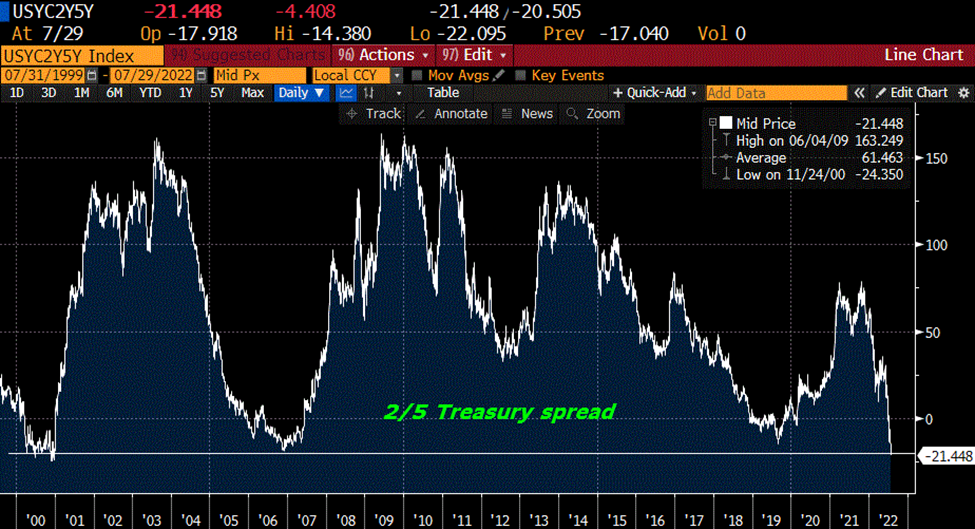
These spreads unambiguously reflect tight monetary policy. That policy was designed to restrain economic activity in order to squelch inflation, and the preliminary evidence is that demand is indeed being destroyed. On the inflation front, yoy PCE prices were +6.8% as expected, with Core a bit firmer than the survey at +4.8%. In terms of inflation expectations, the 5y breakeven hit a high of 368 in March, but the tightening campaign caused a favorable compression down to 229 by early July. In the past week the 5y b/e bounced from 234 to 279 as Powell toned down the tightening rhetoric. The October Fed Fund contract, (FFV2) which prices odds for the September 21 FOMC, had been halfway between 50 and 75 bps, but ended the week closer to 50 at a price of 9710 or 2.90%; 57 bps above the new Fed Effective rate of 2.33%.
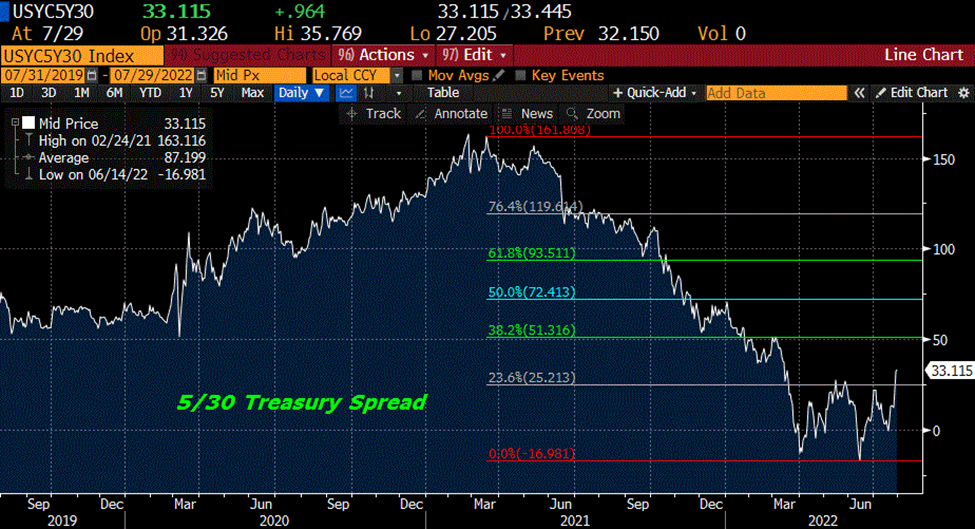
While 2/5 spread is mired at new lows, the 5/30 treasury spread closed at its highest level since mid-March at 33 bps. On a technical basis there’s a double bottom at -17 which projects to around 70, which also happens to be the approximate halfway back point from the high in Feb of 2021 at 163 to the June 14 low of -17.
I would summarize price action as acknowledging very tight Fed policy, with hints of less hawkishness in the future, which encourages profit taking on short curve and long USD. Straddle prices in long dated red Eurodollar options offer further evidence that the market perceives somewhat less aggressive Fed action. For example, EDU3 9687.5 straddle settled on July 22 at 138 bps vs 9689.5. On Friday, the contract settled 9695.0 (+7.5 on the week) and the 9687.5^ settled 125.25 (-12.75 on the week). The 9700 straddle settled 124.5. All red straddles were down 13 to 17 bps; a significant mark-down of panic premium.
A large trade worth mention was Tuesday’s 67k block buy of the Dec’22/Dec’23 SOFR spread at -63 bps. The spread rallied to a high print of -46.5 by Wednesday afternoon, but gave back nearly all of that on Thursday and Friday, ending the week at -61.5. My interpretation is that the buyer expected a stronger signal of a near-term policy pivot. However, SFRZ2 settled at 9674.5 up only 6 bps on the week. The rate on SFRZ2 is 3.255%. In other words, the market’s forecast of a final year-end FF target around 3.25% didn’t much change. SFRZ2 settled 9674.5 and SFRZ3 settled 9736.0. The spread DOES indicate a pivot to easing next year. As always, timing is key.
Both the administration and the Fed have cited the strong labor market as one of the main reasons that the economy is NOT in recession. The employment report is Friday, with NFP expected 250k from 372k. The unemployment rate is expected unchanged at 3.6%. Jobless Claims have been slowly trending up since the historic low of 166k in mid-March to 256k last week.
| 7/22/2022 | 7/29/2022 | chg | ||
| UST 2Y | 299.1 | 289.7 | -9.4 | |
| UST 5Y | 287.5 | 269.3 | -18.2 | |
| UST 10Y | 278.7 | 264.3 | -14.4 | |
| UST 30Y | 300.3 | 297.7 | -2.6 | |
| GERM 2Y | 45.2 | 28.1 | -17.1 | |
| GERM 10Y | 103.1 | 81.7 | -21.4 | |
| JPN 30Y | 122.5 | 119.5 | -3.0 | |
| CHINA 10Y | 278.6 | 276.5 | -2.1 | |
| EURO$ U2/U3 | -27.5 | -25.0 | 2.5 | |
| EURO$ U3/U4 | -43.5 | -50.5 | -7.0 | |
| EURO$ U4/U5 | -5.5 | -13.5 | -8.0 | |
| EUR | 102.16 | 102.27 | 0.11 | |
| CRUDE (active) | 94.70 | 98.62 | 3.92 | |
| SPX | 3961.63 | 4130.29 | 168.66 | 4.3% |
| VIX | 23.03 | 21.33 | -1.70 | |
Post FOMC notes as Q2 GDP spells recession
July 29, 2022
–Post-FOMC notes as Advance Q2 GDP printed -0.9%. FFQ2 settled exactly 75 above the previous Fed Effective (EFFR) of 158 at 233 bps or a price of 9767.0. The October contract captures the next FOMC on Sept 21; FFV2 settled 9710.5 or 289.5. If the Fed goes 50 at that meeting Oct will settle 9717.0. Currently, the conversation is whether the Fed does 75 or 50, with a heavy lean toward the latter, but I expect a shift to include the possibility of just 25, which would be signaled by FFV2 trading above 9717 (though today’s inflation data may preclude that in the short term). The lowest contracts on the FF curve are Jan and Feb ’23 at 9674 or 3.26%. The lowest SOFR contract is Dec ’22 at 9678.0 or 3.22%, and the lowest ED contract is Z’22 at 9639 or 3.61%. The 39 spread between Dec SFR and ED is the turn effect….the other spreads pre-transition are 29. The market has clearly identified the end to the hiking cycle as occurring no later than the start of next year.
–5/30 treasury spread was 15 before the FOMC, popped up to 22 right after and closed at 33 yesterday. The curve steepened as future hikes are pared back. Same thing hit the USD and put a bid into precious metals. SIU2 closed +1.268 at 19.868 and GCZ2 +31.70 at 1769.20. Risk assets embraced the atmosphere and ESU2 ran to new highs, bolstered by after hours gains in AMZN and AAPL.
–Today’s news includes ECI expected +1.2% from 1.4. The Fed’s preferred inflation measure, PCE Core prices expected 4.7 from 4.7 last, however headline expected 6.8 from 6.3 last. Michigan 5-10 year inflation expectations expected 2.8, same as last with 5y breakeven 2.71% and the 10y breakeven 2.50%. Powell deemed the current 2.25 to 2.5% target as ‘neutral’ so a year-end or Q1 target of 3.25% (as reflected by current futures pricing) would thus have to be considered restrictive.
Fed hikes 75 but Powell scales back hawkishness
July 28, 2022
–Fed hiked 75 as expected. Powell mentioned growth risks a couple of times and said FF are now around neutral. He also said that at some point it will be appropriate to slow the pace of rate hikes.
–Aug FF settled 9766.5, just 0.5 away from the new EFFR 233 bps. Oct FF captures the September 21 FOMC and settled 9709 or 291, 58 over 233, so that contract currently favors 50 at the Sept meeting rather than 75…and will likely edge even closer to 50 (towards 9717). Not only did Powell acknowledge slowing conditions, but news of Manchin cutting a deal with Schumer in part to cut government debt is a negative for growth.
–SFRZ2/SFRZ3 that traded -63 on a 67k block Tuesday was -49 late in the day Wednesday. Nice anticipation of the front month rally reflecting pared back tightening expectations.
–On the futures close I marked 5/30 at 20 bps, from just under 15 right before the FOMC. By the end of the day it was 22. Back end doesn’t feel comfortable with the idea of the Fed easing up on the inflation fight. USD eased. Precious metals firmed from depressed levels.
–On the other hand vol was smashed as the big event of the week came and went. For example, on Tuesday 0EZ 9700^ settled 85.5 and EDZ3 9700^ settled 145.75 vs the underlying at 9694.5. Yesterday the futures settled 9700, and the 0EZ 9700^ settled 81.5 (down 4 on the day) while the long dated EDZ2 straddle settled 139 (-6.75).
–Today’s news includes Advance GDP for Q2, expected slightly positive but could easily print negative. AAPL and AMZN earnings post-close.
FOMC day
July 27, 2022
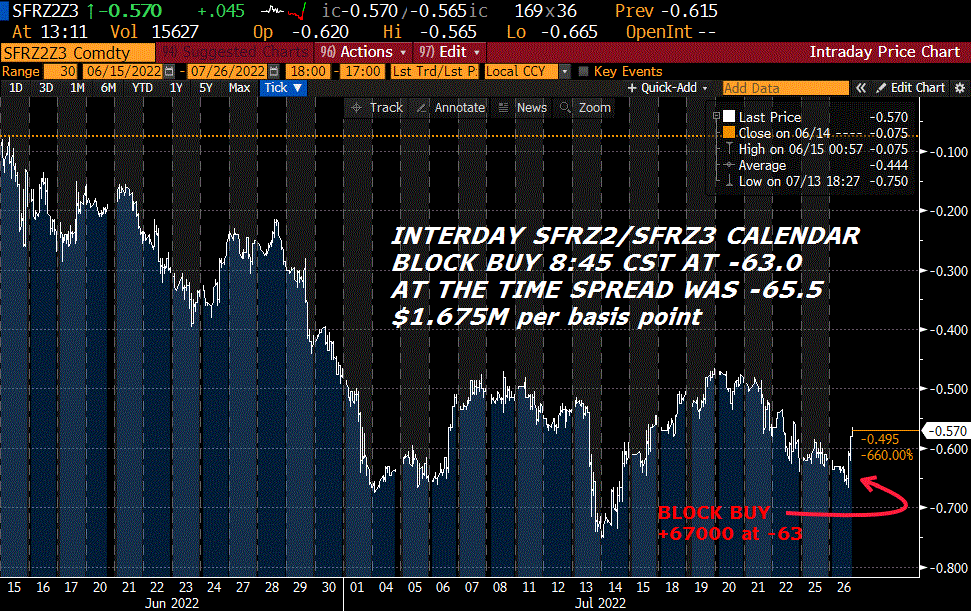
–Attached is a chart of SFRZ2/SFRZ3 one-year calendar. At 9:45 EST there was a 67k block buy at -63.0 (when the spread was offered at -65.5). By the end of the day the spread was trading -54, for a gain of ~$15m ($1.675m DV01). At the 3:00pm EST futures settle, the SOFR spread was -55.5 but EDZ2/Z3 settled -68.5, with the difference between SOFR and ED attributable to the libor related turn-of-year credit aspect on the ED contract. Open interest was up 43k in SFRZ2 and 58k in Z3 so position is new. Peak OI on both ED and SOFR curves is in Z2 with 1.6 million and 990k.
–This one trade defined much of the day’s price action. For example, on the ED curve red pack (2nd yr) settled -3.125 while the white pack (front four contracts) settled +0.875 and the greens +2.875. I.e. the sell leg of the spread was distributed across reds and spilled into the 2yr treasury. Therefore, the red/green pack spread settled at a new low for the month of July at -34, though not quite at the June low of -40. Similarly, the 2/10 treasury spread settled at a new low of -26…that’s through the 2006 low of -19 though not quite at the 2000 low of -56. The 2y yield rose 1 bp to 3.04 while tens fell nearly 3 to 2.787.
–Yesterday’s Consumer Confidence number was unsurprisingly weak at 95.7 vs 98.4 last. Lowest since covid and back to 2016 levels when we feared the election of Hillary. New Home Sales weak as well at a 590k rate (expected 655k). Today is, of course, the FOMC meeting, with a 75 bp hike baked in the cake. If the Fed hikes 75 then FFQ2 should settle 9767.0. FFV2 settled 9705.5, so 61.5 above what SHOULD be the new Fed Effective, essentially indicating 50/50 odds of another 75 at the Sept 21 FOMC. However Z2/Z3 trade leans toward the idea of this being the last hike.
–MSFT and GOOGL lifted ESU2 after the close, but SHOP’s notice of a 10% job reduction is likely more important as it’s another in a line of high profile job cut announcements. Both Powell and Yellen have pointed to solid labor dynamics as evidence the economy is good, but the trend has changed. Meta reports today. Xi and Biden to speak on Thursday: “What are we going to do about Nancy?”
Consumer Stress
July 26, 2022
–Nat Gas is currently 8.75, having set a low in the beginning of the month at 5.32 (NGU2). It’s nearing the high of 9.60 set in June as Russia’s supplies to Europe appear increasingly questionable. Late yesterday Walmart cut forward profit guidance and the stock sank after hours on the news. From the CEO: “The increasing levels of food and fuel inflation are affecting how customers spend…” The warning by AT&T that more customers are delaying cellular service payments reflects the same consumer stress, and it’s apparent in the stock prices (WMT, T). Investors have abruptly realized that consumers are at a tipping point.
–Rate futures gave back some of Friday’s gains. EDM3 was weakest on the strip -7.5 to 9662.0, but currently prints 65. TYU2 is back above 120 having settled 119-21; ten year yield was up 3 yesterday to 2.82%. Five year auction today.
–Dallas Fed Mfg was -22.6, lowest since 2009 outside of the covid plunge in Feb/March 2020 and a brief drop to -34 in the start of 2016. New Home Sales and Consumer Confidence today. MSFT and Alphabet report after the close.
Employment numbers will be important again
July 25, 2022
–Yellen had a pretty good run as Fed Chair from 2014 to 2018. However, the entire administration is being tested and Yellen’s interview with Chuck Todd on Meet the Press isn’t likely to age well. She maintains that the economy is not in recession because today’s slowdown is not a broad-based contraction; she says the job market is still strong and credit quality remains good. Even if Q2 GDP is negative after Q1’s negative print, it does not mean the economy is in recession. “When you’re creating almost 400k jobs a month, that is not a recession.” Q2 Advance GDP is released on Thursday.
–There will likely be more emphasis on jobs numbers going forward, and this week’s earnings reports will probably foreshadow a deteriorating labor market (175 of S&P 500 companies reporting). However, the rate market is fully priced for the Fed to hike 75 at Wednesday’s meeting to 2.25-2.5%, and the end-of-year FF target appears to be 3.25-3.50% (as FFF3 settled 9664.5 and SFRZ2 settled 9668.5). Friday’s stunning rally in treasuries suggests the Fed is succeeding in slowing forward growth and inflation expectations. The ten year yield sank 12.3 bps Friday to 2.787% and fives plunged 13.3 to 2.875% even as the treasury begins auctions of 2’s, 5’s and 7’s today. TYU2 rallied nearly 3 points from Thursday’s low to Friday’s high, 117-14+ to 120-11 as global PMI numbers came in sub-50.
–With August treasury options off the board on Friday, there will likely be more trade in October, expiring 23-Sept. The September treasury option expiration is 26 August, coinciding with the KC Fed’s Jackson Hole Symposium (Aug 25-27).
Spreads indicate a tightening vise
July 24, 2022
On July 21, Scott Minerd of Guggenheim tweeted this:
After four consecutive monthly declines, the leading economic indicators signal that recession is on the way. You’ve been warned.
Of course, the Eurodollar curve inversion has warned for many months that recession is on the way. On March 3, I mentioned it in a tweet as red/gold euro$ pack spread was inverting to new lows. “…chart is telling you a recession is coming.” On April 28, I cited inversion in June’23/Sept’23 spreads in both ED and SFR contracts as another indication of recession in late 2023.
This week however, the interest rate markets seemed to eliminate all doubt. The ten year yield dropped around 15 bps to 2.787% while fives fell 18 to 2.875% as weak global PMI data indicated recession. The Atlanta Fed’s GDP Now is currently -1.6% for Q2, and has been below -1% throughout the month of July, as the BEA releases the advance Q2 GDP estimate on Thursday (expected +0.3 to +0.5%).
It’s often said that monetary policy takes six months to a year to really take effect. The Fed’s first real hike was in March, about four months ago. At that time, the Fed Funds midpoint was 12.5 bps. On Wednesday, we’re expecting the Fed to hike by 75, taking the target to 2.25 to 2.5% (the peak in 2018), with a midpoint of 2.375 and Fed effective rate of 2.33, as indicated by August Fed Funds, which settled 9765 or 2.35%. This rapid tightening is expected to squash inflationary expectations.
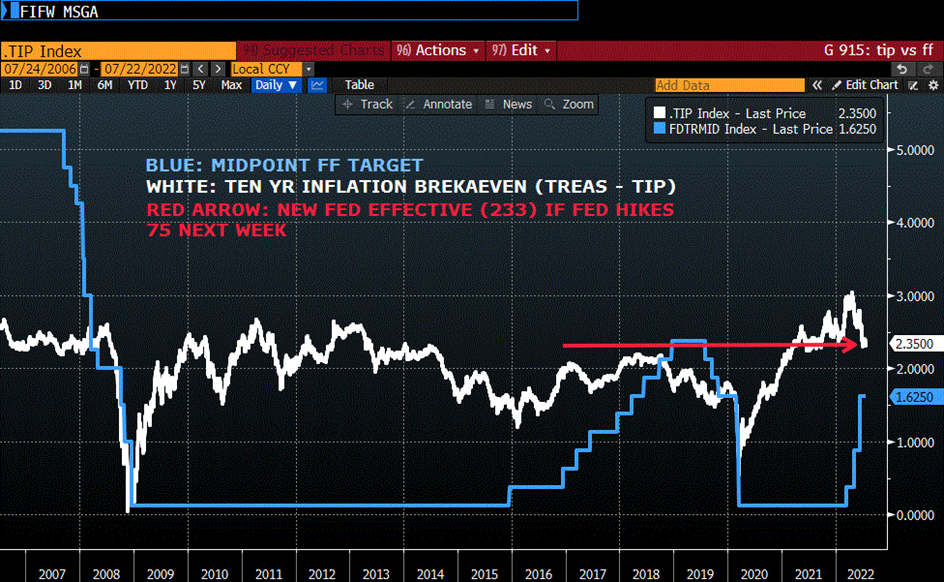
I have attached a chart showing that the new Fed Effective of 233 bps will just be equal to Friday’s close of the ten year breakeven of 234 bps. In 2018, when the former crossed the latter it spelled trouble, but bear in mind it took a lot longer to get there in 2018. It took three years from the end of 2015 to the end of 2018 to go from 12.5 bps to 237.5. Markets and consumers had some time to adjust. Just for a bit more background, the ten year b/e got to a high just above 300 bps in March. The 5y b/e peaked at a bit over 370 and is now 258. So the new EFFR will not exceed the 5y b/e… yet.
I have also included a chart of the yield on SFRZ2 (which is December SOFR) vs the current 10-yr treasury yield. SFRZ2 is the lowest contract on the curve, and likely the best predictor of what the FF rate will be by the end of the year. It settled Friday at 9668.5 or 3.315%. The January 2023 Fed Fund (FFF3) contract which conveys much the same info, settled at 9664.5. What does it mean? That if you are long treasuries and funding with repo then you are incurring large negative carry (shown on the chart as the red shaded area in the lower panel). Indeed, even SFRU2 is 9692 or 3.08%, well above the ten-yr yield, and as of Friday, above all other treasuries besides the 20-yr. Short term funding costs above long term lending rates is not particularly conducive to granting the credit which keeps the ball spinning.

It always comes down to leverage as alluded to in this BBG clip:
Speaking at the Bloomberg Crypto Summit this week, Novogratz implied crypto’s issue was a “confidence” crisis. “I didn’t realize the magnitude of the leverage in the system… It turned into a full-fledged credit crisis with… huge damage of confidence in the space.” Novogratz went on to point the finger at the SEC,” saying, “They didn’t do a lot to protect the retail investors.”
Tighter conditions are working their way through the economy, and the rapidity of changes has caused a shock to the system. Last week AT&T said that customers are starting to put off paying their phone bills (BBG). Said analyst Peter Supino, “I’m not worried so much for AT&T as I am for the broader economy. You wonder if this is the canary in the coal mine.” Actually, a lot of canaries have dropped from their perches. Thankfully, my investing prowess has insulated me. You can see it right here on my official Property Assessment for my new tax bill. I’m up 35% in ONE YEAR!
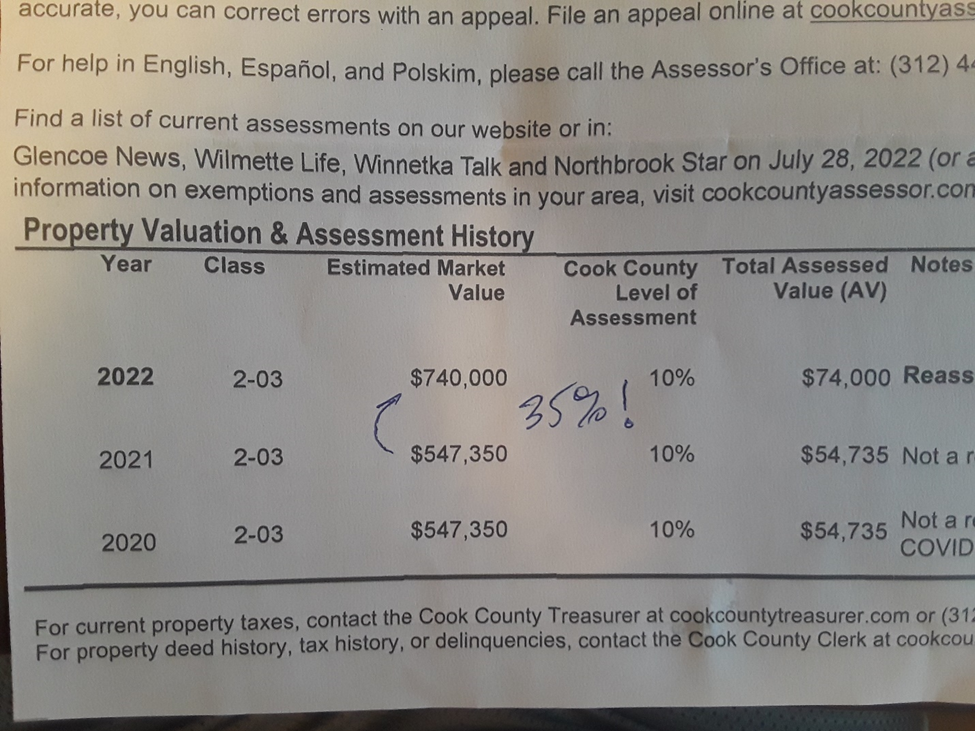
Of course, I’m joking. I did not MAKE 35% in a year, but I am getting ready for a major increase in my property tax bill, which, here in Illinois is already the second highest rate in the nation. And I can’t wait to see what the heating bills will look like this winter. Those higher costs aren’t likely to abate even if official inflation figures start to come down.
How is a ten-yr yield of 2 ¾% justified with yoy PCE prices expected 6.7% on Thursday? I’m starting to think TINA will be applied to treasuries rather than equities. The issue in forecasting lower yields in longer dated treasuries is the negative carry, along with continued supply that the Fed is no long buying. However, on a technical basis the 10y yield has formed a head and shoulders top projecting down to 2.1%; 2.41 is the 50% retrace from the low in December to high in June. In the 30y, 2.58 is the projection, while 2.55 is the 50% retrace.
Given that the highest price contract on the SOFR curve is SFRH5 at 9766 (2.34%) there won’t be negative carry forever!
This is a big news week, with the FOMC on Wednesday, expecting a 75 bp hike to 2.25-2.50%. There is not a ‘dot’ projection; SEP are only released quarterly. Auctions of 2, 5 and 7 year notes begin on Monday.
In terms of economic releases:
Monday: Chgo and Dallas Fed. Dallas Mfg expected -22 which would be the lowest since 2009 outside of a spike lower in 2016 and the 2020 covid plunge.
Tuesday: Richmond Mfg should show the same thing. Also New Home Sales and Consumer Confidence
Wednesday: FOMC and Durables
Thursday: GDP (Q2 advance) and Jobless Claims
Friday: PCE price data and Chgo PMI. Final Michigan numbers for July.
According to CNBC 175 S&P companies report earnings this week. Big ones:
Tuesday: MSFT and Alphabet
Wednesday: Meta (the name change from FB to Meta in October ’21 almost perfectly top-ticked the Nov peak in Nasdaq Comp)
Thursday: AAPL and AMZN
| 7/15/2022 | 7/22/2022 | chg | ||
| UST 2Y | 314.0 | 299.1 | -14.9 | |
| UST 5Y | 305.6 | 287.5 | -18.1 | |
| UST 10Y | 293.4 | 278.7 | -14.7 | |
| UST 30Y | 309.2 | 300.3 | -8.9 | |
| GERM 2Y | 46.7 | 45.2 | -1.5 | |
| GERM 10Y | 113.3 | 103.1 | -10.2 | |
| JPN 30Y | 120.2 | 122.5 | 2.3 | |
| CHINA 10Y | 278.7 | 278.6 | -0.1 | |
| EURO$ U2/U3 | -10.0 | -27.5 | -17.5 | |
| EURO$ U3/U4 | -45.5 | -43.5 | 2.0 | |
| EURO$ U4/U5 | -9.0 | -5.5 | 3.5 | |
| EUR | 100.82 | 102.16 | 1.34 | |
| CRUDE (active) | 94.57 | 94.70 | 0.13 | |
| SPX | 3863.16 | 3961.63 | 98.47 | 2.5% |
| VIX | 24.23 | 23.03 | -1.20 | |
Transmission Protection
July 22, 2022
–Blistering rally in fixed income even as the ECB hiked 50 to end the negative rate regime. At futures close tens were down 12.4 bps to 2.91%, and in another hour and a half at 3:30 CST TYU had rallied from 118-29 at the 2:00pm settle to 119-05 and the cash yield had dropped to 2.875. There was an early 40k block buyer of FVU at 111-240; FVU2 settled 112-095 and was 112-130 late. Philly Fed was -12.3 vs +0.8 expected. It was the lowest print since 2012 outside of the brief covid spike down. This morning’s FT reports: Eurozone business activity falls to 17 month low, raising recession fears.
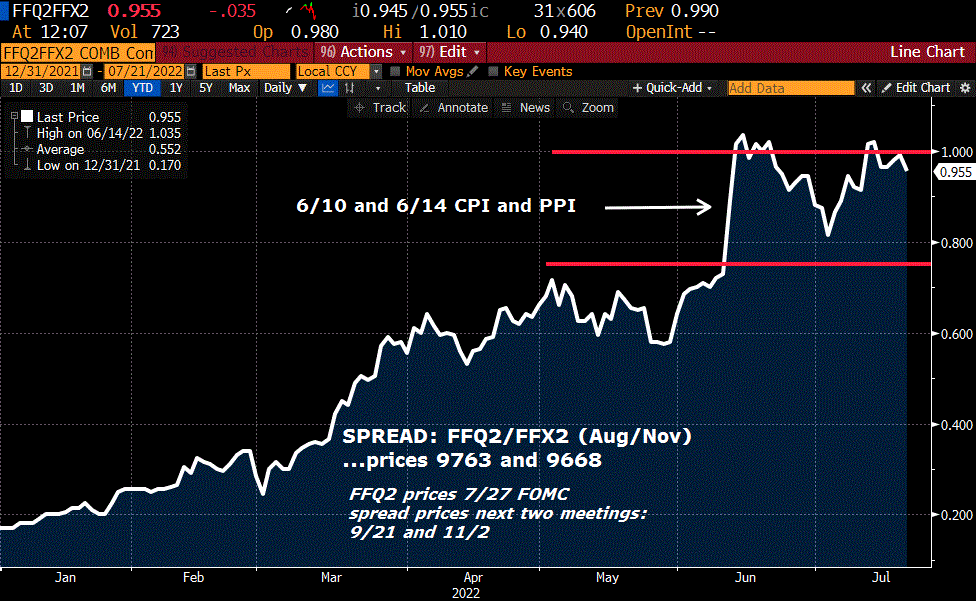
–After CPI data, as FFQ2 panicked toward the possibility of a 1% hike at the July 27 FOMC. Aug/Nov FF spread, which captures FOMC meetings on Sept 21 and Nov 2, traded over 100 (two 50 bp hikes). The spread then fell back close to 80, then powered back above 100 this week. Yesterday it settled 91.5. Of course, the Nov 2 meeting is just prior to midterm elections. The idea of at least 50 per meeting is being scaled back, even though FFQ2 is clearly priced for 75 next week.
–Yesterday I had mentioned that red and green straddles had firmed by several bps on Wednesday. Yesterday those gains evaporated. For example, SFRZ3 9700 straddle was 153 bid early, then 152/54, and was sold down to 148 by the end of the day.
–This is a link of Putin describing inflation pressures in the west.
https://twitter.com/DWhitmanBTC/status/1550009946384879616
from the subtitles (not exactly the Laughing Spaniard):
Everyone’s blaming Russia for the coming food crisis. You as specialists would know that the crisis emerged from the times of the anti-pandemic measures where some well developed economies abused their monopoly powers in terms of currency monopolies. They turned on the printing press in the US and printed $5.9 T, that’s 38% of the entire money supply. They printed it over 2 years – which is roughly the sum of what was printed in the previous 40 years. ..and in the EZ they printed 2.5t euro. They released this money into the economy and gave it out to people, which isn’t bad per se – we utilised a similar tactic. But we were careful, it was sparingly done and as such didn’t lead to such a wave of inflation. Over there measures were funded from budget deficits, which led to them buying up food supplies from global mkts. In previous years US was a net exporter of food, they are now a net importer of food. They bought $17b more than they sold. What does that say? They exacerbated problems for developing/poor countries and closed their own problems off. This is the result of a monopoly on reserve currencies – dollars and euros. This started end of 2019, beginning of 2020. Then the anti-Russian sanctions made the situation worse; they made a bunch of mistakes in the energy sector, gas prices went up. And access to gas is the foundation of many fertilizers. As fertilizer became more expensive, we’ve seen enterprises shut down, particularly in europe and food prices skyrocket further.
–I am adding a link to the ECB press report on the Transmission Protection Instrument, which is supposed to act as a protective cap on bond spreads in the eurozone. But for those who don’t care to read it, here’s a helpful picture that pretty much sums it up.
https://www.ecb.europa.eu/press/pr/date/2022/html/ecb.pr220721~973e6e7273.en.html

ECB day
July 21, 2022
–Relatively low volume on Wednesday, but after a strong open there was selling pressure in rate futures throughout the day. For example, TYU opened the US session just above 118-16 and settled 117-25, despite a well rec’d 20 year auction (3.42% vs 3.445 just prior to auction). The 30 year future settled 138-16 vs 138-18 on Tuesday, but I marked the cash yield slightly lower yesterday at 3.166%.
–ED straddles were noticeably higher, especially in reds. As an example, EDZ3 was unchanged in price at 9667.5, but the EDZ3 9662.5 straddle settled 151.25 on Tuesday, and 155.75 yesterday. ECB is today, and with Draghi’s resignation, a bond fragmentation mechanism is likely to be more contentious (more necessary, but fraught with much higher risks). Rising premiums on US short end rates might also reflect spillover from China’s credit crisis. Spreads between SOFR and ED contracts prior to the libor transition are firm, with U3 and H3 spreads around 29-29.5. Yesterday I marked the SFRZ2/EDZ2 spread at 38; if it starts getting above 40 it’s worth watching, though there will likely be plenty of other signs of cracks. Buyer yesterday of 15k SFRZ2 9600/9550/9500p fly, settled 5.75 vs 9645. This is exactly the time that it’s preferable to own Dec eurodollar vol relative to SOFR. EDZ2 9550p settled 14.0 vs 9607 (57 otm), while SFRZ2 9593.75 also settled 14.0 vs 9645 (51.25 otm).
–5/30 flattened to a new recent low of -1 bp vs a recent high of 23. The lowest level has been -17 from mid-June.
Steer clear of the magnetar lighthouse
July 20, 2022
-In the US red eurodollars were the weakest part of the curve, closing -10. On the treasury curve it was the 5-yr, ending up 7.5 bps to 3.148%. Tens rose 5.2 to 3.015% as stocks rallied on news that Nordstream would come back on line as scheduled. ERU2 (front Sept euribor) made a new low yesterday at 9911.5 as the ECB discussed a 50 bp hike for tomorrow’s meeting. Curve was flatter with 2/10 ending at -21.4, just a couple of bps off the low for the cycle.
–Existing Home Sales today expected 5.36m from 5.41m. New Home Sales were weaker than expected yesterday as relatively high mortgage rates bite. Stocks closed at new highs for the month, punctuated by NFLX, but overnight gains appear to have subsided somewhat. Commodities like copper have only tepidly embraced the rally, not exactly endorsing the narrative of stocks rallying due to “diminished recession fears”.
Astronomers have detected an unusual radio signal from a far-off galaxy, according to MIT officials.
The signal is a fast radio burst, an intensely strong burst of radio waves, the Massachusetts Institute of Technology said in a statement. Usually, the mysterious signals last for a few milliseconds at most. But this one lasted up to three seconds and included bursts of radio waves every 0.2 seconds, in a clear periodic pattern.
“There are not many things in the universe that emit strictly periodic signals,” Michilli said. “Examples that we know of in our own galaxy are radio pulsars and magnetars, which rotate and produce a beamed emission similar to a lighthouse. And we think this new signal could be a magnetar or pulsar on steroids.”