About face
February 25, 2022
–Reversals yesterday were some of the most astonishing I’ve ever seen. Russia’s full scale invasion of Ukraine elicited panic yesterday morning, but stabilized mid-day. SPX was down 2.6% at the low of the day but then closed up 1.5%. Yields plunged but then came back near unchanged, with tens -1.1 bps at 1.965% at futures settlement. While Fed officials said that hikes are still coming, the March meeting is now priced for 25 bps rather than 50 as April Fed Funds rose 5.5 bps to 9963.0. (50 bps would be 9942 and 25 would be 9967). The two-year note reacted with a plunge of 5.6 bps to 1.542%.
–Whenever I hear something like ‘massive cyber attacks’ (which apparently was one of the options presented to Biden) it makes me think “HOARD”. That means cash and non-perishables. Ukraine has vast natural resources. It’s amazing to me that reversals gathered steam as Biden spoke, but it appears as if markets are gratified that the US is staying out and that any disruptions will only be temporary. Biden spent as much time trying to reassure the US public that costs would not increase as he did outlining plans to end international aggression. Which is more important?
–Ten year treasury to inflation-indexed note spread closed 261 bps, a new recent high. Cycle high has been around 277 from mid-November. There is a lot of attention centered on the inflation report slated for March 10, the week prior to March 16 FOMC, with some concerned it could print 8%. Powell gives semi-annual testimony on March 2 and 3 next week.
Full scale invasion
February 24, 2022
–Invasion of Ukraine has gone full scale, sparking major market dislocations. As of this writing WTI is +8.25 over $100/bbl. ESH2 -91 to 4131, and that’s after a drop of 1.8% Wednesday. Gold +60 to $1970/oz. In rates, EDH3 is +12.5 to 9798.5 and TY is up a point to 127-09. Grains are exploding higher. Highly inflationary for raw material inputs while paper wealth takes the elevator down. The threat of cyber disruption in the US and Europe has likely increased significantly, which sidelines the idea of near-term aggressive rate hikes from the Fed.
These were a couple of notes from end of day Wednesday…
–The situation in Ukraine accentuated a ‘risk-off’ sentiment in stocks, with SPX -1.8% and Nasdaq Comp -2.6%. However, the strength in oil and other commodities continues to fan inflation fears so fixed income was NOT the recipient of flight-to-quality flows. The ten year note rose 3 bps to 1.976 with the seven-year auction coming up today. New low in 2/10 treasury spread just under 38 bps. On the eurodollar curve, inversion is creeping up the strip, with EDU3/EDZ3 three-month calendar inverting to -0.5 on settlement. The five-year note has been the target of put buyers, and the renewed need to hedge has caused open interest in FV futures to increase significantly. In 2018 as the economy was doing well and the Fed was hiking, OI in fives rose to a record high 5.1m In 2020 had fallen to just over 3m and now 4.3m. This with the 5y yield at 191, highest since mid 2019.
–In terms of inversion and flattening…maybe U3/Z3 not a big deal, but it’s the nearest inversion on the curve yet seen, and that’s without a hike yet
–FFJ2 is 9957.5 as of Wednesday settle. 9942 for 50 and 9967 for 25…leaves us right about in the middle with Daly saying maybe 4 hikes by year end.
–Aluminum right at the 2008 high. New high BCOMAG though not all-time.
Pain
February 23, 2022
–Starting with a couple of tweets, the first by Anneka Treon (finance commentator of some sort):
“We have never placed this much attention on green energy, yet oil is almost $100/barrel. What am I missing?”
One of the comments, “Replace ‘yet’ with ‘so’ “
–Another tweet from PekalaLaw. “Yikes! The 670,000 sq ft Nordstrom building on Chicago’s Mag Mile was valued at $515 million in 2008. Macerich REIT just sold their 50% stake for $21 million. Mortgage is $375 million.”
An outcome from COVID. But is it more due to a shift to internet shopping or the looting / crime wave that has shuttered many Mag Mile retailers?
–The main news yesterday was, of course, Russia’s advance in Ukraine. Biden responded with a stern implementation of sanctions, and then immediately said he would try to limit the impact on the cost-of-living for US consumers. Lofty policy pronouncements without any pain; it’s the American Way. Of course, the suspension of NordStream 2 may carry some challenges for europe, which circles back to tweet number 1.
–In rates, the conclusion appears to be that inflation will worsen, hastening the need for a front-loaded response from the Fed. The curve flattened to new lows, with 2/10 treasury spread just under 39 bps, down over 8 on the day, and red/gold euro$ pack spread at negative 12.375, down 7.625 on the day. EDM2/EDM3 one-year calendar closed at 102.5, while EDM3/EDM4 closed negative 10.5. There’s your ‘pain trade’, action by the Fed now will lead to a much slower economy next year. Fed semi-annual testimony slated for March 2 and 3.
–Several references yesterday to SPX closing 10% from the peak posted at the start of the year. Of course, in January interday prices were lower, and the Nasdaq Comp is down 17%. Recall that market cap to GDP was a record 200% at the start of the year; this is a very real evaporation of perceived wealth that won’t be replaced through gov’t largesse. Losses ultimately have to be recognized, like Macerich in tweet number 2.
Income flows vs savings stocks
February 22, 2022
–Oil above $94/bbl this morning. New highs in nickel and aluminum. May Corn is 667. Putin’s decision to send troops to Ukraine is adding to inflationary pressure on input prices. The US curve is flattening. From Friday I noted that June’23 SOFR and the ten-yr treasury yield were equal. This morning SRM3 is -5.5 at 9802.5 or 1.975, and TYH is up 3/32’s vs Friday’s closing cash yield of 1.93. Adding to flattening pressure is today’s 2-yr auction. Other news includes Markit PMI with Composite 51.1 last. Also, Consumer Confidence which has held up much better than U of M sentiment. Confidence expected 110 from 113.8. Low at beginning of 2021 was 87.1.
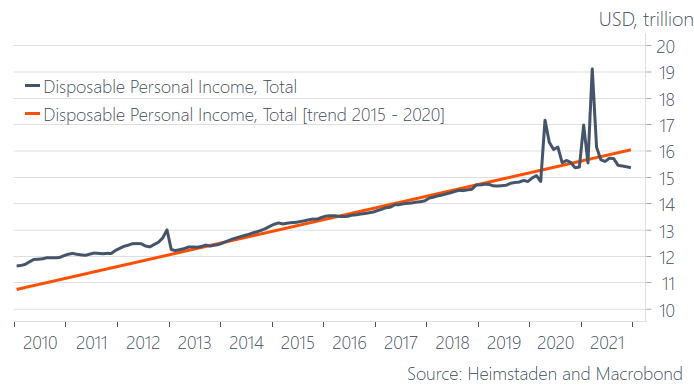
–Below is a twitter chart showing that Disposable Personal Income has fallen well below trend. A lot of commentary has touched on the idea that Household Balance sheets are strong and that consumers have built up savings to cushion any slowdown in consumption. I would counter that the US today is a pay-as-you-go society. Everything is subscription based or financed. This is where the distinction between stocks and flows matters. The flow of monthly income is critical to cost of living, especially when portfolios are slipping.
Propensity for self-destruction
February 20, 2022 – Weekly comment
When I awoke, I suddenly understood that this propensity for self-destruction was not an abomination, not something to be ashamed of or abhorred; it was our greatest strength. We turn the gun on ourselves not because we are more indifferent and less cultured than the British, or the French, or the Italians. On the contrary. We are prepared to destroy that which we have created because we believe more than any of them in the power of the picture, the poem, the prayer, or the person.
The above passage is from the novel A Gentleman in Moscow; it’s a powerful conclusion describing the Russian psyche, shared by Mishka Fyodorovich Mindich with Count Alexander Ilyich Rostov. Mishka cites several events leading to this distillation, foremost being the burning of Moscow in 1812.
“Can you imagine the expression on Napoleon’s face when he was roused at two in the morning and stepped from his brand new bedroom in the Kremlin only to find that the city he’d claimed just hours before had been set on fire by its citizens?” Mishka gave a quiet laugh. “Yes, the burning of Moscow was especially Russian, my friend.”
I’m not sure that I want to inform my view of world events unfolding in Russia/Ukraine by musings in a novel, but I sure as hell wouldn’t dismiss this characterization. The propensity for self-destruction runs a full spectrum from fiercely noble to pityingly pathetic. Let’s move towards the latter with a discussion of markets.
In many ways, Bullard’s doubling down on calling for a 50 bp hike in March and 100 bps by July (Monday) marked the peak destructive fear in rates. This was most evident in the short end. On Monday, EDH2/EDH3 one-yr calendar made a new high of 144.75, and just slightly eclipsed that level on Tuesday at 145.25 before ending the week at 137. April Fed Funds, which price odds of the March hike, settled at a low of 9947.5 on Feb 10, and 9951.0 on Monday, Feb 14. On Friday this contract settled 9960.5, closer to 25 than 50. (A 50 bp hike equates to 9942 and 25 bps to 9967). Both 2/10 treasury spread and red/gold Eurodollar pack spread posted their lowest settles on Friday: the former at 40.7 and the latter at negative 11.5. By Friday, both had rebounded about 5 bps, to 45.6 and -4.75.
Full-blown panic was shown in ED straddle levels. For example, on Monday Feb 7, the at-the-money straddle on EDZ2 was the 9837.5 strike which settled 63.0. On Monday, Feb 14, the atm straddle was the 9800 strike at 85.5. This is a huge level with breakevens at 9885.5 and 9714.5. By Friday we had drifted upward to a price of 9817 and the 9812.5 straddle was down to 70.5.
As the week progressed there appears to have been a subtle shift from the idea of aggressive rate hikes to slightly more emphasis on balance sheet reduction. The head of the NY Fed, John Williams, on Friday said he didn’t see a compelling reason for taking “a big step at the beginning.” (BBG) For balance-sheet reduction, Williams said it can happen more quickly and sooner relative to liftoff than it did after the last cycle. Also on Friday, Lael Brainard voiced support for rate hikes and added that it’s appropriate to begin balance sheet runoff. Williams’ speech also noted that fiscal policy will no longer provide an economic boost and that other central banks are in the process of removing accommodation.
From JPM economists led by Bruce Kasman, “We now look for the Fed to hike 25bp at each of the next nine meetings, with the policy rate approaching a neutral stance by early next year.” There are seven meetings until the end of this year. That would be 175 bps of tightening according to JPM’s schedule. Jan 2023 FF are 9843.5 or 1.465% indicating 5 or 6 hikes. In 2004 to 2006 the Fed hiked at every meeting starting June 30, 2004. On June 29, 2004, just at the onset of tightening, the ten year yield was 4.68%. From that time until March 2006, the ten year yield never got above that point, mostly ranging from 4.6% to 4%, with a dip to 3.88% in May of 2005. By the way, by May 2005 the FF target had been raised to 3% from the initial starting point of 1%. So the FF rate went up 200 bps and tens never really moved…part of the conundrum cited by Greenspan. However, there was ALWAYS positive carry.
In the current situation, June 2023 SOFR future is 9807.5 or 1.925%. The ten year treasury yield ended Friday at 1.93%. I’m not looking at the forward ten-year rate, but the point is that by next year there may be NO positive carry. As was included in the FOMC minutes last week: “…some also noted that SOMA redemptions would require significant adjustments to private-sector balance sheets, as investors absorb the net increase in Treasury and agency MBS issuance to the private sector, and money markets transition to lower levels of liquidity, and that these adjustments could take some time.” My view is that a positively sloped curve encourages private sector absorption of securities, and that the Fed should be cognizant by allowing the long-end do some of the heavy work in terms of slowing economic activity and thus stemming inflation. For example, the mention of the Fed primarily holding treasuries and reinvesting MBS coupons into treasuries could help raise mortgage rates and slow housing price increases. I believe that’s part of the reason the Fed’s focus is slowly shifting to the balance sheet as a tool of monetary restraint.
The other section that struck me from the minutes is this:
The staff provided an update on its assessments of the stability of the financial system and, on balance, characterized the financial vulnerabilities of the U.S. financial system as notable. The staff judged that asset valuation pressures remained elevated. In particular, the forward price-to-earnings ratio for the S&P 500 index stood at the upper end of its historical distribution; high-yield corporate bond spreads and the excess loan premium for leveraged loans remained at low levels; and house prices grew strongly, with price-to-rent ratios that were at elevated levels. The staff noted that the market capitalization of crypto-assets had grown significantly over the past decade and had experienced considerable volatility, including sizable declines since late last year.
“Notable financial vulnerabilities.” The warning isn’t particularly shrill, as other risks were deemed ‘moderate’. On the other hand, there’s this: “…some available measures of hedge fund leverage continued to increase, and important data gaps continued to limit a full assessment of vulnerabilities posed by many nonbank financial institutions.” This is the sort of ‘after-the-fact’ sentence that staff can point to and say, “Well it’s not as if we didn’t warn you!” From Credit Bubble Bulletin: “Bernanke’s coercion of savers into risk markets created a dynamic whereby the markets would become only more integral to the system of financial conditions, perceived wealth, and economic performance.” It’s a feature that the Fed seems to downplay.
This week we have several Fed speakers, mostly on Thursday: Barkin, Bostic, Mester and Waller. On Friday is the Fed’s preferred measure of inflation, PCE prices, expected 6.0% yoy from 5.8%, with Core 5.1 vs 4.9. U of Michigan Consumer Sentiment is also released. I don’t pay much heed to confidence surveys, but the decline in this one has been stark, from over 100 just before Covid to 61.7 last, which is approaching the GFC nadir of 56.4.
OTHER MARKET THOUGHTS/TRADES
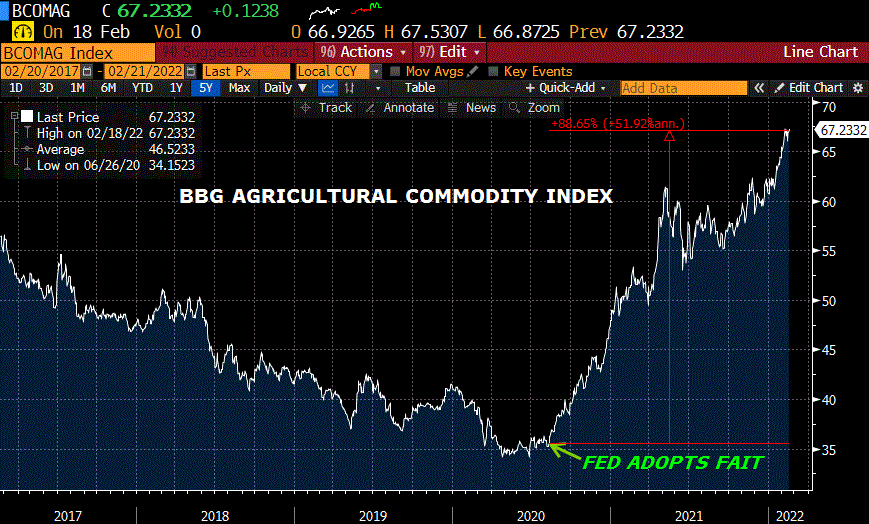
The BBG Commodity Agricultural Index ended the week at a new high. I guess it’s just coincidence, but from the time the Fed adopted FAIT (flexible average inflation targeting) this index is up 88% or 62% annualized. Of course, it’s not just grains that have run, but almost all commodities. Maybe that’s why Fed officials conspicuously omit references to FAIT in recent speeches.
As FT’s John Dizard notes: EU farmers have already been suffering from a 549 pct rise in natgas prices, which has translated to a 263 pct rise in fertilizer costs. He adds, “Europe has great technology strengths, but gas and fertilizer do not come from a virtual reality headset. Russians had a strategy, and they have executed it.”
Again, from A Gentleman in Moscow: “Emile placed bread and salt on the table – that ancient Russian symbol of hospitality.”
It’s not virtual reality. It’s reality.
| 2/11/2022 | 2/18/2022 | chg | ||
| UST 2Y | 150.0 | 147.4 | -2.6 | w/I 150.0 |
| UST 5Y | 185.1 | 182.4 | -2.7 | w/I 182.5 |
| UST 10Y | 194.4 | 193.0 | -1.4 | |
| UST 30Y | 225.4 | 224.9 | -0.5 | |
| GERM 2Y | -32.4 | -47.8 | -15.4 | |
| GERM 10Y | 29.7 | 19.2 | -10.5 | |
| JPN 30Y | 86.9 | 93.9 | 7.0 | |
| CHINA 10Y | 278.8 | 281.0 | 2.2 | |
| EURO$ H2/H3 | 139.5 | 137.0 | -2.5 | |
| EURO$ H3/H4 | 14.0 | 17.5 | 3.5 | |
| EURO$ H4/H5 | -12.5 | -11.0 | 1.5 | |
| EUR | 113.50 | 113.22 | -0.28 | |
| CRUDE (active) | 93.10 | 90.21 | -2.89 | |
| SPX | 4418.64 | 4348.87 | -69.77 | -1.6% |
| VIX | 27.36 | 27.75 | 0.39 | |
Blinken tasked with saving…stocks
Feb 18, 2022
–Russia/Ukraine situation was the main driver yesterday, with SPX -2.1% and Nasdaq -2.9% going into today’s option expiration. Options on March treasury futures also expire today. Yields declined with tens slipping back below 2%, ending at 1.97%, down 7 bps on the day. New talks between Lavrov and Blinken in the coming week have calmed things down this morning.
–The Fed Effective rate has been 8 bps since the start of the year, or 9992 in futures terms. The April FF contract is an appropriate expression for odds of tightening at the March FOMC. In September it was 9991.5. By the January FOMC a bit more than one 25 bp hike had been priced as it was trading 9965. On Feb 10 it traded 9943.5, essentially projecting certainty of 50 bps by the March meeting (9992-50 is 9942). Yesterday it settled 9958.5 up 2.5 on the day…not that geopolitical tensions will stop any hike, but clearly leaning towards 25 and not 50.
–Treasury vol remains firm and rose yesterday with TYJ 126.5^ 1’60 or 6.1. However, eurodollar options seem to have peaked on Valentine’s day. On Monday EDZ2 9800 straddle was 85.5. Yesterday EDZ2 9812.5 straddle settled 72 and EDH3 9800 straddle settled 82 vs 9796.5.
–May beans just above $16/bushel this morning.
50? Not so fast…
February 17, 2022
–A couple of interesting quotes from the minutes:
“…participants generally noted that current economic and financial conditions would likely warrant a faster pace of balance sheet runoff than during the period of balance sheet reduction from 2017 to 2019. Participants observed that, in light of the current high level of the Federal Reserve’s securities holdings, a significant reduction in the size of the balance sheet would likely be appropriate.”
[probably negative for stocks…but…]
“…some also noted that SOMA redemptions would require significant adjustments to private-sector balance sheets, as investors absorb the net increase in Treasury and agency MBS issuance to the private sector and money markets transition to lower levels of liquidity, and that these adjustments could take some time.”
[So, it might not be particularly smooth sailing, and I am just adding my own thoughts here…ESPECIALLY IF FF HIKES HAVE FLATTENED THE CURVE & REMOVED THE LURE OF POSITIVE CARRY FOR THE PRIVATE SECTOR]
And here’s a passage from the staff summary:
“The staff provided an update on its assessments of the stability of the financial system and, on balance, characterized the financial vulnerabilities of the U.S. financial system as notable. The staff judged that asset valuation pressures remained elevated. In particular, the forward price-to-earnings ratio for the S&P 500 index stood at the upper end of its historical distribution; high-yield corporate bond spreads and the excess loan premium for leveraged loans remained at low levels; and house prices grew strongly, with price-to-rent ratios that were at elevated levels. The staff noted that the market capitalization of crypto-assets had grown significantly over the past decade and had experienced considerable volatility, including sizable declines since late last year.”
Just how aggressive does the Fed want to be if conditions are already vulnerable?
–Rates were little changed on balance yesterday. Tens essentially unchanged at 2.04%. Now it’s all shifting back to Ukraine. Gold is $1888/oz this morning (GCJ) the highest level since June. Curve continued to bounce from its recent drubbing with Brainard and Williams speaking tomorrow. There seems to be some second thoughts about the first move being 50 bps. Red euro$ pack gained 4.125 bps while blues were unch’d (2nd year and 4th year). Heavy selling in April FV premium. As the front-loaded hiking scenario had gained traction FV vol outperformed to the upside in treasuries. Yesterday the pushback: FVJ vol fell 0.3 from 4.3 to 4.0 with new sales of 25k in both FVJ 117.75c (settled 0’23 with OI +27k) and 117.25c covered from 43.5 to 42. Settled 0’38 with OI +23k.
–Job Claims and Philly Fed today.
Bullard fever broke
February 16, 2022
–Eurodollar straddles sank yesterday as panic buying came to an end. A few examples: EDM2 9875^ settled 49.0 on Monday and 40.5 yesterday. EDZ2 9800^ settled 85.5 vs 9801 on Monday, and 76.0 vs 9804.5 yesterday. The eurodollar curve, which had been pounded into inversion on Bullard’s front-loaded comments, suddenly floated back up, with red/gold pack spread +6.75 on the day (reds unch’d and golds -6.75) to -4.75. Still inverted, but less so. All this, despite PPI at a scorching 9.7% yoy. Bids came into the front end, with EDM2 and EDU2 the strongest performers on the strip, both +5.0 to 9875.0 and 9835.0. Two-year open interest fell 40k as selling pressure abated in the front end, all other treasury futures showed gains in OI.
–With TYH options expiring Friday, the huge position in TYH 127 puts has been whittled down, with sales rolled into lower delta TYJ puts. TYH 127p now have only 166k open, having been well over 300k, and a delta of -0.97 vs TYH settle of 125-23+. In April the highest OI strike is 126, which settled 1’09 with -0.55d and 95k open. Several factors suggest that the long end of the curve will come under renewed selling pressure, though it might be just after March option expiry. First, the short end selling has peaked, and with it, curve flattening trades. As we move towards the March FOMC, odds of 50 will likely be pared back, with Brainard and Williams slated to speak at the end of the week. For now, there is a slight de-escalation in Ukraine, so flight-to-quality bids may ease. The BOJ today said it has no plans to change its 25 bp yield cap, “We have no plan now to change the band. But that’s not to say the band cannot change forever,” Kuroda told parliament. Implicit or explicit yield caps are likely to go the way of Australia’s if inflation remains high.
–Today brings Retail Sales (exp -1.9% m-o-m) and Industrial Production, followed by a 20-yr auction and the Fed minutes.
Bullard doubles down
February 15, 2022
–Skimming prices this morning, ES +57, Oil -2.80, Gold -13. TY -8.5. Hmmm, maybe Ukraine invaded Russia? Oh no, here it is, Russia is pulling back some troops from the border. The opposite reaction from yesterday’s intel that the invasion was taking place on February 16. Markets are bouncing around on questionable headlines, but at least Bullard’s consistent, he still wants 100 bps of tightening by July. At one point he said the Fed needs to “follow through and ratify the market’s pricing”. I still personally think the first hike will be just 25, but the two-year note rose another 8.5 bps in yield to 1.585% while tens only rose 4.7…new low in that measure of the curve to 40.6 (2/10). On the eurodollar curve, new high in EDH2/EDM2 to 58.25 and new high in EDH2/EDH3, the peak one-year calendar, to 144.75. Bullard also said he’d like to see the curve steepen from balance sheet run-off, but of course his front-loaded tightening comments are only reinforcing the flattening. Once again, in euro$’s the red/gold pack spread settled at a new low of -11.5.
–Fascinating report from Enduring suggests 2023 inflation of 3.8 to 5.5%. “While the Federal Reserve could change our minds about the trajectory by being more aggressive than we expect and/or by shrinking its balance sheet with purpose, we think there is at least as much chance of an increase in money velocity as of a slowdown in money growth.” Increase in velocity? Not something being talked about, but certainly possible. It’s the other side of the coin from Hoisington’s arguments, worth thinking about. Contact: info@EnduringIP.com
–Front end vol hit yesterday, on new buys of 30k each EDM2 9912.5/9862.5p 1×2 and EDM2 9900/9850p 1×2 (5.5 to 7.5 and 5.5 to 6.5) Settles were 7.25 in the former in and 8.25 in the latter vs EDM2 at 9870.0. In treasuries, there was a new roll of 40k, TYH/J 127c calendar for 28 to 29, settled 31 vs 125-31+ in TYH. Treasury vol posting new highs with TYM 6.1 and TYJ 6.3.
Forward Guidance from the Market to the Fed: Don’t Get Too Tight
February 13, 2022 – Weekly Comment
As of Friday, the lowest Eurodollar contract on the strip is EDZ’23, at a price of 9772.5 or a yield of 2.275%. Every contract in front is at a lower yield and every contract behind EDZ’23 is at a lower yield, in other words, the curve is inverted from EDZ’23 back. It’s the same on the SOFR curve, EDZ’23 is weakest at 9798.5 and inverts from that point, but I’m sticking with dollars.
On Friday at futures settlement, the ten year yield was 1.944% and the thirty year was 2.254%. So EDZ’23 has a higher yield than everything on the treasury curve except the 20-yr. Typically, a flat or inverted curve is a sign that the Fed is ‘too tight’, yet in this instance the Fed hasn’t even ended QE yet.
From a Jim Bianco tweet:
Final tranche of QE is from Feb 15 to March 10, total $20b. If the FOMC wants to cancel, the most logical time for them to put out an announcement would be Monday before the NYSE open.
I think they should cancel it, but I don’t expect them to.
So, the Fed will be buying bonds on March 10, Feb CPI release date. Inflation could be as high as 8%.
Less than a week later, March 16, is the FOMC meeting when they are expected to raise rates either 25 or 50 bps.
So congratulations to the Fed.
For the first time in history it will be easing and tightening in the same week! And this accomplishment will happen with inflation at a 40 year high near 8%.
On the treasury curve, 2/10 ended at 44 bps, a new low for the year. After the futures close it was 42, as tens were bid due to another warning of imminent Russian invasion of Ukraine. In August of 2018, the low was 19, though the ultimate low came a year later in August 2019 at -5.6, so currently the spread is still nearly 50 bps above the 2019 low. However, the 5/30 spread is just 40, only 20 higher than the previous cycle low which was in July 2018 at 20 bps.
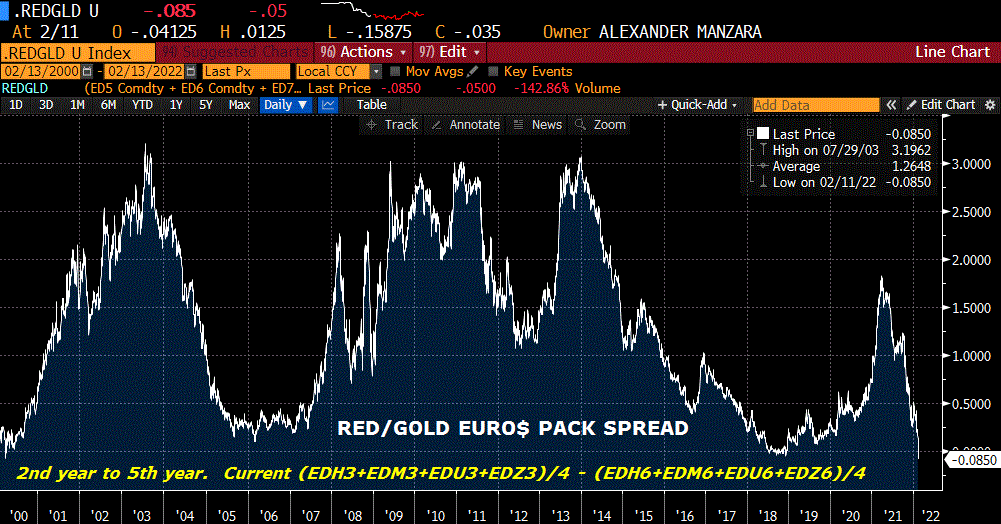
The real eye-popper is the red to gold Eurodollar pack spread (2nd year forward to 5th year forward) which settled Friday at negative 8.5. This is a NEW LOW since the turn of the century. The low in 2018 was -5.625. Some might be tempted to call it an anomaly due to the upcoming SOFR transition, but I would note that each of the golds traded over 50k contracts on Friday, and that open interest is 52k to 80k in each of the four contracts (EDH6, M6, U6, Z6). The average of the four gold contract prices is 9787.125 or 2.13%. That’s a rough one-year rate, 4 years forward. This inversion is a hint that the economy is likely to cool fairly quickly in response to expected Fed hikes (now priced in excess of 150 bps by the end of the year; Jan’23 FF contract settled 98.345 or 1.655%). Amazingly, the red/gold pack spread is signaling that the Fed will be too tight, BEFORE THEY HAVE EVEN BEGUN TO HIKE.
A friend reminded me of the old days (thanks MJ), when we had “Fed watchers” who were paid to interpret monetary policy. At Fed time, 10:30 to 10:40 each day, the time of open market ops, we would wait to see if the Fed did matched sales. If they did, it could be a sign that the Fed hiked. But, it wasn’t always clear. Sometimes there would be disagreement among analysts about whether the Fed really hiked or not. Hence, the Fed watchers, one of whom was David Jones of Aubrey Lanston. I’ve linked an article at bottom, but here’s a quote by Jones about the Fed’s Vice Chair Preston Martin: “Martin was a poor vice chairman for several reasons. He could not hide his ambitions to be chairman, he spoke out of school on internal Fed policies, and he tended to focus narrowly on a few sectors without looking at the overall picture.” Almost sounds like he could be talking about Bullard.
I was standing at an old wooden booth on the west side of the bond pit in the late 1980s. Directly in front of me were the Nolan brothers and Steve Anichini and other pit filling brokers, Steve Phillips, Rob Shatkin. The top step locals on that side of the pit were Dick Pfeil, Kevin Dowdle, Rob Moore and Charlie D. Around the arc of the pit was Dave Ryan, who used to fill orders for Dean Witter. I couldn’t see Ryan from my booth, which didn’t really matter. In fact, what was strange about the CBOT floor as opposed to the CME floor, is that outside clerks and desk brokers couldn’t see into the pit. The pit was elevated and tiered down from a height of about four feet, and we relied on information from the clerks that ringed the perimeter. On the CME floor, desks were tiered up at elevations above the pits. In any case, what I did have a clear view of was John Fife, the main desk broker at Dean Witter. He was always on the line at Fed time, and would frequently blast out large bond orders. That’s when you knew the Fed had done matched sales!
In any case, the mystery surrounding Fed has morphed into excruciating forward guidance, but even the well-intentioned communications policy has recently been botched by the inconvenient acceleration of inflation. Let’s see: yoy gains in BBG Agricultural index of 30%, yoy gain in BBG base metals index 32%, Case Shiller Housing +18%. And suddenly, the market is shocked by a 7.5% CPI print! Wake up and smell the coffee! (Oh, by the way, coffee futures up over 100% yoy).
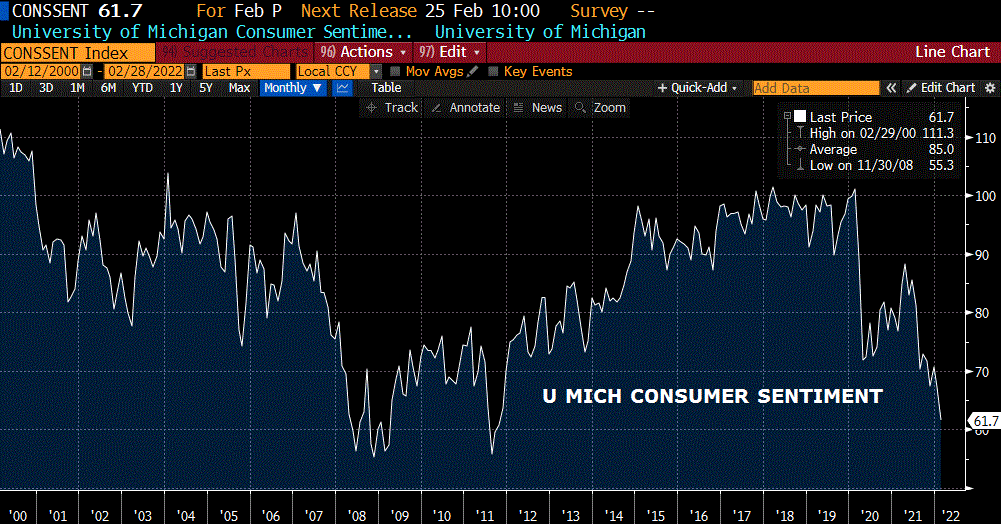
The decline in the University of Michigan Consumer Sentiment report to a decade low of 61.7 bears out the idea that high inflation, and measures taken to quell it, will slow the economy. From the U of M site, quoting survey director Richard Curtin: “Although their primary concern is rising inflation and falling real incomes, consumers may misinterpret the Fed’s policy moves to slow the economy as part of the problem rather than part of the solution.”
OTHER MARKET THOUGHTS/TRADES
Odds of front-loaded Fed tightening increased dramatically this week as Bullard said he’d like to see “100 bps in the bag by July 1.” It’s clear in the table below: the 2-yr yield surged 17.8 bps to 1.50% while tens barely changed on the week at 1.944%, up 1.6 bps. EDH2/EDH3 one-year euro$ calendar jumped 17.5 bps to 139.5, while EDH3/EDH4 plunged 16.5 to just 14 bps. That’s the kind of movement that has led to a shocking increase in implied vol.
Consider the past few sessions at-the-money EDU’22 straddle:
Feb 8, EDU2 9864.0 9862.5^ 49.0
Feb 9, EDU2 9863.5 9862.5^ 48.5
Feb 10, EDU2 9835.0 9837.5^ 64.0
Feb 11, EDU2 9836.0 9837.5^ 75.0
Even with the 25 bp increase in the strike price yield, the increases from Wednesday to Thursday and Thursday to Friday are massive. The Fed Board on Thursday released its hypothetical scenarios for Stress Tests. Short end vol levels suggest that the hypothetical could easily shift towards reality.
I still don’t see the Fed’s semi-annual Congressional Testimony scheduled for the end of February, but Bullard is again on CNBC on Tuesday, and speaks again on Thursday. Mester also on Thursday and Williams discusses the outlook on Friday.
| 2/4/2022 | 2/11/2022 | chg | ||
| UST 2Y | 132.2 | 150.0 | 17.8 | |
| UST 5Y | 178.6 | 185.1 | 6.5 | |
| UST 10Y | 192.8 | 194.4 | 1.6 | |
| UST 30Y | 222.8 | 225.4 | 2.6 | |
| GERM 2Y | -24.7 | -32.4 | -7.7 | |
| GERM 10Y | 20.5 | 29.7 | 9.2 | |
| JPN 30Y | 80.2 | 86.9 | 6.7 | |
| CHINA 10Y | 271.1 | 278.8 | 7.7 | |
| EURO$ H2/H3 | 122.0 | 139.5 | 17.5 | |
| EURO$ H3/H4 | 30.5 | 14.0 | -16.5 | |
| EURO$ H4/H5 | 2.5 | -12.5 | -15.0 | |
| EUR | 114.49 | 113.50 | -0.99 | |
| CRUDE (active) | 92.31 | 93.10 | 0.79 | |
| SPX | 4500.53 | 4418.64 | -81.89 | -1.8% |
| VIX | 23.22 | 27.36 | 4.14 | |
https://www.sun-sentinel.com/news/fl-xpm-1986-06-18-8602050681-story.html