Inflation…in fed speakers
May 6, 2021
–Fed comments yesterday from Evans, Bowman, Rosengren, Mester and Clarida downplayed inflation even as commodities tell a different story. Below are a couple of news bullets:
*EVANS: RISK OF AN OUTBREAK OF ACCELERATING INFLATION IS REMOTE
*EVANS: MONETARY POLICY WILL BE ACCOMMODATIVE FOR SOME TIME
– FED’S BOWMAN SAYS STILL SEES ‘SMALL’ RISK OF PERSISTENT INFLATION OUTBREAK DESPITE INCREASES ANTICIPATED THIS YEAR
– FED’S BOWMAN SAYS EXPECTS ‘UNUSUALLY STRONG’ JOB GROWTH THROUGH THE SUMMER
–ROSENGREN SAYS OIL PRICES, PENT UP DEMAND FOR GOODS AND SHIPPING DELAYS WILL TEMPORARILY DISTORT INFLATION NUMBERS THIS SPRING
– ROSENGREN SAYS THE MOST LIKELY OUTCOME REMAINS THAT INFLATION WILL NORMALIZE CLOSE TO 2 PERCENT
– MESTER SAYS SHE NEEDS TO SEE MORE LABOR MARKET IMPROVEMENT BEFORE ‘I WOULD CONSIDER THE CONDITIONS OF OUR FORWARD GUIDANCE ON ASSET PURCHASES AS BEING MET’
– MESTER: FACTORS THAT HAVE KEPT INFLATION LOW HAVEN’T GONE AWAY IN THE PANDEMIC
–A judge voided the CDC’s eviction moratorium, which some associated with a jump in tip breakevens to new highs. Ten year treasury to tip spread ended at 247 bps. However, yields drifted slightly lower on the day, with tens down 1 bp to 158.
–The big trade of the day was a new buyer of 100k 3EU 9800 put for 6.5. This put settled 6.0 with the underlying Sept’24 future 9854.0. Open interest was +80k. Expiry is September 10, beyond the late August Jackson Hole symposium. Eurodollar option flows are consistent in blues: buying puts/ selling calls.
–ADP yesterday was +742k, with Claims today expected 538k. Tomorrow’s payrolls expected +998k. Today’s Unit Labor Costs expected -1.0% vs +6.0% last, and tomorrow’s yoy Average hourly earnings expected to be down slightly as well, though ‘help wanted’ signs are everywhere.
Short rates tied to zero as critical input prices surge
May 5, 2021
–Crude oil is near new highs this morning at 66.35 (June WTI contract) as API data showed a large draw. Yellen yesterday said rate increases might be needed to prevent overheating, but was forced to walk back those comments later in the day by saying she’s not expecting inflation or rate hikes. Other commodities like soybeans, corn, and copper are on a tear, at or near new highs. It’s astonishing that the mere suggestion of a move off the zero bound is met by resistance. A little over a year ago crude prices tumbled into negative territory, but now the surge in the cost of this systemically critical input is being shaken off as irrelevant.
–Early yesterday morning there was a wave of buying in TY and selling in stocks, perhaps associated with Chinese military aircraft entering Taiwan space, but others suggested a program trade. Open interest in TY rose 36k yesterday and was also up 26k on Monday, so there appears to be new buying in front of Friday’s employment data. Cash tens fell 1.5 bps in yield to 1.59%. Eurodollars rose 0.5 to 2.5 across the strip, with a slight flattening bias. Flows continue to favor put buying and call spread selling in blue midcurves. However, the red/blue September calendar spread declined 1.5 bps, with the red Sept’22 contract up 0.5 to 9968.5, while blue Sept’24 rose 2 to 9851.5. So that two-year calendar is 117 bps. Recall that in the 2004 to 2006 hiking cycle, the fed raised by 25 at every meeting, or 200 bps per twelve month period. Just over 100 bps over two years doesn’t seem like much by comparison.
–News today includes ADP expected 860k from 516k. ISM Services expected 64.1 from 63.7.
No inflation…if you pay in etherium
May 4, 2021
–Yields eased Monday with tens down 2.2 bps to 1.606%. Mfg ISM was lower than expected at 60.7 vs 65, but Prices Paid at 89.6 was near an all-time high. A headline from WSJ proclaims ‘Auto Makers Retreat from Just-In-Time Manufacturing’. I don’t know the details of the story, but I do know that just-in-time was pioneered by Japanese makers to enhance efficiency and keep prices low. With supply bottlenecks, holding inventory as insurance becomes more important than price efficiencies. At the margin, it’s a non-transitory change in behavior that supports inflation.
–Although EDU’24, blue Sept, was +4 on the day to 9848.5, there continues to be buyers of put spreads vs call spreads on the contract. The downside piece is the 9837.5/9812.5 put spread which settled 7.25, while the call spread yesterday was 9887/9925 which settled 4.75. This package only traded about 12k, but the flow remains consistent.
–Today’s news includes Durables, and Mary Daly of the SF Fed speaks at 1:00 at the Economic Club of Minnesota. She has previously indicated that an increase in asset values is irrelevant if an offshoot of policies that help employment. Etherium was 1700 at the end of March, and is now 3350 into the first couple of days of May.
–Treasury released financing estimates, expecting to borrow $463 billion in the current April to June quarter. That borrowing estimate is $368 billion higher than estimated in February, because… COVID. A fudge factor of over $350B in two month’s time! And in the July to Sept quarter the estimate is $821 billion. (But it will only be half that much in etherium).
https://home.treasury.gov/news/press-releases/jy0158
The power to create is the power to destroy
May 2, 2021 – Weekly comment
Several analysts have mentioned the Kansas City Fed’s Jackson Hole Symposium as a likely venue for an announcement that the Fed can begin tapering. The exact date hasn’t been announced, but typically it occurs in late August. By that time we will have had two more FOMC meetings, in mid-June and late July. As mentioned during the week, I went back to a Greenspan Jackson Hole address of 1999 which has bearing on the current environment, not in terms of policy change, but in terms of core concerns of the central bank. In 1999, a big part of that was asset values.
From 1994 until March of 2000, stocks rallied as the promise of the internet permeated the public’s consciousness. The dotcom bubble. Through this period the FF target ranged from 4.75% to 6.0%. From the middle of 1999 to May of 2000, the Fed raised rates from 4.75 to 6.5%, followed by the unravelling starting in Dec 2000, which took the target rate all the way down to 1.75 by the end of 2001.
From 1996, when Greenspan uttered his famous “irrational exuberance” line until the 1999 Jackson Hole speech, Greenspan was concerned about asset values, which generally trended higher even though interrupted by the Asian currency crisis in 1997 and the Russian / Long Term Capital crisis in the following year. From the mid-July 1998 high to October low, SPX lost a bit over 20% and made it all back by the end of the year.
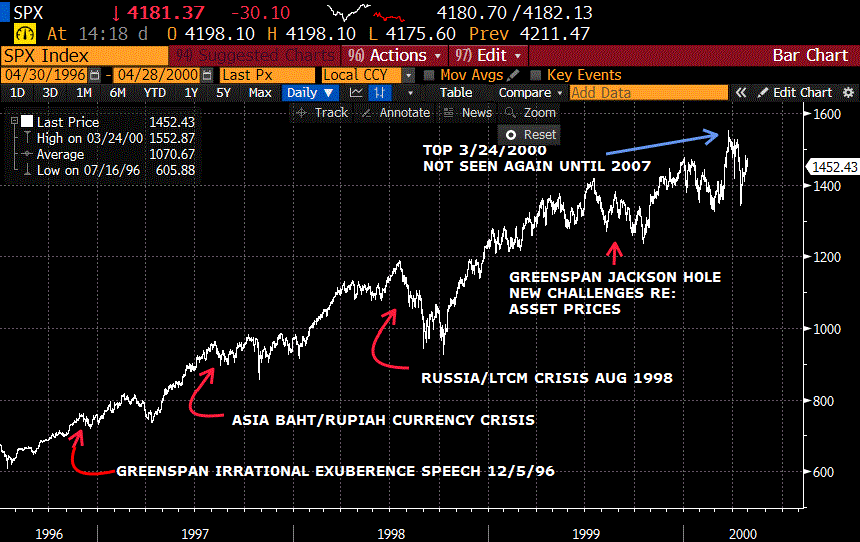
The real declines came after what is shown on the above chart. From the September 2000 high until Sept 2001, SPX lost 38%, then bounced, but the ultimate low in October 2002 at 768 was only about half the value of the year 2000 high.
Here are a couple of excerpts from Greenspan’s speech. The crux of the address concerns equity valuations and confidence. It touches upon discount rates and the wealth effect. These are the issues that currently seem relegated to the dustbin of history.
The translation of value judgments into market prices is, of course, rooted in how people discount uncertain future outcomes. An individual’s degree of risk aversion may vary through time and possibly be subject to herd instincts. Nonetheless, certain stable magnitudes are inferable from the process of discounting of future claims and values.
One of the most enduring is that interest rates, as far back as we can measure, appear trendless, despite vast changes in technology, life expectancy, and economic organization. British long-term government interest rates, for example, mostly ranged between three percent and six percent from the early eighteenth century to the early twentieth century,and are around five percent today. Indeed, scattered evidence dating back to ancient Rome and before reflects the same order of interest rate magnitude, not a one percent interest rate nor 200 percent.
[For the past ten years, the US 10y yield has only briefly tickled the bottom end of this 3-6% range, in 2013 and in late 2018]
It has become evident time and again that when events are unexpected, more complex, and move more rapidly than is the norm, human beings become less able to cope. The failure to be able to comprehend external events almost invariably induces fear and, hence, disengagement from an activity, whether it be entering a dark room or taking positions in markets. And attempts to disengage from markets that are net long–the most general case–means bids are hit and prices fall.
History tells us that sharp reversals in confidence happen abruptly, most often with little advance notice. These reversals can be self-reinforcing processes that can compress sizable adjustments into a very short time period. Panic market reactions are characterized by dramatic shifts in behavior to minimize short-term losses. Claims on far-distant future values are discounted to insignificance.
To anticipate a bubble about to burst requires the forecast of a plunge in the prices of assets previously set by the judgments of millions of investors, many of whom are highly knowledgeable about the prospects for the specific companies that make up our broad stock price indexes
[ I.e. the Fed’s job is clean up…not to second guess the market]
As we make progress, hopefully, toward understanding asset-pricing mechanisms, we need also to upgrade our insights into the effect of changing asset values on GDP–the so-called wealth effect.
And differentiating between gains that arise from enhanced profitability and those that reflect changes in discount factors may also be useful. The former may be more likely to be sustained, given the tendencies of discount factors to revert back to historic norms.
In the current episode of runaway stock values dominated by big tech, few of these considerations seem to enter into the Fed’s deliberations. Of course, the financial press encourages this omission, as evidenced by this quote from CNBC Friday: “Smaller tech companies offer bigger opportunities for growth and returns over the long term. But if investors are looking for investments with the safety of US government bonds and the prospect of at least some future growth, there is no investment class like the tech giants.”
The last snippet of Greenspan’s speech is particularly interesting, because in late 2018 we got a taste of what happens when discount rates revert back towards norms, a Q4 decline of 20%. I would say that the “so-called wealth effect” is exerting tremendous influence on the economy currently. If so, then a sudden loss of confidence or a reset of the discount rate will have an outsized effect on activity, but still might not arrest a general increase in inflation expectations.
In many ways, Powell has become Bizarro Volcker. Volcker, against tremendous political pressure, kept short end rates extremely high to crush inflation. Powell is keeping rates near zero, with a huge political tailwind, to push inflation higher. As Seinfeld explains to Elaine, “Bizarro Superman is Superman’s exact opposite who lives in the backwards bizarro world: up is down, down is up, he says hello when he leaves, goodbye when he arrives.” Volcker used to smoke a cigar in a rumpled suit when he appeared before Congress. Powell talks about social equality.
Volcker: “It is a sobering fact that the prominence of central banks in this century has coincided with a general tendency towards more inflation, not less. If the overriding objective is price stability, we did better with the nineteenth-century gold standard and passive central banks, with currency boards, or even with ‘free banking.’ The truly unique power of a central bank, after all, is the power to create money, and ultimately the power to create is the power to destroy.” Soooo last century.
Bizarro Volcker (last week’s press conference) “So it seems unlikely frankly, that we would see inflation moving up in a persistent way that would actually move inflation expectations up while there was still significant slack in the labor market.” Also: “So one of the areas is asset prices, and I would say some of the asset prices are high. You are seeing things in the capital markets that are a bit frothy. That’s a fact. I won’t say it has nothing to do with monetary policy. But it also has a tremendous amount to do with vaccination and reopening of the economy.”
We know where Powell stands. Inflation is due to bottlenecks, base effects and re-opening. It will not be sustained. They knew where Volcker stood, “By the time I became chairman and there was more of a feeling of urgency, there was willingness to accept more forceful measures to try to deal with inflation.”
What we have now is almost like the WeWork model on a national scale (thanks AG), where the company committed to long-term lease obligations and let clients drink free beer and sign short-term leases. The Federal government is locking in long term debts, sending out stimulus checks for free beer or whatever other goodies the public wants to buy, confident that the capital will keep flowing in. As Sam Zell said on a CNBC interview in early September of 2019, this model has never worked. “Might as well just change the name to Savings and Loan. “Find me an example of creating a company that loses 50 cents on every dollar of revenue and explain it to me.” WeKnow TM that WeWork imploded. The US stimulus model might lead to similar results in terms of inflation. It’s well known that primary inputs are exploding in price with copper and lumber and plastics near or at all time highs. The Fed knows it.
I’ll just leave it with one more Volcker quote: “When I hear complaints about less liquidity, remember there is such a thing as too much liquidity.”
OTHER MARKET THOUGHTS/ TRADES
When the Fed was tapering in 2018, they shaved the balance sheet by $10 billion every three months, in equal percentages of Treasuries and MBS. This time they will simply be growing the balance sheet less rapidly. Due to strength in housing, I would think this time the Fed would shave MBS purchases more quickly than treasuries. Since tapering in the current environment would simply be buying less, and since they have indicated that tapering comes before hiking the FF target, the reduction schedule should be more aggressive than $10b per quarter; perhaps more like $30 billion per quarter. September of 2021 to September of 2022?
Last week, Clarida made these comments:
“If inflation at the end of the year has not declined from where it is in the middle of the year that will be some good evidence,” that the Fed’s current outlook is wrong, Clarida said.
“We would expect those (increases) to be transitory and as the year progresses and as we go into next year, if they are not then we will have to take that into account,” he said.
On Friday, MNI ran a piece with this quote from former NY Fed chief Dudley:
“The chances of a soft landing in this regime is virtually nil,” Dudley said. “They’re going to be late and that’s by design. So when they start tightening they’re going to have to go relatively quickly.”
Late on Friday, there was a buyer of 60k EDM2 9962.5/9937.5 put spreads for 2.5 to 2.75 and then a 30k lot block buy of EDM2 9962/9925 put spread for 3.0. The prelim CME open interest report shows all trades done in the 9962/9937ps in size of 109k. In any event, the idea is predicated on a Fed hike in about a year, a significant move forward on most people’s timelines. Dudley’s warning that the Fed will be late and then have to be more aggressive seems to have struck a nerve.
There has also been significant accumulation of 3EU 9800/9900 risk reversal (buying the put) and on Friday, a similar trade to what originally kicked off the major interest in blue midcurves. This was buy 3EU 9837/9812ps (7.75s) vs sell 9862/9887cs which settled 8.0 ref 9845.5s (traded about 25k). Of course when the similar 12.5 bps put spread vs call spread was originally done in 3EH (which has of course expired) the blues were trading around 9945 and the lower strike was the 9912/9900 put spread. Currently the first blue is EDM24 which trades 9861.5. Clearly the market has already had a significant adjustment, but has a lot more to go if the Fed is wrong about “transitory”.
| 4/23/2021 | 4/30/2021 | chg | ||
| UST 2Y | 15.7 | 16.0 | 0.3 | |
| UST 5Y | 81.3 | 85.4 | 4.1 | |
| UST 10Y | 156.5 | 162.8 | 6.3 | |
| UST 30Y | 225.0 | 229.7 | 4.7 | |
| GERM 2Y | -69.0 | -68.2 | 0.8 | |
| GERM 10Y | -25.7 | -20.2 | 5.5 | |
| JPN 30Y | 63.6 | 65.7 | 2.1 | |
| CHINA 10Y | 317.5 | 315.6 | -1.9 | |
| EURO$ M1/M2 | 8.5 | 7.5 | -1.0 | |
| EURO$ M2/M3 | 39.5 | 40.0 | 0.5 | |
| EURO$ M3/M4 | 68.0 | 72.5 | 4.5 | |
| EUR | 120.99 | 120.20 | -0.79 | |
| CRUDE (active) | 62.14 | 63.58 | 1.44 | |
| SPX | 4180.17 | 4181.17 | 1.00 | 0.0% |
| VIX | 17.33 | 18.61 | 1.28 | |
https://www.federalreserve.gov/boarddocs/speeches/1999/19990827.htm
https://www.inspiringquotes.us/quotes/j8DJ_rwDsozl5
So many of the financial crackups in all countries—all Western countries—that have happened around the last 30 years have been around housing. We really don’t see that here. We don’t see bad loans, and unsustainable prices, and that kind of thing.” Powell at the presser, fighting the last war.
Temporary bottlenecks are everywhere
April 30, 2021
–After early morning weakness on Thursday, rate futures ended little changed going into month end. Ten year yield up slightly at 1.638%. Implied vol was offered throughout the day, without any noticeable reach for puts, even as futures made new lows early. Today Personal Income and Spending are released, with the Fed’s preferred inflation measure, PCE Core, expected +1.8% yoy. New high this morning for palladium, with the June contract testing $3000/oz.
–Here are a couple of news snippets, all of which suggest firmer consumer prices. Reuters: A Bundesbank economist says chip supply bottlenecks will lead to a weaker Q2 recovery. The same dynamic was mentioned in Ford’s earnings report, which caused the stock to plunge over 9%. FT notes that the price of cobalt, used in electric vehicle batteries, has jumped [though it’s still only about half the price of the 2018 peak]. However, as I scanned stories about cobalt, I saw a chart showing that lithium carbonate prices started the year around 40000 yuan per tonne and are now 90000 yuan per tonne. BBG says that La Nina and associated drought is affecting crops. The Washington Post notes that we’re in the midst of a chicken shortage. Wingstop CEO: “Suppliers are struggling, just as many in our industry are, to hire people to process chicken, thus placing unexpected pressure on the amount of birds that can be processed…” I don’t know that I’ve seen the word “bottleneck” used as frequently as it currently is.
–The Wall St Journal has a headline asking “Is the student loan program facing a $500 billion hole?” No news there in my opinion. Student loans are one of the federal govt’s biggest assets, likely destined for the official “write-off” column. But what difference does it make? Stephanie Kelton reminds us that the budget of the Federal Govt is nothing like a household budget, the administration can easily service another half trillion on the deficit, given low rates. And that’s where you come in, Jerome…
Greenspan on asset prices, 1999
April 29, 2021
–In spite of strong and accelerating economic activity and increasing price pressures, the Fed is maintaining full accommodation with short rates pegged to zero and QE of $120 billion per month. Might as well nickname it the 4×4 plan, looking for 4% unemployment and 4% inflation. The curve was mildly steeper at futures settlement, with the thirty year bond up 2 bps to 2.305% and twos down 1.2 to 16.6 bps. Tens ended more or less unchanged at 1.62%. The dollar index eased a bit more; now trading 90.67. The low of the year which occurred in January was 89.21. The Fed’s unstated goal seems to be to push it below that level, with the help of the administration’s unbridled stimulus plans. Unsurprisingly, the ten year tip breakeven closed at a new high of 242 bps. If I heard this correctly, Powell said these levels were consistent with the Fed’s inflation goals.
–Stocks screamed higher late in the day as Powell withheld caution flags and Apple released blockbuster results. The Fed’s preferred inflation metric, Core yoy PCE prices, is released Friday and expected +1.8%. I’m not a conspiracist, but if 1.8 works for the Fed in terms of justifying loose policy, and works for the administration who doesn’t want blame for rising prices, then it will be 1.8. Or 1.7.
–There is talk that a taper announcement could occur at the Jackson Hole symposium in August. I went back to another interesting speech at Jackson Hole called New Challenges for Monetary Policy, by Chairman Greenspan in 1999. Though some now disparage the former Maestro, his speeches are great. This one in particular concerns asset prices, which were rallying wildly in 1999. (Sound familiar?) While Greenspan gave a lot of thought to the probability of unsustainable asset prices, the current Fed ignores such risks. Maybe if you don’t talk about it, there won’t be a repeat of the 2000 “correction”. Here are just a couple of snippets from the 1999 speech:
I should like as a backdrop to this conference on the challenges confronting monetary policy to focus on certain aspects of one of the issues that will be more broadly discussed later this morning: asset pricing and macroeconomic performance.On such judgments of value rest much of our economic system. Doubtless, valuations are shaped in part, perhaps in large part, by the economic process itself. But history suggests that they also reflect waves of optimism and pessimism that can be touched off by seemingly small exogenous events.
https://www.federalreserve.gov/boarddocs/speeches/1999/19990827.htm
| FRB: Speech, Greenspan — New challenges for monetary policy — August 27, 1999Footnotes. 1 For example, Erik Brynjolfsson and Shinkyu Yang, “The Intangible Costs and Benefits of Computer Investments: Evidence from the Financial Markets,” MIT Sloan School, mimeo, April 1999.. 2 The Financial Accounting Standards Board (FASB) will require that the cost of repricing of options be charged against income starting later this year. …www.federalreserve.gov |
–A final sad note: Juan Joya Borga, El ristas, or “The Giggles” passed away. Best known for this interview, which wasn’t actually about bunds, but was tastefully dubbed with fake subtitles:
FOMC and Biden Address
April 28, 2021
–Rate futures slipped lower on Tuesday coming out of the seven year auction, with the FOMC today and Biden’s Congressional appearance this evening. Tens rose nearly 5 bps to 1.616%. The curve steepened with the red pack down 0.625 while golds dropped 6.75. Large seller in EDU1 at 9980 appears to have been an exit, with open interest down 13k in Sept and 12k in EDZ1. Sept settled 9980 and Dec at 9974.
–On the last FOMC meeting, TYM traded a high of 132-09 and settled 132-03. That was March 17, and since then there has been a series of strong economic and price data. At the end of March, TYM posted a low settlement for the move of 130-30. The high since then has been 132-245. The area of 132-08 to 16 should now provide solid resistance, with a likely retest of the lows. Any hint of reduced bond buying by the Fed may spark higher yields, especially when juxtaposed with Biden’s fiscal plans which will require ever more issuance.
–There was continued accumulation yesterday of 3EU 9800 put/ 9900 call risk reversal, which traded 30k covered 9954.5 with 40 delta for 1.5, paying over for the put. The put settled 8.75 with the call 3.50 vs 9845, or 5.25. More or less flat from trade level on a hedged basis. Total position approximately 100k. The were some additional long maturity put plays, for example a buyer of 4000 4EU 9737/9725p spread for 1.75. Recall that interest in blue and gold puts was kicked off with huge positions in Blue March which of course expired over a month ago but pre-dated the large sell off. Renewed activity indicates stronger sentiment for a push to higher yields.
Quiet start to Fed week
April 27, 2021
–Quiet Monday with the ten year yield unchanged at 1.567%. Implied vol continues to ease with TYM 4.5%. Corn, beans and copper all at new highs this morning with July Corn over 670 and beans over 1550, as the Fed prepares to fine-tune its message that inflation pressures are transitory. FOMC announcement and press conference are tomorrow. The BOJ in its meeting today cited mobile phone rates as a pressure on prices. From the statement: “With regard to the risk balance, risks to economic activity are skewed to the downside for the time being, mainly due to the impact of COVID-19, but are generally balanced for the middle of the projection period onward. Risks to prices are skewed to the downside.”
–Stocks remain well bid with SPX pinning all-time-highs. Earnings this week include MSFT and Alphabet today, Apple tomorrow and Amazon on Thursday. The CBOE equity put-call ratio remains at the lower end of the range at 0.43. I have included a chart of SPX as a percentage above or below the 200 day moving average. Currently its over 15% higher than the 200 day. The only time in recent history that it was more elevated was in 2009 rallying after the deep plunge related to the GFC.

Steady Fed this week, but taper looms
April 26, 2021
–May treasury option expiration was uneventful on Friday with TYM settling 132-14, cash yield 1.565%, up 1 bp on the day. This week brings auctions of 2, 5 and 7 year notes. FOMC announcement is Wednesday. The Fed’s preferred measure of inflation, Core PCE prices, is released Friday, expected at 1.8%. An article on BBG says a survey of economists expects the Fed to begin to taper by Q4, with 14% looking for a Q3 start and 45% pegging Q4. The Jackson Hole symposium is late August, sometimes used as the forum for policy announcements. In eurodollars, the theme of buying puts/selling calls is again in vogue, 3EU 9800 put vs 9900 call traded another 28k Friday, with the put settling 7.5 and the call 4.75 vs EDU4 9851.5.
–On Friday, equities shrugged off Thursday’s weakness associated with the administration announcing a proposal to raise cap gains taxes to 39.6% for high earners. ESM closed 4171.50, the high settle of the week and just short of the previous week’s ath of 4176.30. Bitcoin has roared back above 50000 this morning. Apparently the market has little faith in Biden’s proposal actually becoming law.
–July Corn is up another 13 cents this morning to a new high 645. Grains have had a spectacular rally that shows no signs of abating.
–Italy ten year yield is 81.9 this morning, highest since last September.
The risk of delay
April 25, 2021 -Weekly comment
“We do see risks of delaying a return to neutral monetary policy. These risks can lead to the need for a more significant rate hike in the future, and I think we all want to avoid that.” Russian Central Bank Governor Elvira Nabiullina, after the CB raised its key rate by 50 bps to 5% on Friday. Consumer inflation is running at about 6%.
On Wednesday Bank of Canada announced scaled back bond buying and accelerated the timetable for a possible rate increase, due in part to price pressures.
On Friday Mohamed El-Erian was interviewed by Maria Bartiromo and he said the Fed is now “outcome based”, i.e. they won’t try to get ahead of projections. Because monetary policy operates with a lag, that policy presents a risk.
It’s worth taking a look at the Kansas City Fed’s surveys on manufacturing and services last week:
Tenth District manufacturing activity expanded further with the highest monthly composite reading in survey history, and expectations for future activity increased considerably. The index of prices paid for raw materials compared to a month ago also reached the highest level in survey history. In addition, finished goods prices expanded more from a month ago and a year ago. Materials price expectations for district firms over the next six months continued to rise, and many firms also expect higher finished goods prices.
Tenth District services activity continued to rise from a month ago and a year ago, and activity was expected to increase further over the next six months.. The pace of growth for input prices remained near record high levels, and selling prices also expanded considerably to a record posting (since survey inception in 2014). Additionally, firms expected input and selling prices to increase over the next six months.
The FOMC meets this week Wednesday and is expected to re-affirm guidance on asset purchases and holding the Fed Fund target at 0-0.25%. Core yoy PCE prices are released Friday and expected at 1.8% (which is low compared to most other measures). Powell continues to emphasize employment and wages for the disenfranchised, but here again it’s worth referring to the KC Fed. Below are selected comments from the manufacturing survey;
“It is very difficult to handle the increased business with supply chain issues across all materials and finding anyone who wants to work. The federal government has incentivized people to stay home and not be productive.”
“Stimulus and increased unemployment money are wrecking the labor pool. Lower level employees are quitting to make just as much not working.”
“Entry level pay will need to be increased. This will create pressure on all other positions.”
With respect to supply chain problems, there are now frequent references to what is belatedly recognized as under-investment in productive capabilities. Obviously COVID threw some plans onto the shelf, but the trend toward financial engineering led to a lack of true investment. Obviously lumber is not a good proxy for US inflation pressures (even though the price of the near futures contract has more than doubled since the start of the year). In the US we expect products to always be available and ready to be shipped immediately. Think about lumber: “The time it takes for a lumber forest to mature depends on the type of lumber product being cultivated. Birch for chipboard or paper can be thinned for the first time after 10 or 20 years. A forest of red oak grown for lumber will be ready for harvesting in 52 years…” Not everything is instant. It may take years to smooth out the supply chain. By the way, soybeans are up over 50% since the start of the year.
Now for a couple of comments on financial market inflation. April to date SPX is up nearly 5%. That’s with Biden proposing a huge increase in the capital gains tax last week. For now, strong earnings, Fed’l government deficit spending, and Fed monetary largesse are dominant factors. In terms of magnitude, an appropriate comparison might be late 2017 into 2018. Back then it was all about Trump’s tax cut program in terms of stimulus. Congress passed the bill on Dec 20, 2017. “Most of the changes introduced by the bill went into effect on January 1, 2018 and did not affect 2017 taxes.” From December 20, 2017 to January 26, 2018 SPX rose about 7.2%. Currently, in the past 18 sessions since the March 24 dip, SPX is up 7.6%. For a slightly longer comparable timeframe, from an August dip in 2017 to the late Jan high, SPX soared nearly 19%. Over the same length of time, from late October 2020 until now, SPX is up a blistering 30%.
In 2018, from the high on Jan 26, the market dropped over 10% in the next eight sessions. At the high on Jan 26, 2018, SPX was 12.7% above the 200 DMA and it reverted to the 200 DMA on Feb 9. Currently SPX is 15% above the 200 DMA. I don’t think I have ever seen as much of an acceleration in the 200 DMA over a four month period as we’ve seen from mid-December until now. Of course, in 2018 the Fed was leaning against the more robust economic backdrop brought about by fiscal policies. Currently the Fed is aiding and abetting what many consider to be irresponsible fiscal expansion.
OTHER MARKET THOUGHTS/ TRADES
This week the Treasury auctions 2, 5 and 7 year notes. The seven year has been a problem area, but with a yield over 1.25%, even though significantly negative in real terms. auctions shouldn’t be an issue. FOMC Wednesday. Personal Income, Spending and Core Price Deflator on Friday.
Bitcoin has been the big loser over the past couple of weeks, shedding almost a quarter of its value from the April 14 high of 64870. Similarly, the SPACs have been spanked since late February, with SPAK (the SPAC etf) down 27% since then. Peripheral markets are showing weakness.
Over the week, treasury yields and the Eurodollar curve were little changed. However, the theme of buying puts and selling calls saw pockets of renewed interest. As an example, 3EU 9800/9900 risk reversal traded 0.5 and 1.0 for the put, with futures 9853 to 9855. Both strikes added around 40k in terms of open interest. Settlements on Friday were EDU4 9851.5, 9800p 7.5 and 9900c 4.75, so 2.75 for the put. There were some similar trades closer in on the curve, on red midcurves. For those inclined to believe that inflation is likely to be an intransient problem (as I do), the core questions are where on the curve to be short, and, if equities are at risk of a large retracement, will bonds rally? The first question requires assumptions about when/if the Fed is forced to move early. On the second part, consider this snippet from rates strategist Rishi Mishra: “That – policies that shift the balance back towards labor from capital – that will be the ultimate sell USTs, sell SPX trade…” He’s referring to the capital gains tax increase proposal, but the point is that we might be on the cusp of a shift where both bonds and stocks perform poorly. Given the fact that greens to blues (3rd to 4th year) are the steepest part of the euro$ curve at 59 bps, I would tend to favor puts on the front three greens, EDM23, U23 and Z23. Of course, this is also the period of time that encompasses the libor transition, but if the Fed signals rate hikes, a return to 2% or higher FF target could easily occur by mid-2023.
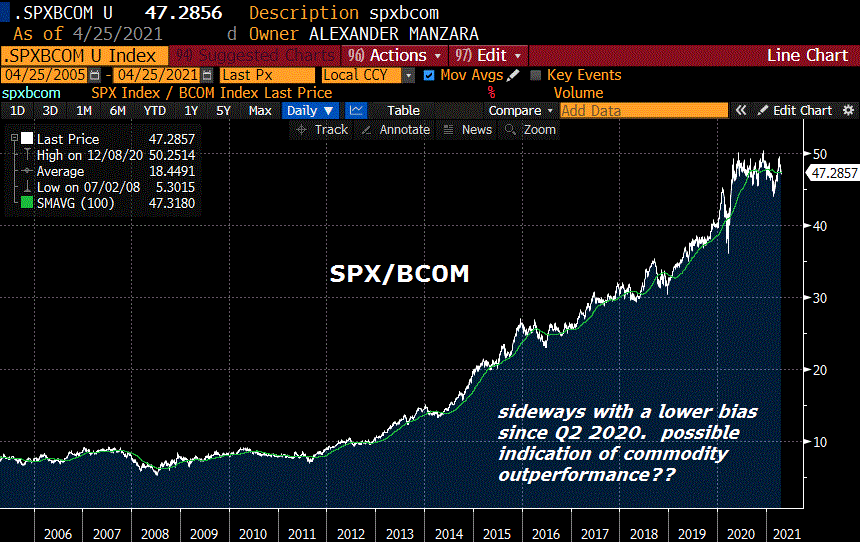
Below is an updated chart of SPX divided by the BBG Commodity Index. It has been nothing but SPX outperformance since the start of QE. However, the most recent commodity surge has caused this ratio to move sideways
| 4/16/2021 | 4/23/2021 | chg | ||
| UST 2Y | 16.1 | 15.7 | -0.4 | |
| UST 5Y | 81.9 | 81.3 | -0.6 | |
| UST 10Y | 156.9 | 156.5 | -0.4 | |
| UST 30Y | 226.0 | 225.0 | -1.0 | |
| GERM 2Y | -69.0 | -69.0 | 0.0 | |
| GERM 10Y | -26.2 | -25.7 | 0.5 | |
| JPN 30Y | 65.3 | 63.6 | -1.7 | |
| CHINA 10Y | 316.0 | 317.5 | 1.5 | |
| EURO$ M1/M2 | 8.0 | 8.5 | 0.5 | |
| EURO$ M2/M3 | 39.0 | 39.5 | 0.5 | |
| EURO$ M3/M4 | 67.0 | 68.0 | 1.0 | |
| EUR | 119.86 | 120.99 | 1.13 | |
| CRUDE (active) | 63.19 | 62.14 | -1.05 | |
| SPX | 4185.47 | 4180.17 | -5.30 | -0.1% |
| VIX | 16.25 | 17.33 | 1.08 | |