Auctions and CPI
March 10, 2024 – Weekly Comment
**************************************
The Fed’s Z.1 quarterly report was released last week for Q4. While the data is perhaps a bit stale, the debt levels are still somewhat eye-opening. Total Household Debt ended 2018 at $15.582 trillion. By the end of last year it had grown to $19.955T, an increase of 28% over five years. Total business debt grew at a similar rate, from $16.151T in 2018 to $21.126 in 2023, or 31%. Surprisingly, on the Gov’t side, State and Local Gov’t debt was $3.124T at the end of 2018, and rose to just $3.255 in 2023, an increase of just 4%! (Did they even have Chicago in there?) But Federal Gov’t Debt over that time period grew 65% from $17.865t to $29.472T. The one-year increase from 2022 to 2023 was $2.621T. In one year Fed’l Gov’t Debt rose almost as much as total State & Local debt. That deficit spending is what is driving economic “growth”.
Yields ended a bit lower last week, with twos down 4.5 bps to 4.484% and tens down 9.1 to 4.087%. Powell repeated that the Fed needs more confidence that inflation is trending to target before easing. The employment report featured a strong headline NFP gain of 275k, but the previous number was revised lower by 124k, the unemployment rate ticked up to 3.9% and average hourly earnings were up only 0.1% month/month. Overall, a moderately weak report.
This week brings auctions of 3-yr notes on Monday ($56b), 10-yr notes on Tuesday ($39b) and 30s on Wednesday ($22b). CPI is released on Tuesday, expected 0.4% m/m with Core 0.3%. Yoy expected 3.1% from 3.1% last and Core 3.7% from 3.9% last. Energy prices firmed over the month of February. On Thursday, PPI and Retail Sales are released.
The FOMC meeting is one week from Wednesday. The BOJ meeting is March 18/19. $/yen had a significant move on the week, falling from 150.12 to 147.06 as an end to negative rates is being considered. From Reuters:
A growing number of Bank of Japan policymakers are warming to the idea of ending negative interest rates this month on expectations of hefty pay hikes in this year’s annual wage negotiations, four sources familiar with its thinking said.
Many BOJ policymakers are closely watching the outcome of big firms’ annual wage negotiations with unions on March 13, and the first survey results to be released by labour umbrella Rengo on March 15, to determine how soon to phase out their massive stimulus.
A shift in BOJ policy could reverberate throughout global markets, strengthening the yen further, making yen carry trades less attractive. While US and European yields were lower on the week, the 10y JGP ended at 73 bps, near the high of this calendar year (up 2 bps on the week).
******************************************
A large amount of Wednesday (March 13 expiry) treasury options traded Friday, weighted heavily toward puts. About 9.8k calls traded, but put volume was over 220k with open interest increasing 76.7k. The 30yr auction is Wednesday (3s and 10s Monday and Tuesday) so all auctions are captured. CPI is Tuesday. It’s a bit hard to see on the CME volume and open interest site, but Wednesday week-2 110.75 puts settled 4, and added 21.4k in open interest. The 111p traded 62k in volume and settled 7, adding 6.6k in open interest. Underlying TYM4 settled 111-23+.

April puts on TY expire on 22-March, just after the FOMC. Put open interest is 1.045 million, with the peak strike being the 109.5p at 129k, settled 3/64. TYJ4 call OI is just 575k.
Does it matter? My sense is that the market’s underlying concern is higher long end yields. Whether these put trades are sparked by fears of inflation due to energy cost spikes, or shipping and other supply chain issues, or just massive bond supply, a ten-year yield nearing 4% requires upside yield protection.
A friend asked where I thought TY Wed 111p would be on CPI if futures printed exactly 111-00. I would imagine the straddle would still be about 7-9 bps given unknown results for 10 & 30 auctions, and figure the puts would be about 15/17.
*****************************
I have to mention NVDA which posted a huge key reversal Friday (new high, outside range, massive volume, closed near the bottom of the range). Volume was over 114 million shares. There have only been three other days in the past year with larger volume: Aug 24 with 115m, closing price 471.63, and May 25, with 154 million volume and a close of 379.80 (both coinciding to earnings reports). On a $2 trillion market cap the range of 974 to 865 represented a swing of over $200 billion.
Technical markers like key reversals haven’t been all that valuable recently in terms of identifying trend changes. For example, March Bitcoin futures had a huge 10k outside range day on Tuesday, 60120 to 70195. Big volume, and price settled in the bottom quarter of the range. Classis reversal. However, on Friday BTCH4 made a new contract high 71055.
My bet is that NVDA will see further weakness going into Friday’s option expiration, which will likely take Nasdaq along for the ride.
*******************************
I don’t follow tax refunds closely. However, it’s worth noting that the average refund amount, as of Feb 16, 2024, was $3207 vs $3140 in 2023. That’s an increase of just $67 or 2.1%. Relative to CPI of 3.4% at the end of 2023, this data suggests that aggregate wage increases aren’t keeping pace with inflation. Likely due to calendar quirks, the total amount refunded so far is $66.9 billion vs $87.2 billion last year. Hey Krugman, tell me again why the average consumer should be thrilled with Bidenomics. A podcast by Grant’s noted that auto insurance has increased by about 20% over the past year, partially due to the fact that social inflation has been staggeringly large, contributing to outsized jumps in insurance costs. [Social inflation is related to large jumps in jury awards] Your government at work?
From the IRS as of Feb 16, 2024. First column is 2022, middle is 2023, followed by percentage change

| 3/1/2024 | 3/8/2024 | chg | ||
| UST 2Y | 452.9 | 448.4 | -4.5 | |
| UST 5Y | 415.7 | 406.1 | -9.6 | |
| UST 10Y | 417.8 | 408.7 | -9.1 | wi 409.0/08.5 |
| UST 30Y | 432.7 | 426.0 | -6.7 | wi 426.5/26.0 |
| GERM 2Y | 289.0 | 275.9 | -13.1 | |
| GERM 10Y | 241.3 | 226.7 | -14.6 | |
| JPN 20Y | 144.3 | 149.5 | 5.2 | |
| CHINA 10Y | 238.3 | 229.3 | -9.0 | |
| SOFR H4/H5 | -119.0 | -126.3 | -7.3 | |
| SOFR H5/H6 | -54.0 | -58.5 | -4.5 | |
| SOFR H6/H7 | -0.5 | -1.5 | -1.0 | |
| EUR | 108.41 | 109.41 | 1.00 | |
| CRUDE (CLJ4) | 79.97 | 78.01 | -1.96 | |
| SPX | 5137.08 | 5123.69 | -13.39 | -0.3% |
| VIX | 13.11 | 14.74 | 1.63 | |
Payrolls
March 8, 2024
***************
–NFP expected 200k. Yields eased yesterday with 2s down 4.6 bps to 4.512% and 10s down 1.6 to 4.09%. Little change this morning though yen continues to strengthen with $/yen 147.16 as the BOJ is expected to end negative rates. Borrow yen, convert to dollars, buy NVDA. Can’t lose, right? But a strengthening yen can put a nick in expected profit.
–Next week brings auctions of 3s, 10s, 30s Monday, Tue, Wed. CPI Tuesday. With one week to go, midcurve straddle levels are fairly high. 0QH4 9687.5^ is 21 ref SFRH5 9592. 2QH4 9650^ is 18.5 ref SFRH6 9651.0. While there has been vigorous debate about the amount of easing that can occur this year, note that slightly forward one-year calendars are all around 125 bps, or roughly 5 eases. SFRH4/H5 is -121.75 (9470.25/9592), SFRM4/M5 is -121 (9495.5/9616.5). FFJ4/J5 is also -121. The yield on SFRH5 is 4.08%… one year away.
–Game of Trades X post says the the Mag-7 market cap is greater than that of all equity markets outside of the US.
–Consumer Credit bounced back in January, with revolving increasing at a 7.6% rate, to a level of $1.327T outstanding. The rate on “accounts assessed interest” is 22.75%. Assuming actual payment, that amounts to about $25 billion per month in interest.
–Yesterday I posted a SOFR option trade (condor) and incorrectly said it was M4 when it was actually MAY expiry.
Record Net Worth, Record Gov’t Debt
March 7, 2024
****************
–Curve continued to flatten (invert further) as Powell stayed on script, repeating that the Fed needs more confidence inflation is moving to target. At the end of January, 2/10 was -28, yesterday the spread was down 4 at -45.2, a new low for this year. The low in mid-December was -52.5. My opinion is that 2/10 will hold -55 to -50. Red/green SOFR pack spread edged to a new low near -33 bps, at the end of January it was +3. [red/green is second year to third year]. The easing schedule is being nudged further back on the calendar.
–Today brings Productivity and Unit Labor Costs, expected +3.1% and +0.7. Jobless Claims 217k. Powell in front of the Senate.
The Fed’s quarterly Z.1 report, which summarizes HH Net Worth and Debt metrics across sectors for Q4 is released. Given the end-of-year surge in stocks, household net worth will likely post a record high. Of course, Federal Gov’t Debt will also hit a new record.
–Employment report is tomorrow with NFP expected 200k from 353k.
–Yen getting a nice pop as the prospect of BOJ ending negative rates draws closer. $/yen was 150.50 on Monday and is now 147.80. Gold hit an all-time high yesterday at $2152. News about NYCB problems only underscores the likelihood of other banks struggling with similar issues.
–Large trades yesterday: +40k SFRM4 9493.75/9487.5/9475/9468.75 put condor for 1.5. Underlying SFRM4 settled 9493.
TYJ4 113c 14 paid for 15k, settled 11 vs TYM4 111-155.
TYK4 109/113 strangle sold at 54 about 7k, settled 51.
Half empty
March 6, 2024
***************
–Yields fell, curve flattened. Tens down 8.2 bps to 4.135%. New low in red/green SOFR pack spread to -30.625 (9617.5/9648.125). Red pack+7.125 and green pack +8.25. Perhaps of note is that SFRU4/U5 posted a new recent low at -105, down 3 on the day (9525/9630). This is the spread the Bill Gross cited as a long. It hasn’t had a lot of volatility; last 20 trading day range is -93.5 to -102. Related to this spread was a new buyer of 60k 9600/9700cs for 6.5 (settled 11.0/4.5). The 4% strike (9600) seems a bit optimistic given a narrowing time window. Maybe optimistic isn’t the correct word, as some bad stuff would have to occur to spark >150 bps in cuts. See Egypt, below.
–News today includes ADP, expected 150k. Powell at 10:00am and JOLTs also at that time, expected to extend its decline a bit more to 8.9m. Beige Book in the afternoon.
–A couple of other significant trades: new buyer of 30k TYK4 110.5p for 54. Settled 50 ref TYM4 111-095, -0.38 delta. Seller of over 10k TYK4 109.5/113 strangle 63 to 62; settled 62.
–Massive volatility in bitcoin, with the March futures having a range of about $10k. Key reversal with outside day after a new historic high of over $70k, but I’m not sure the technicals mean much in this market.
–After a pullback in the past two sessions, CLJ4 is back near $79/bbl (up 73 cents). Does Egypt’s massive hike and currency devaluation have an impact? Hike of 600 bps to 27.25%, ccy down 30%, apparently closer to the black market level. The collapse of Egypt would add to the region’s instability and further complicate oil transport.
Ain’t it a BTCH?
March 5, 2024
***************
–In rates futures, much of Friday’s rally was reversed. The curve flattened, with 2y +7.7 bps to 4.606%, 5y +5.1 to 4.208%, 10y +3.9 to 4.217% and 30y 2.6 to 4.353%. On the SOFR strip, reds were weakest, settling -7.625 at avg 9610.375. Red/green pack spread closed at a new recent low of -29.5 (Grns down 4.375). Not particularly surprising to see relative pressure on the front end as Powell goes before Congress tomorrow; he will likely emphasize this line released in Friday’s Monetary Report: “The Committee does not expect it will be appropriate to reduce the target range until it has gained greater confidence that inflation is moving sustainably toward 2 percent.”
–Explosive moves in bitcoin, gold and silver probably don’t help the case for those betting on a quick ease. March bitcoin (CME symbol BTCH; an appropriate twist of the knife for shorts) which was below 40k in Jan, settled 68480, +4655. GCJ4 settled 2126.30, +30.6. As various House members righteously criticize Powell for the Fed’s mismanagement, he might remind them that reckless fiscal spending factors into the demand for alternatives to USD. He won’t do that of course…
–News today includes Factory Orders and ISM Services, expected 53.0 from 53.4. Prices paid 62.0 from 64.0. Given that Core Service prices have been cited by the Fed as a sticking point in the inflation fight, this release could have a bit more importance than usual.
–A couple of exit trades in SFRZ4 options. SFRZ4 9600/9550/9500 put fly sold at 11.5m 20k, settled 12.25 ref 9552.0. This trade gains value over time if the market sits right around the center strike. Straddles have come down a reasonable amount in the past week, but my guess is that mid-March to mid-April will get a bit more wild.
SFRZ4 9475p cs covered 9552, 16d vs SFRZ5 9475/9400ps covered 9632.5 8d, 2.5 paid for front Dec on exit, 26k. Settled 10.75 and 9.0.
Debasement
March 3, 2024
***************
“Throughout history, many campaigns had been lost by stopping on the wrong side of the river.”
–attributed to General Patton
Powell is in front of Congress this week, Wed and Thurs, and Bloomberg declares: Powell about to double down on ‘No Rush to Cut’.
The enemy is within.
BAML (Michael Hartnett) notes:
US national debt rising $1tn every 100 days ($32tn to $33tn took 92 days, $33tn to $34tn 106 days, $34tn to $35tn will take 95 days); financing domestic bliss & overseas wars. US budget deficit past 4 years = 9.3% of GDP…little wonder “debt debasement” trades closing in on all-time highs, i.e. gold $2077/oz, bitcoin $67734.
Pimco urges the resurrection of bond vigilantes:
(Bloomberg) — Pacific Investment Management Co. is warning that US fiscal profligacy threatens to drag the Treasury market back to the 1980s, a time when bond vigilantes demanded far higher compensation to own longer-dated bonds.
“What if we are heading back to the future, to a market resembling prior decades when higher term premiums prevailed?” they asked in a paper published Thursday. Term premium is generally described as the extra yield investors seek to own longer-term debt instead of rolling over into shorter-term securities as they mature. It’s viewed as protection for bond holders against unforeseen risks such as inflation and supply-demand shocks, beyond other drivers of Treasury yields including economic growth and Federal Reserve policy.
“If the term premium returned even to levels common in the late 1990s to early 2000s – around 200 bps – that would likely become the defining feature of financial markets during this era,” the California-based money manager cautioned, adding such an outcome “would not only affect bond prices, but also prices of equities, real estate, and any other asset that is valued based on discounted future cash flows.”
Financial analysts use “term premium” as a neatly defined input in the exercise of valuing bonds. I would characterize it more as ‘loss of confidence’. It doesn’t necessarily need to be contained in a tight box with algebraic parameters. Think of it more like Pandora’s box. Think of it as someone simply saying, “Get me out.”
The enemy which is boxing in Powell is runaway federal spending that clearly distributes benefits unevenly and unstably across the economy. The lower segments are scarred by rising delinquencies and inflation, while the top see benefits in rising home values and high yields on savings.
I was prompted by a friend this week to mention the bitcoin rally (thanks PB). The reason I stumbled on the quote at the top of this note is because I was searching for a General Patton strategy, which I recall this way: Fierce fighting at the front lines, which may involve heavy casualties, once broken can lead to relatively easy, wide-open gains. It’s an appropriate analogy for market behavior. The ‘stopping on the wrong side of the river’ refers specifically to Powell’s campaign to bring inflation back to target. That goal risks being thwarted by what BAML refers to as “debt debasement”. Friend Rob Luxem at TJM (from whom I gain valuable crypto insights) had pointed out this week that bitcoin is making new highs vs yen, yuan and other global currencies. And, are you sitting down for this? Even against the Turkish Lira. But not against gold.
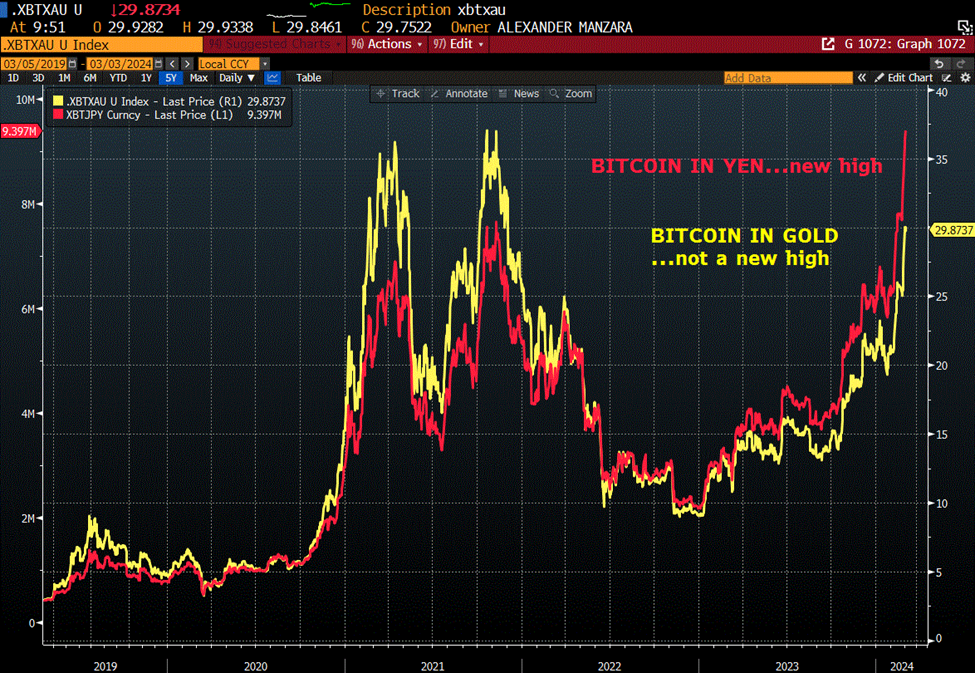
Total crypto market cap is currently about $2.34 trillion. Bitcoin is about half that at $1.2 trillion. The market cap of NVDA is just over $2 trillion. It has added $1 trillion of market cap in the past four months. So, the increase in the value of NVDA in four months is nearly worth the total market cap of bitcoin. Now it’s true as well that bitcoin has doubled since the middle of October. The point is that huge nominal dollar values are rapidly changing across the financial landscape. Which makes the job of all central banks that much more difficult. I’m sure Senator Warren and others will take that into account as they warmly welcome Powell with the express purpose of shifting the blame for fiscal irresponsibility onto the Fed’s plate.
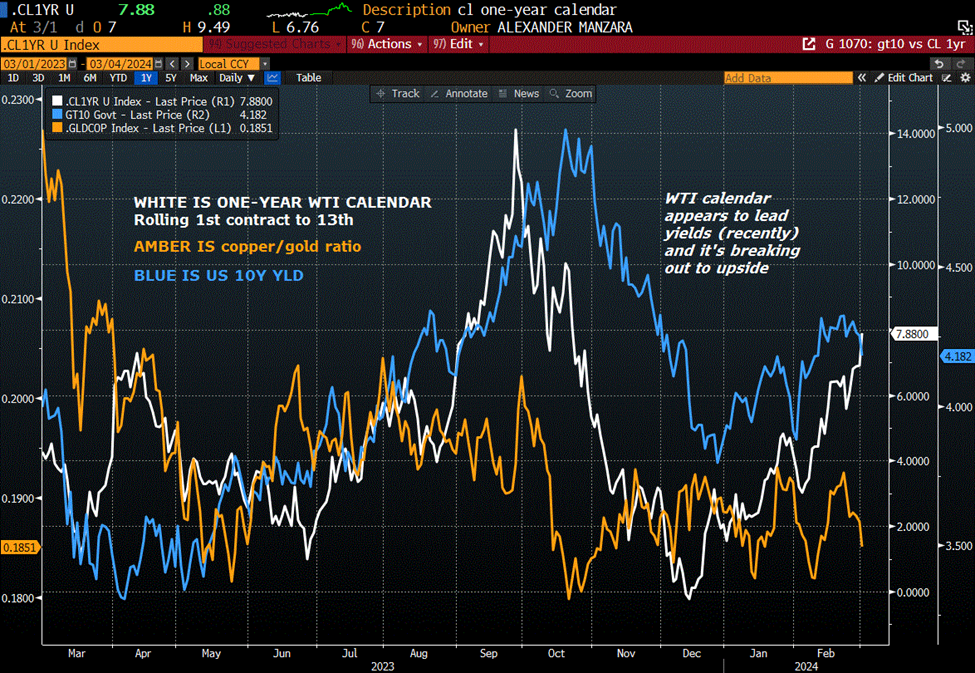
What happens if the “bond vigilantes” return? I suppose we’ll know by how many times ‘term-premium’ is mentioned in the financial press. In terms of yield, in 2023 the ten year posted a low in April of 3.31% and a high in October of 4.99%. The midpoint is 4.15%, exactly where tens were trading Friday. A move above this year’s high of 4.32% would probably suggest a revisit of 5%. The area around 4% should provide strong support.
Below I have updated a chart that I first posted last week, the rolling one-year WTI calendar vs the US ten year yield. The oil calendar appears to lead the move in yields; higher near-term oil prices suggest tightness for physical and is perhaps an inflationary signal. I added Gundlach’s copper/gold ratio, which is indicating LOWER rather than higher yields. The global economy is soft. The US has been supported by fiscal largesse. Does it all end post-election?
Upcoming events include:
Powell testimony on Wednesday and Thursday.
Employment on Friday
March 20 FOMC/ discussion about trimming QT
XBT halving in April
BOJ possibly ending negative funding rates in April
| 2/23/2024 | 3/1/2024 | chg | ||
| UST 2Y | 465.7 | 452.9 | -12.8 | |
| UST 5Y | 426.8 | 415.7 | -11.1 | |
| UST 10Y | 425.6 | 417.8 | -7.8 | |
| UST 30Y | 437.8 | 432.7 | -5.1 | |
| GERM 2Y | 285.3 | 289.0 | 3.7 | |
| GERM 10Y | 236.3 | 241.3 | 5.0 | |
| JPN 20Y | 144.5 | 144.3 | -0.2 | |
| CHINA 10Y | 240.0 | 238.3 | -1.7 | |
| SOFR H4/H5 | -110.3 | -119.0 | -8.8 | |
| SOFR H5/H6 | -53.0 | -54.0 | -1.0 | |
| SOFR H6/H7 | -1.5 | -0.5 | 1.0 | |
| EUR | 108.23 | 108.41 | 0.18 | |
| CRUDE (CLJ4) | 76.49 | 79.97 | 3.48 | |
| SPX | 5088.80 | 5137.08 | 48.28 | 0.9% |
| VIX | 13.75 | 13.11 | -0.64 | |
Regional banking issues are… contained
March 1, 2024
***************
–NYCB back in the news, reporting an additional $2.4 billion hit as the fallout from the regional banking episode continues in a slow burn, a year later. It’s more controlled, but underlines weak CRE valuations and lingering effects of deposit flight.
–China’s Mfg PMI down for a fifth month, as expected at 49.1. Today’s US Mfg PMI expected 49.5 from 49.1. Fed’ Kugler speaks at 2:30 today on the Fed’s dual mandate. Powell in front of Congress next week on Wed and Thursday. Employment report on Friday.
–Somewhat odd trade given that easing prospects have been pushed further forward in time: new buyer of 35k SFRM4 9550/9575cs for 1.0 (settled there ref 9489). Perhaps systemic banking issues are going to flare up once again. In any case, if I needed upside, I might look at spending an extra 0.5 for the 9550/9600cs, which settled 1.25 (but was offered 1.5). Current FF are 5.25 to 5.5%; this call spread would need about 100 bps worth of cuts to play, but using the easing models of 2001 and 2008, it doesn’t seem to be a completely outlandish scenario, though there are only 3.5 months to go.
–Yesterday’s PCE data were as expected , leading to relief rally. Net changes across curve were small. Vol continued to compress, as shown below.
–Just an example of vol slide over the week in SOFR. I am just looking at contracts from SFRZ4 to SFRH6.
The futures settlements on Friday, Feb 23 and yesterday Feb 29 were nearly identical as shown in left columns. The atm straddle prices are immediately following, showing declines of 4-6 bps over those few days. and down 3 or more in midcurves.
From 2/23 to 2/29
Z4 9551.0 9550.0 84.50 to 78.00
H5 9579.0 9578.5 104.25 to 98.00
M5 9601.5 9602.0 118.50 to 112.50
U5 9618.0 9619.0 127.75 to 122.75
Z5 9628.0 9628.5 135.35 to 130.75
H6 9632.0 9633.0 140.75 to 135.75
mids
H5 30.0 to 25.0
M5 64.5 to 61.5
U5 82,5 to 79.5
Z5 97.5 to 94.5
Searching for divergence
February 29, 2024
*******************
–PCE prices today. M/M headline expected +0.3 from +0.2 last and Core +0.4 from +0.2. Yoy expected 2.4 from 2.6 with Core 2.8 from 2.9.
Regarding inflation, the Bureau of Labor Statistics sent out a note to ‘Super Users’ yesterday which contained this line:
The weights for single family detached homes increased materially from December 2023 to January 2024. All of you searching for the source of the divergence have found it.
–From the BBG article on this story:
The pop in owners’ equivalent rent was a major factor behind the strength of the overall January CPI figure — which was published on Feb. 13 — given its outsize weight in the index. The higher-than-expected CPI numbers have been cited by Federal Reserve officials as a reason to delay widely anticipated interest-rate cuts.
–Regarding the pace and magnitude of expected eases, Williams said yesterday that we have a ways to go to reach 2% inflation, and that three cuts in 2024 is a reasonable starting point. Collins sees “methodical” and gradual easing. I think that’s the key message from the Fed: ‘methodical’. Almost on auto-pilot going into the craziness of the election. Powell will have a chance to hone the strategy next week, beginning with testimony in the House on March 6. Employment data released March 8.
–Yields eased yesterday with tens down 4.7 bps to 4.266%. On the SOFR strip reds (2nd year out) contracts were the strongest, settling +6.75. SFRZ4 settled +7 at 9551.5 near 4.5%, consistent with three cuts by year end and more to come in 2025. However, rate futures are lower this morning, going into PCE price data; near the lows of the move. SFRZ4 currently prints 9546, -5.5, very close to last week’s low of 9544.5. Feels to me more like long liquidation rather than new shorts pressing the narrative of near-term inflation acceleration. Open interest fell across the treasury curve, though that’s mostly related to the roll.
–Volume was light yesterday; option trades were mainly premium sales.
Targeted ease plays
February 28, 2024
*******************
–SOFR theme yesterday: plays for ease. In the beginning of last year that theme consisted of 100 bp wide call spreads being bought for significant premium, 8-12 bps. Yesterday, trades were more targeted and less aggressive. Buyer 35k SFRM4 9500/9525/9550c fly for 2.5 (settle 2.75 ref 9486). Buyer 45k SFRM4 9525/9550/9575c fly 0.75 (settled 0.75). Buyer 25k SFRU4 9506.25/9518.75/9550/9562.5c condor for 3.0-3.25.
–With respect to the first fly, I looked at the last time SFRH4 settled above 9500, which was Jan 12 at 9501. That date is about two months before option expiration. The 9500/9525/9550c fly settled 3.0 on Jan 12, so just 0.5 over the price paid for June yesterday, which is about 3.5 months away from expiry. If the Fed skips the March 20 FOMC as is expected, then May 1 is in play. Yesterday’s trade was mostly at 9472 in FFK4, or 5.28, as compared with the current 5.33 EFFR. If the Fed eases in May then the contract should settle just above 9491. Then there are meetings June 12 and July 31. Final for SFRM4? 9512 to 9518 seems reasonable (just my opinion). While the Fed might see deterioration in the private sector that justifies easing, the fiscal authorities are not likely to take the foot off the gas (and/or electric) pedal going into the election. It’s likely to make the Fed’s job harder.
–Q4 GDP revision expected 3.3%. Yesterday’s Atlanta Fed GDP Now model has 3.2% as a forecast for Q1. Bostic, Collins and Williams today.
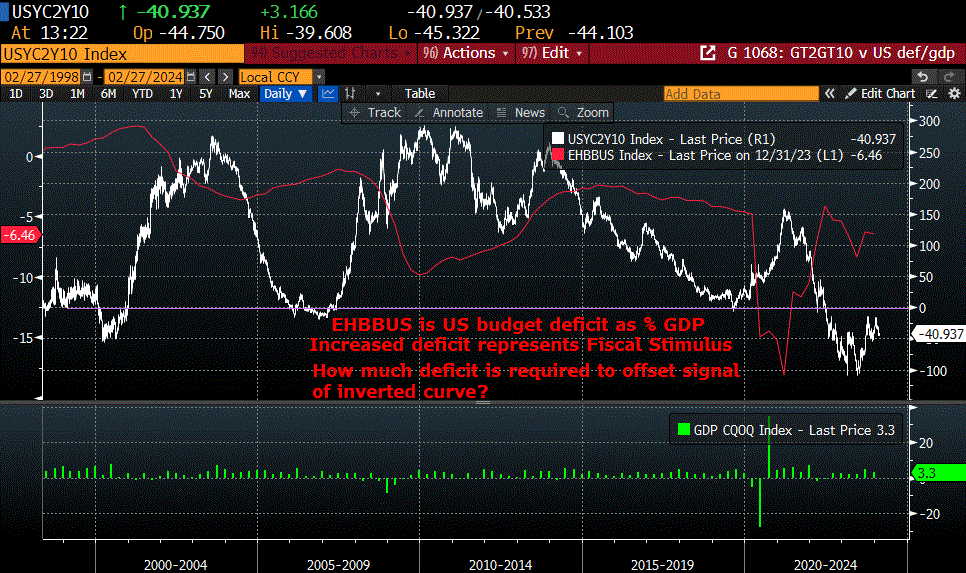
–Attached chart is the Federal Budget Deficit in red, vs 2/10 treasury spread in white. When the curve inverted at the end of the hiking cycle in 2006, the budget deficit was around 2.5 to 3%. Even at that time, many were wondering whether curve inversion was giving a “false” signal with respect to future econ activity. It wasn’t. In the current case, the inversion has been much more dramatic, reaching -108 bps, and the same “false signal” with respect to forward growth has been a topic in the financial press. My thought is that a budget deficit that’s more than twice the percent of GDP (-6.5%) as it was in 2006 has masked the message of the curve, but hasn’t changed the basic forecast.
February: a month of paring back ease expectations
February 27, 2024
*******************
–Price concession allowed the market to absorb two and five year auctions, and contributed to new recent lows in the curve. 2/10 closed -44, down about 1 bp. Red/green SOFR pack settled near -28, down nearly 2 bps on the day. The 2y and red SOFR pack both rose 5 bps in yield; 2y to 4.735% and Red pack to 9601.625. In early February, the peak contract on the SOFR strip was SFRZ’25, which settled 9687.0 on 1-Feb. Yesterday that contract settled 9623.0 (down 64 from Feb 1), and the peak contract has moved over a year further back in time to SFRH’27 at 9631.5. Just another reflection of eases being squeezed out and the curve flattening. Currently, every SOFR contract from Dec’25 through Dec’28 is between 9622.5 and 9631.5, right around 3.75%. The lowest contract is still SFRH’24, which made a new recent low yesterday of 9467.
–Japan’s inflation data showed Core Prices +2.0% in Jan, down from 2.3% in December but higher than the 1.8% expectation. BOJ expected to end negative rates in March or April.
–7 year auction today, $42b. Yesterday the 10y rose 4 bps to 4.295%. Durables and Consumer Confidence, amid more reports that consumers are trading down in terms of brands and generally being more frugal. Confidence expected 115 from 114.8. The administration seems desperate to get out the message that the economy is doing great (with the implicit undertone that only the stupid can’t see it).
–Interesting line by Matt Taibbi yesterday (Nikki Haley’s $100 million faceplant)
“All of this speaks to one of the major unreported stories of our time: a dramatic political realignment by income and class, presented as a schism between smart and ignorant, ‘normal’ and not.”