3 yrs ago, WTI went negative. Now near 80 bbl on OPEC+ production cuts
April 3, 2023
–CLK3 up 5.2% at 79.62 as of this writing as MBS was apparently displeased that the Biden admin refused to support oil by buying for the SPR with prices in the low 70s. OPEC+ cutting production by 1mbd. It was three years ago in April that front WTI crude went negative during Covid, causing Core PCE to fall below 1%. On Friday, PCE prices were lower than expected at 5.0 with Core 4.6%. Also on Friday Waller cited anchored inflation expectations as an important factor which could support the idea of lower inflation without much in the way of job losses.
–ISM Mfg today expected 47.5.
–Friday featured higher fixed income prices. Ten year yield fell 5 bps to 3.494%.
–Large TY call spread exits Friday. Sale of 40k TYM3 111.5/113.5cs ~1’27, settled 1’40 ref 114-295, and sale of 15k TYM3 113/114cs 1’19 to 1’20. settled 1’24. These were bought right around SVB news, near the lows in TY.
–April FF, which expire at the end of the month, settled 9518.5. One year forward FFJ4 settled 9600.5, or 3.995%. On the treasury curve, only the two year sports a 4% handle (4.06%).
Defund the (small) banks
April 2, 2023 – Weekly Comment
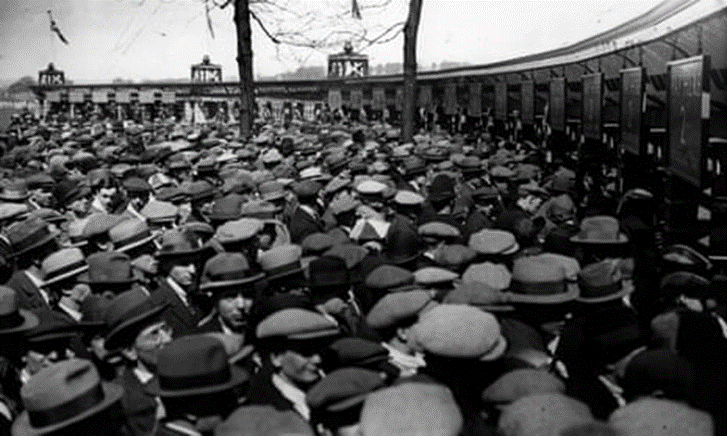
When does the tipping point occur? This photo is from The Guardian, “When and Why did Men Stop Wearing Hats?” I think the hat thing was also a topic in Malcolm Gladwell’s ‘The Tipping Point’. In the photo, every man is wearing a hat. Then it all changes.
I think there are two tipping points relating to SVB. First, savers are much less likely to accept bank yields close to zero. Second, the idea of counter-party risk is growing. While the authorities are doing a decent job of quelling the latter risk, the former appears far more permanent. Money market funds have seen huge inflows, for example. Almost everyone is now aware that deposits can earn a non-trivial yield.
For a long time, there was much lamentation that savers were getting screwed in a world of zero (or repressed) short term rates. Spenders were encouraged. That dynamic has changed, as perhaps indicated by this clip from BBG:
As the Federal Reserve steadily increased the federal funds rate over the last year to try to tame inflation, the average interest rate on loans for new cars jumped to 8.95% last month, up from 5.66% a year earlier, according to researcher Cox Automotive. That, along with average car prices that now approach $50,000, has driven auto loan payments to $784 a month on average, up about $177 a month since March 2020 when the pandemic began.
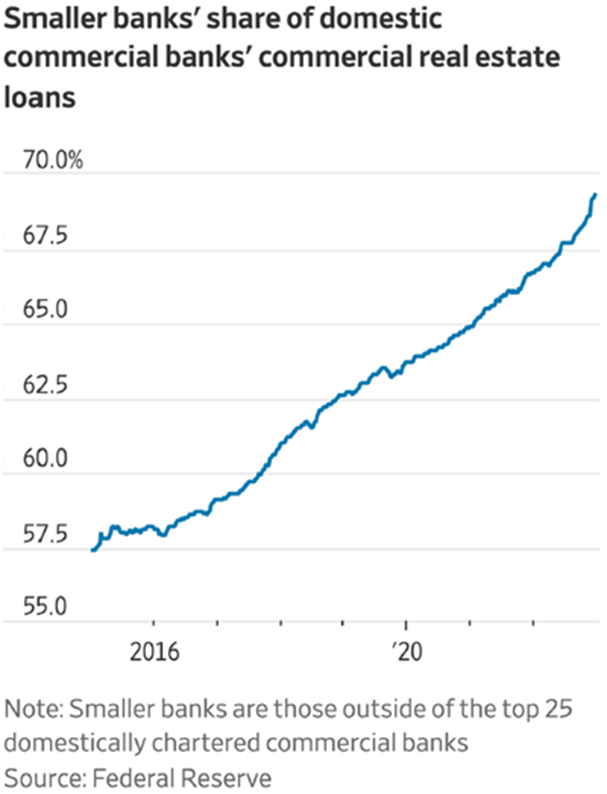
What are the implications going forward? Primarily, a credit crunch, and lower profitability for smaller banks. The Fed has already cited this risk, though the magnitude of the effect is uncertain. I have seen estimates that equate the upcoming credit crunch with 50 to 150 bps of Fed tightening. A chart from Mauldin’s ‘Disturbing Thoughts’ this week points up vulnerabilities:
In terms of the economy as a whole, when does the tipping point occur? I’ve thought that as long as short-term funding rates are below the inflation rate, the plates keep spinning. Prices go up, but wages increase as well, and with funding rates below the gains on either of those two, financing pressures might actually decline. However, as the chart below shows, for the first time in this cycle, the FF rate is above PCE Core prices. If the effect of the credit crunch is 50 bps, then the synthetic midpoint of the FF range would be equal to the cycle-high Core PCE deflator which was 5.4%.
On Friday, the Fed’s Waller gave a speech about the ‘Unstable Phillips Curve’. This curve relates inflation to unemployment. From the speech: “We all know that if you simply plot inflation against the unemployment rate over the past 50 years, you get a blob. There does not appear to be any statistically significant correlation between the two series.” He then goes on to introduce inflation expectations as a determinant for shifting of the Phillips curve and concludes it’s possible “…inflation can be brought down quickly with relatively little pain in terms of higher unemployment.” Note that the U of Mich 1-yr inflation expectation release last week came in at 3.6%, a new recent low and well off the 5.4% high last year. From 2015 to 2020 this survey averaged around 2.7% (high of 3% low of 2.2%). All that Waller’s speech really accomplished in my view is to confirm that the Fed is grasping for explanations, trying to find narratives to fit the data while fending off political attacks, and thus has become more dependent on actual data releases.

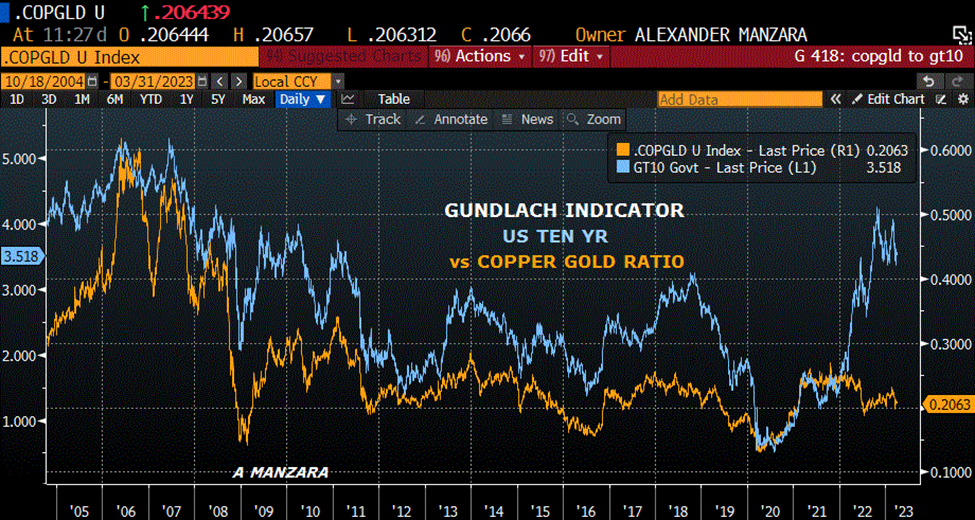
Below I have included a couple of charts related to Gundlach of Doubleline, the copper to gold ratio vs the ten year yield. For the former, I just use HG1/GC1 which is an adequate representation over time. This ratio indicates that the ten year yield likely has room to fall. Copper represents an industrial metal, while gold tends to firm when there are cracks in the financial architecture. The decline in the ratio suggests that yields should decline both due to economic weakness and, perhaps, because of a flight-to-safety. However, relatively high inflation levels are holding yields higher for the time being.
I’ve added the KRW bank index on the lower chart. This index has retraced about half of the move from the GFC low to the high set in the beginning of last year. Large drops in the bank index are typically associated with large declines in the ten-yr yield.

OTHER THOUGHTS / TRADES
The two-year yield rebounded over 30 bps on the week to end 4.062%, while the 30yr rose only 5 bps to 3.692%. Range on 2/30 for the month of March was an astonishing -118 to -13.
There were a few significant exits on Friday. A seller of 40k TYM3 111.5/113.5cs around 1’27; settled 1’30 ref 114-295. Originally bought on March 8, near the lows of the move in TY. TYM3 112/114cs likewise sold at 1’20 to 1’19 in size of 15k; settled 1’24. There was a buyer of 22k SFRZ3 9550/9500/9450p fly for 11-11.5; settled 11.0 ref 9570.0. Appears to be an exit, perhaps by a market maker.
This week brings ISM Mfg (Monday), and Services (Wed). The employment report is released on the holiday-shortened session Friday. Futures settlements to determine in-or-out-of-the-money strikes will occur 10:00 am Chicago time. Trading will cease at 10:15. NFP expected 240k. Unemployment rate expected 3.6%.
FFK3 settled 9506.0. The FOMC is May 3. I calculate Friday’s settle as almost exactly 50/50 odds for a 25 bp hike. No hike =9517.0, hike 25=9494.4.
| 3/24/2023 | 3/31/2023 | chg | ||
| UST 2Y | 372.5 | 406.2 | 33.7 | |
| UST 5Y | 340.0 | 361.5 | 21.5 | |
| UST 10Y | 338.0 | 349.4 | 11.4 | |
| UST 30Y | 364.3 | 369.2 | 4.9 | |
| GERM 2Y | 239.2 | 268.3 | 29.1 | |
| GERM 10Y | 212.9 | 229.2 | 16.3 | |
| JPN 30Y | 132.3 | 124.2 | -8.1 | |
| CHINA 10Y | 287.0 | 285.8 | -1.2 | |
| SOFR M3/M4 | -145.0 | -131.0 | 14.0 | |
| SOFR M4/M5 | -31.0 | -57.5 | -26.5 | |
| SOFR M5/M6 | 4.5 | -5.5 | -10.0 | |
| EUR | 107.62 | 108.73 | 1.11 | |
| CRUDE (CLK3) | 69.26 | 75.67 | 6.41 | |
| SPX | 3970.99 | 4109.31 | 138.32 | 3.5% |
| VIX | 21.74 | 18.70 | -3.04 | |
https://www.federalreserve.gov/newsevents/speech/waller20230331a.htm
Panem et circenses
March 31, 2023
–They just HAD to put Trump on the front pages again.
–Rate trading was quiet yesterday in front of today’s PCE prices, expected 5.1 from 5.4 with Core 4.7 vs 4.7 last. With the recent hike, the FF rate will now be above Core. The curve inverted a bit more with twos up almost 2 bps to 4.097% and tens down an equal amount to 3.545%. I marked 2/10 just below -55. On the SOFR curve, the front 4 contracts were down 3.5, reds -1.5, greens +3.875, blues +5.0. From SFRH’25 to H’28, settles are between 9700 and 9685, yields 3-3.15%. The dollar index has been trending lower since the start of last year’s fourth quarter, and is now just above 102, having been 114 in September.
–Almost Daily Grant’s had another interesting clip yesterday:
Silicon Valley picks up the tab. On Tuesday, Apple, Inc. formally announced the long-awaited debut of Apple Pay Later for “select” U.S. customers. The newfangled service, which will front up to $1,000 for online and in-app store purchases split into four payments spread over six weeks without interest or fees, will roll out nationwide in the coming months, the company conveyed.
–ADG referred to this as BNPL (buy now, pay later). Four payments, 6 weeks. Is that what we’re now referring to as “innovation”? They already have something like this. It’s called a credit card. If you buy at the start of the billing cycle, you get 4 weeks without interest or fees.
–With the curve giving back much of the rebound seen after the failure of SVB, the market perceives the Fed as “tight”. I’ll just add a couple of end-of-month, end-of-qtr, items that run along the same theme. A ZH article cites the RH (Restoration Hardware/ high end furnishings) earnings call, with CEO Friedman saying business in his sector will be getting worse before it gets better.
https://www.zerohedge.com/personal-finance/its-not-rocket-science-rh-ceo-warns-not-normal-dangerous
Of course, this guy has been warning of trouble and uncertainty (correctly) in the economy for over a year.
–Another note was on BBG yesterday:
Worker Adjustment and Retraining (WARN) Notices are picking up which points to unemployment claims soon rising and a deterioration in the jobs market, posing a risk to stocks.
“The WARN Act obliges employers with more than 100 full-time workers to provide written notice to the state and the workers themselves at least 60-90 days ahead of planned plant closings and mass layoffs.”
Initial crisis averted, now comes regulation
March 30, 2023
–As the first effects of the banking miscalculation wash over the financial system, there’s a sense of relief that crisis was averted. Stocks are rising and the curve is inverting further. For example, yesterday SFRM4 was -5 (9571.5), SFRM5 -1.5 (9592.0) and SFRM6 +1.0 (9694.5). The 2yr note up 1.6 to 4.078% while tens were unch’d at 3.564. SPX +1.4% and Nasdaq Comp +1.8%.
–Though SVB was apparently saddled with inept risk controls, the broader ramifications for healthier banks are 1) a still inverted curve 2) deposits which now must be compensated 3) more regulation. I googled high CD rates, and Bankrate.com showed these offers:
Marcus is offering 5.05% for 10 months
Ally is offering 5.0% for 18 months
BofA at 0.03% for 12 months
Chase is 0.01% for 12 months
So, there’s a modest spread of FIVE HUNDRED BPS between too-big-to-fail and competitors.
–Yesterday a seller of 20k SFRZ3 9800/9850cs at 4.0 (originally bought for 1.5, and mostly exited at higher levels).
–Jobless Claims today expected 195k
–PCE prices on Friday expected yoy 5.1 from 5.4% with Core 4.7 from 4.7
Simmering down – except bitcoin
March 29, 2023
–Rate futures continued to recede as fears of bank contagion abate. SFRH4 and M4 both down 12 at settlement to 9613.5 and 9646.0. The ten year note rose 4 bps in yield to 3.564%. Implied vol in rates eased. SOFR straddles are now being quoted 3 to 6 bps wide rather than 10 to 14 wide during the panic. Having said that, SFRU3 9550^ settled yesterday at 107 (ref 9548.5). As a comparison, on 3/7, three weeks ago, SFRU3 atm straddle was the 9437.5 strike (ref 9435.5) and the premium was 53.5, exactly half of yesterday’s value. On March 15, SFRU4 atm straddle was the 9600 strike (ref 9598.5) at 142.
–FRC closed yesterday at 13.50, down 2.3% and down 90% from February. While the worst of the funding crunch might be over, expensive dislocations continue. I saw a bunch of CDs yesterday 1yr to 1.5yr at various banks over 5%. Not sure if bitcoin is a leading indicator of traditional banking system stress, but worth noting that it’s back near the high of the panic move this morning, around 28500. Both stocks and crude oil continue to rebound, with CLK3 now back to $74.
–There were a few decent size SOFR option trades yesterday. Buying of 30k SFRZ3 9550p for 48-48.5 appears to be an exit. SFRZ3 atm 9575^ settled 128. Seller of 80k x 140k 0QJ3 9537.5/9500p 4×7 (sold 9537.5p at 1.75 and paid 1 for the 9500 strike) was likely an exit before quarter-end, but the for the opposite side it was a new position because OI didn’t change.
–7 year auction today.
Worst is over?
March 28, 2023
–FFJ3 settled 9518 or 4.82%. On March 23 and 24 EFFR was 4.83 or 9517. May FF settled 9506.5 or 4.935, indicating decent odds of a hike at the May 3 FOMC. The August contract is right back at 9530. FFJ4, one year forward, fell 26.5 bps yesterday to 9616.0. Despite this quarter percent move, it is still almost exactly 100 bps higher in price/lower in yield than front April. Even as leaks in the banking system are addressed with duct tape (with requisite Fed guarantees), the market still believes eases are coming.
–Implied vol slid in conjunction with futures giving back some of the ftq bid. Tens rose 14.6 bps from Friday, to 3.526%. Two-year auction saw tepid demand, perhaps not surprising given that its yield is more than 100 bps lower than it was a couple of weeks ago. Five year auction today. TYM3 atm 116^ was 3’52 Friday, but 3’25 yesterday (atm 115 strike)
–Range this year on 30y bond yield has been around 3.53 to a bit over 4%. Ended yesterday in the middle at 3.757%, up 11.4 on the day. US and WN contracts appear to be under a cloud of consistent sellers going into the end of the quarter.
Panic Abates
March 27, 2023
–New highs for the move in rate futures Friday, but panic subsided and futures retreated, to close nearly unchanged. It’s reported that First Citizens is acquiring SVB. Rate futures considerably lower this morning. For example, SFRH4 posted a high Friday of 9684 but settled 9652.5 (just +2.5 on the day at settle) and this morning prints a low of 9630.5. so over 50 bps of range in less than two sessions.
–On Friday SFRM3/M4 settled at a new low of -145 (9529/9684). That’s a significant amount of easing, if realized. This Friday the Fed’s preferred measure of inflation is released, PCE prices expected 5.1% from 5.4, with Core expected 4.7 from 4.7. With last week’s hike to 4.75/5.0 for the FF target, funds are now above the Core inflation number, in other words, restrictive.
–Fed speakers throughout the week. Jefferson this afternoon post-close. Waller on Friday. Auctions of 2, 5 and 7 year notes start today.
The Ghost of Ace Greenberg
March 26, 2023 -Weekly Comment
****************
$3.2 Billion Move by Bear Stearns to Rescue Fund – NYT
By Julie Creswell and Vikas Bajaj
- June 23, 2007
Bear Stearns Companies, the investment bank, pledged up to $3.2 billion in loans yesterday to bail out one of its hedge funds that was collapsing because of bad bets on subprime mortgages.
It is the biggest rescue of a hedge fund since 1998 when more than a dozen lenders provided $3.6 billion to save Long-Term Capital Management.
The crisis this week from the near collapse of two hedge funds managed by Bear Stearns stems directly from the slumping housing market and the fallout from loose lending practices that showered money on people with weak, or subprime, credit, leaving many of them struggling to stay in their homes.
Bear Stearns averted a meltdown this time, but if delinquencies and defaults on subprime loans surge, Wall Street firms, hedge funds and pension funds could be left holding billions of dollars in bonds and securities backed by loans that are quickly losing their value.
******************************************************************
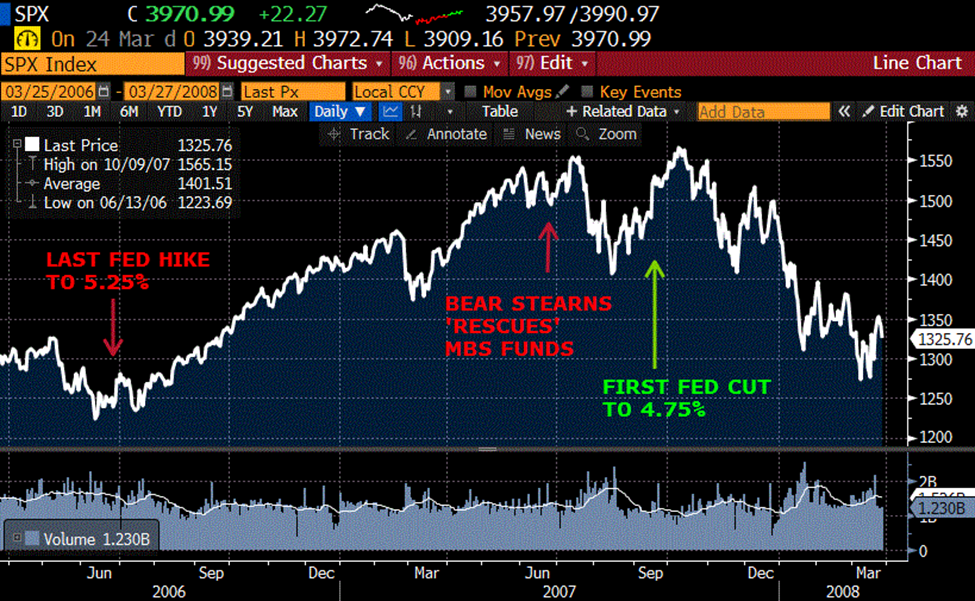
We know how this turned out. This time around, SVB depositors were saved, but CS AT1 bondholders weren’t. The last hike prior to the GFC was June 2006 to 5.25%, the first ease was Sept 2007 to 4.75%, one-and-a-quarter years later. Below is a chart of SPX over the two-year time frame of March 2006 to March 2008. In March 2008, Bear essentially failed and was bought by JPM with Fed backed financing. Sound familiar? Now the SNB financed the UBS purchase of CS. In September 2008 Fannie and Freddie were nationalized, and shortly thereafter Lehman filed for bankruptcy. [thanks MB for bringing up CS/BS comparison].
The core problem is that long-dated crappy assets can’t be funded at current high short rates. The crappy assets were accumulated during the long period of zero to negative rates. That issue doesn’t go away when a stronger institution marries a weaker one. In the 1980s Savings and Loan crisis, the Resolution Trust Corp was created. It took the bad assets and slashed the prices, which then went into stronger hands. Assets need to be written down. Does relatively high inflation change that equation? Maybe. Typically, the CB cuts and the positive curve allows everyone to build-back capital relatively quickly. Current inflation will drag the process out. In an inverted curve, the value of assets becomes questionable, and the holders of these assets try to fudge the values. “First gradually, then suddenly”, as desperation sets in. Unsurprisingly we’re getting articles like this:
Is corporate malfeasance on the rise? The Wall Street Journal reports today that an indicator of potential earnings manipulation developed by Indiana University accounting professor Messod D. Beneish is registering at its most elevated levels since the late 1970s. The so-called M-Score, which tracks eight balance sheet and P&L metrics including changes in accounts receivable, depreciation expense and timing of accruals, signaled red flags at Enron and Wirecard prior to those firms becoming embroiled in accounting scandals.
from Almost Daily Grants. March 24, 2023 [link to more info on M-Score at bottom]
From this week’s Credit Bubble Bulletin:
SVB, no doubt about it, was up to its eyeballs in idiosyncratic risk. Yet the unfolding banking crisis is systemic. Years of loose “money” was systemic. Gorging on risky loans and mispriced securities – systemic. There was a protracted period of extraordinary system-wide excess. Crazy everywhere.
Lending will now tighten, Credit growth will slow, and the downside of the Credit Cycle will surely unleash economic stagnation and major loan quality issues. Understandably, focus is now on the small and medium sized banks with their big exposures to vulnerable real estate loans. Compounding U.S. risks is the harsh reality that finance and economies are fragile globally.
Powell clearly emphasized that tighter credit is coming, not necessarily through rate hikes, but through a combination of regulation and counter-party risk dynamics.
Below is a chart of the 2yr yield now, which topped on 3/8/23 at 5.07% (SVB failure 3/10), and the 2y yield in the GFC, which topped in 2006 at 5.28, but made another move higher to peak at 5.10% on June 12, 2007, just before the article at top was published.
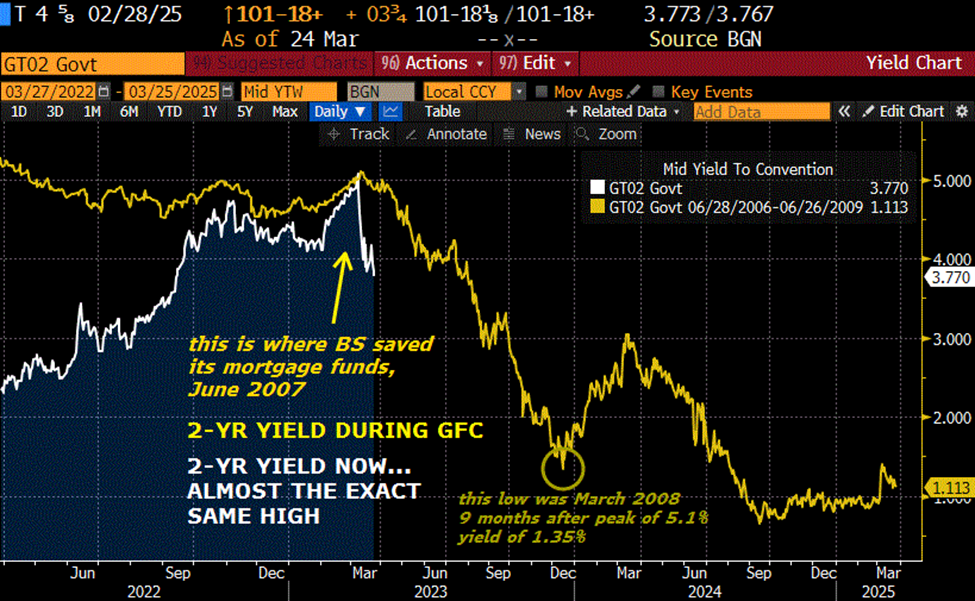
From the behavior of the 2yr yield this time around, it appears as if the market is taking current issues more seriously. We’ve dropped 130 bps in yield in 2s in two-and-a-half weeks. It took 3 months in 2007.
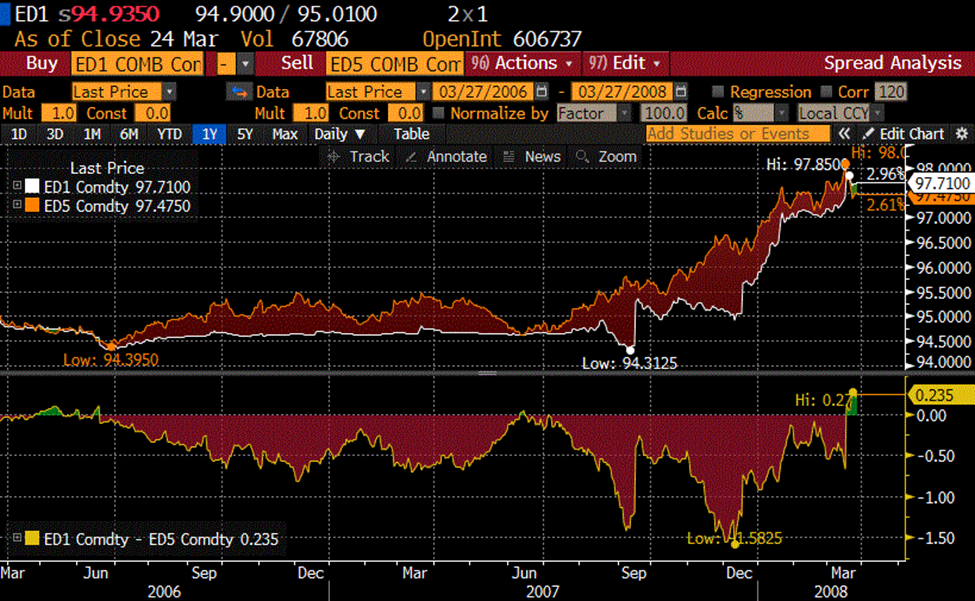
I have also added a chart of the first-to-fifth ED calendar spread. Currently, the lowest one-year SOFR calendar is June’23/June’24 at -145 (current 1st to 5th). Sept’23/Sept’24 is -127. In Sept 2007 the ED calendar was -142. In December the low was -158. What is also interesting is that by mid-March 2008 the 5th ED contract reached 98.10. (Remember, first Fed ease was Sept 2007. SPX heaved a sigh of relief and made a brief new high. It didn’t last). On Friday. SFRM4 settled 9684 and SFRU4 at 9705.5. The highest SFR contract at Friday’s settle was SFRH’25 at 9715.5. For a more accurate comparison, 26 bps should be subtracted from SFR contracts, so SFRU4, for example, would be more like 9680. If the current situation unfolds like 2007/08, there’s more room to run in reds; SOFR red pack settled Friday just under 9705.
This week we’ll have several Fed speakers. So far they are hewing to the anti-inflation fighting message despite liquidity problems.
03/27 17:00 Fed’s Jefferson Discusses Monetary Policy
03/28 10:00 Fed’s Barr Appears Before Senate Banking Panel
03/29 08:05 NY Fed Head of Supervision Dianne Dobbeck Speaks to Bankers
03/29 10:00 Fed’s Barr Appears Before the House Financial Services Panel
03/30 12:45 Fed’s Barkin Speaks at Virginia Council of CEOs Event
03/30 12:45 Fed’s Collins Speaks at NABE in Washington
03/31 15:05 Fed’s Williams Speaks at Housatonic Community College
03/31 16:00 Fed’s Waller Discusses the Phillips Curve
03/31 17:45 Fed’s Cook Discusses US Economy and Monetary Policy
Auctions of 2, 5, 7 year notes begins Monday
Fed’s favored inflation measure released Friday:
PCE prices yoy expected 5.1% from 5.4%. Core yoy expected 4.7% from 4.7 last.
*********************************************************************************************
Ace Greenberg was CEO of Bear from 1978 to 1993 and Chairman of the Board from 1985 to 2001. In 1998, when Long Term Capital Management failed, Bear, then under CEO Jimmy Cayne, famously refused to participate in the LTCM bailout. When Bear’s problems occurred, other banks weren’t inclined to help out.
| 3/17/2023 | 3/24/2023 | chg | ||
| UST 2Y | 383.1 | 377.7 | -5.4 | wi 372.5 |
| UST 5Y | 346.1 | 341.0 | -5.1 | wi 340.0 |
| UST 10Y | 339.1 | 338.0 | -1.1 | |
| UST 30Y | 359.7 | 364.3 | 4.6 | |
| GERM 2Y | 238.7 | 239.2 | 0.5 | |
| GERM 10Y | 210.7 | 212.9 | 2.2 | |
| JPN 30Y | 128.7 | 132.3 | 3.6 | |
| CHINA 10Y | 286.6 | 287.0 | 0.4 | |
| SOFR M3/M4 | -109.5 | -145.0 | -35.5 | |
| SOFR M4/M5 | -24.5 | -31.0 | -6.5 | |
| SOFR M5/M6 | -1.0 | 4.5 | 5.5 | |
| EUR | 106.65 | 107.62 | 0.97 | |
| CRUDE (CLK3) | 66.93 | 69.26 | 2.33 | |
| SPX | 3916.64 | 3970.99 | 54.35 | 1.4% |
| VIX | 25.51 | 21.74 | -3.77 | |
https://www.thebalancemoney.com/2007-financial-crisis-overview-3306138
https://www.grantspub.com/resources/commentary.cfm
https://en.wikipedia.org/wiki/Beneish_M-score
Projected easing
March 24, 2023
–Here we go again. Yields cratered with short maturities leading. On the SOFR curve SFRZ3 rallied 27.5 bps to a price of 9610.5 or 3.895%. 120 bps lower in yield than the just-released 2023 Fed dot of 5.1%. Banking issues remain at the forefront, with Yellen’s tepid guarantees of deposits falling short of instilling confidence. The 2y note sank 16.4 bps to 3.806%. The highest settle for SFRZ3 was 9616.5 last Friday. It currently trades 9623.
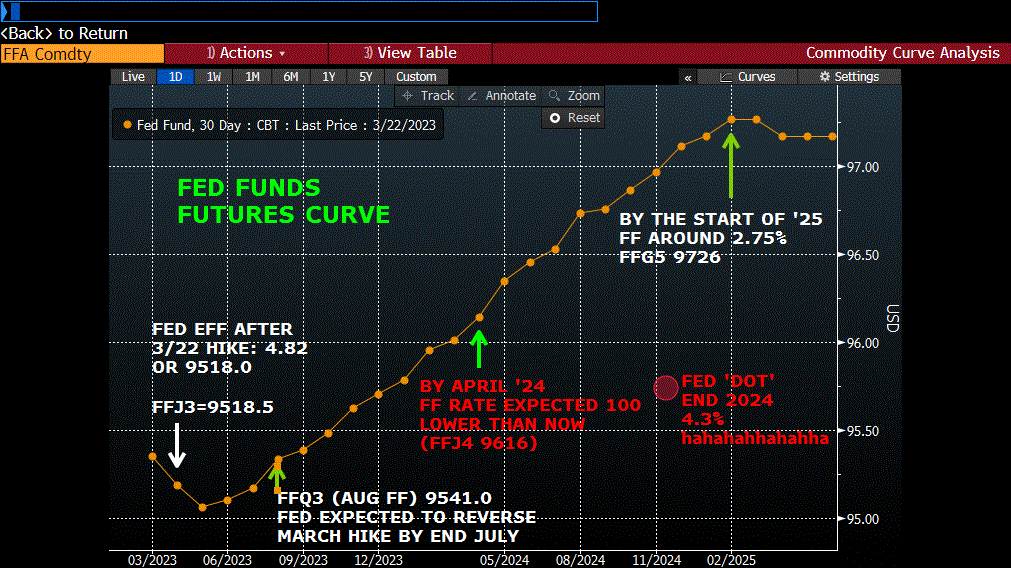
–I’ve attached a plot of Fed Funds futures prices. The upward slope indicates a consistent expectation of ease. (And the chart was out of date as soon as I printed it as prices rallied further). FFJ3 settled 9519 or 4.81%, within a couple of bps of the new EFFR. FFQ3 (August) settled 9551 or 4.49%, a spread of -32 to April, indicating a full reversal of this week’s hike, and then some. The April’24 contract, one year from now, settled 9640.5 or 3.595%, almost 125 bps lower in yield than the current EFFR. The peak FF contract is the last one listed which has any open interest, Feb’25 at a price of 9739.5 or 2.605%. Worth noting that the 2024 Fed dot was 4.3%, and FFZ4 settled 9724.5 or 2.755%, more than 150 under the Fed’s projection. So…if the local bank now has to offer CDs over 4% in order to cover vanished deposits that swooshed over to Chase or BofA, might as well lock it in. Yellen’s got your back. Sorta.
–Unsurprisingly, the 30y yield was unchanged yesterday as the curve steepened, with a yield of 3.68%. Perhaps as Japan closes the fiscal year, some selling of long-dated US paper is occurring. Perhaps the Fed’s renewed balance sheet expansion is engendering thoughts of renewed inflation. Maybe term premium is coming back into play. Today is April Treasury option expiration. Peak open interest in April TY calls is the 116 strike with 38k open and 22/64 settle. TYJ 116p settled 23 and has only 5k open; peak OI is the worthless 112.5p with 96k expiring. On the US side, nothing stands out except for 17k open in 129 puts, which settled 1 ref 131-25.
–SOFR straddles are back to being 8-10 bps wide bid/ask. Early yesterday it started to feel like things were tightening up and getting closer to ‘normal’ but the end of the day was more panicky. Lowest one-yr SOFR calendar is June’23/June’24 at -143 bps (9539.5/9682.5).
Settle in at 3% in a little over a year
March 23, 2023
–Powell went to great pains to say that the Fed’s goal is still squarely bringing inflation back to 2%. He said that the banking issues will likely result in tighter credit conditions for households and businesses and therefore act as restraint in the same way as overt Fed tightening might, though it’s difficult to quantify. He also said a few times that the US banking system is well-capitalized, and that depositors should all feel safe. Undone immediately by Yellen who said the US is NOT considering a blanket guarantee for depositors. Stocks immediately slid, hard, though bouncing this morning.
–In terms of inflation, Powell again split it into three parts: Goods are seeing disinflation. In housing, new leases are being written at steady to lower prices. However, the service sector is where the issues are. Powell said the Fed’s base case does not anticipate the Fed cutting this year. The market differs with that assessment.
–Fed left the 2023 dot at 5.1 (indicating only 1 more hike) while the 2024 dot went up to 4.3 from 4.1. So that would indicate Z3/Z4 at -80, and it actually settled -111.5, down 7 on the day (SFRZ3 9583, +18 and Z4 9694.5, +25). SFRU3/Z3 three-month spread settled at a new recent low -32.5, down 7.5 on the day. EFFR going into yesterday was 4.58% or 95.42 price equivalent. FFJ3 settled at 9518.5 or 4.815%, very close to what should be the new EFFR of 4.83 or 4.82%. There are three FOMC meetings in front of August: May 3, June 14 and July 26. There is no meeting in August and FFQ3 settled 9533.5 or 4.665%. In other words, the market is pretty sure this hike will be reversed in the next four months. Further out, the red pack (2nd year) settled 9685, green pack 9697, blue pack 9694 and gold pack 9687 (all rounded). So after this year, the next four years are pegged at a rate of just over 3%.
–On the Feb 1 FOMC there was a buyer of 50k SFRZ3 9550/9750cs for 33.5/35. On yesterday’s pre-FOMC a new buyer of 15k SFRZ3 9650/9750cs for 17.0/17.5. Settled 19.5.
–Final thought. Curve is still inverted. Depositors are not covered. More problems will crop up.