I guess they took the TACO thing too far
June 22, 2025 – Weekly comment
************************************
On Friday there was an early buyer of 40k TYQ 112c, 24/64s paid ref 110-205. Expires 25-July, delta 32, settled 28 vs 110-315. Total volume for this strike on Friday was 136k, with open interest increasing 82.8k to 172k, easily the peak open interest of any TY call. Next closest are 112.5 and 113c at 73k and 75k. With TYU5 having a DV01 of 66.30, the 112 strike is about 15 bps away, roughly 4.22% on cash tens.
It appears as if someone needed a hedge in case of a US bombing campaign in Iran, which of course came to pass this weekend and now overshadows Powell’s semi-annual testimony (Tues/Wed) and PCE prices (Friday).
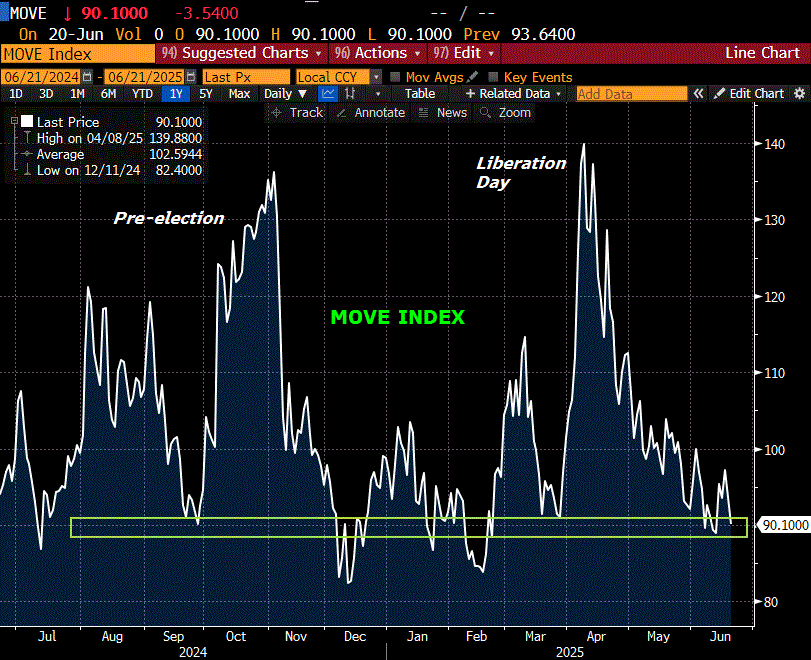
As can be seen on the MOVE index, implied vol has been unwinding ever since Liberation Day, despite huge geopolitical uncertainties. August TY calls could easily be considered in the “buy” area. I would hazard a guess that treasuries will again function as a risk-off play, though a wider conflict will almost certainly exacerbate inflationary pressures. (How much does US weaponry depend on rare earth inputs from China?)
From DefenseOne.com on April 23, 2025.
Since 2010, the Pentagon’s demand for components containing five critical minerals—antimony, gallium, germanium, tungsten, and tellurium—has surged, with contracts growing by 23.2% annually and gallium-related contracts alone increasing 41.8% per year. More than 80,000 distinct parts across 1,900 weapons now depend on these materials, or about 78% of all DoD weapons may be affected, according to a new report by the Govini data analytics firm.
https://www.defenseone.com/threats/2025/04/chinas-rare-earth-mineral-squeeze-will-hit-pentagon-hard/404776/
Modest risk-off reaction in bitcoin over the weekend, with a low of $101k as of Sunday morning 7:00am EST. High on Monday June 16 was around 109k.
************************************************
Just a couple of non-war-related items from Friday:
Waller said Fed could ease as soon as July as the “Fed’s benchmark rate is 1.25 to 1.5% above the estimated neutral level…” (BBG). I also saw this bullet point
*WALLER: DON’T WANT TO WAIT FOR CUTS UNTIL JOB MARKET TANKS
Some saw Waller’s comments as a brazen ploy to jockey for the Fed Chair job. I think that’s indiscriminately harsh and fails to recognize consistent messaging from Waller all year.
https://www.federalreserve.gov/newsevents/speech/waller20250217a.htm
From February 2025: ‘Disinflation Progress Uneven but Still on Track; Rate Cuts on Track as Well’
So for now, I believe a pause in rate cuts is appropriate. Assuming the labor market continues to be in rough balance, I can wait and see if the higher inflation readings in January moderate, as they have in the past couple of years. If so, I’ll have to decide if this reflects residual seasonality that will go away later in the year and if the underlying trend in inflation is toward 2 percent, or if there is a different issue holding up inflation and how that may play out. Whichever case it may be, the data are not supporting a reduction in the policy rate at this time. But if 2025 plays out like 2024, rate cuts would be appropriate at some point this year.
https://www.federalreserve.gov/newsevents/speech/waller20250414a.htm
From April 14, 2025 (post-Liberation Day) ‘A Tale of Two Outlooks’
While I expect the inflationary effects of higher tariffs to be temporary, their effects on output and employment could be longer-lasting and an important factor in determining the appropriate stance of monetary policy. If the slowdown is significant and even threatens a recession, then I would expect to favor cutting the FOMC’s policy rate sooner, and to a greater extent than I had previously thought. In my February speech, I referred to this as the world of “bad news” rate cuts. With a rapidly slowing economy, even if inflation is running well above 2 percent, I expect the risk of recession would outweigh the risk of escalating inflation, especially if the effects of tariffs in raising inflation are expected to be short lived
In such a scenario, the outlook for monetary policy might not look much different than it did before March 1. With a fairly small tariff effect on inflation, I would expect inflation to continue on its path down towards our 2 percent target. In this case, “good news” rate cuts are very much on the table in the latter half of this year.
The Fed is data dependent (I am accepting that premise at face value and am ignoring political motivations) but comments from Powell and Waller indicate institutional uncertainty about which mandate is more important: inflation or labor. As friend James Fishback mentioned on Stuart Varney’s show, Powell mentioned the word ‘tariffs’ 31 times [during the press conference]. He mentioned the words ‘deregulation or regulation’ zero times…” Powell is more concerned about inflation, and given the weekend’s events, that’s clearly the dominant concern. Waller sees a deteriorating job market and thinks there’s room to proactively address that side of the equation.
Powell at the press conference:
“So, of course, this is something [tariffs] we sort of know is coming. We just don’t know the size of it. And again, the economy seems to be in solid shape. The labor market is not crying out for a rate cut.
I was going to write about the impact of AI this week. Over the medium term, the labor market will suffer. We’ll leave that for another time, though I did see this amusing comment:
“As a typical American, I’m not entirely sure whether AI is good or bad, but I now know that it stands for Applebee’s and IHOP.” The company behind Applebee’s and IHOP plans to use artificial intelligence in its restaurants and behind the scenes to streamline operations and encourage repeat customers. That’s the power of AI: an upsale to tater tots from regular fries.
In terms of whether the market is crying out for easing, I would have to agree with Powell’s assessment, though I lean toward Waller’s idea that the Fed’s too late by the time the actual ‘crying’ starts.
In terms of pricing, SFRU5/SFRU6 one-yr calendar settled at a new low for the cycle of -81.5 (9589.5/9671). The low settle in SFRM5/M6 was -111 on settlement basis, on 30-April. The next FOMC meeting is July 31, so I am also watching FFQ5/FFQ6 since August FF will be the first clean FF contract after the July FOMC. FFQ5/Q6 settled -96, (9571/9667). The current Fed Effective rate is 4.33% or 9567; one year forward FFQ6 is exactly 100 bps lower. So, for the past several months at least, the near one-year calendars have been tacking around -100 to -90 with a roll bias to the downside. My rule of thumb is that the one-year calendar prices somewhere around 50% of the probable move. If 100 bps is neutral and inflation is 2.25%, then a FF rate of 3.25% makes sense, and that’s essentially where SFRU6 and Z6 currently trade. If the environment devolves into a rapid risk-off asset price plunge it wouldn’t be surprising to see FF down to 2.25% a year from now.
A couple of other trades from Friday:
SFRZ5 9568.75/9550p 1×2 0.25 was paid 50k. Settled 2.0 and 0.75, the top strike now has 395k open and the 9662.5 strike has 627k open. This is a ‘Fed on hold or one hike’ trade. SFRM5 settled Friday 9567.5 so that’s 1.25 in the money on the 1×2 top strike (Assume no eases). SFRZ5 9562.5/9550p spread 1×1 settled 0.5. Could severe supply-chain disruptions and a jump in energy spark a hawkish response from Powell before his term ends? (May 2026)
2QX5 2QZ5 9650/9625/9600p fly stupid (bought both) 7.5 paid for 20k. 2QX5 settled 3.25 and 2QZ5 settled 3.50. SFRZ7 settled 9660, and the preceding contract, SFRU7 settled 9666, so at present the roll over time is higher, a slight headwind for this trade, but there are many scenarios where it could work out.
Last week I had flagged a trade: SFRM6 9800c vs 0QM6 9800c, buying M6. Both options expire on 12-June, 2026. On Friday, 6/13 the option spread settled 0.25 (8.75 and 8.5). Futures settled 9653.5 and 9663.0 (M6, M7).
My comment last week: “This trade is a synthetic steepener. Works best on aggressive easing which typically causes reds to outperform and steepen vs more deferred SOFR contracts. Obviously, the 2% strike is ambitious and zero premium outlay would be preferable, but I wouldn’t be surprised to see more of this type of trade go through.”
What’s worth considering is that Powell’s term ends just prior to June 2026. If Trump has his way, the new Fed chair will be EASY MONEY. (This very topic was discussed by Kevin Muir and Patrick Ceresna on Market Huddle). Outsized rate cuts would almost certainly be associated with forward steepening (think September 2024 initial 50 bp cut and the following reaction in one-year forward SFRZ5: On Sept 19, the day after the 9/18 cut, SFRZ5 settled 9708. Two months later, on 11/19, it was 9615.5). On Friday, SFRM6 settled 9658 and M6 9800c 8.5. SFRM7 settled 9671.5 and 0QM6 9800c 9.25. The trade is slightly underwater, and I am not certain it’s predicated on the timing of Powell’s exit. However, this line of thinking is likely to become a strong theme, and a risk-defined way to play it is long nearer calls or call spreads and short deferred.
THIS IS NOT A RECOMMENDATION.
********************************************************
This week:
Monday: S&P Mfg PMI and Existing Home Sales
Tuesday: Philly non-mfg, Consumer Confidence (April matched Covid lows at 85.7 but May bounced to 98.0)
Auction: $69b 2yr
POWELL Semi-Annual Testimony Tuesday and Wednesday
(On Friday Waller said Fed could ease in July. Barkin said there’s no rush to cut).
Wednesday: New Home Sales
Auction: $70b 5yr
Thursday: Q1 GDP final. Durables. Jobless Claims expected 247k
Auction: $44b 7yr
Friday: PCE Prices expected 0.1 with Core 0.1. YOY expected 2.3% with Core 2.6%
| 6/13/2025 | 6/20/2025 | chg | ||
| UST 2Y | 395.6 | 390.6 | -5.0 | wi 387.8 |
| UST 5Y | 401.9 | 395.9 | -6.0 | wi 396.9 |
| UST 10Y | 442.0 | 437.5 | -4.5 | |
| UST 30Y | 491.1 | 488.9 | -2.2 | |
| GERM 2Y | 185.1 | 184.5 | -0.6 | |
| GERM 10Y | 253.3 | 251.6 | -1.7 | |
| JPN 20Y | 235.2 | 234.2 | -1.0 | |
| CHINA 10Y | 169.8 | 163.8 | -6.0 | |
| SOFR U5/U6 | -73.5 | -81.5 | -8.00 | |
| SOFR U6/U7 | 6.5 | 5.0 | -1.5 | |
| SOFR U7/U8 | 19.0 | 20.0 | 1.0 | |
| EUR | 115.52 | 115.25 | -0.27 | |
| CRUDE (CLQ5) | 71.29 | 73.84 | 2.55 | |
| SPX | 5976.97 | 5967.84 | -9.13 | -0.2% |
| VIX | 20.82 | 20.62 | -0.20 | |
| MOVE | 95.31 | 90.10 | -5.21 | |