Industrial Disease
August 17, 2025 – Weekly Comment
**************************************
Mark Knopfler identified problems afflicting the current administration as early as 1982:
Yeah, now the work force is disgusted, downs tools, walks
Innocence is injured, experience just talks
Everyone seeks damages, everyone agrees that
These are classic symptoms of a monetary squeeze
On ITV and BBC they talk about the curse
Philosophy is useless, theology is worse
History boils over, there’s an economics freeze
Sociologists invent words that mean “industrial disease”
–Dire Straits – Industrial Disease
Bessent with Larry Kudlow on August 12:
We have these agreements in place where the Japanese, Koreans and to some extent the Europeans will invest in companies and industries, that we direct them, largely at the President’s discretion.
Taking a stake in MP and Intel is just the start.
It was probably in 2013 or 2014 when then Chicago Mayor Rahm Emanuel created the Chicago Infrastructure Trust. I had heard an interview at the time (I can’t find it now) where he said, government doesn’t create jobs. Gov’t invests in infrastructure and creates conditions that encourage private companies to grow and hire.
It appears the fed’l government will choose winners and losers both through direct investment and contract awards. I favor Emanuel’s philosophy, but I think there’s a risk that the bond market reflects concerns about the new regime by pressing to higher yields. Perhaps it’s no wonder that BBB/Baa spread is just 1%, matching the lows of the last five years, also the low since 2003, farthest BBG goes back. Why should there even be a spread? It’s the same rate.
The extra yield that investors receive for owning investment-grade corporate bonds instead of Treasuries shrunk to just 73 bps Friday, the lowest since 1998, according to Bloomberg index data.”
To a small extent (so far) the steepening curve is a signal of these dynamics. 2/10 closed 56.7 (3.757/4.324) essentially the highest level since the spike to 64.5 around mid-April (Liberation Day aftermath). 5/30 at 108 (3.843/4.924) is highest since Oct 2021 and 2/30 at 116.7 (+7.2 on week) is highest since January 2022. I’m starting to think that every time Trump makes an off-the-cuff policy pronouncement the long bond yield rises by a few bps. The 2021 high in 2/30 was 228 bps (now 117). Of course, that’s when 2’s yielded 15 bps and the long bond was 2.45%. Currently twos are about 57 bps lower in yield than current EFFR at 4.33. Before the last Jackson Hole meeting the spread was -130 to -140. That is, the 2y was around 4% with EFFR at 5.33%. By the time of the last Fed ease in December 2024 to 4.33%, the 2y had risen to the same level, around 4.3%. Clearly the market expects easing now, but less aggressively so.
At the last Jackson Hole meeting, Powell was explicit about easing:
The time has come for policy to adjust. The direction of travel is clear, and the timing and pace of rate cuts will depend on incoming data, the evolving outlook, and the balance of risks.
We will do everything we can to support a strong labor market as we make further progress toward price stability. …The current level of our policy rate gives us ample room to respond to any risks we may face, including the risk of unwelcome further weakening in labor market conditions.
The following chart was a part of the slide deck at the last J-Hole presentation. Hiring rate vs Quits.
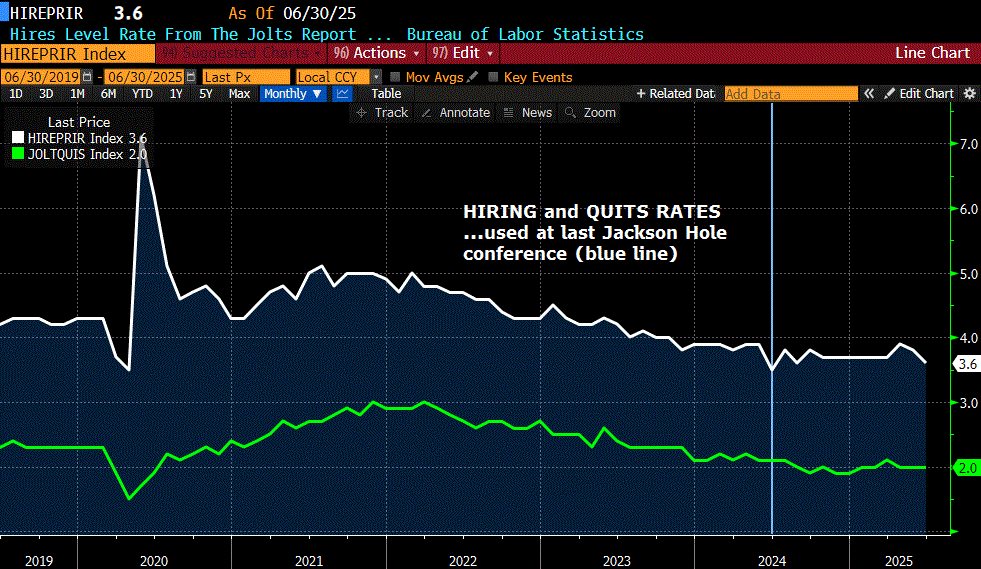
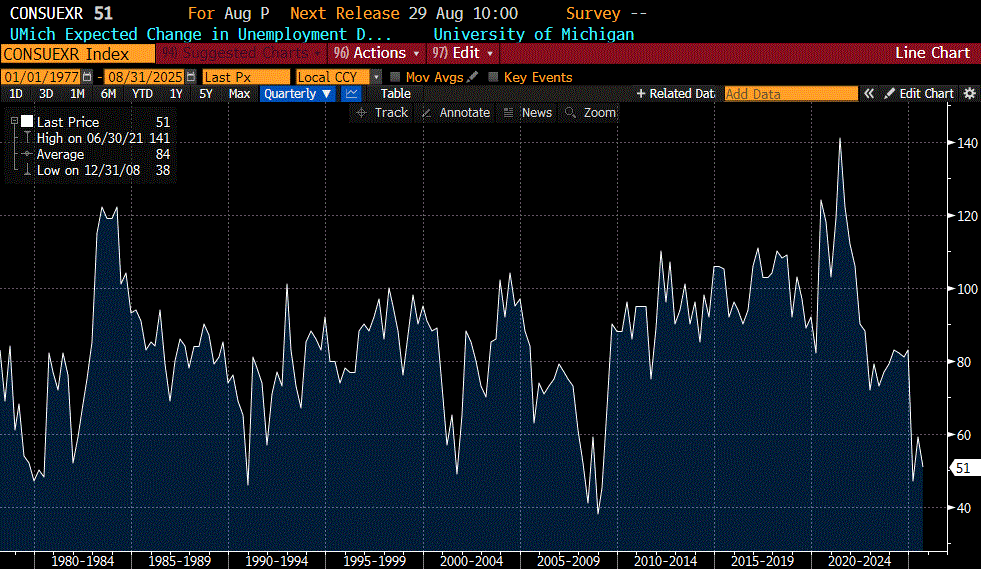
There is plenty of cover for Powell to ease 25 at the next FOMC. Funds are above neutral. Any uptick inflation can be explained away as a ‘one-time’ tariff response. Labor conditions are softening. All Powell has to say is that the Fed is taking a small step towards bringing policy closer to neutral as an insurance policy against weakening labor conditions at a time of AI angst. The Fed talks a lot about the importance of inflation expectations. How about job expectations? The next chart is from U of Michigan. If the next employment report is awful, then a 50bp cut could occur.
Last week FFV5, which telegraphs odds of the Sept FOMC, traded between 9596.0 and 9588.5. Settlement was 9589.5 after the higher than expected PPI data. A price of 9592.0 represents certainty of a 25 bp ease. We traded a few bps either side, but ended with a slight lean closer to zero than 50. FFF6 which is a rough proxy for the end-of-year rate traded a high 9633.5 and a low 9621 with a final settle 9622.5. A price of 9592 is one ease, 9617 is two, 9642 is three. So at the end of the week, Jan FF is closer to two rather than three.
Not a lot of economic news this week besides FOMC minutes Wednesday. Powell’s Jackson Hole speech scheduled for Friday at 10:00 am.
*********************
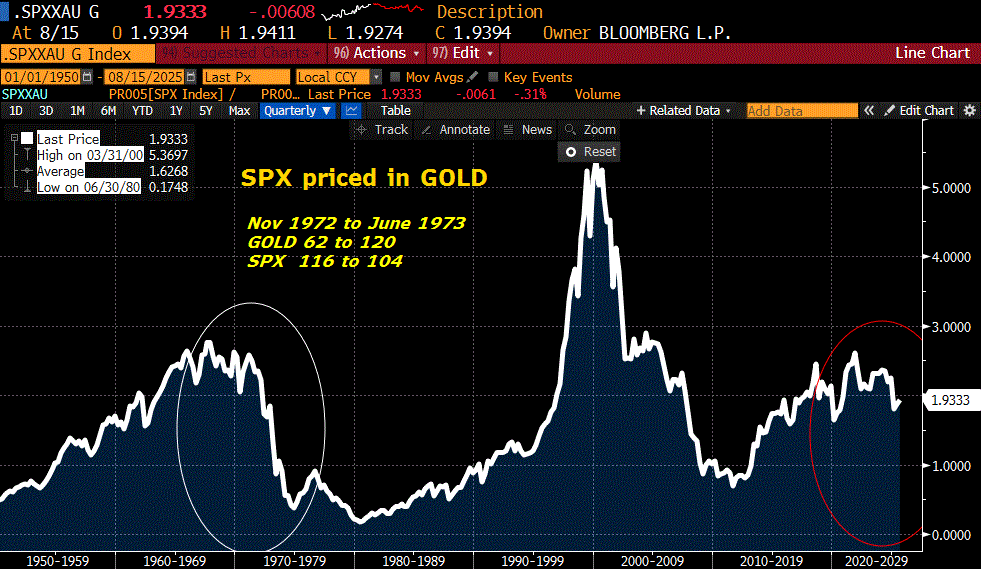
The gold window closed August 1971. But it was Nov 1972 to June 1973 when gold doubled from $62 to 120. Just prior to the 1973 oil shock.
In Nov 1972 SPX was 116.52, on its way to closing out a strong year. Nixon was re-elected in Nov 1972. By June 29, 1973 SPX was 104.26.
Is Bessent going to revalue gold to ‘strengthen’ the Fed’s balance sheet? Here’s chart of SPX priced in Gold. Looking at buying wingy calls on GCZ5.
| 8/8/2025 | 8/15/2025 | chg | ||
| UST 2Y | 375.8 | 375.7 | -0.1 | |
| UST 5Y | 383.0 | 384.3 | 1.3 | |
| UST 10Y | 428.3 | 432.4 | 4.1 | |
| UST 30Y | 485.3 | 492.4 | 7.1 | |
| GERM 2Y | 195.2 | 197.0 | 1.8 | |
| GERM 10Y | 268.8 | 278.7 | 9.9 | |
| JPN 20Y | 250.8 | 256.1 | 5.3 | |
| CHINA 10Y | 169.6 | 174.3 | 4.7 | |
| SOFR U5/U6 | -88.5 | -90.5 | -2.0 | |
| SOFR U6/U7 | -1.0 | -2.5 | -1.5 | |
| SOFR U7/U8 | 21.5 | 24.5 | 3.0 | |
| EUR | 116.43 | 117.05 | 0.62 | |
| CRUDE (CLV5) | 63.00 | 61.98 | -1.02 | |
| SPX | 6389.45 | 6449.80 | 60.35 | 0.9% |
| VIX | 15.15 | 15.09 | -0.06 | |
| MOVE | 79.20 | 76.66 | -2.54 | |
https://www.governing.com/archive/gov-chicago-infrastructure-trust-build-up.html
https://www.foxbusiness.com/video/6376845663112