Legacy
January 6, 2022
–Robert J. O’Brien Sr passed away yesterday at 103. I never had the honor of meeting him, but that’s one hell of a legacy to have built a private firm with your name on it, that has thrived and competed to this day. I don’t think that can happen without a core of integrity. He also served as Chairman of the CME from 1967 to 1968, helping to transform the image of the exchange into a respected financial institution.
–Stocks and bonds were walloped after yesterday’s release of the FOMC minutes. SPX sown 1.9% and Nasdaq down 3.3%. Ten year yield rose over 4 to 1.705%. Some financial press summaries have pointed to the idea of faster rate hikes, but that has been priced into the front end of the curve for a long time, with FFF2/FFF3 holding around 75 bps, indicating three hikes over this year. It was a discussion of balance sheet shrinkage which knocked the wind out of the sales. With inflation raging, the only way the thirty year bond yield could remain under 2% was through constant support of the Fed. Further hints on withdrawal from that role only means one thing, and that’s that real rates rise from severely negative levels.
–Some commodities are getting hit this morning, with gold down $25 to around $1800. perhaps with the idea that a Fed more cognizant of the risks of inflation is finally going to get serious about tamping down. However, energy is a key driver of prices, and WTI is up 1.25 this morning to 79.10 (CLG2), within $3/bbl of October’s high. And it’s 8 degrees here in Chicago, that’s when the heating bills get pricey!
–In spite of a move higher in rates yesterday and a huge ADP number of over 800k, implied vol in rates fell on the front part of the curve. Most ED straddles lost 1.5 to 2 bps. I like to gauge the strength of trend by price movements, increases in open interest and higher vol. Open interest across rate futures was mixed yesterday, and vol was quiescent. Price is the most important, of course, but for now it doesn’t seem as if fear has really gripped rate futures. Perhaps tomorrow’s payroll report will do the trick.
Rotation
January 5, 2022
–Yesterday the DJIA was up 214 points and Nasdaq was down 210 points (+0.6% and -1.3%). The red pack in euro$’s (2nd yr) was up 3 bps, and the gold pack (5th yr) was down 4 bps. Markets are undergoing asset rotation to start the year. Long duration big-tech is pressured by the rise in yields. In just two days, the red/gold pack spread has jumped 13.75 bps from 36.75 to 50.5. The 2/10 treasury spread has had a similar move, steepening from 76.7 on the last day of 2021 to 90.1 yesterday. The ten year treasury yield was up another 4 to 1.663%; the high of last year is 1.74% which had been tested a couple of times and now presents formidable resistance. However, there have been TY put buyers in size in the last two days. on Monday it was mostly TYH 127p which settled unchanged at 16 vs 129-09, but have peak open interest of 240k. Yesterday there was heavy buying of TYH 127.5/125.5ps with OI in both strikes up about 30k (settled 22 and 7). DV01 on the TY contract is currently about $81, so 1 point in futures is around 12.3 bps given parallel curve shifts. With TYH 129-09 and ten-yr cash yield 1.663%, we can very roughly call the 125.5 put about 50 bps away (46.7). Does the financial system implode if the ten year yield goes to 2 1/8% ? I don’t think so.
–Red/green (2nd to 3rd yr) euro$ pack spread settled at a more respectable level of 31.25 bps, having languished around 21 to 24 for the last half of December. EDH2/M2/U2 butterfly settled 2.5 having been around 4.5 into year-end. EDH2/EDM2/EDU2/EDZ2 condor had been around +1 to +1.5, settled -1.5 yesterday, 23.5 in EDH/M and 25 in U/Z.
–News today includes ADP expected 400k before Friday’s Employment report. Also, FOMC minutes are released, but prior to that the NY Fed engages in treasury purchases of $2.4b 7-10 years and $1.8b of 22.5 to 30 years. Next week we’ll be treated to Congressional hearings on Brainard and Powell which could give hints of policy in 2022.
Yields rise as longs exit
January 4, 2022
–Yields jumped and the curve bear steepened on the first trading day of 2022. Tens rose 12.8 bps to 1.623% and the 30-yr bond finally poked back above 2%, ending at 2.012%. As can be seen on the attached charts, tens have a lot of resistance just above 1.70%. I also added the five-year note chart, which had similarly had an upside boundary of 92 to 94 bps before breaking out last September. The 2/10 treasury spread made a new recent high of 84.7 bps. On the dollar curve, reds fell 9 bps while golds plunged 15.75; the red/gold pack spread (2nd to 5th year) settled at 43.5. The ultra bond contract settled down 4-28 at 192-08. Almost all treasury contracts saw significant drops in open interest, so we’ll call it ‘long liquidation’ for now. TYH lost 49k of open interest, however, there was a new buyer of 70k TYH 127p for 14 to 15. This put settled 16 vs 129-14 and has a delta of -0.17, bringing the total OI in this put to 231k, accounting for nearly 30% of total TYH put open interest.


Standing Repo
January 3, 2022 – Weekly Comment
I’ve felt that yields on treasury securities are too low, especially given inflation rates. This note is more about open questions rather than prognostications. When Powell was asked at the last FOMC press conference why longer maturity treasury yields remained so low, he simply said that sovereign yields are low everywhere…”I think a lot of things go into the – you know, the long rates. And the place I would start is just look at global sovereign yields around the world.” Brian Cheung (Yahoo Finance) who asked the question, added, “would you prefer the curve be a little steeper?” Powell ignored that part of the inquiry.
Every time there is a financial problem, the Fed cuts funding rates and steepens the curve, so that the financial sector can quickly rebuild capital. The recovery is always based on low and certain short-term funding.
Above is a chart of the Fed’s repo operations. Here’s an excerpt from a Richmond Fed paper from September 2021, which makes a note of the blip on the left hand side of the chart related to the March Covid liquidity operations:
Then, [March 2020] the COVID-19 crisis led to significant stress in Treasury and short-term funding markets, and the Fed’s daily repo operations helped mitigate this stress by providing large amounts of liquidity in a brief period of time. The quantity of reserves in the system rose very quickly also as a result of the Fed’s large-scale asset purchases. By the end of June 2020, market participants became more confident of their assessments of the pandemic effects, and demand for Fed repo operations fell back to zero.
https://www.richmondfed.org/publications/research/economic_brief/2021/eb_21-31

So, if March of 2020 was related to “stress” then what in the wide wide world of sports is going on now? In July 2021 the Fed established the Standing Repo Facility or SRF. As can be seen on the chart above, usage of this facility has been a great…um…success, with record usage at the end of 2021 of over $1.9 trillion. Here’s another clip from the Richmond paper.
Even in periods with calm financial markets, the SRF could become heavily used once the Fed begins balance sheet normalization. Higher money market rates — relative to the facility’s interest rate — could lead the SRF to become the preferred vehicle for funding Treasury and agency securities.10 This is a non-trivial risk given the historical range of repo rates: The median spread between high and low published repo rates between April 2018 and August 2021 is 17 basis points while the spread between the ON RRP rate and the SRF rate is 25 basis points. To the extent that some of the high rates paid in the market reflect credit and other risks, SRF usage could raise moral hazard concerns.
The SRF was put in place prior to the Fed’s reduction of securities purchases. It creates an environment where there is no need to worry about availability of financing, and therefore risks of negative carry are reduced to zero and the private market can easily plug the gap as the Fed’s buying is reduced.
Last week I linked an article that I thought was more recent but was actually from October 14 of 2021. I am adding the link here
The main thrust of the KC Fed article is that raising the FF rate prior to reducing the size of the Fed’s balance sheet can lead to a flatter curve, and the paper outlines many of the negative consequences of a flat or inverted curve. “Because movements in the federals funds rate do not fully pass through to longer-term interest rates, raising the federal funds rate mechanically flattens the yield curve, holding other things constant. …A flat or inverted yield curve may signal pessimism about the economic outlook. More importantly, however, it can also materially affect firms that profit from the spread between short- and long-term interest rates, such as banks and investment funds.”
Is the SRF is a major consideration in holding down treasury yields, and are yields more or less capped for that reason? The issue of moral hazard, introduced by the Richmond Fed is a concern that permeates the economic landscape, especially now. Not only as it relates to underpricing credit risks, but that continued low funding, which is becoming more and more a function of the Fed rather than the market, contributes to moral hazard in the form of increased risk and increased inflation.
Charts like the one above tend to continue until something breaks, requiring a whole new program of monetary intervention to “fix” it. A break in this case could come in the form of near term hikes which further flatten the curve. Positive carry is based on the availability of funding and the shape of the curve. Even if the former condition is met, if the curve is flat then the system might be prone to a serious risk adjustment. The KC Fed paper appears to acknowledge this issue, though not in connection with the huge SRF component. At the Dec press conference Powell said, “…I’m not troubled by where the long bond is.” But maybe he should be giving a lot more consideration to the shape of the curve.
| 12/23/2021 | 12/31/2021 | chg | ||
| UST 2Y | 73.7 | 72.8 | -0.9 | |
| UST 5Y | 126.2 | 125.6 | -0.6 | |
| UST 10Y | 149.1 | 149.5 | 0.4 | |
| UST 30Y | 190.5 | 188.8 | -1.7 | |
| GERM 2Y | -67.8 | -62.0 | 5.8 | |
| GERM 10Y | -24.9 | -17.7 | 7.2 | |
| JPN 30Y | 67.9 | 68.3 | 0.4 | |
| CHINA 10Y | 282.2 | 277.8 | -4.4 | |
| EURO$ H2/H3 | 85.0 | 86.5 | 1.5 | |
| EURO$ H3/H4 | 41.5 | 41.0 | -0.5 | |
| EURO$ H4/H5 | 6.0 | 9.0 | 3.0 | |
| EUR | 113.16 | 113.73 | 0.57 | |
| CRUDE (active) | 73.79 | 75.21 | 1.42 | |
| SPX | 4725.79 | 4766.18 | 40.39 | 0.9% |
| VIX | 17.96 | 17.22 | -0.74 | |
Happy (real) New Year
December 31, 2021
–I called the restaurant down the block and ordered a turkey club yesterday. It was $15. The online menu had it posted at $11.95. It’s a local place, I am sure they don’t much bother to update the website. The point is that people are increasingly seeing price rises like that. So, it’s not too surprising that the ten year inflation indexed note (REAL) yield closed yesterday at -1.11%. It’s near the low of the year. The breakeven against the ten year treasury ended at just over 262 bps, a new monthly high, which is closing in on the high of the year set in November at 277. The year 2021 started with the b/e spread at 200. Gold seems to be sensitive to the tip yield, this morning GCG2 is 1821, the high for the month of December. Real price increases mean real yields are even more deeply negative than indicated by tips. I saw an email response the other day where the sender wrote, “I’m sorry I am not answering your email, I’ve lost control of the day.” I sort of feel like the authorities lost control of the day in 2021, on many levels.
–Rate trading was quiet. Back end of the dollar curve was slightly steeper. In dollars, whites +2.875, reds +2.75, greens +1.75, blues +1.0 and golds +1.125.
–Happy New Year….really
A couple of bearish bond signals to end the year
December 30, 2021
–Yields took a nice jump going into 7y auction and year end. The 30y bond yield neared 2% at 1.955% (+5.7 on the day); the 20y ended the futures session at 1.991%. Still not quite able to break the 2% barrier. Curve steepened with 2/10 up 6.4 bps to 79.5. Similar move in reds to golds with red pack (2nd year) -1.625 and golds (5th yr) -7.875, so pack spread +6.25 to 36.
–According to prelim open interest, FV gained another 52k positions and TY 61k. Rate futures up slightly this morning, but an increase in open interest along with a firming in implied volatility (which occurred across the treasury curve) would typically be construed as a bearish indicator going forward.
–New high again in EDH2/EDM2 at 25.5 up another 0.5. EDH2/M2/U2 fly is pinned to the high at 4.5.
–0EM 9862^ sold down to 48 in size of 10k. Settled 49 on Tuesday and 48.5 yesterday.
–Today brings Job Claims expected 206k and Chgo PMI expected 62.0.
Might want to hedge that…
December 29, 2021
–Yields little changed Tuesday with tens at 1.477%. What is somewhat interesting is that even though volume across markets was quite light, open interest in FV was up 61k and in TY was +35.8k, rather large jumps. I might be off base, but would attribute the increases to yesterday’s five-yr auction and today’s upcoming seven-yr auction. My interpretation is that, without the unwavering QE bid from the Fed, perhaps the private market, which cares about price, finds it prudent to place hedges on new supply. If that’s the case, there are likely significant implications for yields and volume in futures going forward. I would also surmise that vol stays somewhat better bid in the absence of the Fed.
–A couple of other notes: 2EH 9800p were sold on exit at 5.0 covered 9835, 20k. Settled 4.5 vs 9837 in EDH’24. Secondly, there was a sale in EDZ2 9900 straddle at 49.5 yesterday. On December 15, the day of the FOMC, the straddle settled 56.5. The next day someone blasted out ~40k from 51.0 to 50.0. Since then it has been 50.5 to 51.5. Yesterday it settled exactly 50 vs 9894.0. So breakevens are 9850 to 9950 with a sweet spot of three rate hikes by the end of next year. For added context, EDZ22 9850/9950 strangle settled 15.5, 5.25 call and 10.25 put.
–Finally, EDH2/EDM2 three month spread edged to a new high of exactly 1/4% or 25 bps. For comparison’s sake, EDM’23/EDM’24 one-year calendar settled nearly the same level, 25.5. The market is pretty confident about next year, but growth and inflation in the out years don’t have much play.
KC and the Sunshine Band
December 28, 2021
–Light volume in rate futures; the curve flattened, weighed by the two year auction yesterday with fives on the slate for today. The two year yield rose 2 bps while the 30y bond fell 2 bps. SPX rumbled to a new all-time high, though Nasdaq is still below the high from late November (16212). On the other hand, Nasdaq has surged 6% in the last four sessions. Also putting in a sizzling performance is the March Soybean contract, up over 9% in the last eight sessions to this morning’s 1381. The high settle this year of S H2 is 1433 in June. Big jump yesterday in WTI, with CLG2 +2.12 late to 75.91.
–New high settle in March/June 3-month ED spread at 24.5, up 0.5 (EDH’22/EDM’22). That spread is reflecting at least one hike with certainty. However, it could still be considered cheap depending on the aggressiveness of the hiking cycle. The March FOMC is 16-March but EDH2 expires the Monday before on 14-March. I personally think the first hike will be May 4; the next meeting is six weeks later on 15-June. Again, EDM2 expires the Monday prior, on 13-June. My scenario on a timetable is that the Fed will at most hike only four times in the first year, so I doubt there will be increases on consecutive meetings. In connection with thoughts on a rate hike schedule, the Kansas City Fed put out an interesting paper on the composition of stimulus withdrawal, noting that the Fed’s FF hikes contributed to flattening and even inversion of the curve after the GFC. “A flat or inverted yield curve may signal pessimism about the economic outlook. More importantly however, it can also materially affect firms that profit from the spread between short- and long-term interest rates, such as banks and investment funds.” [and we CAN’T have lowered profits in the financial industry, now can we]. The note concludes:
Overall, evidence from the normalization of monetary policy after the Great Recession highlights that the order in which policymakers normalize monetary policy matters. The sequence of normalization from 2015 through 2019 appears to have contributed to flattening in the yield curve, which can generate financial conditions that make future downturns more likely. Reducing the balance sheet before raising interest rates might forestall yield curve inversion in future normalizations. [Somewhat amusing the word “normalization” can be used 4 times in such a short paragraph in an episode that resulted in anything but a ‘normal’ outcome].
The point, which I agree with, is that a flatter curve might not be particularly helpful with respect to the Fed’s policy goals. It’s worth keeping in mind that Mester, who runs the KC Fed. is a voter next year.
https://www.kansascityfed.org/research/economic-bulletin/when-normalizing-monetary-policy-the-order-of-operations-matters/
you’re welcome
Brief Bond Comment
December 26, 2021 -Weekly
Did they get you trade / Your heroes for ghosts -Pink Floyd
Thirties and tens had fairly big jumps in yields this week as omicron seems to be discounted by the markets. The ten year yield ended at 1.491% up 9.1 bps on the week, and thirties at 1.905%, up 8.9. Tens started the year at 91 bps, peaked at 1.74% in late March, and have been capped by that high ever since, with a test of 1.70% in October and 1.67% in November. The thirty-year bond remains much closer to its low of the year, which occurred at the start of 2021 at 1.65%. The high in March was 2.45%. Since the March high, 30s have been in a flattening downtrend, and were capped in November with three highs between 2.02 and 2.03%. If 30s can close above 2.02% then a rapid move to 2.25 should ensue, which should put USH somewhere around 157 to 157-16.
The inflation picture is unambiguously bearish. The Fed’s preferred measure of inflation, Core PCE prices, accelerated to 4.67% last week. The FOMC’s four rotating regional President members will consist of a more hawkish group in 2022: Bullard of St Louis, Mester of KC, George of Cleveland and Bostic of Atlanta. The Fed has accelerated taper. It’s rarely as simple as relying on an obvious fundamental backdrop to take a position, but going into 2022, I think yields will make new highs.
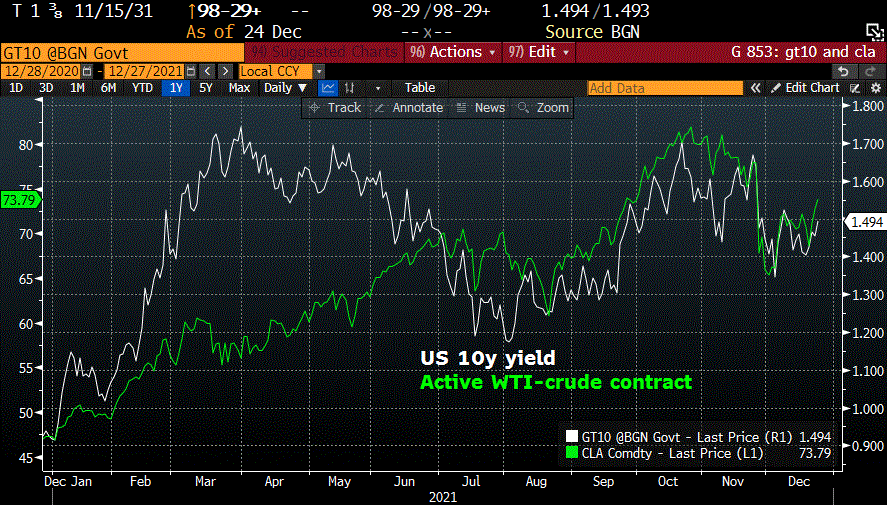
Green energy and fossil fuels. Heroes for ghosts. Since the middle of the year, the ten year yield and crude oil prices have been fairly well correlated. The covid surge, along with Powell’s hawkishness, conspired to send both yields and oil prices lower in the beginning of September. However, those moves may end up being a mere pause of the stronger trend, especially in oil.
Last week featured a solid 20-yr auction. This week brings 2, 5 and 7 years, with $56b in 2s Monday, $57b in 5s Tuesday and $56b in 7s on Wednesday. Economic data releases are light.
| 12/17/2021 | 12/23/2021 | chg | ||
| UST 2Y | 64.0 | 68.6 | 4.6 | w/I 73.7 |
| UST 5Y | 117.3 | 124.0 | 6.7 | w/I 126.2 |
| UST 10Y | 140.0 | 149.1 | 9.1 | |
| UST 30Y | 181.6 | 190.5 | 8.9 | |
| GERM 2Y | -72.0 | -67.8 | 4.2 | |
| GERM 10Y | -37.8 | -24.9 | 12.9 | |
| JPN 30Y | 65.5 | 67.9 | 2.4 | |
| CHINA 10Y | 289.5 | 282.2 | -7.3 | |
| EURO$ H2/H3 | 81.5 | 85.0 | 3.5 | |
| EURO$ H3/H4 | 39.0 | 41.5 | 2.5 | |
| EURO$ H4/H5 | 5.0 | 6.0 | 1.0 | |
| EUR | 112.39 | 113.16 | 0.77 | |
| CRUDE (active) | 70.72 | 73.79 | 3.07 | |
| SPX | 4620.64 | 4725.79 | 105.15 | 2.3% |
| VIX | 21.57 | 17.96 | -3.61 | |
In: Eurodollar Options
Rare Corn
Dec 23, 2021
–Not much to report from interest rate markets yesterday as yields edged slightly lower in light trade. Tens fell 3 bps to 1.455% with Jan treasury option expiration today. There’s about 70k of open interest in both TYF 131c and 130p; the market feels comfortable right about in the middle.
–A couple of interesting headlines on FT: China merges three rare earth miners, and India suspends agricultural futures trading to alleviate inflation fears. Both are inflation related, the former concerning supply chains and computer chips, and the latter…well, self explanatory. I noted that grains appear well bid yesterday and, in my opinion will shortly surpass highs set in 2021. Nothing captures global focus like expensive basic food.
–Merry Christmas and Happy New Year!