Yields capped but vol firm
December 22, 2021
–Higher yields yesterday with the euro$ strip down 6.5 to 8.5 from reds to golds. Ten year yield ended at 1.484% up 6.7 bps. The concession drew buyers for the 20yr auction, which saw solid demand. Late day w/i yield was 1.95%; 2% seems to be a cap on the long end for now. Implied vol firmed on the move to higher yields, indicating increased fear of the downside.
–New high in the front three-month calendar EDH’22/EDM’22 at 24 bps. March/June/Sept fly settled 3.5 but I believe traded 4.5 yesterday. The front end of the market believes in Fed hikes as soon as the taper is over.
–Grains appear to want to make a run for new highs. March Corn is above $6 this morning, having been 5.20 in October. The contract high was just above $6.40 in May.
–Although Mayor Lightfoot has been completely ineffective at stopping muggings, smash and grab thefts, carjackings and murder, she now wants to make the city safe by requiring proof of vaccination to eat at restaurants. Covid has already decimated the dining industry. I was planning a CME dinner with friends in early Jan. I had been thinking Twin Anchors, or the Italian Village. Not now…it will be outside city limits.
Winter solstice
December 21, 2021
–Shortest day in the Northern hemisphere.
–Curve steepened yesterday as the bond contract reversed early strength and had an outside day, closing near the lows. The two year yield fell 1.2 to 62.8 bps while thirties rose 3 to 1.846%. Stocks reacted negatively to omicron concerns and Manchin’s refusal to back BBB, but had an end of day bounce which has continued this morning. Twenty-year auction (re-opening) today of $20 billion. I have attached a chart, showing that the current yield is right about in the middle of the year’s range; the w/i was 189.5/189 at the time of futures settle. Without continued Fed buying, against a backdrop of high inflation, I’m not quite sure where sponsorship comes from.
–Near one-year eurodollar calendar spreads have been grinding to new recent lows. The peak is still EDH2/EDH3 at 79.5, but pre-FOMC the high was 96. EDM2/EDM3 is 72.5, also a new recent low. Huge buyer of 100k 0EH 9862.5/9850 p spread yesterday, paying 3.5 covered various futures prices. Settled 3.25 vs EDH3 9885.0. Euro$ curve: Whites +1.375, reds+2.125, greens +0.625, blues -1.25 and golds -3.25.
–Large earthquake off the Northern California coast yesterday. More seismic activity than usual off the northwest coast.
https://earthquake.usgs.gov/earthquakes/map/?extent=-3.16246,-186.32813&extent=70.49557,8.4375–Biden address today, though the major theme is NOT more shutdowns, according to a late news blurb.
Montani Semper Liberi
December 20, 2021
–West Virginia’s Manchin has decided not to support Build Back Better, causing stocks and oil to crater. The resulting curtailment of government spending plans has caused several shops to trim estimates for GDP going forward. An avalanche of bad press over Omicron is also a factor, with Biden scheduled to address the nation and further dampen holiday spirits on Tuesday. Nasdaq futures have edged through the low from the beginning of December, but ES has not. TYH at 131-13 is at the high of the range since early October. As expected, China continues to take small easing steps, cutting the one-yr Loan Prime Rate from 3.85% to 3.80%.
–Regarding economic forecasts, I checked to see if the NY Fed’s NowCast has been reinstated, NOPE. Been gone for a year and a half. From the NY Fed site, “The uncertainty around the pandemic and consequent volatility in the data have posed a number of challenges to the Nowcast model…” It has been suspended indefinitely. If the models aren’t working, where are they getting the dots?
–Turkish lira continues to implode, now at 17.5, it’s been cut in half since September. Of course, bitcoin has also had a hard break, now just under 46k and off over 30% from the early November high of 67582. Thin conditions are likely to exacerbate volatility, speaking of which, Dec VIX options expire Wednesday. The 25c has 110k of open interest and has traded 2.00 today, the 30c has 142k open. Jan treasury options expire Thursday.
*****************************
..Montani Semper Liberi (Latin for “Mountaineers are Always Free”) is the official motto of the state of West Virginia. Doesn’t quite carry the punch of New Hampshire’s “Live Free or Die” but it’s not bad.
Variable Lags
Weekly Comment – December 19, 2021
At the FOMC press conference, Steve Liesman asked an interesting question about long and variable lags inherent in monetary policy, adding that actions on the taper might not have an effect on inflation for six months to a year. Powell’s response was reasonable, noting that deliberative, methodical changes best served the goals of monetary policy. But he added something a bit more nuanced, which is that in this world of interconnectedness, perhaps the lags aren’t nearly as long. He said that financial conditions in the markets almost immediately adjust; they “…can change very quickly.” Then he said something else.
“But in addition, when we communicate about what we’re going to do, the markets move immediately to that. So, financial conditions are changing to reflect, you know, the forecasts that we made and — basically, which was, I think, fairly in line with what markets were expecting. But financial conditions don’t wait to change until things actually happen. They change on the expectation of things happening. So, I don’t think it’s a question of having to wait.”
Now that’s an interesting take. It almost sounds as if Powell thinks the Fed is out in front of the market. Powell had not strongly signaled the possibility of rate increases until Nov 30. The markets had already adjusted, based on data, to the idea that there could be three hikes in 2022. That’s pretty clear from the one-year calendar FFF’22/FFF’23. It really started to move higher after the Sept 22 FOMC. At that time the dots nudged up…the FF expectation for the end of 2022 went from 0.1% to 0.3%. However, the calendar spread went from 20 to 60 in the next 5 weeks, a projection of less than one hike over 2022 to nearly two-and-a-half. That is, it’s not that the Fed made a correct forecast and the market adjusted. Rather, it’s that the Fed was forced to change its forecasts at the margin due to markets already reacting to incoming data. On Nov 24 FFF2FFF3 had settled at a peak of 71. On Friday Dec 3, it was 61.5. The next Friday, Dec 10 at 66.5 and on this past Friday 69. That is, the markets had been telegraphing 2.5 to 3 hikes since the middle of November, well before Powell articulated a change.
There are two points here. One, is that monetary policy lags are shorter, which makes perfect sense given today’s instant information flow and 24 hour trading. But the second is that the market is leading the dance with the Fed, not the other way around.
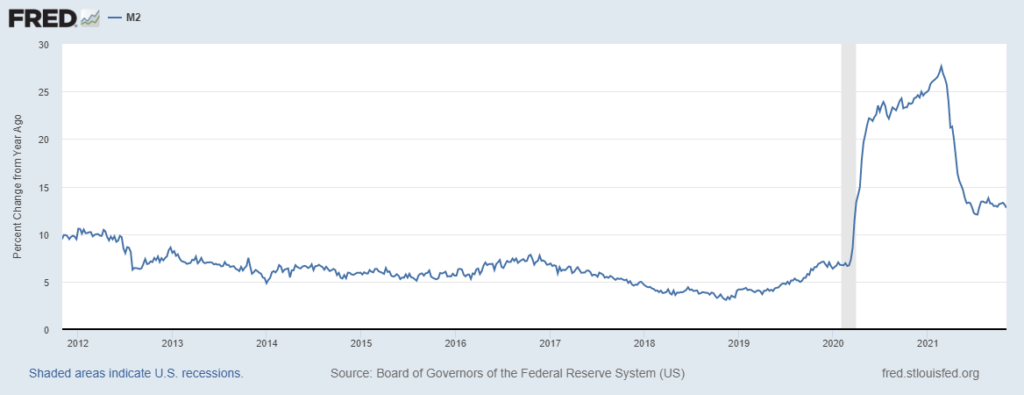
This second point is something that could be quite important going forward. According to former NY Fed chief Dudley, financial conditions consist of five major factors, short and long term interest rates, the value of the dollar, corporate bond spreads, equities. The pace of change in the shape of the yield curve has been extraordinary. From a high of 182 at the end of March the red/gold pack spread is now 25. The 2/10 treasury spread at 76 is less than half the March high of 156. The dollar index is at the high of the year, about the same level it was in late October 2018, when the Fed was hiking and tapering the balance sheet simultaneously (and stocks tanked in Q4). The BBB-10yr spread is 125 bps, relatively low historically but still at the high of the year. Perhaps not dramatically, but financial conditions have tightened. Below I have added a chart of the yoy change in M2. Obviously it’s still expanding at an elevated rate, but the inflation associated with monetary growth may begin to ease. That is not to say that the rate of inflation is going to magically gravitate to the Fed’s 2% target. The wheels have been set in motion for price increases, partially due to monetary and fiscal policy, partially due to green initiatives and the move away from (and lack of investment in) fossil fuels, partially due to other changes inspired by covid. [At bottom I’ve linked a short article by Doomsberg about magnesium and its importance as a structural alloy in metals, which cuts overall weight while maintaining strength integrity. Its production is energy intensive and centered in China. New magnesium production isn’t instantaneous and isn’t cheap. It’s the type of article that leads one to conclude that inflation will continue].
The idea is that the long end of the market is reflecting concern about a possible overreaction by the Fed. On the week, the five-year yield fell 8 bps to 1.173% and tens fell 8.5 to 1.40%. EDH’22/EDH’23 one-yr calendar fell 8 bps to 81.5, still indicating 3 hikes from Q1 2022 to Q1 2023, but EDH’23/EDH’24 dropped 11 from 50 to 39; 2 hikes to 1.5. Currently the Fed seems to be somewhat deaf as to warnings provided by the back end. In fact, when asked about low long-term yields Powell sort of fumbled around. He pointed to lower JGB and Bund yields, and added “there may be some assessment in there of what the neutral rate is or what the terminal rate is. I don’t know about that.” He continued with a couple of sentences about the neutral rate and concluded, “…we’ll make policy based on what we’re seeing in the economy rather than based on what a neutral – what a model might say the neutral rate is.” Let me translate: “We’re flying by the seat of our pants.” A final thought by Powell on the topic, “So, I’m not troubled by where the long bond is.” As they say in Uncle John’s Band, “Cause when life looks like easy street, there is danger at your door.”
Well, here’s what might potentially make you worry: less demand and wider tails at bond auctions. On Tuesday the Treasury auctions $20b of 20-year bonds. (Re-opening, when-issued yield was 1.86% on Friday at futures settlement time). Yields fell last week; there has been no concession, and the Fed is affirming that it will no longer be the marginal buyer. I perceive a bit of risk for this auction.
An underlying view within the Fed seems to be that the accelerated taper buys optionality on rate hikes to follow. Indeed, Waller specifically articulated that concept in his hawkish speech on Friday (he would like the Fed to move soon after taper ends). However, he also specifically hedged with the Omicron variant. Here is the summary, wrapped up nicely in the last sentence of his speech:
So, by choosing to speed up our reductions in asset purchases, the FOMC is providing flexibility for other adjustments to monetary policy, if needed, as early as spring to accommodate changes in the economic outlook. Omicron, as I said earlier, could slow the recovery or exacerbate inflation pressures, so we will have to be ready in the coming weeks to adjust as needed.
Every news outlet now seems to be fixated on Omicron and its transmissibility, and government reactions. Waller might have more precisely said, “Omicron…could slow the recovery AND exacerbate inflation pressures…” We’re probably not far from a whole new set of edicts. Biden speaks Tuesday.
| 12/10/2021 | 12/17/2021 | chg | ||
| UST 2Y | 66.0 | 64.0 | -2.0 | |
| UST 5Y | 125.2 | 117.3 | -7.9 | |
| UST 10Y | 148.5 | 140.0 | -8.5 | |
| UST 30Y | 188.2 | 181.6 | -6.6 | |
| GERM 2Y | -69.2 | -72.0 | -2.8 | |
| GERM 10Y | -34.6 | -37.8 | -3.2 | |
| JPN 30Y | 66.7 | 65.5 | -1.2 | |
| CHINA 10Y | 287.6 | 289.5 | 1.9 | |
| EURO$ H2/H3 | 89.5 | 81.5 | -8.0 | |
| EURO$ H3/H4 | 50.0 | 39.0 | -11.0 | |
| EURO$ H4/H5 | 4.5 | 5.0 | 0.5 | |
| EUR | 113.18 | 112.39 | -0.79 | |
| CRUDE (active) | 71.48 | 70.72 | -0.76 | |
| SPX | 4712.02 | 4620.64 | -91.38 | -1.9% |
| VIX | 18.69 | 21.57 | 2.88 | |
https://doomberg.substack.com/p/magnesium-pi
In: Eurodollar Options
Got nothin’
December 17, 2021
–In Wednesday morning’s note I suggested the outcome of the FOMC press conference was likely to be a steeper curve and lower front end vol, as I imagined Powell would sound a dovish note. He was much more aggressive than I thought. But yesterday, the curve steepened and vol was crushed, punctured by a new sale of over 50k EDZ2 9900 straddles at 50 to 50.5. Settled 51.5, but that’s still down 5 from Wednesday’s settle of 56.5! The ten year yield fell 4 bps yesterday to 1.42%, but the two-yr note plunged over 6 bps to end at 62 bps, while the long bond was actually up nearly 1 bp to 1.86%. It was as if Powell HAD leaned against the hawkish dot signal.
–Many near euro$ calendar spreads made new recent LOWS, in spite of the fact that dots were moved higher for 2022 and 2023. The highest I had marked a one-yr calendar in this cycle fell just shy of 100 bps (or 4 hikes in a year), that being EDH2/EDH3 at 96. Yesterday, EDH2/H3 settled 82, down 8 on the day, as the red contracts (2nd year forward) exploded higher in price. June’22/’23 settled 76, Sept’22/23 at 70.5 and Dec’22/’23 at 53. The market is currently projecting a few near term Fed hikes…and that’s all it’s going to take to slow the economy and inflation. In all, yesterday’s price action was thin and somewhat confusing given Powell’s posture. Get used to it into the end of the year, maybe they won’t be black swans, but there’s a murder of crows haphazardly flying towards us.
–The Fed Effective rate has been 8 bps; January ’22 FF contract is 9991.5 or 7.5, so right on top of EFFR. The January’23 FF contract settled 9924.5 or 67 higher in yield than FFF2. I.e. 2.5 hikes.–Let’s say that the Fed is able to raise the FF target to 1.5% over the next two years. EDZ’23 is 9848 or 1.52%, so perhaps current pricing is appropriate. Well, the ten-year yield is only 1.42%. And we have a 20-year auction next week. Without the Fed buying, and without a steeper curve to provide a carry cushion beyond two years, how do government funding sales go? Not very well would be my guess. Probably a good thing that Build Back Better is being Bumped into next year.
–Nasdaq led the way lower yesterday with the composite -2.5%. Big cap tech was weak, with NVDA -6.8%, TSLA -5.0%, AAPL -3.9%, MSFT -2.9% AMZN -2.6%. These individual charts all look toppy. A pullback of government support coinciding with omicron fears could put the wealth effect into reverse. Some are embracing the reverse wealth meme; there’s a charming story about people in the Bay area leaving their car windows down and trunks open to show that there’s nothing worth stealing and to avoid having their windows smashed. I don’t have anything! Grab the tire iron out of the truck and smash the front windshield anyway, this guy is insulting us.
Hawkish Pirouette
December 16, 2021
–I was wrong about Powell sounding a more dovish tone at the press conference; front end contracts were the weakest on the strip with EDM2 and EDU2 settling -5.5 at 9943.5 and 9922. The five year treasury rose 2.5 bps in yield to 1.255% while 30s were up 3.6 to 1.852%. In the Summary of Projections, PCE inflation notched up from 4.2 in Sept to 5.3% yesterday for 2021 (belatedly reflecting the reality in the data). For 2022, it rose from 2.2 to 2.6 and for ’23 from 2.2 to 2.3. The FF rate leapt from a guess of 0.3 in September to 0.9% in 2022 and from 1.0% to 1.6% for 2023. So…even though Powell says the economy is incredibly strong, in 2023 the FF guess is 1.6% vs inflation of 2.3%, i.e. continued negative, accommodative rates; likely a tailwind for risk assets. Once again, the Fed is catching-up to the market.
–The high one-yr euro$ calendar is EDH2/H3 at 90 bps, +1.5 on the day. Some of the deferred 1-yr spreads edged to new recent lows. For example, EDZ2/EDZ3 settled 59, down 4 on the day, and exactly the same amount as the FF guesstimate increase from 1.0% to 1.6%.
–I was struck by Powell saying a couple of times that he changed his mind to embrace an accelerated taper and hawkish pivot because of a strong ECI prior to the November meeting, followed by a robust labor report, followed by high CPI. Three data points. Granted, strong data…but the Fed has an elite professional staff for forecasting and estimating. This caught everyone off guard?
–Powell said “we’re two meetings away from finishing the taper.” I suppose it opens the door to a May hike; meeting is May 4. Interestingly, EDH2/M2/U2 butterfly was -1/-0.5 pre-FOMC and +0.5/1.0 afterwards, settling at 0.5. That is, EDH2/M2 at 22.0 and EDM2/U2 at 21.5. Does it really make sense that slightly more of a hike is priced into the first spread than the one behind it? By the way, EDM2/U2/Z2 fly settled -5.5.
–There was an early block of 30k FVH sold at 120-28.25. The contract settled at 120-260 with open interest up 72k. It’ll be interesting to see how the next auctions go at the long end. When asked about low US long-end rates, Powell’s best answer is that they are higher than most of the rest of the world; that long-end rates are low everywhere.
–News today includes BOE who will likely whiff, and ECB. I don’t have any idea why EUR isn’t at parity with USD! Jobless Claims expected 200k, Industrial Production and Housing Starts as well. Philly Fed expected 29 from 39.
FOMC day
December 15, 2021
–FOMC today. Here’s what I think is going to happen. At 2pm when the announcement and SEP are released, there will be a knee-jerk reaction lower in near and red ED contracts because the dots are going higher as are the inflation projections, even IF the taper is accelerated. However, at the 2:30 presser Powell will temper the hawkishness and by the end of the day the curve will be steeper, long rates will be higher, short end rates will be lower, and front end vol will be much lower.
–The Fed has been buying the supply of treasuries. They have been planning for the taper for a long time, and have taken great care to set up a repo facility to make sure that funding is plentiful. If the Fed is not the marginal buyer, it is going to fall to other domestic institutions to plug the gap. But what incentivizes the private market to do so? A steep curve with a lot of positive carry. That’s exactly what we’re NOT seeing right now. The curve has flattened as Powell was beaten into submission by high inflation numbers. But take a step back. What are the pros and cons of moving the hiking timetable aggressively forward? The pro is that perhaps inflation will come down. That will likely occur in the context of slower growth. What are the cons? That stocks might come unglued. That the curve may invert and provide a huge headwind for the government in terms of finding buyers of debt because there’s no carry. The inflation numbers have become quite scary, but the curve has flattened. The market is giving Powell cover to slow-play rate hikes. In fact, the only way the government is going to be able to handle its massive debt burden is THROUGH inflation. And, if wages can keep pace with the cost-of-living, then one might say it’s a win/win from the gov’ts perspective.
–In any case, on a bond rally post-FOMC announcement and pre-press conference, I will look to buy puts on the long end.
–There was a buyer yesterday of 60k or so 0EH 9937.5/9962.5 cs for 2 ref 9881.5 to 9884 in EDH3 (settled 1.75 vs 9880.5). I couldn’t help but be reminded of all the 50k clips of EDU’20 9887.5/9937.5 call spreads and 9875/9925 call spreads that were bought in Nov and December of 2019…before COVID was well known. Those call spread were grand slams. However, I think yesterday’s was just a protective play for a policy error.
–I skimmed option open interest on TSLA going into this Friday’s expiry. The stock closed 958, lowest since late Oct. At that time there was a gap left, which will be filled just above 900. There are over 27k 900 puts of open interest for Friday’s expiry, a rather large amount relative to other strikes. A break below that level would likely get messy.
Turbo Taper Trepidation
December 14, 2021
–PPI released today, expected to be 9.2% yoy from 8.6 last, with Core 7.2%. Monster numbers. At the same time, the top headline on zerohedge is: Morgan Stanley Warns the Fed’s Turbo Taper Will Trigger Market Chaos Over ‘The Next 3-4 Months’. I didn’t bother to read the article, but continued pressure on yields and on the back end of the curve provides context to the warning. As noted several times, the three years of ED contracts from EDZ’23 forward are essentially the same price. That’s just not reflective of massive inflation concerns, especially at relatively low yields of around 1.7%. I would also mention that the ten year note to tip spread edged to a new recent low of 2.456%. If that spread is an appropriate proxy for long term inflation expectations (and I don’t really believe it fits the bill on its own) then Powell’s previous framework using ‘transitory’ could ring true.
–In any case, there was a new buyer of 50k EDH2 9993.75 calls for 0.25 yesterday. What would have to happen to reach that strike? Well, a turbo-taper that causes the wheels to fall off stocks could do it, but it would have to be a real crash! EDH2 settled yesterday at 9970 and the 3 month libor setting just over 20 bps. The Fed Effective rate is 8 bps.
Intervention
December 13, 2021
–Friday’s 6.8% yoy print in CPI caused little reaction; curve steepened slightly with the two year yield down 2.4 bps while the 30-yr bond rose 2 bps to 1.882%. It was more noticeable on the dollar curves as reds closed +4.25 and golds -3.0. Midcurve expiration was quiet. SPX closed at a new high.
–EDZ1 contract has settled this morning. Flatness in the eurodollar curve is even more pronounced as March contracts become the front on each pack. For example, red/gold pack spread using March as front settled just below 27 bps. (The previous one-month range using Dec contracts was 34.25 to 49). That’s the spread between the second year forward and the fifth, with barely 1/4% between them. With real yields severely negative and real wages also heavily negative, it’s astounding the market is signaling a “tight” central bank, but that’s what we’re faced with as we go into Wednesday’s FOMC.
–Of course, maybe the inflation data can be massaged a bit, as suggested by this BLS note: “Starting in January 2022, weights for the Consumer Price Index will be calculated based on consumer expenditure data from 2019-2020. The BLS considered interventions, but decided to maintain normal procedures.” Sometimes a gentle nudge puts “considered interventions” into play.
Powell Presser Pause
December 12, 2021 -Weekly Comment
At the September FOMC, the Projections for the PCE Deflator went from 3.4% to 4.2% and for Core from 3.0 to 3.7% for 2021. Just like always, the Fed was playing catch-up to the actual data: On August 27, the data were released with PCE deflator 4.2 and Core 3.6. However, even with a large realized jump, the estimates for 2022 were only grudgingly moved up, by 0.1 for PCE to 2.2% and up 0.2 in Core to 2.3%.
On November 24, the PCE Deflator was released at 5.0% and Core at 4.1%. What does that mean? It means that the Fed’s estimates for that data will also be raised at the FOMC this week. It also means that the estimates for inflation in 2022 will have to be moved up, because we’re almost IN 2022. The dots for the end of 2022 at the September meeting showed 9 expecting UNCHANGED rates through the year, 6 had moved to one hike 0.25% to 0.50%, and 3 expected two hikes, 0.5 to 0.75%. The market is already pricing nearly three hikes for the end of 2022. January 2023 Fed Funds are 99.25 or 75 bps, against a current Fed Effective of 8 bps, so the rate on FFF3 is 67 higher. I think the majority of dots will now indicate two hikes for 2022.
Obviously, the dots are going up, because the market has already priced the new reality. The Fed mostly just follows. They see the data and belatedly move. So, the dots are going higher, inflation estimates are going higher. Great, we already have seen that. But here’s what is a little bit different. On November 30, Powell came out more hawkishly and said the Fed will retire transitory and will DISCUSS accelerating the taper. But what happened after that?
Here are a few select prices from 11/29, the day before Powell’s hawkish pronouncements and from Thursday, the day before Friday’s monster CPI number of 6.8%.
| 29-Nov | 9-Dec | bp chg – yld | |
| EDM3 | 9871.0 | 9854.0 | 17.0 |
| EDM5 | 9819.0 | 9826.5 | -7.5 |
| GT10 | 1.501 | 1.501 | 0.0 |
| GT30 | 1.856 | 1.877 | 2.1 |
Nearer contracts went up in yield, while longer contracts barely moved. The spread between EDM’23 and EDM’25 declined by nearly ¼% to just 27.5 bps. The market is projecting that the Fed will essentially be done with tightening by the end of 2023, and that a relatively small increase in the FF target to around 1.5-1.75% will be enough to slow both inflation and economic growth. EDZ’23 closed Friday at 9828.0 or 1.72%. Every contract in the three year period from EDZ’23 to EDZ’26 is within a six bp range from 9828 to 9822.
I am of the opinion that inflation is becoming more entrenched. However, I also believe that the surge we’ve seen in many prices will begin to decelerate. The fiscal impulse will not be as strong. Prices will rise, but less rapidly (still well above the 2% target). By being too hawkish at the FOMC meeting, the Fed risks much broader curve inversion, which forecasts significantly weaker economic activity. Even if the taper is accelerated, which I don’t believe is a done deal, Powell will try to tamp down on aggressive rate hike expectations now being made by Goldman, William Dudley, etc. As I mentioned last week, Powell does not want to repeat the equity market stress of Q4 2018 by aggressively hiking into a slowdown.
On Friday, the Fed released the Z.1 report. In terms of debt growth in Q3 of the three major categories, Households (HH), Business and Government, only one had a negative sign: The Federal Gov’t at -1.32%. State and Local Gov’t were +1.7% but the total outstanding is only 13% as large as Federal. HH growth was a healthy +6.16% and Corporate +6.02% for Q3. The conclusion might be, “Great, we’re making the hand-off from the public sector to the private sector, with a probability of much more balanced organic growth.” The question is, how accurate is that assessment?
We’re all familiar by now with the pump-and-dump Redditt strategies. My hypothesis is that these ploys were in large measure abetted by government cash handouts. I googled the top 10 meme stocks of 2021 and a yahoo article named the ones in the below table. I added a couple of earlier ones: Blackberry, Bed Bath Beyond, and even Silver, as they were publicized raids made early in the year.
| STOCK | Month of High | Approx from high |
| GME | Feb | -60% |
| AMC | June | -50% |
| SAVA | June | -68% |
| HUT | Nov | -45% |
| UPST | Oct | -60% |
| LCID | Nov | -30% |
| MMAT | June | -80% |
| ASAN | Nov | -50% |
| BGFV | Nov | -55% |
| RVLV | Nov | -28% |
| BB | Feb | -64% |
| BBBY | Feb | -66% |
| SLV | Feb | -22% |
Clearly there are companies that experience a positive catalyst that rise and continue to rally. But if a part of the thesis is that the ‘catalyst’ for above stocks was gov’t cash handouts, and that these stocks took a tumble when those flows dried up, then the idea can likely be applied to general economic conditions. Has the hand-off to the private sector been seamless? Will the wage-price spiral become entrenched without government support? As BofA notes, 64% of the 23% ytd gain in the Nasdaq Composite comes down to just five stocks, MSFT, GOOGL, AAPL, NVDA, TSLA.
Powell sees the flattening and has to balance that against calls to strike against inflation with rapid increases in the FF target. However, he might be better served by signaling slower rate hikes than are currently expected, and let a steeper curve do some of the heavy lifting for him.
| 12/3/2021 | 12/10/2021 | chg | ||
| UST 2Y | 58.7 | 66.0 | 7.3 | |
| UST 5Y | 112.2 | 125.2 | 13.0 | |
| UST 10Y | 134.7 | 148.5 | 13.8 | |
| UST 30Y | 167.5 | 188.2 | 20.7 | |
| GERM 2Y | -74.3 | -69.2 | 5.1 | |
| GERM 10Y | -38.3 | -34.6 | 3.7 | |
| JPN 30Y | 66.3 | 66.7 | 0.4 | |
| CHINA 10Y | 290.3 | 287.6 | -2.7 | |
| EURO$ H2/H3 | 88.0 | 89.5 | 1.5 | |
| EURO$ H3/H4 | 43.0 | 50.0 | 7.0 | |
| EURO$ H4/H5 | -2.0 | 4.5 | 6.5 | |
| EUR | 113.14 | 113.18 | 0.04 | |
| CRUDE (active) | 66.26 | 71.67 | 5.41 | |
| SPX | 4538.43 | 4712.02 | 173.59 | 3.8% |
| VIX | 30.67 | 18.69 | -11.98 | |
In: Eurodollar Options