New shorts in front of payrolls
August 6, 2021
–Payrolls today expected 870k with yoy Avg Hourly Earnings expected +3.9% from 3.6 last. Technical seasonal factors are a tailwind behind NFP forecasts. In the past few days, Clarida said he expects the next couple of jobs reports to show strength, and Waller said he was hoping for strong data. Is it possible they’re telegraphing what they have already seen in comparable data? Once again, greens (3rd year on strip) led the way lower, closing -6.0 on the day, bringing the two day loss to almost 11.5 bps. EDZ3 traded a high of 9923 on Wednesday and now prints 9904.
–Large option plays reinforced weakness in greens, for example, a buyer of 40k 2EZ1 9875/9850ps for 3.75 to 3.80 synthetically (settled 4.0 vs 9906 in EDZ3) and a buyer of 40k 2EH2 9875/9825ps for 8.5, which settled 10 ref EDH4 9897.5. This latter spread has a delta of 21, so approximately 8k futures, and open interest rose in the underlying contract by 18k. Also worth a mention is a rise in EDZ’24 open interest of 30k contracts. Settlement price was 9873.0, down 5.5 on the day. Of course, this was one of the legs on the EDZ’22/EDZ’24 buy recommendation from a couple of weeks ago over 100 bps. The spread traded 80 on Wednesday and settled 84.0 yesterday. Somewhat interesting that it appears shorts are being aggressively added to one leg of a spread position that remains under water, even as the biggest report of the month looms. On a technical basis, EDZ4 traded a high of 9889 on July 20. It then put in a low of 9866.5 on July 22, had a small bounce and then equaled the 9866.5 low on July 28. On Wednesday’s ADP it eclipsed the July high by 0.5, printing 9889.5, and is working on an outside weekly range (current price 9869.5). A close below 66.5 would signal a double top with an objective around 9844. By the way, the low after the hawkish June FOMC was 9833.5, so there has been a good deal of play in this contract.

Hawkish Clarida highlights risks of changing Fed composition
August 5, 2021
–After a much weaker than expected miss in ADP drove interest rate futures to new highs, Clarida’s hawkish speech caused a sharp sell off. As an example, EDZ3 (green Dec) had a large outside range day, popping up to 9923.0 on ADP and breaking to 9909.5 on Clarida, ending at 9912.0, down 5.5 on the day. The ten year yield only finished 1 bp higher at 1.182%. Once again, the greens (third year forward) are the weakest contracts, just as they were after the hawkish dot-plot at the June FOMC, which makes sense given that greens (3rd year) start with EDU’22 and Clarida cited year-end 2022 as a time fed funds could be raised. Net changes by year: Whites +0.125, reds -3.0, greens -5.5, blues -4.5, golds -2.5.
–Clarida’s term expires in January and his term as Vice Chair ends next month. I have excerpted a few comments from the speech below. Main points are: employment is a lagging indicator, but he cites 3.8% as full employment. (I had a sense from Powell that 3.5% was full emp). Risks to inflation are to the upside, but the Fed is outcome based (which means they are likely to be behind the curve). If end of 2022 is a target for rate hikes, then the taper will happen fairly quickly.
–One large trade of interest is +36k 3EU 9875/9850/9825p fly vs -12k 9900/9912.5 c spread for 8.0, covered right in the middle at 9887, 50d. The put fly settled 3.5 and the call spread at 3.25, so the package settled 7.25.
–The Treasury Borrowing Advisory Committee (TBAC) released recommendations yesterday which, in my opinion, dovetails nicely with a taper: reduced auction supply starting in November will partially offset less demand by the Fed. (Excerpt at bottom). Does that mean that a taper will have no consequences on price action? I think there WILL be consequences in that markets will perceive a withdrawal of liquidity at the margin going forward. Supportive for the dollar, but not so much for stocks and bonds.https://home.treasury.gov/news/press-releases/jy0308
**************************************
excerpts from Clarida speech:
transitioned from economic recovery to economic expansion.
the recovery in employment has always lagged the recovery in GDP, and this cycle is no exception.
First, if, as projected, core PCE inflation this year does come in at, or certainly above, 3 percent, I will consider that much more than a “moderate” overshoot of our 2 percent longer-run inflation objective. Second, as always, there are risks to any outlook, and I believe that the risks to my outlook for inflation are to the upside.
While, as Chair Powell indicated last week, we are clearly a ways away from considering raising interest rates and this is certainly not something on the radar screen right now, if the outlook for inflation and outlook for unemployment I summarized earlier turn out to be the actual outcomes for inflation and unemployment realized over the forecast horizon, then I believe that these three necessary conditions for raising the target range for the federal funds rate will have been met by year-end 2022.
My expectation today is that the labor market by the end of 2022 will have reached my assessment of maximum employment if the unemployment rate has declined by then to the SEP median of modal projections of 3.8 percent.
Indeed, under present circumstances, I judge that the support to aggregate demand from fiscal policy—including the more than $2 trillion in accumulated excess savings accruing from (as yet) unspent transfer payments—in tandem with appropriate monetary policy, can fully offset the constraint, highlighted in our Statement on Longer-Run Goals and Monetary Policy Strategy, that the ELB imposes on the ability of an inflation-targeting monetary policy, acting on its own and in the absence of sufficient fiscal support, to restore, following a recession, maximum employment and price stability while keeping inflation expectations well anchored at the 2 percent longer-run goal.
In light of these uncertainties, the Committee is rightly basing its judgments on outcomes, not just the outlook.
TBAC:
Given the current fiscal and economic outlook, the Committee strongly supports coupon reductions beginning at the November refunding. The Committee estimates that beginning the adjustment in November rather than waiting until the February 2022 refunding results in about a $350 billion reduction in the amount of coupon debt outstanding, allowing the Treasury to maintain more T-bill supply for a given amount of coupon cuts. For November, the Committee recommends reductions of 2-, 3-, and 5-year securities by $2 billion per month. The Committee also recommends reductions of the 10-year security by $3 billion, and the 30-year security by $2 billion for both new issues and reopenings in the quarter. For 7-year and 20-year securities, the Committee recommends declines of $3 billion and $4 billion, respectively2, which are somewhat larger than the declines in surrounding securities. It was expected that, based on current fiscal and economic projections, these cuts would need to be sustained over a few quarters in order to maintain T-bills in the recommended range of 15 to 20% of total debt outstanding over time. However, the Committee recognizes that a wide range of funding needs are possible and that Treasury would need to adapt issuance plans based on incoming information over time. The group acknowledged that while these reductions are sizeable, the gradual pace of the adjustment and the advance signaling of these changes would be generally in line with Treasury’s approach of regular and predictable issuance.
Hard Landing?
August 4, 2021
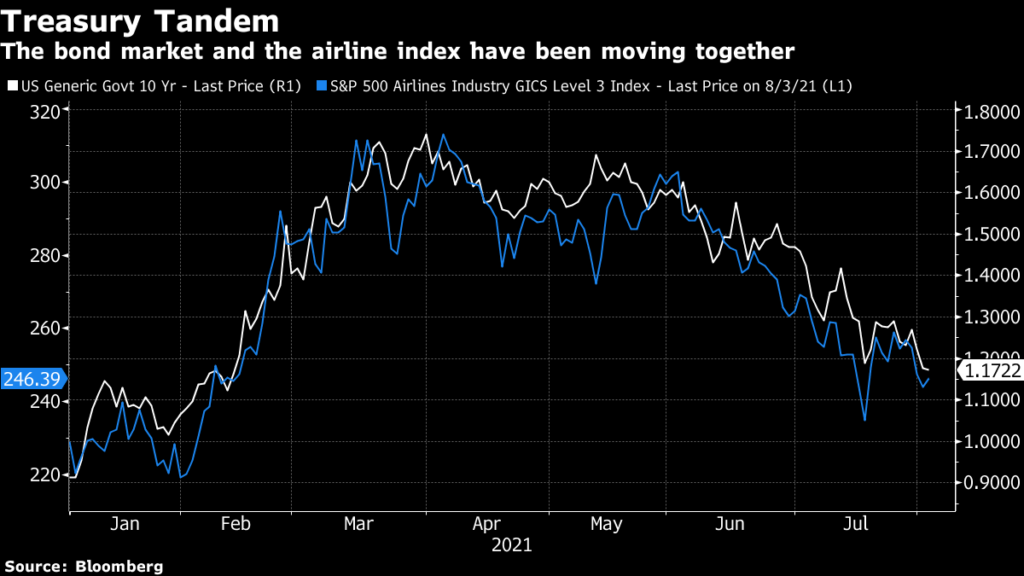
–Yesterday it was reported that Alphadyne lost $1.5 billion in the treasury short squeeze. Enough to exacerbate the move? Probably, but hardly a reason for continued strength in tens. This morning Tracy Alloway of BBG highlights a compelling chart, noting a strong correlation between airline stocks and the ten yr yield this year. “Treasury yields and airline stocks are still moving together, more than a year after the start of the pandemic. The question is what exactly are airline stocks reflecting? Clearly, they’re a proxy for Covid-19 fears – as worries over a spread of delta cases go up, airline stocks go down.”
–Yesterday’s option activity appeared weighted towards the downside, but the ten year yield was unch’d at 1.172%. New low in EDU21/EDU22 calendar spread at 12 bps, down 0.5 on the day, even though there was a buyer of 35k 0EU 9968.75/9962.5ps vs 9974.5 for 1.0. Just before the June FOMC, EDU2 was right here at 9975. After the hawkish dot plot it traded to 9960 and ended the month of June at 9962.5. Since then it began marching back, helped along by the July FOMC. So now we have 0EU 9975p settling at 3.25 vs 9975.5 with 37 days until expiry, as if there’s no chance at all of ever seeing this contract in the 60’s again. And I suppose that’s probably right.
–In tens there was a buyer of 10k TYU 134/133ps which settled 11 vs 135-00. Short cover buyer of 20k TYU 135.75c from 17 to 20, settled 20.
Waller sees strong jobs
August 3, 2021
–Ten year yield hit 1.15% and ended down 5.2 bps at 1.172% yesterday as ISM Mfg missed, coming in at a still-robust level of 59.5. Prices retreated to 85.7 from the near record 92.1 last. While inflation seems to have little to do with yields at this point, an article on ZH points out that “…according to word counts of corporate earnings transcripts by BofA’s Predictive Analytics team, mentions of ‘inflation’ on Q2 earnings calls topped 1Q levels and jumped to a record high.”
–Fed Governor Waller yesterday said he could support tapering as soon as September: “If the jobs reports come in as I think they’re going to…then in my view, with tapering, we should go early and fast.” In 2018, the amounts of securities that weren’t rolled was cut by $10 billion every three months as the Fed was actually cutting the size of the balance sheet. Now the goal is simply to slow the growth of the balance sheet at a time when there seems to be insatiable demand for treasuries. NFP is Friday, expected somewhere between 900k and 1 million.
–New recent lows on near eurodollar one-year calendar spreads. EDU’21/EDU’22 fell 1.5 to 12.5 and EDZ’21/EDZ’22 fell 2.5 to 20. EDZ2 settled 9962.5, exactly 25 below front EDU’21. Pricing one hike by the end of next year.
–Of course, the delta variant is one of the factors driving markets currently. How does it spread? Well, here’s a picture from Chicago’s Lollapalooza fest.
I guess you can either view this picture as a sign of pent-up demand and economic dynamism or a super-spreader risk. Rolling Stone has a photo slide show here:
https://www.rollingstone.com/music/music-pictures/lollapalooza-2021-photos-1204812/foo_7305c/

Let’s run it thru the model
August 2, 2021
–A few things from Friday: the ten year yield fell 3.4 bps to 1.234%. There was a new buyer of 50k TYU1 133.5 put which settled 20 vs 133-145. On the short end, three-month libor set at a new all-time low of 11.775 bps. New recent low in EDH2/EDM2 at 4 bps, down 0.5 on the day.
–EDZ’22 which settled at 9960 is the first euro$ contract that prices one 25 bp hike (EDU1 is 27.5 higher at 9987.5). On the Fed Fund futures curve it’s necessary to go out to April’23 to find a contract that has a larger spread than 25 to the front contracts. FFQ’21 is 9991.0, the fed effective rate has been coming in at 10 bps, and at 9963.5, FFJ3 is 27.5 bps higher in yield than FFQ1.
–Employment data this week. Tracy Alloway of BBG notes that August can sometimes be a volatile month, noting the surprise 2015 China devaluation. The end of this month brings Jackson Hole, though much of the thunder of policy implications has already been stolen. It’s somewhat amusing that in May, China rebuffed US efforts to set a meeting between Def Sec’y Lloyd Austin and China’s top military leader, and again in July, snubbed Deputy Sec’y of State Wendy Sherman by refusing a meeting with her counterpart, but now China’s securities regulator is seeking closer cooperation with the US after the SEC tightened financial disclosure rules for Chinese companies seeking to list in the US. Money talks, as they say.
–The debt ceiling suspension officially ended, so now there will be nail-biting suspense relating to US borrowing plans. Spoiler: the US will raise the limit because it needs to borrow a LOT more.
–There’s a post on ZH which is an excerpt by Morgan Stanley’s head of US rate strategy. Although I agree with the conclusion that the ten year yield is too low, there’s not much meat regarding the MS argument. “We think that 10-year yields are too low versus our fair value estimate at ~1.60%, in large part due to positioning unwinds in recent weeks that have magnified the impact of negative COVID-19 headlines. In our view, yields do not appropriately reflect the strong US economy, or the Fed’s stance. With cleaner market positioning, our economists’ expectations for strong labor market and inflation data, and our base case for a deficit-funded infrastructure package, we see yields rising in the coming weeks.”
–So… the explanation for lower yields we have recently seen is due to short covering, as MS notes open interest in TY has fallen recently. There is also this line: “…most investors mistook the rise in yields as validation for a super-hot economy, and consensus bought into the idea that 10-yr yields were headed above 2%. We cautioned investors that yields had overshot relative to the economic reality.” OK, maybe these stats aren’t “super-hot”. Then again, maybe they are: Core CPI 4.5%, Core PPI 5.6%, Retail sales yoy in June 18.0%, Case-Shiller home prices yoy 16.6%, Q2 GDP 6.5%, Shot-and-killed in Chicago +9.0% yoy in July. Jalapeno or habanero? Finally, to get the “fair-value” estimate of 1.6, MS considers the timing and pace of rate hikes:
“Currently, 10-year yields imply that markets see the first rate hike in March 2023, and a pace of ~1.5 rate hikes per year thereafter. We think that this implied pace is too low, especially when one looks at the June dot plot…”
–So, here’s what we have: a short cover rally that took rates too low because the Fed will probably tighten more than the market thinks, because the economy is pretty darn strong. Makes it sound a little more impressive when a “fair value model” is inserted into the dialogue, doesn’t it?
https://www.zerohedge.com/markets/morgan-stanley-yields-are-ways-where-they-should-be
Keystones
August 1, 2021 – weekly comment
***********************************
“If you lose the keystones, you’re going to see very big changes.” – John Terborgh, Duke University
I watched a fascinating documentary on PBS called Serengeti Rules, which outlined experiments and advances regarding the concept of “keystone species”. The first scientist was a guy named Bob Paine, who in the 1960’s developed a natural experiment in the wild tidepools along the Washington State shore. These individual tidepools teemed with diverse aquatic life, mussels, small crabs, plants, bottom feeders. Amazingly enough, the top predators in these pools are starfish, which are strong enough to open and devour shellfish. What Paine did was to remove starfish from several of these pools. Over time, what occurred was that the pools were overrun by mussels and all diversity was lost. The health of the system severely deteriorated. He also found that if he left the starfish and removed other species, the health of the pools remained more or less constant. Hence, the starfish was deemed the keystone species.
Forward to the 1990’s where Jim Estes was working on sea otter populations in the Aleutian Islands. The otters had been decimated by fur hunters but were staging a comeback, moving westward on the island chain. He was totally captivated by the diversity of grand kelp forests around the islands. His thought was, ‘How do these spectacular kelp forests with their diverse ecosystems help to support the health of the sea otter population?’ As it happens, Bob Paine had come to Alaska to see a former student, and Estes and Paine had a meeting. Estes described his “bottom up” ideas about the kelp forests supporting the growth of the otter population. Paine had a suggestion: “Why don’t you think of them as predators?” For Estes, the lightbulb went on, and he began to consider the situation from the top down. He needed to find an area where there were no sea otters. As it turned out, the islands at the far western end of the Aleutian chain hadn’t been reclaimed by otters…and what Estes found, or rather, didn’t find, were huge kelp forests. Instead these areas were barren because the sea urchin population (which otters feed on) dominated everything, devouring life at the sea bed, preventing more diverse growth. There were no predators to keep them in check.
The program documented similar research by many scientists over different ecological settings, both aquatic and on land, and results were startlingly similar. “Some species are more equal than others.” These are the ‘keystones’ that hold the system together. Mary Power, who studied smallmouth bass in Oklahoma rivers also mentioned another factor, which is that predators instill the ‘landscape of fear’ in prey, which also makes the system healthier as a whole. A scientist named John Terborgh studied the area around the Guri hydroelectric plant in Venezuela, which led to the loss of the big cats. “Remove the predator and it leads to the deterioration of the whole system. Loss of predators is almost always a loss of diversity. We coined the word “downgrading” to describe it.”
The program notes that a keystone is not always an apex predator. My question regarding markets is, “what is the keystone?” Is the Fed thinking about the system and its health in the correct way? Are they doing a bottom up: “Keep rates low and growth and beneficial inflation will follow”? Maybe the thing that holds the system together is more of a hurdle in the true capitalistic system, a COST of capital. Druckenmiller often refers to this concept… “for years now a mix of financial repression and central bank intervention has made long-term interest rates largely determined by government fiat.” He thinks it leads to distortions and general malinvestment which is suffocating the system. A good example is the Fed buying $40 billion per month of agency MBS to keep mortgage rates close to 2.5% at a time when the Case-Shiller index of home values climbed 16.6% yoy in May. Mussels have taken over the tidepool. Bottom feeders are crushing any chance for new growth and diversity, clearly represented by repo facility usage of nearly $1 trillion at 5 bps.
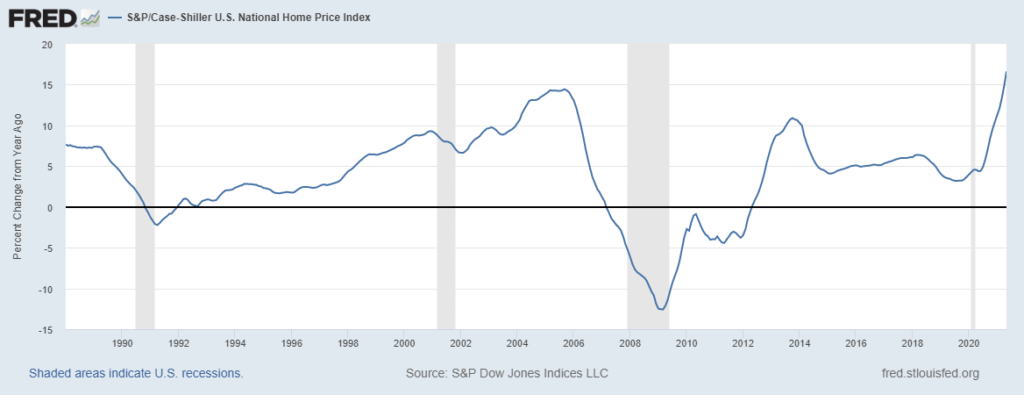
Case-Shiller home price yoy increase from 1988 to present
My thought is that the keystone is the base interest rate. If the Fed just moved the funding rate to 2% and KEPT IT THERE, the entire system would adjust in a healthier way.
Entering the month of August, when the Jackson Hole Symposium is held, is an appropriate time to consider Greenspan’s 1999 speech at that event where he touches upon the same concept:
“Nonetheless, certain stable magnitudes are inferable from the process of discounting of future claims and values. One of the most enduring is that interest rates, as far back as we can measure, appear trendless, despite vast changes in technology, life expectancy, and economic organization. British long-term government interest rates, for example, mostly ranged between three percent and six percent from the early eighteenth century to the early twentieth century, and are around five percent today. Indeed, scattered evidence dating back to ancient Rome and before reflects the same order of interest rate magnitude, not a one percent interest rate nor 200 percent.”
I saw an amusing quote by Jim Iuorio: “Rule of thumb… if your used car is appreciating in value there is something very wrong with the monetary system.” How should we discount the future claims and value of a 2005 Toyota Camry?
What about financial panics? The Fed is known as the “Lender of Last Resort”. Not the lender of last resort at zero interest rates. Not the lender to everyone at zero interest rates. It is there to make credit available when normal channels have seized. If there’s a wounded caribou (or zombie company) out there that can’t make it with available credit given a base rate of 2 or 3% then perhaps its days are rightly over. The overgrazing of paying more and more for a given dollar of earnings or sales, spurred in part by repression on interest rates, will adjust to a more reasonable level.
OTHER MARKET THOUGHTS/TRADES
EDU1/EDU2 declined 2.5 bps on the week to 14, fully retracing the move up to 24.5 following the hawkish June FOMC. This occurred even as libor made a new historic low of 11.775. However, EDU2/EDU3 rose by 2.5 on the week to 53.5 coming out of the FOMC. Again, this level is well below the move to 65.5 following the June FOMC. But the red/green pack spread has pretty much traded in a sideways range since the surge in Q1. There are still strong expectations of hikes coming into late 2022, early 2023.
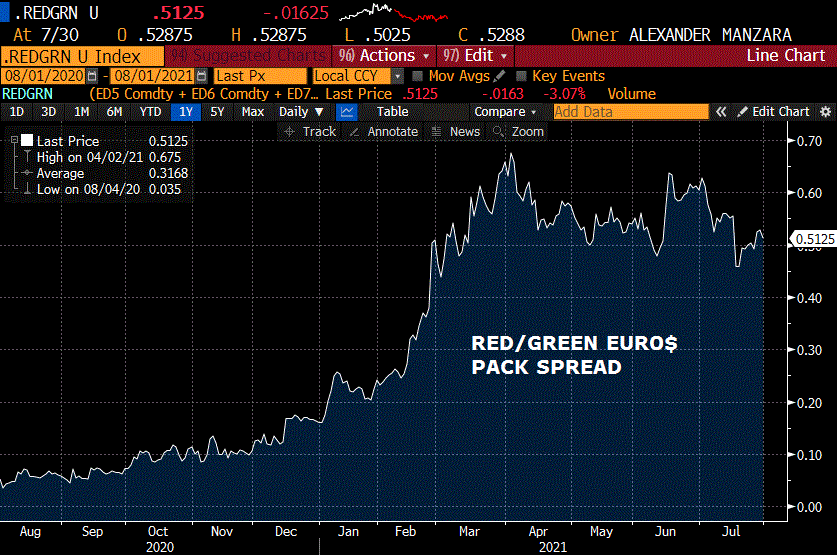
The odd aspect is that EDU3EDU4 fell 1.5 on the week to 37.5. Greens to blues were crushed on the hawkish June FOMC and continued to compress over the month of July. EDU3/U4 was 54 before the June FOMC, fell to 44 by the end of that week, bounced to 47.5 by the start of July and ended at Friday’s 37.5. This spread started the year at 24, put in a March high of 69, and has thus retraced 70% of the move. The market is indicating that a couple of hikes in 2023 will be enough to halt both inflation and the economy in general. I have a hard time accepting that thesis.
There’s a lot of news out this week, culminating in the employment report on Friday with NFP expected 900k. Interesting trade on Friday was a new buyer of 50k TYU1 133.5p (open interest +48k, settled 20 vs 134-145 with -0.28 delta). Implied vol remains at the lower end of the range since March, currently 4.4.
| 7/23/2021 | 7/30/2021 | chg | ||
| UST 2Y | 21.7 | 18.6 | -3.1 | |
| UST 5Y | 73.2 | 70.0 | -3.2 | |
| UST 10Y | 128.5 | 123.4 | -5.1 | |
| UST 30Y | 192.4 | 189.4 | -3.0 | |
| GERM 2Y | -72.5 | -76.2 | -3.7 | |
| GERM 10Y | -42.0 | -46.1 | -4.1 | |
| JPN 30Y | 65.4 | 63.5 | -1.9 | |
| CHINA 10Y | 291.2 | 285.5 | -5.7 | |
| EURO$ U1/U2 | 16.5 | 14.0 | -2.5 | |
| EURO$ U2/U3 | 51.0 | 53.5 | 2.5 | |
| EURO$ U3/U4 | 39.0 | 37.5 | -1.5 | |
| EUR | 117.73 | 118.69 | 0.96 | |
| CRUDE (active) | 72.07 | 73.95 | 1.88 | |
| SPX | 4411.79 | 4395.26 | -16.53 | -0.4% |
| VIX | 17.20 | 18.24 | 1.04 | |
https://www.pbs.org/video/the-serengeti-rules-41dfru/
Jackson Hole, 1999
https://www.federalreserve.gov/boarddocs/speeches/1999/19990827.htm
TIPping point for commodities
July 30, 2021
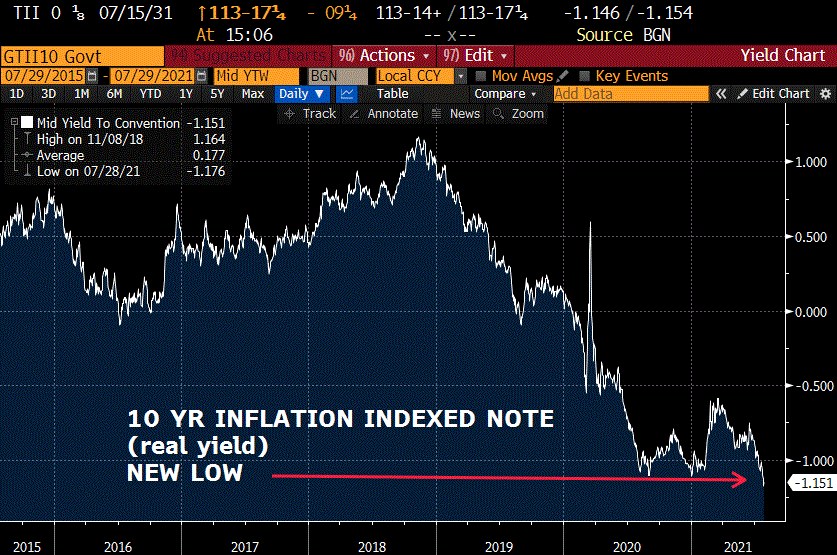
–A couple of related charts are attached. One is the ten year inflation-indexed note yield, which has made a new all-time low near negative 116 bps. The five year is, of course. even more deeply negative, also at an all-time low, at -196 bps. Today we get the Fed’s preferred inflation number, Core yoy PCE prices, expected +3.7% from 3.4 last, Headline prices expected 4.0 yoy. With the ten-year treasury yield hovering just over 1.25%, actual real yields are much more negative than indicated by tips. So, what is one to do? Borrow as much as you can, as near to treasury yields possible, because it appears as if the ultimate goal is to destroy the purchasing power of the currency. (At least that’s what the $30 rally in gold yesterday seems to be indicating). Unsurprisingly, AAPL did just that with a $6.5 billion bond offering which will help them buy back shares. Sort of like the Fed buying treasuries…
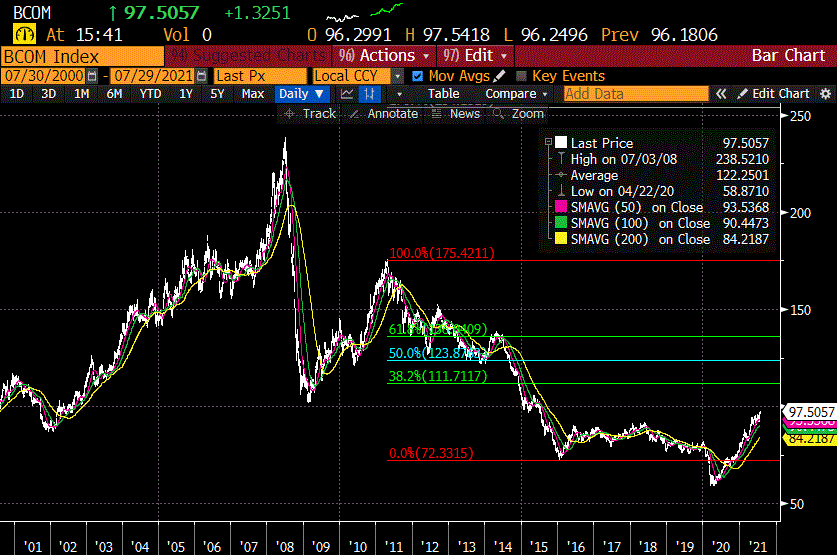
–It’s not just gold. The Bloomberg Commodity Index made a new high for the year yesterday. In fact, at 97.50 it reached the highest level since before Trump was president, early 2015. When looking at a long term chart of BCOM (attached) it appears to have plenty of room to run. Even if one ignores the extremes entirely caused by crazy oil prices in 2008 ($140/bbl) and in 2020 (negative $60/bbl)… take the 2011 high of around 175 on BCOM and the 2016 low of 72, and the midpoint is 123.5. Versus 97.50 now. All we need is for Tim Cook to take a little of that bond money and copy Bill Gates by buying farmland. TC thought bubble: ‘I’ll let those other idiots build rocket ships. I’m going to buy something people really need, AAPL shares and food. Smart.’
–Speaking of rocket ships, AMZN results underwhelmed the market, causing a pre-market loss of 6%. I know this isn’t the right way to think about it, but according to my back of the napkin calculations, that’s an instant evaporation of about $100 billion in market cap, landing right about where it was at the start of the year.
–In eurodollars, the Dec midcurve 0EZ 9937.5/9912.5 put spread traded 2.5 about 80k, some covered 9956.0. Settled 2.25 vs 9958.5. New buying, as open interest rose about 30k. These options expire in four and a half months on Dec 10. Is it possible, within that 4+ month timeframe, to perceive the Fed hiking in the second half of next year (underlying contract is EDZ’22) when they haven’t even started to taper yet? The top strike is 62.5 bps, vs current 3-month libor 12.5 bps. Real rates are trying to tell us something. Commodities are whispering the same message.
Labor market strong. Inflation high. We’ll keep rates at zero.
July 29, 2021
–At yesterday’s futures settlement, yields were higher, with tens up 2.5 bps at 1.26% and the green eurodollar pack (3rd year forward) the weakest on the strip at -6.5 bps. However, as Powell’s presser was digested, yields again slipped lower. For example, green Dec, EDZ3 was 9904.5 at 3:00pm settle, but quickly floated back to 9909.5 nearer to the electronic close. Some of Powell’s comments were bearish, noting that the labor market is quite strong as are current inflation numbers. However, he refused to call a start date for tapering. Today should provide almost comedic evidence that removal of accommodation is long overdue: Q2 GDP is expected 8.5%, yet the NY Fed is scheduled to buy $2.025 billion in 22.5 to 30 year treasuries, with the 30-year bond yield around 1.9%. A twitter comment by Michael Ashton touches on another aspect of the inflation debate: “…we are going to find out on Thursday that money velocity rose at about a 10% rate in Q2 unless GDP is a lot weaker than the forecasts suggest.”
–After the hawkish June FOMC, the dollar rallied and gold dropped hard. Yesterday DXY eased, and gold is seeing signs of life. GCZ1 had been churning around 1800 in the last few sessions, but has popped to 1825 as of this writing. Perhaps that’s due to the FOMC, but another factor could be Biden’s comments saying a shooting war with a major power could be the outcome of cyber-attacks. The world seems to be moving towards cyber disruptions as an acceptable form of conflict, but if Biden wants to fight the last war with conventional boots on the ground infantry, I guess it’s appropriate to grab a musket and turn to the old-time conventional hedge. Of course, the new hedge is holding its own as well, with bitcoin around $40k.
–There are reports that Softbank is selling Uber shares to cover for losses on Didi. China Evergrande has been downgraded by Fitch and S&P. Just a reminder that losses in one place can sometimes cause forced selling in another, even though China convened bankers yesterday to signal an end to the rout.
–Implied vol in treasuries was crushed yesterday. TYU 134.25 straddle settled 1’23, versus 1’32 in atm 134.5^ Tuesday. ATM USU straddle from 3’58 to 3’40. No news until Jackson Hole?
FOMC as Covid risks are touted
July 28, 2021
–The Fed has always cited Covid as a risk to its outlook, and just before today’s FOMC announcement the CDC has decided that most people look better in masks and that the efficacy of vaccines is suspect. Yesterday featured a flatter curve and lower rates as China’s tech crackdown spilled into US equities with Nasdaq closing down 1.2%. Tens ended at 1.234%, down 4.1. One notable new low set in EDZ1/EDH2 calendar at -2.0, down 0.5 on the day and the only inverted calendar on the ED strip.
–New buying of 30k 3EU1 9912.5/9937.5 call 1×2 for 2.0 (settled 3.0, 0.5 ref 9887.5). The lower strike is 29 bps out of the money. I suppose we would see fives sub-50 bps if EDU4 was to hit the lower strike; fives were auctioned yesterday at 0.71. Large exit of 50k 0EZ 9962/9950/9937p fly at 1.75. Settled there ref 9959.0. Also some new buying of EDU1 100c for just under 0.25 synthetically, 20k.
–No dot projections to interfere with Powell’s dovish message today. If prices associated with re-opening were the only drivers of elevated inflation, then surely renewed restrictions will tamp those same prices back down, right? Of course, consumer expectations of higher inflation appear to have taken hold and won’t be easy to shake. This risk to today’s press conference would seem to be that a consistently accommodative Powell acknowledges both a shift in expectations and upcoming increases in owner-occupied rents.
China tech spillover
July 27, 2021
–The China tech sell-off is continuing, leading to spillover weakness in US index futures. Hang Seng down 4.6%, and Shanghai Comp down 2.5%. Alibaba fell 5.5% and Meituan was crushed, falling 17.6%. The latter company is something like Groupon, but the clip I read was that both companies were hit as they are expected to face regulations on employee pay structure for their respective food delivery service arms. A headline on FT says, “Big fines can change big tech, says French competition chief”. Maybe the global trend of gov’ts leaning against big tech is getting legs… as juggernauts in the US release earnings reports today: Alphabet, Apple and Microsoft, with AMZN on Thursday. China’s Evergrande is also making a new low (HK:3333 is symbol).
–US news today includes Durables and 5 year treasury auction.
–Activity in rates was light, but there are a couple of things to note: The ten-year inflation indexed note made a new low yield of -112.6 bps. We know that real yields are much lower of course, as inflation data has been quite high and yields are in the dirt, but a lot of news sources are writing that real yields are making a new low at negative 1.12%. Secondly, 5/30 squeaked up to a new monthly high at 121 bps. The low last week was 112.5, so this 8.5 bp rally is more in the category of a mild bounce for now. Finally, there has been consistent buying of 2EH 100 call for 0.5. 10k yesterday, bring the total to nearly 80k. Probably not even worth highlighting, except that it’s the zero percent strike on a contract 2.5 years forward (option expires 11-March 2022). Certainly not worth selling as there’s an asymmetric reaction whenever disaster strikes. EDH’24 settled 9898.5.