One more straw
June 1, 2021
–Reflation trade this morning with July WTI over $68/bbl at a new high. China raised the FX required reserve ratio from 5 to 7% in order to stem the strength of the yuan and it is having the intended effect with CNY now 6.38. Eurozone Markit Manufacturing PMI released this morning at 63.1, a new high, with input prices at 87.1 from April’s reading of 82.2, “easily the highest on record”. US rate futures are lower this morning with TYU down 8 at 131-22.
–US Manufacturing ISM today expected at 60.9 with prices 89.8. Thus far rate futures have absorbed every straw of high inflation data without budging in price, but the weight of evidence is growing. Even if inflation isn’t sustained at the current levels, extraordinary accommodation seems misplaced. The employment report is slated for Friday morning, with NFP expected 650k.
–The peak one-year eurodollar calendar spread is EDM’23/EDM’24 which settled Friday at 69 bps. It’s less than 10 off the high settle of the move which was 78 in early January. For the sake of comparison, the spread was around 15 when the Fed announced its change of framework in August. Of course, June of 2023 is when libor ends, thus making this spread a bit higher than others, but EDU’23/EDU’24 is still 61.5 bps. Compare these spreads with June’22/June’23 at just 38 bps. Rate hikes are currently priced more aggressively further out the curve, but may move more forward as inflation and economic data continues to strengthen.
Can zero rates in an inflationary environment foster destabilization?
May 28, 2021
–Front eurodollar futures are making new historic highs, with the June’21 contract settling 99.8825 or just 11.75 bps. The July and August contracts settled 99.885. Three month libor has been making a new low every day as the Fed’s RRP is flooded; yesterday’s operation totaled a record $485 billion. At the same time, stocks are near all time highs, and one article noted that Memorial Day gas prices are the highest in seven years. The Q1 GDP Price Index from yesterday’s data was 4.3%, a new high, though I only looked back to 2006. The zero-rate regime is almost certainly creating distortions that are unlikely to unwind gracefully. Yesterday’s price action featured a steeper curve, with tens up 3.4 bps to 1.608% and twos unchanged at just 14.5 bps. So 2/10 ended at 146.3, while the red/gold pack spread (2nd to 5th years on the euro$ curve) rose 3.25 bps to 158.5. Option trades favored the downside, with new put buying vs call selling occurring yesterday. There were also a few outright large futures sales, for example, 60k EDZ2 sold at 99.615 on a block. One hike before the end of next year puts this trade in the money; the contract settled 99.62 yesterday. Just 38 bps by the end of next year. I have a feeling the world will look very different by that time. Will USD continue to attract backers with yields this low against an increasingly inflationary backdrop? (Even if transitory). China yuan at a new high vs USD 6.365. The trade weighted dollar made a new low for the year but DXY has seen a small bounce in the past three days.
–Today’s news includes the Fed’s favorite inflation metric, PCE Core yoy Price, expected 2.9%.
Bottlenecks that don’t open
May 27, 2021
–Yields edged slightly higher with tens up just over 1 bp at 1.574%. Once again, three month libor set a new historic record low yesterday at 13.5 bps, as the Fed’s monster RRP operation totaled $450 billion. Huge buyer of 50k EDU1 early at 9986.5 supported a final settle of 9987 or 13 bps, with EDM1/U1 settling at a new low of just 0.25. There was a chaotic trade in the US bond roll, with the June/Sept spread surging from around 1-19 to 2-24 on a massive buy; the exchange let all trades stand but capped the price at 1-26.25. A change of 2/32’s on a day is big. This error was extremely expensive with the spread settling 1-19. Trade was said to be over 200k contracts. 7/32’s on 100k contracts is $22mm.
–Quarles gave a balanced speech on the outlook of the economy, acknowledging economic strength and that inflation is significantly above 2%. His outlook is mostly optimistic about sustained strong growth due to savings and the continued re-opening, but he warned a couple of times on supply bottlenecks that could keep inflation elevated and said it would be appropriate to discuss tapering at upcoming meetings. He noted elevated asset prices and business debt, but also said cash flows were ample. Not as forceful as Kaplan’s comments have been, but his opinion likely carries greater weight within the FOMC.
–With money-market rates at rock-bottom lows, a change in IOER is almost certain to cause a small jolt to the short end. The lower these yields go in a blistering economy, the more likely that Dudley’s warnings about a taper ‘tantrum’ are likely to come true.
–Supplier delays are a form of inflation, and a leading headline from the FT highlights the situation: “Tesla set to pay for chips in advance to overcome shortage. Electric car maker also explores buying foundry but analysts warn of high costs.” When Quarles warns of the risk of continued bottlenecks, here’s a solid example.
–Durables and Capital Goods today, along with Q1 GDP adjustments. Jobless Claims expected 425k, Seven year auction.
https://www.federalreserve.gov/newsevents/speech/quarles20210526b.htm
Gaming the system
May 26, 2021
–Another new historic low in 3 month libor yesterday at 13.85 bps. Yesterday’s Fed Reverse Repo operation totaled an astonishing $435 billion. (Going big). Given the magnitude of excess reserves, yields again fell and the curve flattened, with tens down 4.4 bps to 1.562%. The red eurodollar pack was +2.0 on the day (second year forward) while greens, blues and golds (3rd, 4th, 5th years) were +4.25, +5.5 and +5.75. The red/gold pack spread made a new recent low, just over 154 bps.
–They say that the cure for high prices is high prices, and some commodities, like corn, were bashed yesterday. Housing may be undergoing sticker shock which could slow activity, as evidenced by the tumble in New Home Sales which fell 5.9% yesterday. However, the monetary authorities appear to believe that in the case of stocks, the cure for high prices is higher prices. Yesterday, speculative darling Gamestop closed at 209, the highest since March. We’re back baby! After the upward burst to 483 in January, it languished around 50 for much of February. Does GME have anything to do with excess liquidity engineered by the Fed and federal government? Nah. There’s a story that Biden is being urged by the chief of righteous indignation, Elizabeth Warren, to dump Quarles, who is the Fed’s man in charge of bank supervision, because he missed the Archegos blow-up. (By the way, Quarles speaks on the economy at 3:00pm today). Um, Senator Warren, short rates are being pounded to dust and government spending has engendered excess liquidity that could threaten financial stability. Archegos was but one manifestation. Just keep your eyes on that tree.
–At the same time, taper talk is heating up again, with Zoltan Poszar saying rates don’t necessarily have to rise due to tapering, if the Fed unleashes the Wells Fargo balance sheet from its regulatory shackles simultaneously. That’s a great solution! Let Wells buy the rich mortgages, being underpinned by record housing prices, so that we can keep asset price plates spinning. Certainly we don’t want the economy to continue to labor under a stifling ten year treasury yield above 1.5% any longer than is necessary. The USD dollar is trying to sidle quietly out of the circus tent, unnoticed. However, CNY is at a new high this morning at 6.3926. June Gold is holding above $1900.
RRP
May 25, 2021
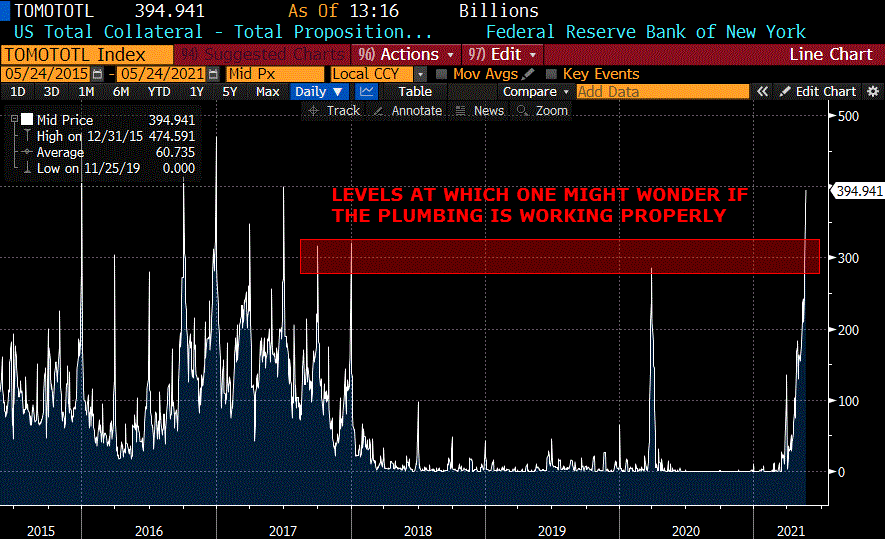
–Usage of the Fed’s RRP facility hit a whopping $395 billion as attached chart shows. It’s hard not to conclude something is ‘wrong’ when we see this sort of outlier regarding EXCESSS excess reserves. New historic low yesterday in 3-month libor at 14.088 bps. This morning China yuan is at a new high vs USD around 6.40. Yesterday Brainard said inflation expectations are “extremely” well-anchored (as dollars continue to flood into the system, thereby raising every price). DXY is 89.60 this morning, testing the year’s low.
–Today’s news includes New Home Sales expected 950k, Consumer Confidence and the auction of 2-year notes with when-issued yielding about 15.7 bps, just over 1.5 bps above 3m libor. Curve flattened somewhat yesterday with tens down 2.2 bps to 1.606%. The thirty year bond fell 3 bps to 2.301%.
Fed framework change was a catalyst
May 24, 2021
–Over the past month TYM has pretty much traded from 131-28 to 132-20, currently at the upper end of that range at 132-17. On Friday ten year cash yield ended at 1.628% nearly unchanged from Thursday. Implied vol has compressed and is now at the low end with July at 4%. Tremendous usage of the Fed reverse repo operations with $369 billion on Friday, indicate that excess reserves are smothering the system. Three month libor posted a record low on Friday at just 14.7 bps. Against this backdrop of forced liquidity, it’s difficult for risk assets to sustain lower moves. Even bitcoin, which traded as low as 31280 yesterday is back above 36k this morning. Auctions of 2, 5, and 7 year notes this week are likely to see solid demand.
–A post on ZeroHedge outlines David Rosenberg’s thesis that inflation will be transitory, that by Q4 the stimulus surge will wear off at the same time supply chains are being repaired. He notes that M2 money supply growth has not been correlated to inflation and cites longer term inflation breakevens to conclude that higher expectations have not taken hold. All legitimate arguments that could end up being right. I am much more inclined to note that curves began to steepen almost immediately after the Fed changed the policy framework in August. In hindsight one can see that many commodities started their run around that time. Ordinary conversations indicate that inflation expectations have increased. The regulatory burden of the new administration is likely to bolster instincts to hoard, perhaps exemplified by the push for a global corporate tax of 15%. The US previously was under a disinflationary cloud due to a weak yuan and cheap manufactured goods from China. Now US military officials have been repeatedly rebuffed in attempting to communicate with Chinese counterparts. Is that a signal of frictionless global trade? Can we be certain that chip supply out of Taiwan will be completely reliable? The yuan has consistently strengthened against USD for a year, from 7.1 last summer to 6.43 now, and of course USD has lost value against all basic commodities. Fiscal and monetary stimulus in the wake of covid have been overwhelming and have unwittingly been successful in changing consumer and corporate psychology in the US. I think that’s what Rosenberg misses, but even if he’s right, does a ten year yield of 1.63% with deeply negative real rates make sense for the US?
–All I am saying is that this was probably a pretty fun wedding to attend
Reversal of flows
May 23, 2021
Major flows could reverse by summer
The week ended with both three month libor and the Bloomberg bank funding index (BSBY3m) at new record lows, 14.700 bps and 11.578 bps. The front June Eurodollar future ended the week at 99.8525 or 14.75 bps. At the same time, July ten year treasury implied vol went just under 4%, the lowest level since late February, while the ten year yield hovers around 1.63%, down just one bp on the week. China’s ten-year yield ended at 3.07%, the lowest since September of last year. At 6.4342, the yuan is near the strongest level of the year versus USD.
In terms of inflationary pressure, contrast the yields noted above with these comments from a conference call with Cummins, Inc. “You name it, and we have a shortage on it,” Tom Linebarger, chairman and CEO of engine and generator manufacturer Cummins said on a call this month. Clients are “trying to get everything they can because they see high demand,” Jennifer Rumsey, the company’s president said. “They think it’s going to extend into next year.”
For anyone who thinks it’s all going to end in a few months, consider the somewhat obscure U.S. economic indicator known as the Logistics Managers’ Index. The gauge is built on a monthly survey of corporate supply chiefs that asks where they see inventory, transportation and warehouse expenses — the three key components of managing supply chains — now and in 12 months. The current index is at its second-highest level in records dating to 2016, and the future gauge shows little respite a year from now. The index has proven unnervingly accurate in the past, matching up with actual costs about 90% of the time.
In my view, the increased inflation outlook is becoming entrenched, in part because of pent-up demand, in part because lack of previous investment in productive supply (which is going to take a while to catch up), and finally, because the dollar continues to trade weak.
The big story of the week concerns the Fed’s massive Reverse Repo operations which totaled $369 billion on Friday. Obviously there are huge excess reserves looking for some sort of yield. As the government draws down balances in the Treasury General Account (TGA), these excess reserves grow. A good and succinct explanation of the mechanics is contained in this link:
https://fed.tips/sico4-1/
Here are a couple of excerpts:
One may ask here why would Fidelity choose to use the Fed RRP, which is paying 0bps? Why can’t Fidelity invest in T-bills instead for higher yield? Of course, Fidelity would buy T-bills instead, if there were T-bills yielding better than 0bps available in the market. And it was indeed the case before Q2 2021. However, since the beginning of April 2021, in each week, Treasury has been letting ~$39Bn worth of T-bills (specifically, cash management bills) to mature to lower the TGA balance. T-bill has been scarce, in comparison to the large deposit balances MMFs are carrying, as a result of QE (which removes UST from the market) and Treasury’s effort of replacing T-bills with longer duration T-notes and T-bonds. Fed RRP is now the highest yielding vehicle for many MMFs, and that’s why RRP balance has been edging up every week lately.
That said, for us traders, let’s enjoy this new trading regime in which the price action in equity market is closely driven by the Fed/Treasury/GSE cash flow and the reactive MMF flow (rising RRP is bullish for stocks because it lowers banks reserve footprint, vacating precious balance sheet space for total-return swaps and other derivatives that enable leveraged speculative positions). This regime should last at least into the next Fed meeting (June 15-16th).
The technical factors associated with the Fed’s plumbing are causing pressure on all short term rates.
At the same time, that’s a likely partial explanation for pressure on implied vol in treasuries. We’re just over three weeks away from the next FOMC, where the Fed will have to tweak IOER to alleviate this situation. In the meantime the pressure on short term yields spills over into longer maturities as well. Simultaneously, China has cracked down on crypto and is trying to tamp down on commodity prices.
The broad overarching situation is that inflation appears to be taking hold for what might be less of a transitory period than the Fed currently thinks. Policies of continued QE seem to be exacerbating the situation by adding to reserves, while the gov’t draws down TGA balances which are being used for transfer payments, thus disincentivizing labor. The next few Fed meetings are June 16, July 28 and September 22. The Fed’s Jackson Hole symposium is typically around the last weekend in August; this year it should be August 26th to 28th. September treasury options expire on August 27, coinciding with Jackson Hole. For that reason, implied vol on Sept trades at a significant premium to July.
The next several Fed meetings may be extremely important. What is more transitory than inflation is the amount of time that the Fed will be able to hold current policies in place. Communication to jawbone down inflation may not be enough, especially if there’s a nice bounce in the next employment data. In a recent talk at the USC Marshall School of Business, Stanley Druckenmiller said, “Simply put, the fastest and strongest recovery from any post-war recession is being met by the easiest response on record by the Federal Reserve, by a mile.” He adds, “I believe we have crossed the Rubicon” and says he thinks the US dollar will lose reserve currency status within fifteen years. Interestingly, he said that the dollar didn’t decline during the covid period, even as foreigners were net sellers of US bonds, because large US companies that were perfectly positioned for the digital economy drew huge foreign investment, thus counteracting bond sales. If that thesis is correct, then the dollar may be ready for another large leg lower. In short, recent major flows with respect to the dollar and excess reserves may run their course by the official start of summer. Yields will revert higher and risk assets could see pressure as USD makes new lows for the year.
| 5/14/2021 | 5/21/2021 | chg | ||
| UST 2Y | 14.9 | 15.5 | 0.6 | w/I 16.2 |
| UST 5Y | 81.9 | 82.6 | 0.7 | w/I 84.7 |
| UST 10Y | 163.7 | 162.8 | -0.9 | |
| UST 30Y | 235.4 | 233.1 | -2.3 | |
| GERM 2Y | -65.6 | -65.4 | 0.2 | |
| GERM 10Y | -12.9 | -13.0 | -0.1 | |
| JPN 30Y | 65.2 | 67.1 | 1.9 | |
| CHINA 10Y | 313.6 | 307.1 | -6.5 | |
| EURO$ U1/U2 | 13.5 | 14.0 | 0.5 | |
| EURO$ U2/U3 | 53.5 | 54.5 | 1.0 | |
| EURO$ U3/U4 | 61.5 | 63.5 | 2.0 | |
| EUR | 121.47 | 121.81 | 0.34 | |
| CRUDE (active) | 65.36 | 63.58 | -1.78 | |
| SPX | 4173.85 | 4155.86 | -17.99 | -0.4% |
| VIX | 18.81 | 20.15 | 1.34 | |
https://www.ttnews.com/articles/world-economy-suddenly-running-low-everything
Yields fall, vol crushed
May 21, 2021
–May equity option and June treasury option expirations today. Yesterday saw yields fall in the context of a flattening curve, with implied vol getting smashed. While TYM was up 14.5/32’s on the day, the TYM at-the-money 131.5 straddle settled at just 15/64’s. TYN implied hovering just above 4%, at the low end of the range. On Wednesday, the blue eurodollar pack (4th year) fell 5.875 bps in the wake of Fed minutes which suggested an onset of taper. Yesterday that loss was exactly erased with blues +5.875. Tens fell 5.3 bps to 1.63%. The 2/10 treasury curve flattened by 4.5 to 148.
–The Fed’s RRP operation yesterday totaled a whopping $351 billion as banks are stuffed with excess reserves. In earlier QE episodes, inflation only occurred in financial assets rather than the real economy. It wasn’t too much money chasing too few goods, it was too much money looking for some sort of yield. Yesterday’s price action felt that way: a levitation of paper assets because excess money is just sloshing around looking for a one-nighter. Of course, the inflation ramifications this time are much more widespread given commodity surges and a shift towards labor that favors wage increases. In any event, the Fed may not be able to wait three and a half weeks for the next FOMC to tweak IOER, and there will almost certainly be a move on tapering at that time. One trade of note yesterday was a buyer of 20k May week-4 TY 130 p for 2/64. These expire one week from today, just before the holiday weekend, with TYU as the underlying (settled 131-19). Likely just some sort of protective trade to cap risk, but could some sort of Fed announcement leak out next week?
t-t-t-t-taper
May 20, 2021
–Yields pushed higher after Fed minutes showed that some members wanted to accelerate the taper discussion. Tens rose 4.3 bps to 1.683%, while blue eurodollars (4th year forward) were the weakest on the strip, with the pack down 5.875. Interesting note on ZH about participation in the Fed’s Reverse Repo facility, quoting Zoltan Pozar: “use of the facility has never been this high outside of quarter end turns, and the fact that the use of the facility is this high on a sunny day mid-quarter means that banks don’t have the balance sheet to warehouse any more reserves at current spread levels.” In other words, the Fed’s QE of $80 billion treasuries per month (and $40b MBS) has stuffed banks ever more full of reserves, leaving SOFR at 1 bp and risking a move to negative rates as banks lend forced-fed reserves overnight at almost any rate. An adjustment higher in IOER appears imminent, but that, along with taper discussion has the potential to signal a change in policy. Then we’ll see if Dudley is right about the inevitability of a tantrum.https://www.zerohedge.com/markets/fed-alert-overnight-reverse-repo-usage-soars-above-covid-crisis-highs
–Large trades yesterday included a sale of over 40k EDM3/U3 calendar spread at 22, which marks the cessation of libor at the end of June 2023. Prior to the late November announcement on libor, this calendar was trading around 4bps, but immediately shot up to the high teens and then over 25 on the prospect of contracts following June’23 being adjusted to SOFR with a spread. Trades were mostly at 22, though spread settlement yesterday was 23. For the sake of comparison, EDH3/M3 settled 14 and EDU3/Z2 settled 16.
–A couple of front one-year eurodollar calendars made new recent highs: Sept 21/Sept 22 rose 1 to 15.0 and Dec 21/Dec 22 rose 1.5 to 22.0. The latter spread at under 1/4% still seems low to me, though the recent low is 14. Post-minutes there was a vol seller of 7k 2EU 9912 straddle at 31.5 to 31.0; settled there with underlying EDU23 exactly on strike at 9912.5.
–Stocks starting off on the back foot today. Any modifications to an unending torrent of liquidity threatens current valuations, with a gentle reminder coming from what are lovingly referred to as digital assets.
Protecting against a hike that may be moved forward
May 19, 2021
–Twenty-year auction today, followed by Fed minutes. W/i 20 yr was 2.27% late yesterday. Tens were nearly unchanged at 1.64%. The dollar was weaker yesterday with DXY ending near the low of the day at 8975. The low of the year, set in early January was 8921.
–While a lot of attention has been focused on put buying in green and blue midcurves (the 3rd and 4th year forward), there has been accumulation recently of EDM2 9962/9937 put spread in size of about 150 to 200k. Yesterday, 2.5 paid for 45k, the spread settled 2.25 vs 9977 in EDM2. These options expire at the same time as the underlying future, 390 days from now. There was also a buyer of 10k 0EZ 9950/9925 put spread for 4.0. These midcurve options expire in December of this year, with EDZ2 as the underlying contract. Put spread settled 4.0 vs 9959.5. Keep in mind that the main proponent of keeping the FF rate at zero has been Chairman Powell himself, and his term as Chair ends in February 2022. My personal bet is that he will be replaced by Brainard, who has also defended zero rates, but market forces could overwhelm the Fed by the end of the year. While the official line is that the Fed will go right through 2022 without hiking, these trades are (inexpensively) hedging for an earlier move.
–China crackdown on financial institutions dealing with crypto has pummeled bitcoin to 40k. Lumber was limit down yesterday and other commodities are paring recent gains this morning, with general weakness spilling over into stock futures. However, the longer end of the treasury curve is soft, perhaps due to the twenty-year; as of this writing, TYM is -5.5 at 132-07 and USM is -11 at 156-11.
–Three month libor set at a record low on Monday below 15 bps, with the Bloomberg Bank Funding Index (BSBY3m) following suit yesterday, setting at a new low of 0.12075.