Today’s events encapsulate the macro story
February 10, 2021
–On October 9, there was a buyer of 50k 3EH 9900/9912ps vs 9975/9987cs for 0.25. I don’t know if that was the first trade to kick off the interest in blue midcurve options, but it was one of them. Subsequently, a big chunk of the 9912 strike was rolled up to the 9925 put for 1 or 1.5; I can’t recall. In any case, the 9925/9900ps is now 5.75 with EDH4 just below the upper strike at 9923.5. Yesterday, there was a buyer of 125k 3EM 9875 put for 3.5. Settled 3.25 vs EDM4 9912.5. Maybe the guy just likes to trade on the 9th of the month. In any case, downside interest remains, with this trade taking place in front of today’s CPI release, ten-year auction, and Powell’s speech on the labor market. I doubt that any one of those events in and of itself is a catalyst for a renewed jump in yields, but they do crystalize the big issues facing the market and economy: 1) inflation and perceived inflation 2) massive bond supply 3) a Fed that emphasizes improvement in the labor market above all other goals. Worth noting that USD resumed its decline yesterday and is a shade weaker this morning. On the inflation expectation front, the ten year breakeven edged to a new high of 221 bps yesterday.
–A few similar trades occurred following the big 3EM buy, for example +25k 3EU 9862/9937 risk reversal, paying 2.5 for the put. The market is becoming comfortable with strikes above 1% even as front end funding rates are currently in the low single digits (like Chicago’s temperature). The question is, how quickly will those funding rates be forced to rise… We know it will warm up here again. By June.
–I have attached a chart of bond vol, which continues to recede in the absence of put buying there. The last little shockwave occurred before the election, and although that story has wrapped up apart from the impeachment bread and circus, I can’t help but think another flare up is around the corner. However, given the extra juice in US vol as compared to FV and TY (which has persisted since April) it’s understandable to lose big chunks of straddle value when the futures price consolidates, especially going into expiration. On 2/4 the atm 167.5^ was 2’14, yesterday’s 167^ settled 1’48 with ten days to go.

Food scarcity / security
February 9, 2021
–Profit taking in treasury curve. 2/10 at 105, down 1.3 on the day and 5/30 at 146.8, down 2.8. However, the euro$ curve steepened to new highs. Red/gold pack spread closed at 110 at a new high, up 1 on the day. EDM3/EDU3 which is the libor extension kink, settled at 18.5 also a new high. The next closest 3-month spread is EDU3/Z3 at 10.
–Implied vol faded on the long end with the small retracement in the curve and yields. The ten year note ended at 115.8, down 1 bp.
–New buyer of 40k 2EM 9937/9912ps for 2.0, settled 1.75 vs 9960.0. Also a buyer of EDZ2 9925/9875ps for 2.0 vs 9969.5; some plays being made for the possibility of the Fed moving up a tightening timeline. The latter trade expires at the same time as EDZ2 futures, 679 days from now. Not much decay on that!
–Ten year treasury/inflation-indexed note breakeven hit a new high of 220.3. CPI released tomorrow.
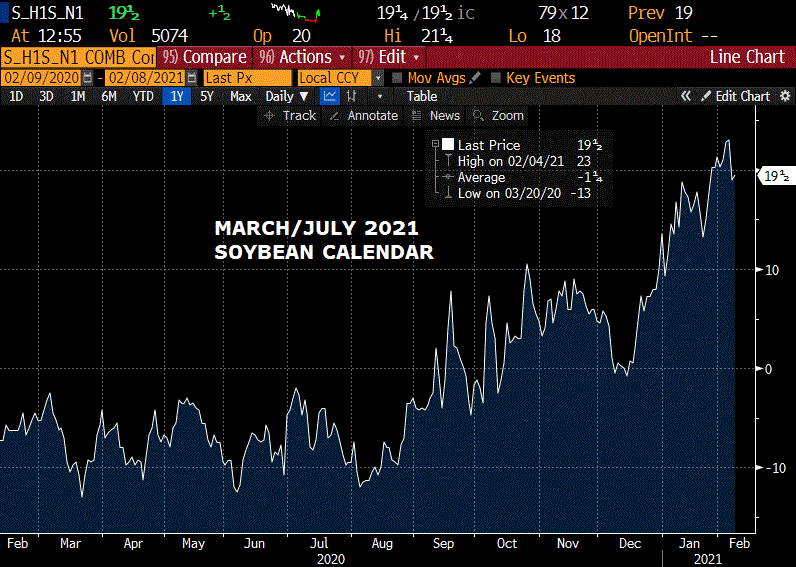
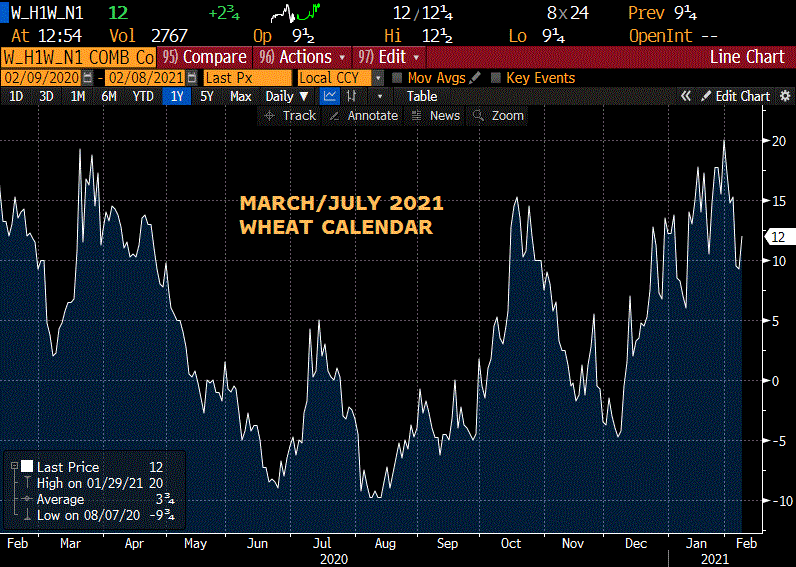
–I’m no expert on grains, but I spoke to a friend yesterday who noted a new high in March Corn at 564, and pointed out the March/July calendar spread which has also surged to 15 1/2 cents (thanks DK). When demand is strong and supplies are tight, the market squeezes the near contract. Though not as pronounced, soybean and wheat calendars are showing the same thing. Food prices aren’t considered a major budget item in the US, but recall that the spark for the Arab Spring was just that. Additionally, oil settled at a new high yesterday with CLH1 57.97, and it’s over 58 this morning. For a long time last summer Corn languished around 320. Now the July 8 dollar calls (C N1 settled 548) are 3 5/8.

Bond yield warming up
February 8, 2021

It’s about 0 degrees Fahrenheit in Chicago. This is what happens when you live in a city neighborhood and the street plows bury you in after a snow. The picture below may seem a bit strange to the uninitiated, but that’s what people do when they go through the toil of shoveling out their cars. Almost looks a bit festive. Lawn chairs, buckets, milk crates placed in empty spots to hold them. Festive that is, unless you move said items and park your car in a spot you didn’t shovel out. Probably the best retribution I heard of is bringing out the garden hose and setting it to a medium mist, encasing the entire vehicle in ice. Takes a bit of time, but then again so did the initial shoveling. It’s the purest form of capitalism. “I did the work, and now that’s MY spot until everything melts down” (and that’s not happening here for another two weeks). Of course, there is also compassionate capitalism, shoveling out an elderly neighbor’s car, asking them where a spare lawn chair is.

–Last week ended with new highs in the curve even as the employment data printed on the weak side. 2/10 at 106.2, up 3.8. 5/30 at 150.6 up 3.2, and red/gold euro$ pack spread 109, up 2.625. Also worth noting that the ten year treasury vs inflation-indexed note closed at a new high of 219.4, regaining the high after the last tip auction temporarily caused a drop of 10 bps.
–On Friday afternoon, consumer credit was released for December, and revolving credit (credit cards) showed another drop, falling over $35 billion, a -3.6% annualized rate. The level is $976 billion, down from the 2019 level of $1.094T. Non-revolving car and school loans are at $3.208T, a new high, +4.8% annualized. The narrative is that government transfers have allowed the revolving decline, which will transform into pent-up demand this spring.
–USH settled lower the last four days of the week, but there has yet to be evidence of panicky put buying. The cash yield is at its highest since February of last year with 30’s printing 2% this morning. This week features $126 billion treasury auctions, comprised of $58b 3’s, $41b 10’s and $27b 30’s. CPI is out on Wednesday, followed by Powell talking about the labor market to the Economic Club of NY. New high in WTI crude last week, with CLH1 trading over $57/bbl late in the electronic session, and building on gains to 57.50 this morning.
Cross of inflation
Weekly Comment – February 7, 2021
Two great interviews this week: 1) Goldman’s head of commodity research Jeff Currie on Bloomberg’s Odd Lots and 2) Stanley Druckenmiller, interviewed by Tony Pasquariello also of course, from Goldman.
I’m summarizing a couple of main points from Druckenmiller, crystalized from his observations: 1) in three months the Federal Gov’t increased the deficit by more than the sum of the last five recessions combined and 2) in the span of six weeks, the Fed bought more treasuries than they did in TEN years under Bernanke and Yellen. He says now is the “wildest cocktail” he has ever seen and expects much higher inflation and a continued boost to commodities. I have linked the 30-minute interview at bottom
Jeff Currie argues for a bull market in commodities, which he has been doing for some time. In that connection, I start with a couple of updated charts, one short term and one which covers the past twenty years, of the ratio of SPX to BCOM (Bloomberg Commodity Index). Top chart is the one-year horizon. Since April, as monetary and fiscal authorities stomped on the gas pedal, this ratio has gone sideways. In other words, even with the speculative fervor in stocks and a growing tech wfh economy, commodities have kept pace.

The next chart is over a twenty year horizon, and this of course shows the massive outperformance of stocks over commodities. Since the GFC low in 2008, the ratio has gone up 9 times from 5.3 to current 47.1. From 2008 to 2013 it doubled. From 2013 to 2015 it doubled again. From 2015 to 2020 it doubled again, and kept on going. Until this year.

Podcast on Bloomberg’s Odd Lots with Joe Weisenthal and Tracy Alloway with Jeff Currie, Global Head of Commodities Research at Goldman.
One of the initial topics concerned the short-lived speculative burst in silver early in the week. Interestingly, Currie mentioned that silver has always been the “populist” metal, and he referred to William Jennings Bryan “Cross of Gold” speech at the 1896 Democratic Convention which is widely hailed as one of the greatest political speeches ever. The issue of the time pitted the free money silver advocates against the east coast elites in favor of the gold standard. The miners and farmers and labor of the west wanted silver included in a bi-metalism monetary standard, which would in effect loosen financial conditions, and make it easier to pay back loans made by eastern bankers under the hard-money gold standard in place since 1873. There are obvious parallels to today’s populist sentiment, though there is no question that loose monetary and fiscal standards have carried the day, now in the form of monetary transfers raised from government borrowings and issued directly to individuals, from Biden’s $1400 stimulus checks to the possibility of the cancellation of student debt, to Romney’s $3000 per child credit.
Here is a short summary of Currie’s arguments that commodities are in a super bull cycle. I would of course encourage you to listen to the source podcast on Odd Lots (for those without access I have linked a GS 2021 outlook interview below). The points are that volatility is starting to rise across commodity markets. He notes that inventories are generally low, making this a structural story. Every market with the exception of [zinc??] and cocoa is in deficit (meaning that demand exceeds supply). He goes on to make an interesting point about green energy initiatives ironically supporting oil in the medium term. The reason has to do with structural long term UNDER-investment in supporting production of ‘old-economy’ commodities. The NEW economy has sucked capital away from the OLD economy and has left inventories low. He doesn’t really mention things like M2 money supply growth or pinpoint deficit spending, but does refer to USD weakness as an underpinning factor of his thesis. He highlights three themes that result in policy driven demand.
1) redistributive policies
2) environmental policies
3) versatility in supply chains and security of supply (redundancy).
He calls attention to income and wealth transfers to lower income individuals and their higher propensity to spend. Higher income people spend about 3 cents per extra dollar on things that are not very commodity sensitive. Lower income spends 100% of transfer funds in more commodity intensive ways. Green initiatives have contributed to underinvestment in old energy. In the ‘outlook’ interview he said that in the first half of 2020 there was an unheard of 40% decline in oil capex (and has a $65/bbl target for 2021). Another interesting stat, 20% of the industrial demand for silver comes from the manufacture of solar panels. In terms of supply chains (though not in Currie’s presentation) semiconductor chips have become the hot topic, with shortages (most are supplied by Taiwan) leading to factory shutdowns in autos and widespread inventory hoarding, beginning with Huawei and now spreading to Apple and others. An analyst cited by Bloomberg notes that key chip component prices “have risen as much as 15% in the past three to six months.”
One other fascinating point was that he cited 1979 to 1980 as another period of high real commodity prices, but also the time of the lowest wealth and income inequalities. I think it might be a stretch to connect those two features of the era. I will note however, that CPI accelerated through the late 1970’s of the Carter years, and posted a yoy high of 14.8% in 1980 before plunging under Volcker. Reagan was elected in 1980. He was born on February 6, 1911, so would have been 110 yesterday. At the time he took office he was 69 and there was widespread concern that he was too old. Hmm. In August 1991 he fired the air traffic controllers who would not return to work, thus busting the PATCO union. It’s an interesting comparison with today’s loose money Fed, borrow-and-spend Treasury and an administration focused on wealth and income redistribution. Do populist movements give rise to inflationary environments?
Here’s an excerpt of Bryan’s 1896 speech:
More than that; we can tell them that they will search the pages of history in vain to find a single instance where the common people of any land have ever declared themselves in favor of the gold standard. They can find where the holders of fixed investments have declared for a gold standard, but not where the masses have. Mr. Carlisle said in 1878 that this was a struggle between the “idle holders of idle capital” and “the struggling masses, who produce the wealth and pay the taxes of the country,” and, my friends, the question we are to decide is: Upon which side will the Democratic party fight; upon the side of “the idle holders of idle capital” or upon the side of “the struggling masses”? That is the question which the party must answer first, and then it must be answered by each individual hereafter. The sympathies of the Democratic party, as shown by the platform, are on the side of the struggling masses who have ever been the foundation of the Democratic party. There are two ideas of government. There are those who believe that if you will only legislate to make the well-to-do prosperous, their prosperity will leak through on those below. The Democratic idea, however, has been that if you legislate to make the masses prosperous, their prosperity will find its way up through every class which rests upon them.
And the bombshell conclusion:
Having behind us the producing masses of this nation and the world, supported by the commercial interests, the laboring interests and the toilers everywhere, we will answer their demand for a gold standard by saying to them: You shall not press down upon the brow of labor this crown of thorns, you shall not crucify mankind upon a cross of gold.
Bryan was nominated for President on the strength of that speech. He lost to McKinley.
OTHER MARKET THOUGHTS/ TRADES
This week beginning on Tuesday, the treasury auctions $58 billion 3’s, $41 billion 10’s and $27 billion 30’s, for a total $126b raising $62 billion in new cash. There will come a time when these auctions go badly. On Wednesday, Powell speaks about the State of the Labor Market to the Economic Club of NY. It’s likely he will continue to emphasize needed accommodation to help the 10 million unemployed. Will that create a concession for bond buyers? During the week I mentioned 3EH 9900/9875ps for 0.75 ref 9924.5. Expires 3/12. While it’s not likely to finish in the money, the large open interest in 3EH puts makes this part of the ED curve more vulnerable to large swings.
In terms of a broad play in commodities, the Bloomberg Commodity Index trades on the CME/CBOT under Bloomberg ticker DNA. While volume isn’t great, it’s worth noting that total open interest has recently doubled from last year, to around 42k. The index is up 39% since March.
| 1/29/2021 | 2/5/2021 | chg | ||
| UST 2Y | 11.3 | 10.5 | -0.8 | |
| UST 5Y | 44.1 | 46.6 | 2.5 | |
| UST 10Y | 109.1 | 116.7 | 7.6 | w/I 118.7 |
| UST 30Y | 185.4 | 197.2 | 11.8 | w/I 197.0 |
| GERM 2Y | -73.3 | -71.1 | 2.2 | |
| GERM 10Y | -51.8 | -44.8 | 7.0 | |
| JPN 30Y | 65.7 | 65.3 | -0.4 | |
| CHINA 10Y | 318.5 | 322.1 | 3.6 | |
| EURO$ H1/H2 | 1.0 | 2.0 | 1.0 | |
| EURO$ H2/H3 | 11.0 | 12.5 | 1.5 | |
| EURO$ H3/H4 | 42.5 | 45.0 | 2.5 | |
| EUR | 121.38 | 120.50 | -0.88 | |
| CRUDE (active) | 52.20 | 56.85 | 4.65 | |
| SPX | 3714.24 | 3886.83 | 172.59 | 4.6% |
| VIX | 33.09 | 20.87 | -12.22 | |
https://www.youtube.com/watch?v=rgtkq5vS5OE -Druck
https://www.youtube.com/watch?v=y9yuyAAn5Dc -Currie
https://blinks.bloomberg.com/news/stories/QO14VSDWLU6I
Payrolls
February 5, 2021
–Even the Financial Times noted today that the US curve is the steepest it has been since 2015. 2/10 closed +0.8 to new high 102.4. Ditto 5/30, up 2 to 147.4, with red/gold euro$ pack spread up 0.625 to 106.375. Tens ended at 113.7 and thirties at 193.1, up 0.6 and 2.0. Plans for student debt cancellation, stimulus checks, checks to parents, are all causing some trepidation in the long end. Concerns that the timing for an initial Fed move could be brought forward are spilling over into the shorter end. For example, yesterday there was a buyer of 25k 2EZ 9912/9887ps vs selling 9962/9987cs, 1.5 debit. The put spread settled 4.25 and the call spread 2.5 vs 9934.0 in EDZ23.
–Payrolls today with NFP expected 100k. Average Hourly Earnings yoy expected 5.0% from 5.1 last. Consumer credit report at the end of the day. While the employment report hasn’t provided much in the way of fireworks recently, I still find 2EG 9968.75 straddle interesting at 3.75 settle. Feb midcurves expire one week from today. Underlying EDH3 settled 9969.5, range since Jan 12 is 9963 to this week’s high 9974.
–This morning CLH1 is at a new high of 56.82, up 36 cents. This contract is now right around where it started in 2020.
Bottlenecks
February 4, 2021
–Several tweets on Wednesday, along with auto mfrs trimming production due to a shortage of computer chips gives rise to concerns of more [temporary] inflation pressures the Fed may have to “look past”.
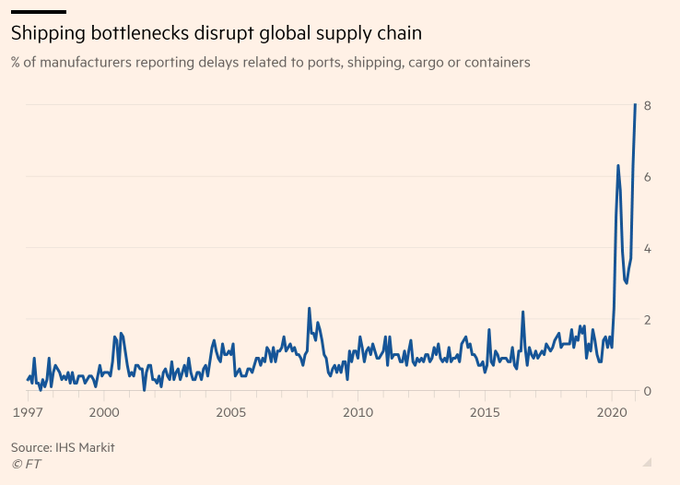
–There was a time not too long ago when just-in-time manufacturing processes were all the rage. Not so in the time of covid. Although every delivery service promises rapid, and in some cases same day gratification, it appears as though bottlenecks aren’t fading away, giving rise to more expensive shipping etc. My inclination is to suspect that redundancies and insurance ‘on-hand’ supplies will filter through to final prices.
–Long end continues to lag as Biden presses the case for stimulus. Treasury announced a record auction of 3, 10 and 30 year notes for next week in aggregate size of $126 billion, raising approximately $63 billion in new cash. There is still put buying in deferred euro$ contracts, example EDZ3 9850p 9 paid 2500 and 2EM 9925p 1.5 paid (against 9958.5/60/60.5)) for about 30k.
–Red/gold euro$ pack spread again made a new high at 105.625, up 2.5 on the day. 2/10 and 5/30 also made new highs as the curve continues to gradually steepen. 101.6 (+2.8) and 145.4 (+2.1) respectively. The controlled nature of this move is keeping vol in line; treasury vol just slightly firmer yesterday despite weak futures prices on low volume. There were a couple of upside plays, most notably a buy of 30k EDU1 9987.5/9993.75/100 c fly for 0.5.
–BOE today. In the US Jobless Claims expected 830k. NFP tomorrow expected 100k. New highs WTI crude. DXY 2 month high as a rise in US rates provides support.
Long end weakness persists
February 3, 2021
–Nasdaq near ATH following AMZN and GOOGL results. Yellen stepping into the financial stability arena with investigative committees (uh-oh) as the spectacular short squeeze in GME et al abated.
–Weakness in the long end persists with tens and bonds up about 3.6 bps yesterday to 1.103% and 1.876% respectively. 5/30 treasury spread posted a new high of 143.3. On the euro$ curve, the red/gold pack spread (2nd to 5th year) made a new high just over 103, up 3.5 on the day as golds (5th year forward) fell 4.875 bps. The part of the curve that showed the most strength was the period straddling the June 2023 cessation of libor. For example, one-year calendars EDH3/EDH4 and EDM3/EDM4 made new highs at 44 and 46. The latter is the peak one-year calendar on the curve, just after libor ends, while EDU3/EDU4 is only 39. Of course, the three-month spread specifically covering the period, that is, EDM3/EDU3 closed at a new high of 17…recall that it was around 5 in late November just prior to the extension announcement. 3-m spreads just before and after this kink are 8.5 and 9.5.
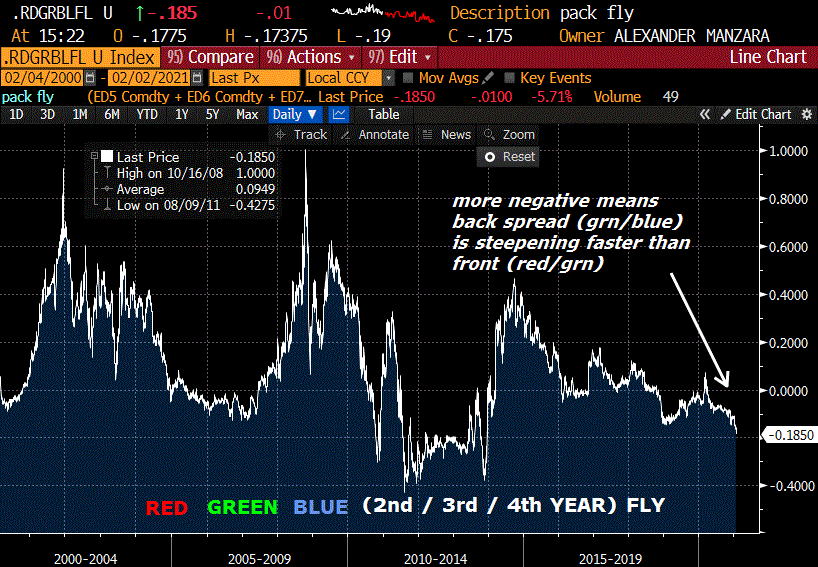
–I’ve attached a red/green/blue pack butterfly chart which settled at a new low of -18.375, the difference between red/green at 23.75 and green/blue at 42.125. As can be seen the historical low on this fly is around -40, but its current level is the low since the end of 2013. Reasons for the weakness: 1) libor cessation plays a part 2) long end is building in an ‘inflation premium’ and 3) expectations that the Fed will be in a tightening cycle by that time. Perhaps out-of-control bond issuance is also a factor.
–A colleague within RJO had written a note about using long treasury vol as a replacement for the credit aspect of forward libor contracts when SOFR takes over. While I didn’t agree with some specifics, the broad point of treasury vol correlating with credit problems is certainly valid. With stocks near all-time highs and corporate spreads in the dirt, I suppose it’s reasonable that TY vol is languishing around 3.4. But if you think financial vulnerabilities are lurking just under the surface only to be exacerbated by the new Treasury Secretary’s focus on the issue, it might be wise to avoid heavy premium sales in treasuries.
Imbalances
February 2, 2021
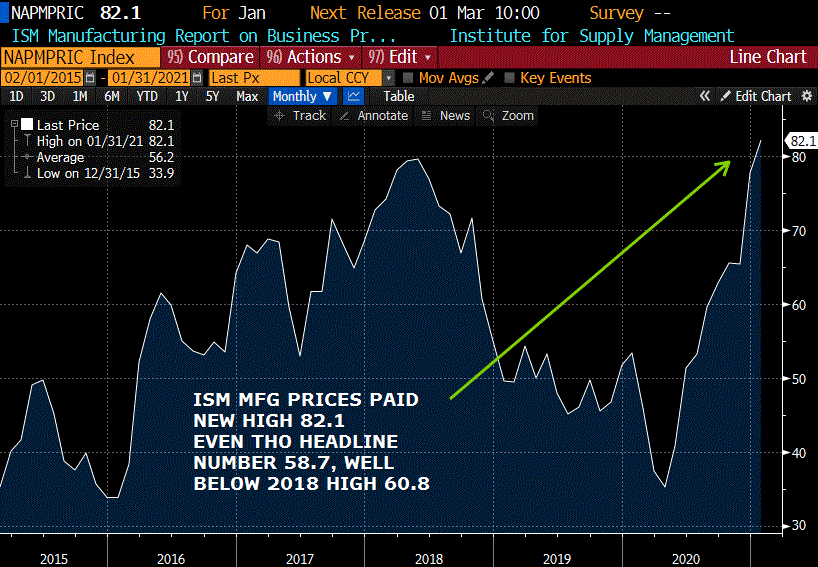
–Yesterday’s 3 month libor setting was a new record low 19.5 bps, underpinning strength in near ED futures. EDH1 settled 9984 with EDM1 as the peak point on the curve, settling 9984.5. Tens ended at 1.066, down 2.5 bps on the day. Although the headline ISM Mfg number was weaker than expected at 58.7 (the high in 2018 was 60.8), the Prices Paid component surged to a new high of 82.1, eclipsing the 2018 level. The data trend has generally been for stronger prices, which the Fed is promising to look past, having elevated the labor market to its top priority. Minutes from South Korea’s central bank meeting in January show an interesting contrast with the US Fed. From Reuters, “Minutes of the last meeting showed the majority of the seven board members were worried about the red-hot property market as well as surging stock prices, especially as household income and job market remained sluggish. ‘As the recent rise in asset prices is accompanied by a significant increase in debt, there is a high possibility that risk of financial imbalance is accumulating’, said one policymaker…” Compare to Powell’s presser: housing strength is one-off; not considering margin increase on stocks; large debts are more easily serviced at these low rates.
–The reddit crowd appears to have met its match with the silver market. After popping to a high of 30.35 in SIH1 yesterday morning, it now trades 27.80. The August surge above 30 was followed by a move to 23 by late September. Sure I am personally long silver, but with a preponderance of derivatives, this is no easy squeeze.
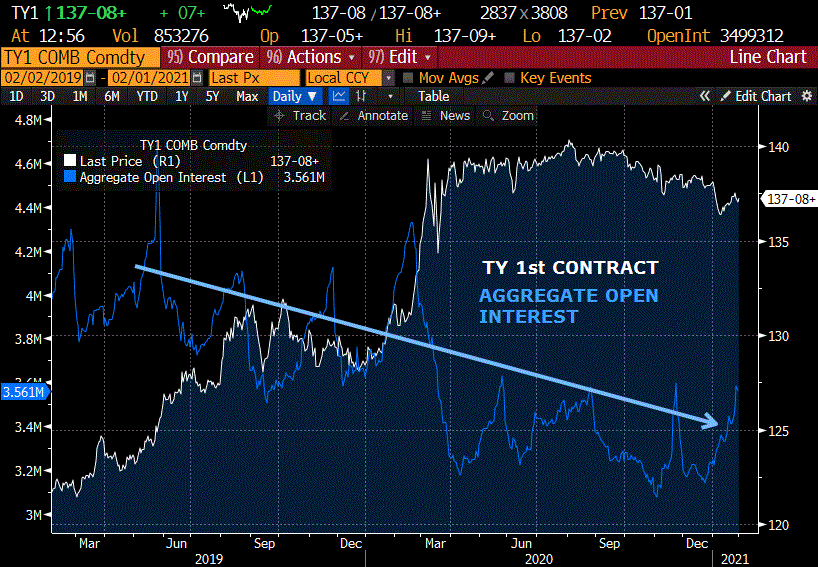
–I was examining open interest in TY yesterday in preparation for the roll, and noticed that aggregate OI has fallen quite significantly since Fed easing associated with the virus. In Q2 2019, TY OI was around 4 million, now it’s 3.4 to 3.5 million, in spite of huge treasury bond supply. Upon looking at all contracts, OI has also seen large declines in TU and FV, but has climbed to a new high in the Ultra TenYr (UXY) and has also risen in the US contract. I’ll post charts on a separate note. Sort of fits the Fed and inflation narrative so it shouldn’t come as a surprise: Short contracts are constrained by the Fed’s ‘low funding for years’ promise, so no need to hedge, while long dated maturities are useful for hedging inflation.
Silver
February 1, 2021
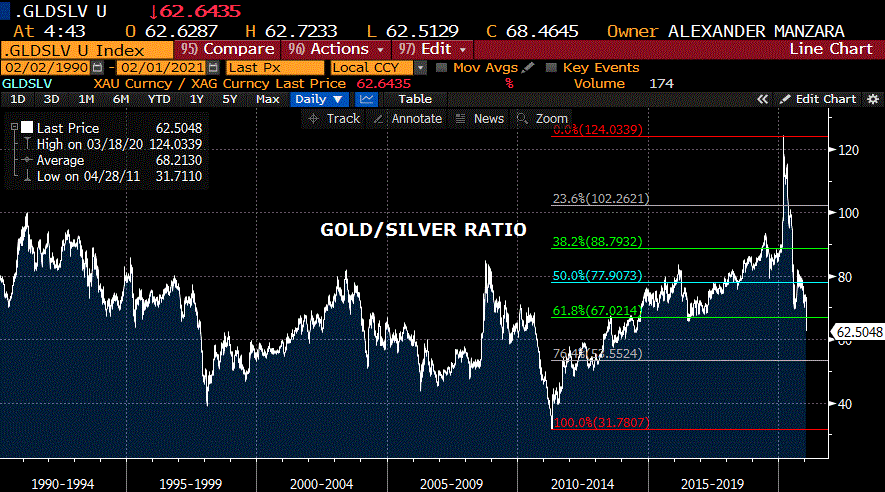
–They’ve targeted silver now. sparking a rally above the August high, now 29.30, up 2.31 on the day. Three month vol at 62 is also at the spike high in August, but SIH1 vol is 93. The gold/silver ratio has plummeted to 63, the lowest since 2014. For context the spike high in this ratio in 2020 was 124, the low in 2011 was 32. Corn also at a new high today, with C H1 over 553 (up 66% from the low in August).
–On Friday the curve steepened as stocks fell. SPX was -1.9% with Nasdaq -2.0%. 2/10 gained 4.4 to 97.8, near the recent high of 99.3. Red/gold euro$ pack spread settled at new high of 100.5, up 6 on the day.
–Today’s news includes ISM Mfg, expected 60.0 from 60.7 last. The high of the last five years was 60.8 in 2018. Prices paid was 77.6 last against the 2018 high of 79.5.
There Oughta Be a Law
January 31, 2021 – Weekly Comment
Finally, a tweet that had some real value in the context of the week’s action. Abishek Raju tweeted an excerpt of The Securities Exchange Act of 1934, Section 9. I searched for this section and the link is here (Abishek said he got it from the FT):
http://www.columbia.edu/~hcs14/SX9.htm
https://twitter.com/Abishekraju/status/1355361591680634888
“It shall be unlawful for any person, directly or indirectly, by use of mails or any means of instrumentality of interstate commerce, or any facility of any national securities exchange… (2) to effect, alone or with one or more other persons, a series of transactions in any security registered on a national securities exchange creating actual or apparent active trading in such security or raising or depressing the price of such security, for the purpose of inducing the purchase or sale of such security by others”
According to Reuters, a 1996 law known as Section 230 protects Message Boards and internet sites. Quoting Eric Goldman, a prof at Santa Clara University School of Law, “The whole point of Section 230 is to enable sites like Reddit to allow conversations to take place… Knowing that some conversations will be antisocial and in some cases illegal, section 230 says that’s not the responsibility of the service that creates the venue of those conversations.”
So these are the Gamestop battle lines. I am sure that Robinhood will be one of the first casualties. There have obviously already been some spectacular losses and gains. Of course, there will be unforeseen consequences apart from the oft repeated “This will end in tears”. For example, JA brought to my attention a tweet from Holger Zschaepitz noting contagion from the short squeeze is forcing some hedge funds to sell longs in order to cover losses from shorts.
The question is, how much responsibility does the Fed have in all of this, and Powell answered that question at Wednesday’s press conference. “None.” When asked about financial stability, in a broad reply he referred to banking stress tests for the system as a whole. When Steve Liesman pressed and asked whether “super easy” monetary policy has created a bubble, Powell responded that what was primarily ‘driving asset prices’ was vaccine progress and fiscal policy, NOT monetary policy. Of course, the Fed has been vocal in urging more of a fiscal response, but never mind that. He said the Fed had not at all considered raising margin requirements, and that issues of financial stability could be handled with macroprudential tools (without specifically naming any of those tools). It could be construed as somewhat disingenuous for the Fed to take credit for reducing employment while shunning blame for asset price instability. In an interview on Friday, Mary Daly of the SF Fed took that issue head on: “I am not willing to pull that bridge [monetary accommodation] away and injure, in my judgment, the livelihoods of people – because they don’t have jobs, they don’t have income, they don’t have wage growth – simply to ensure that some people who already have stock market wealth don’t get more.”
Clearly Powell was miffed at Dudley’s assertion that a taper tantrum would be “inevitable”. It was during that part of the press conference that Powell went to great pains to say that the Fed is a long way from exit and would communicate such plans well in advance. He also gave some insight into the Fed’s thinking on present conditions. First, he echoed Brainard on upcoming strength in inflation measures due to base effects, as weak March and April data from last year fall out. The Fed will look past the data as there are significant pockets of unemployment and slack resource use. Regarding strength in housing, he mostly considers it a one-time shift with transitory effects. In short, he emphasized long-term disinflationary forces, including demographics, technology, and globalization.
It’s somewhat interesting to juxtapose Powell’s performance, with a paper written by Ray Dalio on the topic of bitcoin. He wrote:
There aren’t many alternative gold-like assets at this time of rising need for them (because of all the debt and money creations that are underway and will happen in the future). Because of what is going on in the world, besides there being a growing need for money or storehold of wealth assets that are limited in supply, there is also a growing need for assets that can be privately held. Because there aren’t many of these gold-like storehold of wealth assets that can be held in privacy and because the sizes of their markets are relatively small, there exists the possibility that Bitcoin and its competitors can fill that growing need.
Implicit in this excerpt is an opposite assumption about inflation. Debt and money creation erodes purchasing power, thus causing the need for a store of wealth. Maybe that’s what the reddit crowd is on to with respect to the new squeeze campaign targeting silver. But as Keith Weiner notes: “GME market cap was under $3B prior to its runup… To make math easy, assume at least 3 billion ounces [of silver] in bullion form. That means the total ‘market cap’ of silver is 25 times greater than that of GME…”
The market’s reaction to the week’s events provided support for short end instruments, but relative weakness on the long end. 5/30 treasury spread finished at 141.3 bps, just below last week’s high of the move of 142.8. The red/gold Eurodollar pack spread (2nd year forward to 5th year) closed at a new high of 100.5. The VIX surged to 37.5 but closed 33.09, up 11.18 on the week. Treasury vol firmed modestly, most notably on the long end. With the Fed accommodating the short end, and Treasury considering longer maturity bond issuance, a steepening trend isn’t much of a surprise. In 5/30, 161 bps is halfway of the move from the 2010 high to 2018 low, and should provide significant resistance. Red/gold posted its high of 306 bps at the end of 2013 with a low of -6 at the end of 2018. The halfway mark is 150 bps; 107 to 115 should provide strong initial resistance.
News this week includes ISM Mfg and Services on Monday and Wednesday. Payrolls on Friday with NFP expected 50k. Average Hourly Earnings yoy expected 5.0%.
OTHER MARKET THOUGHTS/ TRADES
The EDU3 9950c settled 18.75 on Friday, versus 9947.0. That’s down 1 on the week with futures also down 1. 2EU 9937/9912ps settled 5.25, unch’d.
The trend in options trading on fixed income is dominated by long put/short call risk reversals. In spite of sloppy price action in stocks, there was an exit seller last week of 30k TYH 138 calls at 10; settled 7 vs 137-01.
As Cameron Crise, Bloomberg’s Macro Man said last week, “This is what happens at the intersection of overabundant liquidity, a commitment to financial repression, and the madness of crowds.” Well put. I don’t know if this is “the big one”, but I do know that from here I would rather be long treasury vol than short it. April atm TY vol closed under 3.6. When things get crazy, it’s not a stretch to see 6%.
Here’s a clip of Robinhood accounts trying to access their funds…
Just a little sidenote about low interest rates. I received one of those innocuous e-mails from Chase about changes to credit card terms. I usually just delete these but glanced at this one. “Penalty APR and when it applies: UP TO 29.99%…” I don’t know what it was before, but 30% seems a little steep. The section below that was for “My Chase Plan Fee (fixed finance charge).” Not sure what this plan is exactly, I think it may be a way to stretch payments on larger purchases. Anyway, here’s the change: “Monthly fee of 1.72% of the amount of each eligible purchase transaction or amount…” MONTHLY FEE. I guess that’s how the Fed’s commitment to low rates trickles down to the little guy.
| 1/22/2021 | 1/29/2021 | chg | ||
| UST 2Y | 12.3 | 11.3 | -1.0 | |
| UST 5Y | 43.3 | 44.1 | 0.8 | |
| UST 10Y | 108.7 | 109.1 | 0.4 | |
| UST 30Y | 185.6 | 185.4 | -0.2 | |
| GERM 2Y | -70.7 | -73.3 | -2.6 | |
| GERM 10Y | -51.2 | -51.8 | -0.6 | |
| JPN 30Y | 64.9 | 65.7 | 0.8 | |
| CHINA 10Y | 312.6 | 318.5 | 5.9 | |
| EURO$ H1/H2 | 0.0 | 1.0 | 1.0 | |
| EURO$ H2/H3 | 10.5 | 11.0 | 0.5 | |
| EURO$ H3/H4 | 40.0 | 42.5 | 2.5 | |
| EUR | 121.75 | 121.38 | -0.37 | |
| CRUDE (active) | 52.27 | 52.20 | -0.07 | |
| SPX | 3841.47 | 3714.24 | -127.23 | -3.3% |
| VIX | 21.91 | 33.09 | 11.18 | |
https://www.reuters.com/article/idUSKBN29Z0HI