US yields edge up as Greece funds at negative rates
Oct 10, 2019
–Rates backed up a bit more on Wednesday, as stocks firmed on renewed hopes of progress in US/China trade talks. Tens rose nearly 5 bps to 1.585% and EDU0 and EDZ0, the weakest ED contracts on the board, settled -7.5. The curve was a bit flatter. On Monday, the ten-year inflation indexed note had a yield of half a basis point. In the two sessions since then it leapt to a ‘real’ yield of 10 bps. EDZ9/EDH0 jumped 4 bps to -28.5 as Z9 is underpinned by expected near term rate cuts.
–News today includes CPI with yoy Core expected 2.4% (following weaker than expected Core PPI of 2.0% on Tuesday). Thirty year auction today as well. It’s worth noting that Greece just issued 10’s at 1.5%, a shade under the US rate, and issued 13 week bills at a slight negative yield. That makes perfect sense, right?
–Back in the financial crisis, when no one thought housing prices could ever fall, the issue was excessive debt, without much of an equity cushion. Short term rates were adjusting higher, making cash flows unambiguously negative. If, at that time, the Fed gave anybody with a mortgage a locked rate of, let’s say 1%, the negative asset spiral probably wouldn’t have occurred. Without interest carrying costs, perhaps rents and other income could have covered property taxes and maintenance. Of course, when lenders are private, they worry about things like resale value, and incomes (or at least they do now). Rates tend to be higher for borrowers who seem stretched.
–Currently we have a giant edifice of debt, both government and corporate, which doesn’t throw much off in terms of income. Short term yields are very close to long term, so there is little in the way of positive carry. The recent surge in repo is an indication that the private market is uncomfortable. So the Fed has stepped in to GUARANTEE cheap funding, and indicates that rates will become cheaper yet, rather than risk letting the market clear. That keeps the plates spinning, even in a world of extended valuations.
Fed has ONE mandate: Keep funding costs low
Oct 9, 2019
–Yields fell with tens down 1.4 bps to 1.537%. Curve slightly steeper as Powell said the Fed would once again expand the balance sheet by buying bills to create a reserve buffer. He said the Fed prefers to administer rates through reserves rather than continuous market operations. The very fact that the Fed has to heavily intervene to keep funding markets from malfunctioning suggests that the underlying problem is going to manifest somewhere else. For now, the market is pricing high odds of an ease at the Halloween meeting, with Oct/Nov FF spread closing at -19.5. Even with expected monetary largesse, stocks closed negative with financials taking a beating. XLF closed -2% while SPX was -1.56%.
-Core PPI was lower than expected at just 2.0% yoy Core. CPI is tomorrow. Ten year auction today.
–FOMC minutes are also released today. However, the circular trade talks with China are a more immediate factor. This morning stock futures have reacted positively to small signs of progress. However, the NBA tweet blow-up exposes larger risks of firms depending on China as a growth market.
Fraying at the corners
Oct 8, 2019
–Yields rose and the curve flattened Monday on light trade, with upcoming inflation figures and supply weighing. Tens up 4.4 bps to 1.551%. Reds, weakest on the dollar curve, closing -6.375, greens -5.75, blues -5.125 and golds -4.125. Implied vol declined. For example, last Tuesday, ED prices were within a couple of bps of yesterday’s close, and EDM0 9862^ settled 49, vs 46.5 yesterday. 0EH 9875^ from 45.0 to 42.5 now, and 2EH 9875^ from 43.5 to 41.5.
–Consumer credit, released yesterday afternoon, was up a healthy $17.9 billion. However, revolving credit was DOWN $2 billion and non-revolving up $19.9B. Let’s go back to school. The democrats will pay for it! (Non-revolving is student loans and auto debt).
–Today’s data includes PPI, with yoy Core expected +2.3%. Three year auction as well, with tens and thirties to follow Wed and Thurs.
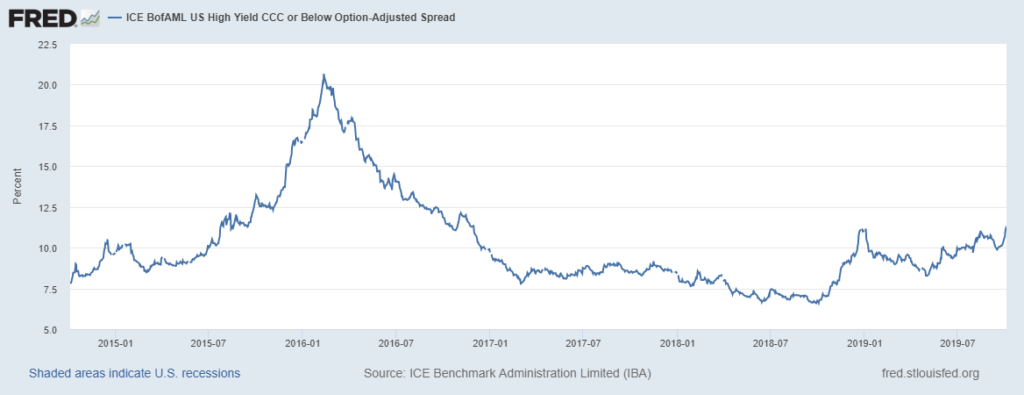
–A couple of interesting charts cited by the Daily Shot yesterday indicate that credit conditions at the perimeter are fraying. I have attached a St Louis Fed chart showing CCC yield spread, which is now at 11.08% testing the level from late last year when markets were unraveling. I’m sure part of this is due to WeWork. For now, it doesn’t seem to be seeping into markets at large. For example, in late 2018, the last time CCC spread was over 11%, HYG had plunged to 80. It’s now holding near the highs above 86.
To start the week…
Oct 7, 2019
–In spite of a spirited 40 point rally in ES on Friday, (Nasdaq and SPX both up 1.4%), yields remain close to recent all time lows. Tens fell 2.2 bps to 1.507%, and that’s in the face of this week’s supply of 3, 10 and 30 year paper. In response to new highs in the curve on Thursday, a decent amount of flattening trades went through on Friday, bringing 2/10 down 2.8 bps to 11.9. This morning stock futures have given back some of Friday’s gain, as China reportedly wants to narrow the focus on a trade deal, and N Korea talks hit an impasse. Additionally, Bernie Sanders’ health scare was upgraded to a heart attack; one poll showed that his supporters would migrate primarily to Warren, leaving her as front runner.
–Record low unemployment rate of 3.5% (since 1969) reported on Friday, but wage growth decelerated to 2.9%. This week we’ll get inflation data in the form of PPI on Tuesday and CPI Thursday, with the Fed minutes in between on Wednesday afternoon. Just over three weeks until the Oct 30 FOMC, and spreads indicate that odds of an ease are > 70% as Oct/Nov FF spread settled -17.75. Also worth noting that EDZ9/EDH0 edged to a new low of -36.0 on Friday (-0.5). This partially reflects weakness in EDZ9 due to turn-of-year considerations, and also the idea of front-loaded easing. With EDZ9/EDZ0 at -57.5, Z9/H0 comprises nearly 2/3rds. EDH0/EDZ0 9-month spread is only -21.5.
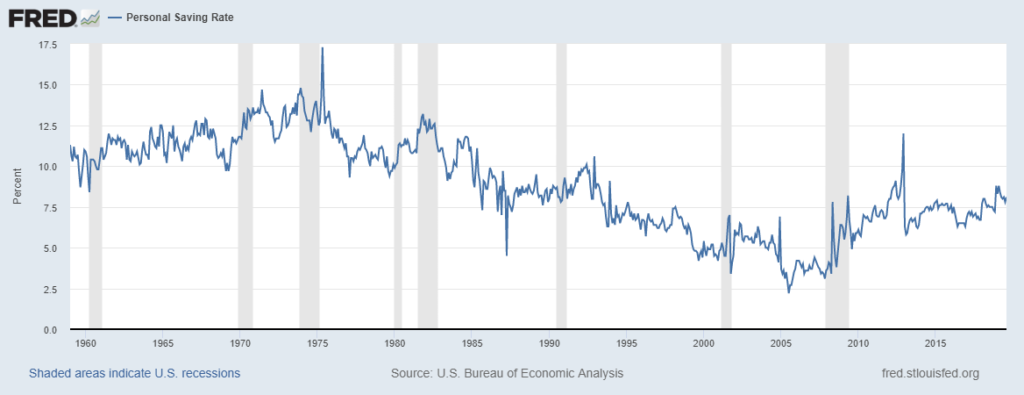
–The ‘real’ ten year yield as shown by the inflation-indexed note is again zero. Not exactly a sign of a robust economy. One other interesting note: An article on CNBC blames millennials for – get this _ a high savings rate! https://www.cnbc.com/2019/10/06/millennials-are-to-blame-for-sluggish-economy-raymond-james-report.html
While I don’t know that I agree with the premise, I did go to the Fed website to get a chart of the savings rate (attached), and sure enough it’s over 8%.
Send Lawyers Guns and Money
Oct 6, 2019 Weekly Comment
How was I to know, she was with the Russians too.
–Warren Zevon
The first comments on the thread of this youtube video are “I’m playing this loud, to annoy the neighbours, as revenge for waking me up with the hedge trimmer.” In response, “I don’t always listen to Zevon, but when I do, so do the neighbors!”
How was I to know Lawyers Guns and Money would be a global anthem? Play this one at top volume. The neighbors will love you for it.
Lawyers for Trump, Guns for entire world and Money from the Fed. The September repo scare focused the Fed on liquidity issues. Since then it’s been non-stop repo operations, with no end in sight. The two-year yield dropped over 23 bps this week. In my book that’s an ease! With a 2-yr yield of 1.388%, it’s back to where it was in Q3 2017. That’s five hikes (and two cuts) ago for those keeping track. Of course, tens and 30s are within spitting distance of new all-time lows, with tens ending at 1.507% and bonds at 2.004%, and that’s with supply on tap. This week treasury auctions $38b 3’s, $24b 10’s and $16b 30’s, raising $54 billion in new cash. Yeah, that stuff needs to be financed. Or monetized.
At the same time, corporate bond sales are off the charts with $434 billion in global corporate bond issuance in the month of September, a record. (CreditBubbleBulletin). Borrowers are thrilled to refinance at these rates. Lock in now and secure financing while we can.
A quote from Almost Daily Grant’s (10/4/19) sums up the other side of the equation. “Needless to say, this vanishing interest-rate epoch has been less kind to lenders, particularly pension funds which are chasing increasingly daunting annual return targets. …Private equity has been all too happy to step into the void.”
Of course, private equity has experienced
some shrinkage as well, thanks to WeWork, and to a lesser extent Uber (and let’s
welcome Peleton to the club, the next Blue Apron). A facetious staff memo from an imaginary
founder written in the WSJ captures the environment. It starts,
“Folks, I know everyone was excited about cashing in on our upcoming public
offering, but it looks like this whole ‘profitability’ craze is here to stay,
at least for a while.”
The problem from a macro perspective, is that these cash-burners employ people. And those folks are about to become a statistic for future payroll reports. It might just be a one-off, but remember how layoff announcements used to spark buying in the stock, as cost-cutting was perceived as improving profitability? Well, Hewlett Packard announced layoffs of 7000-9000 of its 55,000 workforce, and the shares dropped 9.6% Friday with Nasdaq up 1.4%. I’m sure it’s just an isolated event…
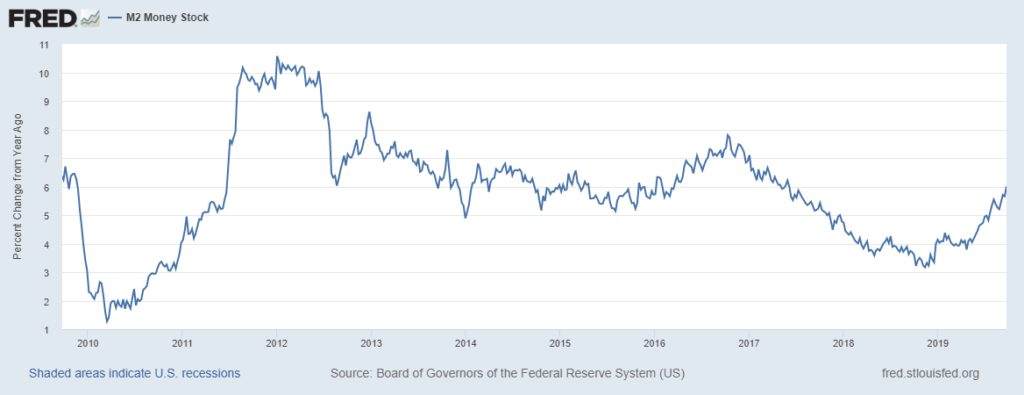
It was ISM data that sparked the latest yield plunge, with Mfg at 47.8 and Services, while still showing growth, much lower than expected at 52.6. The Fed is responding with Money. Below is a chart of the annual growth rate of M2 from the St Louis Fed, last at 6%. Acceleration this year has been rapid and consistent. A long time ago, M2 growth was considered a precursor to inflation. We’ll get a sense of whether it holds true now, with PPI out Tuesday, yoy Core expected 2.3% and CPI Thursday with yoy Core expected 2.4%. Of course, workers’ earnings from Friday’s employment data slowed, to an annual rate of 2.9%.
M2 Growth- St Louis Fed
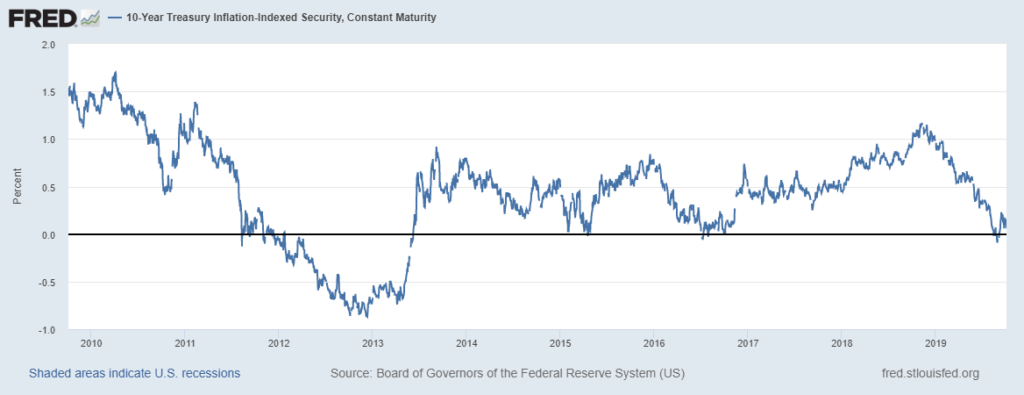
One other yield level worth mention is the ten year inflation-indexed note which ended the week barely above zero at half a basis point. I.e. the real yield is zero. The entire return comes from CPI. After the 2018 tax package the real yield was over 1%. Now it has vanished. Like the neutral rate. As can be seen on the chart below, the zero level also occurred in Q1 2015 and mid-2016, when all yields made their lows. In 2012 it was significantly negative as the Fed tried to force investment further out the risk spectrum.
I don’t know if the FAANG stocks are an appropriate measure for ‘seeking risk’ or now more of a flight away from to safety, but it’s sort of interesting to note that mid-2016, after the late 2015 oil and emerging markets plunge, is when US yields posted their lows, with tens for example reaching 1.36%. So where were some of the high-cap risk stocks? Here’s a partial list, with mid-2016 levels followed by current: FB was 120, now 180. AAPL 100 to 227, AMZN 750 to 1740, NFLX 100 to 270, GOOGL 800 to 1200, MSFT 55 to 138. This, at the same time a shadow has been cast over IPOs. Doesn’t seem as if it will be as easy to shift investors out the risk curve from these levels. Warm up those helicopters. With impeachment, Brexit, Iran & Saudi Arabia, stagnant China talks, Hong Kong, slowing EZ growth as Lagarde takes over the ECB, etc, uncertainties are piling up (with N Korea making a new push for the limelight). It’s little wonder that money is seeking shelter. It’s like the turtle hatch, when all those little turtles are racing for the safety of the sea. A lot of them will be eaten and never make it, so the strategy is sheer numbers. That’s where the Fed is, err on the side of big numbers.
Ten year inflation indexed note yield –St Louis Fed
While Mfg ISM decelerates, it’s also somewhat interesting to look at industrial mainstays oil and copper. From the lows made in early 2016 to the highs in 2018, both are around halfway retracements, with copper just below the midway area. Oil continues to shrug off the attack on Saudi supplies, closing near the low of the week, essentially telegraphing that a global slowdown doesn’t require as much of the stuff.
Fed minutes released this week on Wednesday.
OTHER MARKET/TRADE THOUGHTS
Since mid-Sept there has been an
extraordinary short squeeze in EDZ9 of over 25 bps, with Friday’s settle
pulling back a bit to 9817.0. The spread
between EDZ9 and FFF0 is still firm at 37.5, but it has pulled back from the
low 40’s. End of year funding tightness
remains a concern.
On Oct 1, I noted that Oct/Nov FF spread was -9.25 and Nov/Jan FF spread was
-16.0. These spreads more or less
isolate the Oct 30 and Dec 11 FOMC meetings.
Both indicate that cuts are coming, but the odds of an ease at the Oct
meeting were much lower than those for December. Towards the end of the week, both spreads
were below -19, with the market pushing for an October ease to counter weak ISM
data. Closes Friday were -17.75 and
-20.5. (Pricing one and a half cuts by
the end of the year).
In spite of the end of week stock surge, treasuries closed near the highs. Surprisingly, implied vol in rate futures is not confirming the move, and is slipping on new upticks, especially in bonds. This may portend a change, where vol now has a chance to firm on downticks, which would catch many positions offsides. A Fed which errs on the side of ‘easy’ to insure against a funding crisis, along with continued bond supply could conspire to push the inflation boulder just a little bit closer towards a slope where it picks up speed on its own accord. While that particular narrative doesn’t have many proponents, it’s worth keeping in mind. In 1993, when the Fed kept funds at the then unheard-of-low of 3% for a year, the 1994 rate increase jolt sent bonds into a tailspin. The Bernanke taper-tantrum of 2013 had a similar effect. In those instances, it was fear of central bank tightening. Is it possible that (global) central bank laxness could now inspire the same sort of bust in the long end?
One trade I mentioned last week was EDH0 9850/9875/9900 c fly for 2.25 ref 9833.5 (previous Friday settles). I wasn’t looking for an instant 30 bp rally to Friday’s 9853.0. This fly settled 3.75. Worth holding as the market once again looks for the Fed to target a funds rate of 1.0 to 1.25%.
October midcurves in eurodollars expire Friday. EDZ0, EDZ1 and EDZ2 are all at the 9875 strike: 9874.5, 9879.5 and 9874.0. The next strike lower, 9862.5 puts, settled 1.25, 0.50 and 1.25. That was a low settle for 2EV 9875p, but any one of these could play over the coming week.
| 9/27/2019 | 10/4/2019 | chg | |
| UST 2Y | 162.2 | 138.8 | -23.4 |
| UST 5Y | 155.1 | 132.4 | -22.7 |
| UST 10Y | 167.5 | 150.7 | -16.8 |
| UST 30Y | 212.5 | 200.4 | -12.1 |
| GERM 2Y | -77.0 | -78.0 | -1.0 |
| GERM 10Y | -57.3 | -58.6 | -1.3 |
| JPN 30Y | 31.8 | 34.6 | 2.8 |
| EURO$ Z9/Z0 | -50.0 | -57.5 | -7.5 |
| EURO$ Z0/Z1 | -8.0 | -5.0 | 3.0 |
| EUR | 109.42 | 109.79 | 0.37 |
| CRUDE (1st cont) | 55.91 | 52.81 | -3.10 |
| SPX | 2961.79 | 2952.01 | -9.78 |
| VIX | 17.22 | 17.04 | -0.18 |
The market is demanding an ease NOW.
Oct 4, 2019
–Service ISM came out at 52.5, the weakest since Q3 2016, confirming the Mfg ISM flop. Recall that July 2016 was the all-time low 10y yield at 1.365. Yesterday’s close was 17 bps away at 1.529% (-6.3 on the day). The curve steepened, but interestingly, implied vol eased, perhaps partially in sympathy to a lower VIX as stocks stabilized. (VIX at 19.4 late vs 20.56 Wednesday). New recent highs in most curve measures. 2/10 up 3.5 bps to 14.7. 5/30 up 4.2 to 69.5. Reds led the euro$ strip +10.125. Reds to deferred made new highs with red/gold pack spread up 4.125 to 21.5. The curve has steepened as the MARKET decides that the Fed will be easing in October. Oct/Nov FF spread has plunged this week from -9.25 bps to -20.75, now indicating better than 80% odds of an ease at the Oct 30 FOMC. Jan20 FF contract closed +5.5 bps at 98.565, a spread of -41.25 to FFV9.
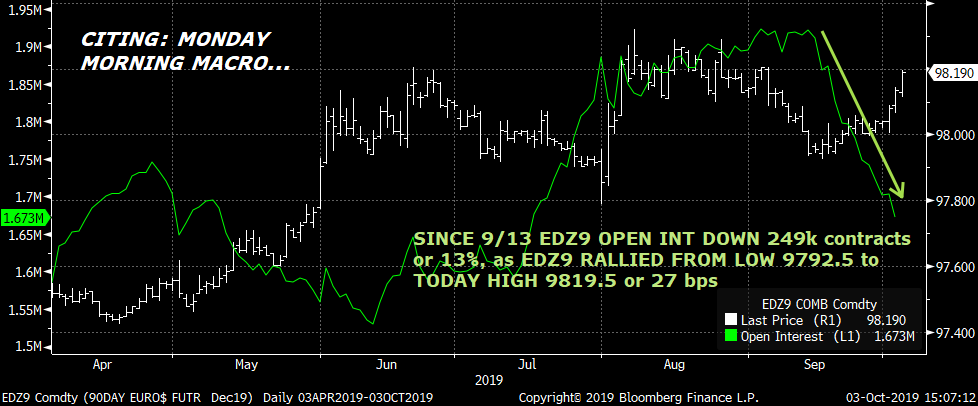
–There are lots of large euro$ call structures going through targeting MUCH lower rates. As just one example, EDG0 9875/9912.5/9950 call fly was bought 10k for 4.25. Looking for FF target of 0.75 to 1.0%. There continues to be buying of EDZ9 9825/9837/9850c fly for 1.5 (around 50k). As was noted by Monday Morning Macro (see chart below), since mid-Sept, EDZ9 has rallied 27 bps and open interest has shed 250k contracts, falling another 28k yesterday. Classic short squeeze.
–It’s not just the short end that sees lower rates in the (near) future; there was a buyer of 25k TYX 134/135 call spreads for 5/64’s. Corresponding with the all-time low yield of 1.36 in tens, TY1 traded 134-07+ on July 6, 2016. Hard to imagine that call spread filling out, but who knows what today brings! Only three weeks left for Nov option expiry (but this was probably just a hedge for a weak employment report).
–NFP expected 140-145k. Gains in treasuries from here should be hard to come by, but stocks again point to a lower open as does copper. Regardless of cheerleading efforts for the US economy, the global picture remains shaky, and we’re back to an element of weekend risk.
Interesting quote:
“We are being told today that there is no inflation, but if you take a basket of the 72 most bought items at Walmart, the price of that basket is up 4,8% year on year.”
https://themarket.ch/interview/gave-the-bond-market-is-the-biggest-bubble-of-our-lifetime-ld.945
Tin Men
Oct 3, 2019
One of my all-time favorite movies is Tin Men, with Danny Devito and Richard Drefuss, which details the exploits of aluminum siding salesmen in the 1960’s. You know it’s the 60’s because of the tailfins on the Cadillacs! Anyway, I was reminded of the clip below as Schwab and others cut commissions to zero. This JOB IS FREE!!!!
And here’s another clip to give a fuller picture
Service ISM to Confirm Mfg Weakness?
Oct 3, 2019
–Yields fell and the curve steepened at SPX fell 1.8% yesterday. Besides the technical and seasonal aspect to the decline in equity markets, I would attribute the fall to several reasons 1) Mfg ISM underscored global mfg weakness 2) Political impeachment drama and a shift left 3) WeWork implosion caused renewed uncertainty about (tech) valuations 4) September’s repo spike leaves nagging worries that perhaps funding isn’t quite as readily available as we all take for granted 5) the Saudi situation points to less stability in the mideast.
–On point number one, Service ISM is released today, expected 55.1 vs 56.4 last. A number that confirms mfg weakness will be problematic. Additionally, the trade war has definitely had an impact, and tariffs on Europe were just announced late yesterday. However, stocks didn’t react to the announcement and actually edged a bit higher, and EUR also shook off the news.
–Regarding point two, Jim Bianco put out an interesting tweet that in the immediate aftermath of news that Bernie had a stent procedure, Warren had picked up his supporters at the expense of all others, leaving her as the undisputed front runner. Obviously hard to trust an instantaneous poll, but that scenario makes sense.
–Nothing more to say about 3…reverberations will be felt in real estate and IPOs. On four, Evans was out saying the Fed might have to respond to economic shocks, a day or two after saying rates were about right. Monetary policy and repo calibration uncertainty.
–On point five, Reuters had a piece saying internal dissatisfaction with MBS is increasing.
–In terms of US rates, several measures of the curve edged to new recent highs. 2/10 +2.4 bps to 11.2, 5/30 +4.5 to 65.3 and red/gold euro$ up a bit over 1 bp to 17.375. Heavy buying of near calls again. For example, EDZ9 9837/9862 c 1×2 0.5 paid for another 50k. EDX 9850c were bought 40k for 1.75 (exit). Open interest in EDZ9 calls peaks with the 9825c at 590k, with 9837c 471 and 9850c 449k. Some technicians suggest that the market gravitates to peak OI, which would suggest a couple of more Fed eases, further corroborated by Oct/Jan FF spread which fell 5 bps yest to -36.5.
WeSell
October 2, 2019
–Interest rate futures opened lower across the board yesterday, but the weakest Mfg ISM number since 2009 (47.8) sparked whiplash, with tens ultimately falling 3.5 bps to 1.64%. Employment sub-index fell to 46.3. The curve steepened as odds for near term easing jumped. Oct/Nov FF spread was -9.25 before the data but closed -14.5 as Nov FF rallied 5 bps to end at 98.295. Reds led the way on the euro$ curve, closing +6.25, with greens +4.75, blues +3.25 and golds +2.125.
–TYZ9 low of 129-20 was the halfway back point from the Sept 13 low of 129-16 to the Sept 25 high of 130-25, That high was eclipsed post-data as yesterday’s high hit 130-29+. SPX closed -1.2% with Nasdaq -1.1% but selling has continued overnight. Political uncertainty is also seeping into the market with impeachment proceedings gaining steam.
–ADP today. Fed speakers include Barkin, Harker and Williams. The most important is Williams at 10:50, who should have plenty to talk about as the head of the NY Fed. In July he gave the “don’t keep your powder dry” speech. Recently, officials like Evans have indicated that policy is about right. The NY Fed desk tamped down the repo surge, but the markets are looking for more signs of liquidity, especially as the WeWork implosion spills over into IPO valuations, commercial real estate, and venture capital.
–Good scathing article on WeWork linked here:
http://nymag.com/intelligencer/2019/10/marketing-expert-scott-galloway-on-wework-and-adam-neumann.html
When CBs CUT bond purchases
Oct 1, 2019
–Fixed income under pressure this morning as a Japanese gov’t 10 year bond sale went poorly due to BOJ indicating plans to slash bond purchases. According to BBG, 10y JGB yield jumped 5.5 bps to -16.
https://www.bloomberg.com/news/articles/2019-10-01/bond-traders-sound-alarm-in-japan-with-weakest-auction-in-years?srnd=premium
This, just as the Fed is about to increase its bond portfolio. As we’ve seen, moves toward ‘normalization’ are met with fear.
–Huge drops in precious metals and oil yesterday. SIZ down 65 cents to just under $17/oz while GCZ9 fell 33.50 to $1473. CLX9 hit a low of $53.98, almost $10 below the high print Monday 9/16 of 63.89 which followed the attack on oil infrastructure in KSA. There has been no military response and MBS yesterday said a war with Iran would cause a global economic shock. The Saudis appear to have capitulated, although odds of further destabilization are likely increasing. Oil rebounding today.
–Chicago Fed’s Evans has already spoken today and is not anxious to cut rates further, saying that the Fed’s 2% objective can still be achieved. Bullard and Bowman on tap. Chicago PMI yesterday fell to 47.1. Mfg PMI today expected to edge back over 50 from 49.1 last. Prices were 46.0 last, expected today at 48.5.