August 16. Asia lower, but bouncing elsewhere
–Yields pushed lower yesterday on a ‘risk-off’ theme sparked by emerging market concerns (but we’re seeing ‘turnaround Thursday’ so far this morning). US tens fell 4 bps to 2.85%. While Turkey’s currency bounced, the broader issue of EM USD-denominated loans is leading to stress. Is it tariifs, or is it the gradual withdrawal of dollar liquidity being engineered by the Fed? In any case, Asian markets continue to press lower, with SHCOMP, Hang Seng and Kospi at new lows. The Shanghai Comp is down nearly 25% from the high in January; it’s hard to imagine the sort of angst that would grip the US if SPX were to fall 25% in the next six months. How about DOW 19000 instead of DOW 25000? Tencent hammered today on slowing profits; a dent in tech.
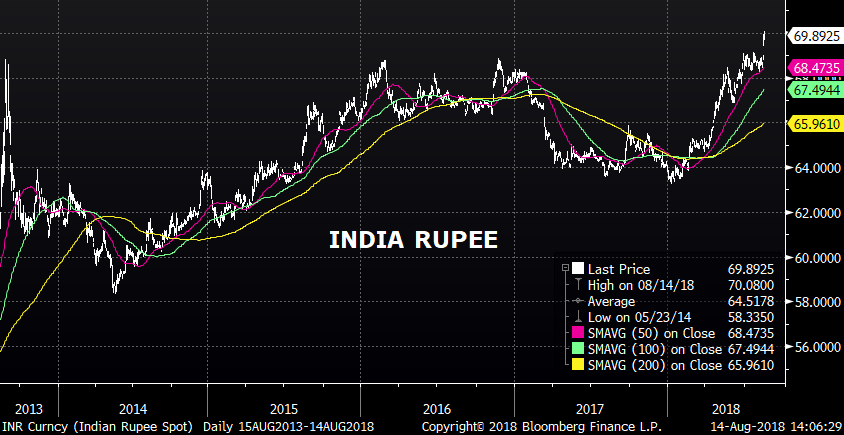
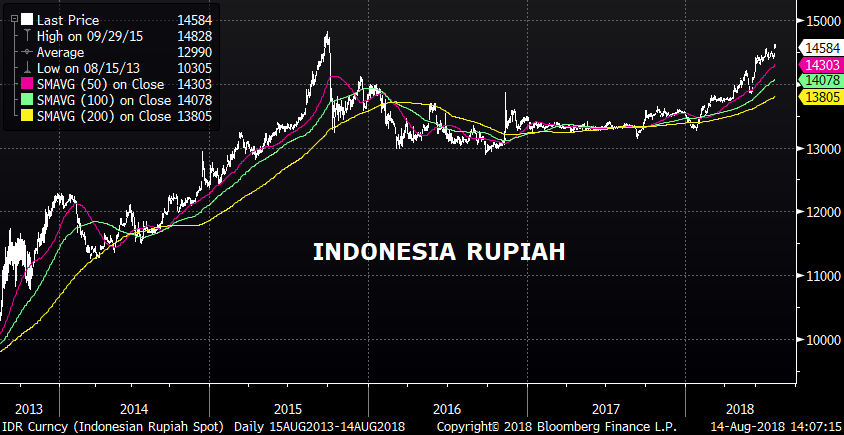
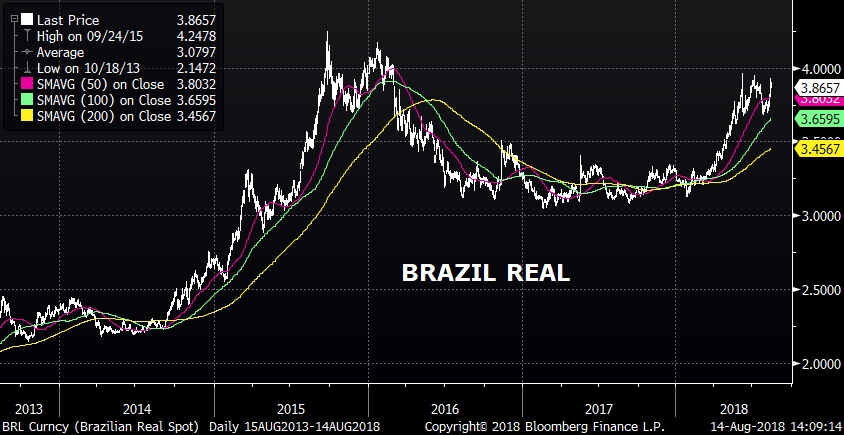
August 15. It’s not just the Turkish lira
Aug 14. Safe haven swissy
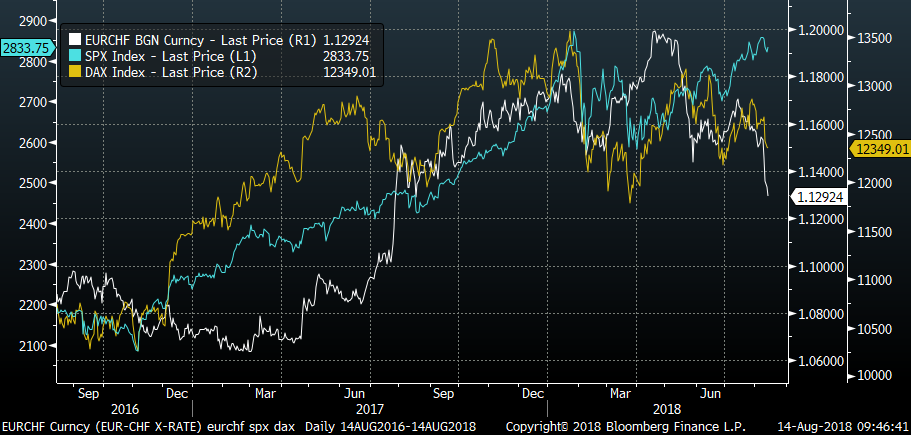
Chart shows SPX in blue, DAX in yellow and EURCHF white. Fairly close track between DAX and EURCHF; SPX on its own currently….
EURCHF weakness a sign of stress?
August 14. A roar or a whisper
–A couple of headlines this morning:
Reuters: Shares regain footing as lira roars out of rout
WSJ: Global stocks rise as lira stages small rally
I’ll go with option number two, a tentative suspension of lira selling took immediate pressure off. But it’s also worth noting that the Argentine peso made a new low yesterday and Brazil is making a push for new lows as well. Also, more analysts are suggesting impending capital controls in Turkey.
–Rates edged higher in the US yesterday with the eurodollar strip mostly down 2 and tens +1.6 to 287.5. Large trades were primarily covered put buys on EDZ20 contract, covering shorts. Open interest in 2EV 9675p fell 25k on a buy of 2.5’s covered 9705.5. 2EZ put open interest declined a total 112k, with a buy of 2EZ 9675p for 6.0 also covered 9705.5. large buy as well in 2EZ 9650p, 2.0 paid vs a futures cover in EDZ9. New shorts were more modest, with buys in 0EX and 0EZ 9700/9687/9675 put flies on a strip, paying 4, (2.0 on each). On the upside, there was a buyer of EDZ8 9750/9762p 1×2 for 0.5. Libor/ois spreads continue to compress, with EDZ8/FFF9 at a new low of 29.5.
–NFIB released small business optimism this morning, at 107.9, staying right near the high and indicating a robust domestic outlook. China’s investment growth reported at a record low.
August 13. Get ready for containment strategies
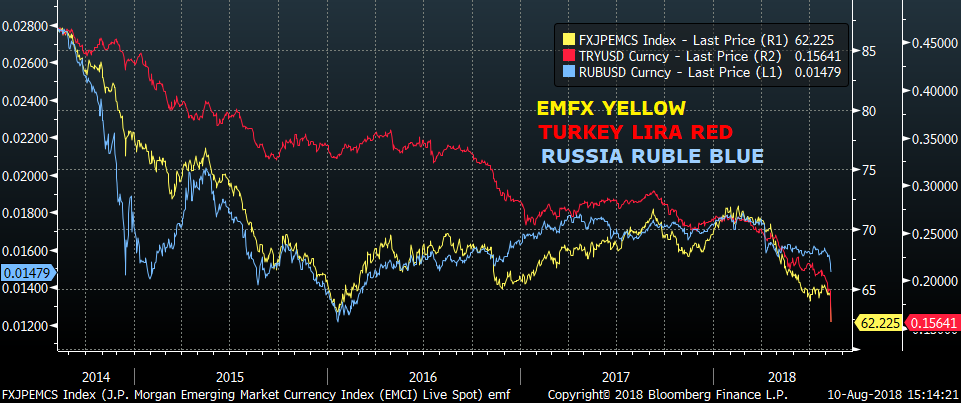
–Turkish lira made a new low but US market taking it in stride. TRY fell to 7 but rebounded slightly; last around 6.9. China yuan also at a new low, 6.88. Well at least those two are at parity. South African Rand plunged 10%. Time to get out some duct tape and Krazy glue and try to repair this thing.
–In spite of Friday’s massive call spread exit in TYU, the ten year yield dropped 7.4 bps to 2.86%. The sales were TYU 120/121 and 120/122 call spreads. Open interest in the 120c fell 106k, 121c -44k and 122c -23k. At the end of the day, 120c settled 35 (ref 120-12) right around the initial premium paid for the 120/122cs. While these call spreads were exited, there was obviously new positioning in futures, as TY open interest went up 101k. Fear is to the upside, and on the dollar curve, reds to greens and greens to blues (2nd to 3rd year and 3rd to 4th) are still slightly inverted.
–As mentioned over the weekend, EDZ8/FFF9 settled just 30 bps, right at the low end of the range. Quite odd given stress in the european banking system related to Turkey, with new lows in a couple of the names mentioned in news reports on Friday (UniCredit and BBVA). The Fed effective has been solidly anchored at 1.91 bps, and FFV8 settled at 97.865 or 2.135 bps, up only 1 on the day on Friday. The spread between the fed effective and FFV of 22.5 bps indicates near market certainty that the Fed won’t be shaken from plans to hike in September.
–And don’t forget Venezuela, which is now at risk of losing Citgo: https://www.washingtonpost.com/business/judge-canadian-firm-can-go-after-venezuelas-us-refineries/2018/08/09/1398112e-9c43-11e8-a8d8-9b4c13286d6b_story.html?utm_term=.ecd341f69e87
August 12. The North Anatolian Fault
The old Chicago Mercantile Exchange trading floor between Monroe and Madison Streets on the east bank of the Chicago river is somewhat of an architectural marvel. The three storey, 36000 square foot (3345 square meter) space was designed to be devoid of structural pillars that would impede eyesight across the pits, and so it was suspended between two towers.
However, as engineering feats go, it’s a mere trifle in comparison to Hagia Sophia in Istanbul. Originally commissioned by the Byzantine Emperor Justinian as an Eastern Orthodox cathedral, it was completed in the year 537. At the time, it was the world’s largest building, capped by a massive dome that required completely new building techniques. The architects were Greek geometers Anthemius of Tralles and Isadore of Miletus. The main building is square, with soaring arches on each side. Because of the immense spans of these arches, huge supporting pillars are on the outside, containing the lateral forces. It is 269 feet long and 240 feet wide or over 64,000 square feet. The dome rises 182 feet.

The architects were aware that earthquakes were prevalent in this area, and it is thought the design accounted for this fact. The building used new materials, including a mortar composed of crushed brick, lime and sand, which was more tensile. The bricks in the dome were fired at lower temperatures than ordinary brick and were thus less dense and lighter in weight. The building is near the North Anatolian Fault (comparable to the San Andreas Fault), and while the dome collapsed in an earthquake in 558, it was re-built and has miraculously withstood many quakes since that time including the 1999 Izmit disaster (7.6). One could easily spend all day watching documentaries and reading articles on this fascinating building, but I have only added a couple of links at the bottom.
Hagia Sophia means Holy Wisdom, in ironically short supply across our modern world.
The markets were shaken this week by a metaphorical earthquake which collapsed the Turkish lira (down nearly 14% on Friday alone, and down 41% ytd). Like the computer generated models that simulate earthquake effects on Hagia Sophia, modern central bankers create ‘stress tests’ for the financial system. However, the ECB expressed concern about some banks’ exposure to Turkey and shortly thereafter Trump decided to ramp up the pressure by increasing tariffs.
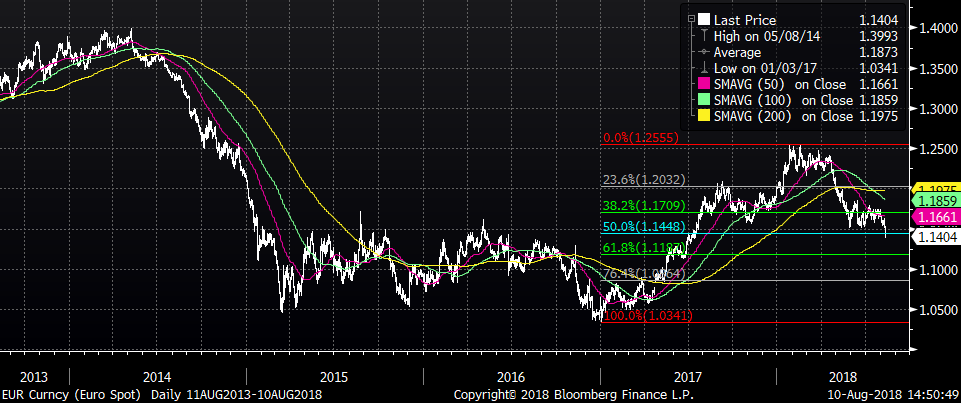
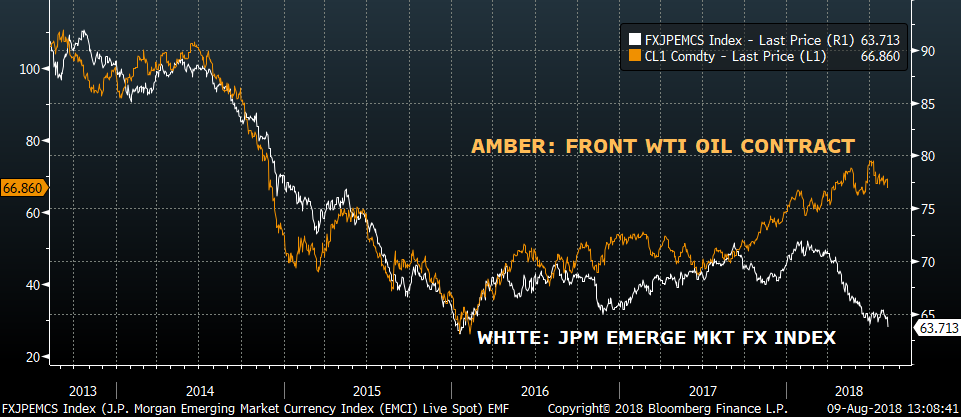
The last period of market angst was in late May, as the Italian political situation caused some to question whether Italy would stay in the euro. Many markets are testing key areas right around stress levels that obtained at that time. The euro actually slid below the level of late May which was around 1.15, now 1.14. The US ten year treasury note which ended Friday at 2.86% (at futures settlement) is holding just above the low yield in late May which was 2.78%. The German bund which traded 26 bps on May 29 was yielding 31.7 on Friday. The spread between Italy and German 10’s got just above 290 in late May. Friday’s level of 268.5 is the highest it has been since early June. The JPM emerging market currency index (FXJPEMCS) is testing lows last seen in early 2016, after the energy rout of 2015.
Overall, equity markets have shown utter disregard. While some European bank stocks were hard hit on Friday, including the Italian bank stock index which is around the low of late May, US markets are well above levels from that period. VIX had a slight tremble, moving up 1.52 on the week from 11.64 to 13.16. The eurostoxx index was down 1.94% Friday, around the low in May but well above the low of the year in March.
In spite of long dated treasury auctions in the past week, the curve flattened, with the 2y note -4.5 bps and tens -8.6. Tens also easily absorbed a large exit of TY call spreads Thursday and Friday, with over 200k TYU8 120 calls sold (120/122 call spreads and 120/121 call spreads). The 120 call started the week with nearly 330k open and ended with just 135k. September treasury options expire one week from Friday; TYU settled 120-12.
Recently, every time a large event is perceived to rattle markets, follow-through is limited, forcing break-out players to exit positions. Currently, many markets are in critical areas which could lead to violent moves. The dollar index made a new high for the year (will it continue?). The euro has a head and shoulder formation, closing below the 50% retrace from the late low in 2016 (1.0341) to the tax-plan high earlier this year of 1.2555. Friday’s close targets the 105 area. In terms of yield, the ten year treasury is right at the support of a gently sloping uptrend from April. A close below 2.84 would initially target around 2.70. While vol firmed slightly in rates at the end of the week, premium is still quite cheap. That is, if we see break-out moves. The jury is still out. The light volume, low liquidity, holiday month of August can still provide excitement. We’ll see if it holds together or crumbles.
Domestic news this week includes Retail Sales and Industrial Production on Wednesday. TIC flows also late Wednesday with focus on Japan and China treasury holdings. Philly Fed on Thursday. Of course, the geopolitical drama with US, Turkey, Russia, China and Iran is likely to overshadow all else.
EURUSD below
https://www.youtube.com/watch?v=5DTh1c-f1uc
Aug 10. Freefallin’
–CPI expected +0.2 with 2.9 yoy. Core yoy expected 2.3%
Aug 9. The Cadillac of minivans
–New low in Russian ruble due to freshly imposed US sanctions, and the Turkish lira also continues to plunge to new lows. Strongmen of Venezuela and Turkey borrowing pages from the same playbook with plunging fx and action-movie coup attempts. Rate trading remains lethargic in the US, with yields steady to lower yesterday. Crude oil a large mover, plunging 2.23 to settle 66.94, testing the low from mid-July; looks to target 65 or lower.
https://www.marketwatch.com/story/behold-the-scariest-chart-for-the-stock-market-2018-08-08
Aug 8. Herd mentality
Aug 7. Drifting prices
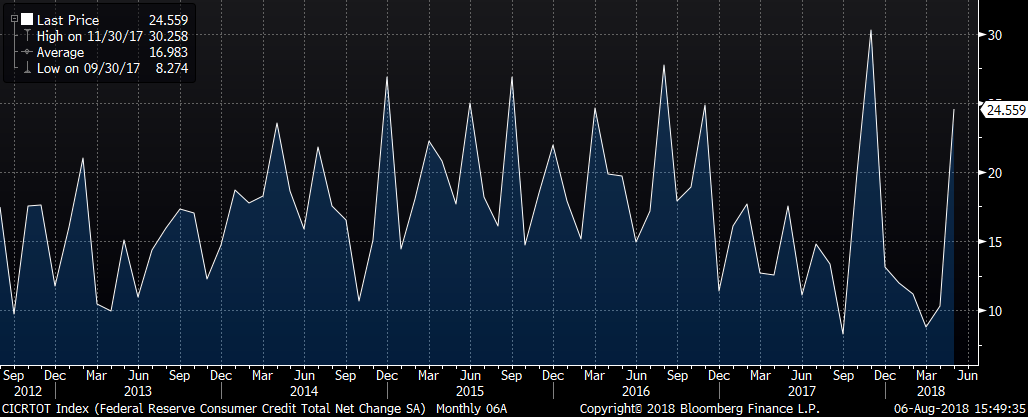 While stocks continue to press higher, there is little pressure on fixed income. The ten year yield drifted further away from 3%, falling 1.7 to a yield of 293.4. Eurodollar curve was marginally flatter on light volume. China’s reserves unexpectedly rose in July to $3.118T, up 5.8 billion. Japan’s 30 year yield pushed over 85 bps, while Germany’s 10y hovers around 40 bps.