Jan 19, 2018. What IF?
–At the December FOMC, the Fed’s FF projection for the end of 2018 was 2.1; in other words, three hikes this year. Finally the Fed and the market are in sync, with both Eurodollars and Fed fund futures coming closer to pricing that outcome. For example, Jan’19 FF settled 97.96 or 2.04, only 6 bps away from the Fed’s projection, while EDZ8 closed 97.685 or 2.315. In fact trading sentiment is now shifting to the idea of 4 hikes this year, as evidenced by recent option activity. For example, first thing yesterday morning there was sizable buying of EDZ8 9750/9725 put spread for 4.5. Simplistically, if EDZ17 expired at 98.37, then 4 quarterly hikes would put EDZ18 around 97.37. (There was also a large buy of EDZ8 97.375p for 2.0. Open interest up in all strikes, so new positions).
–What’s interesting about yesterday’s trade is that even with good size buying of EDZ8 puts, EDZ8/EDZ9 was able to close at a new recent high of 23.5. There was heavy outright buying of the spread at 23.5; the next hurdle is 25, a high close from late October. All near ED calendars made new highs, with the peak EDH8/EDH9 at 53.5. Huge late buying of EDH8 at 9814.5 (+100k) caused the white pack to close positive on the day, with successively more negative closes further out (reds -0.75, greens -2.125, blues -2.875). The ten year settled 122-14+ at the floor close, with 2.609 cash yield, but immediately thereafter fell to 122-11 with cash yield of 2.626, equaling last year’s high. Low so far today is 122-09. While implied vol firmed slightly on the sell off, it’s still depressed.
–Despite a move to higher rates, USD is weakening. What is not really occurring is a reach for out of the money puts. For example, on the EDZ7 put spread mentioned at top, the 9725 strike was sold at 0.5. These puts (EDZ8 9725) are 0.5 bid of course, but have traded that price. The market assigns very little probability of ever reaching that level. What’s sort of missing in general is the idea: ‘what if the crazy sonofabitch does THIS?’ Won’t happen…. ‘Yeah, but WHAT IF?’ The markets have given a pass to central bank authority and power to keep it all reined in, both economically and politically. Today we have the looming gov’t shutdown. Next week Davos. Onward 2018…
Jan 18, 2018. Short end yields post new highs
–Yields rose yesterday with tens up 3.3 bps to 257.4. Last year high yield was 262.7, should equate to around 122-09 in TYH; this morning’s low so far 122-12+. There were some analysts attributing weakness in bonds to AAPL’s announcement of repatriation which will cause a $38 billion tax bill to Uncle Sam; the idea being that perhaps AAPL would have to sell some holdings to raise the cash. However, that amount, even if it was ALL treasuries, isn’t huge. I saw an article this morning that Ripple’s co-founder alone has lost $44 billion since the high made in that crypto ccy earlier this month. On the other hand, the idea of repatriation and re-investment in the US as a whole certainly has some bearing.
–2 and 5 year note yields making new highs (2yr closed at 2.04%). Weakest part of the ED strip was Blue pack (4th yr) which closed -4.75. All near eurodollar calendars made new highs as well, with EDH18/EDH19 at 52.5, just shy of the previous cycle high in Z7/Z8. Jan’18/Jan’19 FF spread closed over 5/8%, at 63.75 bps. The market is accepting the idea of a string of near term hikes, yet the red/green pack spread is just barely over 10 bps.
–If one-year ED calendars become comfortable in the 50-60 bp area, then one year midcurve puts seem cheap. For example, with an assumption of hikes in March and June, and a widening EDM8/EDM9 spread (now 38.5), it’s not hard to see EDM19 at or through the 9737.5 strike. 0EM 9737p settled 4.5. Of course, looking at EDM19/EDM20 spread at just 11 bps, it’s really the green mids that could blow up.
–Several articles about possible termination of NAFTA, as the President goes to Davos to put a further chill on global trade. So far nothing matters…and I’ll note that China’s GDP was reported +6.9%.
–There was a buyer of some 45k TYH 124call late yesterday for 8/64’s. (Settled there vs 122-21, 17d, 7 weeks til expiry). Open interest in the strike rose by 32k so it appears new. However, there was also a seller of some 10k TYH 123c earlier at 45-46. In general vols are stuck in the mud. Blue March 9737.5 straddle 17.5s ref EDH21 9739.0, with the contract -4.5 on the day.
–News today includes Jobless Claims, Housing Starts and Philly Fed, with latter expected 25.
Jan 17. Rallies fizzle
–Tuesday started with a mad grab for stocks, but the party fizzled later in the session. Bitcoin mania has cooled for now, holding just above 10000 this morning, about half the level from the high at which the CME futures contract debuted last month.
–The curve flattened with 5/30 treasury spread closing at a new low of 48 bps. Ten year yield was nearly unch’d at 254.1 (-0.9). In spite of large liquidation of EDH8 9825 puts (45k), EDH8 settled 9814 and remains there this morning. EDH8 9812.5p trades 2.0 with 62 days until expiration, and the FOMC meeting 2 days later. A hike at that meeting is priced over 85% odds. Similarly, EDM8 9787.5p traded 2.25 ref 9795.0. There continues to be buyers of 9787/9775/9762 p fly for 2.0; open interest in EDM8 9787p is over 950k. High confidence of a March hike and growing confidence of another in June, yet the markets see almost no chance of an overshoot…
–While EDH8/EDH9 spread closed unchanged at 49.0, the Jan’18/Jan’19 FF spread settled at a new high of 61.25. I am viewing this spread as indicating certainty of at least 2 hikes and 50/50 for a 3rd in 2018.
–Davos is a week away, and Trump will be there, mingling with the elites and touting the virtues of global trade. Well, he will be there anyway. Interestingly, ZH has a story citing WSJ about a possible US/China trade war. This story compares the late 1980’s trade tensions with Japan versus China now, indicating that it’s unclear who has the upper hand currently (as opposed to a much smaller Japan in the 80’s). Impact of monetary policy is unclear; at the margin a trade war is both inflationary and a weight on growth.
Jan 16. Increased revenue visibility
–(Reuters) “The China Banking Regulatory Commission (CBRC) said late on Saturday in a statement that its priorities included increasing supervision over shadow banking and interbank activities.” Not much of a surprise as it’s already having an impact. BBG reported 2 weeks ago that Jack Ma’s Ant Financial was suspending bond sales backed by consumer loans, after having issued $37 billion in 2017. In what I suppose might be called related news, China is cracking down on crypto, as is S Korea, the net result of which is a cut in bitcoin to nearly half its recent high (trading under $12k as of this note). In other news Germany is buying renminbi for reserves. I don’t know if the above factors are contributing to USD weakness, but yesterday the euro continued its run to recent highs. Now assuming the mantle of parabolic levitation is the US stock market, with ESH trading over 2800 this morning. If the flow from Asia can’t be funneled into bitcoin, then park it in US stocks.
–Weakness in the front end of the market yesterday with EDH8 trading 9814.0, over 23 bps lower than the final settlement of EDZ17. The March hike is priced; it’s time to look further back the curve. However, what we see further back on the treasury curve is flattening, with continued buying of the long end (USH near 151-00). On the eurodollar strip, red/gold pack spread is printing -2 this morning, which puts it near 21; the low of the move has been 19.25.
–It’s worth noting the rapid collapse of UK construction firm Carillion, announced yesterday. This firm had 43k on the payrolls. “Bricks and mortar” as Lenny Cole from RocknRolla might say. From the FT: “Carillion’s journey from reporting ‘an encouraging start to the year’, ‘new orders’ and ‘increased revenue visibility’, to writing down of its construction contracts by £845m, to struggling with debt and unpaid suppliers, to entering compulsory liquidation has taken…just 258 days.”
Lifting the Lid. Weekly comment, Jan 14, 2018
Last week I discussed Dudley’s definition of financial conditions in conjunction with some old Powell quotes, and concluded that a Powell Fed might be more inclined to tighten financial conditions by, for example, stepping back from the Fed put. The idea is that one of the Fed’s goals should be to make sure currently benign conditions don’t sow the seeds of amplified future instability. The Fed forced a move into risk assets post-GFC; now it must attempt to gracefully inject risk pricing back into the markets without lifting the lid of Pandora’s box.
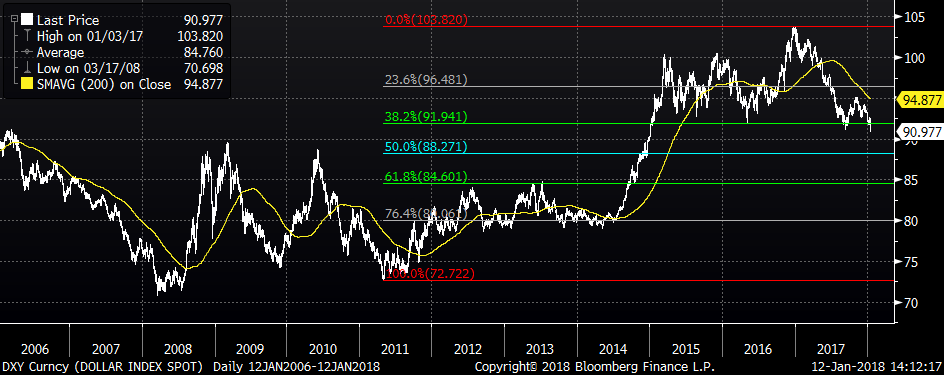
Dudley, in a previous speech, defined financial conditions as being related to short and long term interest rates, corporate bond spreads, and the value of the dollar and equities. It’s fascinating. While short term rates have risen, rates at the long end have done very little. The dollar fell throughout 2017 and on Friday neared a new low. Corporate bond spreads are historically tight; the BAML Hi-Yield option adjusted spread closed at 340 bps according to the St Louis Fed, equaling the low of 2014 which itself was the lowest since 2007. Equities have, of course, surged. “The US mean value of wealth to GDP is 3.8, and I note that wealth is now in excess of 5 times GDP in the US; i.e. total wealth will have to drop 25–30% for equilibrium to be reestablished.” Niels Jensen.
Along with these factors, and obviously related, implied volatility is low across asset classes. Some time ago I suggested that implied vol was like cartilage, providing cushion for the market’s bones. In a larger sense, higher prices for risk, be they option premia, wider corporate spreads, a steeper yield curve, lower CAPE adjusted PE ratios, all provide a cushion. Premium these days has lost its meaning, it’s been pounded flat, from Tiffany’s to the Dollar Store.
The natural world has provided numerous examples of sudden disasters over the past year, causing unexpected gov’t spending and increasing insurance premiums. However, the forward projection of markets is a permanently stable plateau.
Dudley gave another speech on Thursday. He is resigning this year and has been a leading voice on the Fed; his departure is a loss for the institution. He warned of a near term risk of overheating. But perhaps of more interest were his long term concerns, specifically with regard to the nation’s finances. Fed chairs at least since Greenspan have warned of unsustainability, but Dudley’s comments are worth citing. Here’s a key quote (link to speech at bottom)
In fiscal year 2007, federal debt service costs totaled $237 billion on $5 trillion of federal debt held by the public. By fiscal year 2017, although federal debt held by the public had nearly tripled to almost $15 trillion, debt service costs were $263 billion, only modestly above where they were 10 years earlier. Over the past decade, the sharp decline in short- and long-term interest rates has kept a lid on debt service costs—that lid is now being lifted.
Think about that: DEBT LEVEL WENT UP 3x and DEBT SERVICE COSTS WERE UNCHANGED. Some might say, ‘Don’t worry about it, that’s why rates CAN’T go up’. But here’s something else to put in your pipe and smoke: At the end of 2007 total business borrowings were $10.1tn. As of Q3 2017 this amount is $14.1tn. Obviously the growth rate is much lower (just under 4%), as the gov’t essentially transferred private debt into public hands during the GFC. But the idea of stable nominal debt servicing costs over this ten year time frame still applies, and the lifted lid will still create a challenge.
Regarding gov’t finances (from a Goldman report): “… as a result of these factors [increased deficit from tax bill, treasury cash balance build, Fed balance sheet runoff] we expect net marketable borrowing to increase from $488bn in FY2017 to $1030bn in FY2018, and we expect a similar level of net borrowing in FY2019. The increase in financing needs is likely to be addressed through increases in bill and coupon issuance.” [to be outlined at the Feb quarterly refunding statement at the end of this month]
Conclusion: higher rates on more debt in an environment of increased inflation, due to both tight labor markets and a weaker USD.
Now let’s shift to a note from Claudio Borio of the BIS, one of my favorite reads. It’s not just government that expanded debt levels with the free lunch of lower rates. It’s also the business sector, as noted above. And here, the loss of cushion is a bit more nuanced.
Below are a few excerpts from Borio’s speech last week. (A blind spot in today’s macroeconomics?) Link at bottom.
…I will highlight the interaction between interest rates and the financial cycle and will also present some intriguing empirical regularities between the growing incidence of “zombie” firms in an economy and declining interest rates.
…not only do credit booms undermine productivity growth…they do so mainly by inducing shifts of resources into lower productivity growth sectors
Cyclical variations aside, the mean share of publicly quoted zombie firms across these economies has steadily trended up, from close to zero [in 1987] to above 10%…
Zombies are defined as companies that don’t generate enough profit to cover interest, are at least ten years old, and not in high growth businesses. In essence Borio’s paper isn’t about the loss of cartilage, it’s the additional problem of increased fat. But the key concept of mispricing due to CB policies is expanded. The issue with persistently low interest rates is that they allow misallocation of capital. Then, when combined with the tsunami of passive investing, the idea of ‘value’ diverges from ‘price’. Of course, if that’s the case, then one might say…”Great! That’s what provides short sellers with stellar ideas! That is, zombies that have been carried with the tide of indexed funds but whose fundamentals just don’t make sense.” The fight has been with enormous liquidity provided by CBs, crystallized by the ECB’s Steinhoff episode. If the CBs directly and indirectly buy everything, then what’s the use of shorting?
However, the tide is shifting, the lid is lifting. The Fed’s QT schedule is in place. The ECB has cut buying and said that continued reflation may cause a change in forward guidance. Japan is trimming longer term duration buys. China has warned treasuries aren’t as attractive. The US needs to issue more debt. We have one rock of evidence piling up on another which could coalesce into a rapid shift in sentiment.
UPCOMING EVENTS TO BE AWARE OF
23-26 Jan. Trump is going to Davos for the World Economic Forum. A downbeat message for global trade? From Politico: “The annual gathering …will be choking with the kind of people who disdain Donald Trump and genuinely regard his presidency as a menace to the planet. In other words, exactly the kind of party Trump loves to crash.”
End of Jan (29th?) Treasury forward borrowing estimates, likely at the end of the month.
31-Jan. FOMC meeting.
9-25 Feb. Winter Olympics in South Korea
4-March Italian elections
A FEW MARKET NOTES (Charts at bottom)
The dollar sold off throughout 2017 and closed near new lows on Friday. A weaker dollar should work its way through to higher inflation.
All near Eurodollar contracts through Sept’21 made new lows on Friday.
The US 2yr yield closed just shy of 2%.
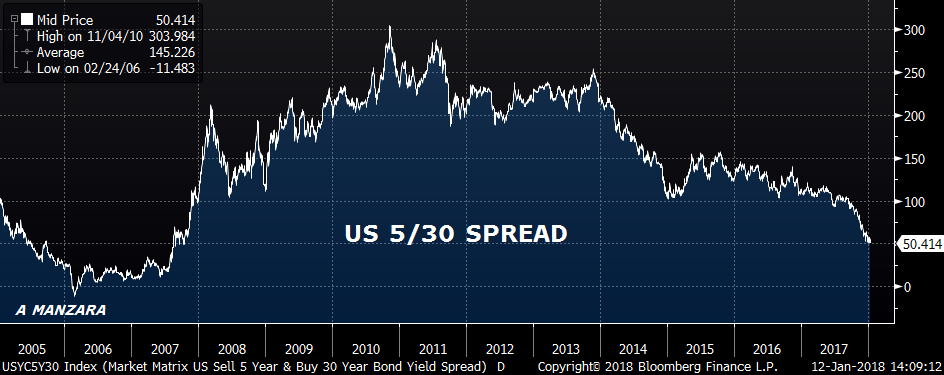
5/30 treasury spread made a new low for the move, ending just above 50 bps. Lowest since 2007.
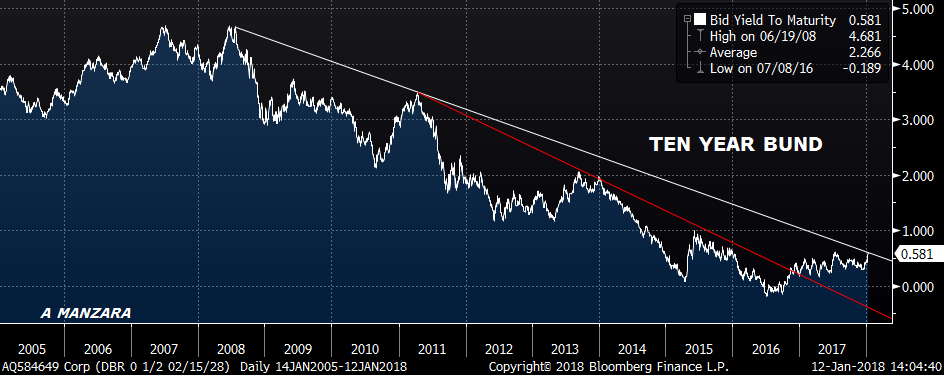
The German bund yield closed at 58 bps, testing a downward sloping trendline from 2008
WTI at new highs with CLG8 64.30.
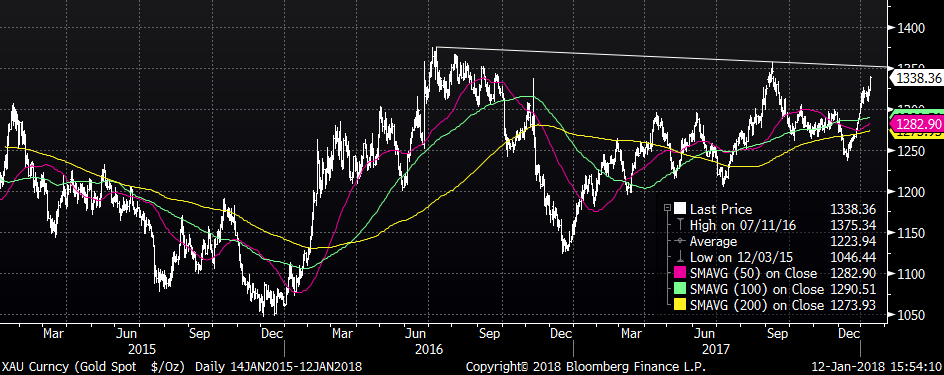
Gold is testing resistance (1355-1375). Above this level look for 1500. Long suffering bulls have enviously watched bitcoin go parabolic. Brethren in gold, the day is coming.
A great resource for Gold and gold forward rates is Monetary Metals. https://monetary-metals.com/data-science-charts/gold-forward-rates/ The firm also pays interest in gold on gold deposits. For more info contact Keith Weiner, CEO.
There was huge buying last week of EDM8 9787/9775/9762p fly, up to 1.75. EDM8 9787p settled 2.0 and 9775p 0.25 ref 9797.0. The 9787p now has 950k open interest. This trade looks for hikes in March and June, with odds of March now priced over 85%.
Other trades targeting Fed hikes further out are also popular, for example, EDZ8 9750/9737/9725p fly, which settled 1.75 ref 9774.0.
________________________________________________________________
| 1/5/2018 | 1/12/2018 | chg | |
| UST 2Y | 195.8 | 199.8 | 4.0 |
| UST 5Y | 228.4 | 234.7 | 6.3 |
| UST 10Y | 248.2 | 255.0 | 6.8 |
| UST 30Y | 281.0 | 285.4 | 4.4 |
| GERM 2Y | -60.5 | -56.8 | 3.7 |
| GERM 10Y | 43.9 | 58.1 | 14.2 |
| JPN 30Y | 81.5 | 83.0 | 1.5 |
| EURO$ H8/H9 | 47.5 | 49.0 | 1.5 |
| EURO$ H9/H0 | 14.0 | 15.5 | 1.5 |
| EUR | 120.32 | 122.00 | 1.68 |
| CRUDE (1st cont) | 61.44 | 64.30 | 2.86 |
| SPX | 2743.15 | 2786.24 | 43.09 |
| VIX | 9.22 | 10.16 | 0.94 |
https://www.newyorkfed.org/newsevents/speeches/2018/dud180111
*definition of “zombie firms” that the OECD has employed…firms that are at least 10 years old and whose profits (EBIT) are insufficient to cover interest payments. Then they further refine the definition by restricting zombie firms to be those with comparatively low expected future growth potential, i.e. those that also have below median Tobin’s Q… the more restrictive definition is intended to excludes the Tesla’s of the world.
https://www.bis.org/speeches/sp180110.pdf
Jan 12, 2018. ECB sentiment shift
–PPI lower than expected yesterday at -0.1%, but the driving factor early in the day was ECB news that forward guidance may need to be reconsidered given continued reflation. European bonds immediately sold off. However, US rate futures regained early losses and closed up on the day. CPI today expected +0.1 with Core +0.2, and yoy Core +1.7. Retail sales expected +0.5.
–There were a couple of surprising buys late in the day. For example, +20k TY week-2 (today expiry) 123c for 13 ref 123-02 (settled 16 vs 123-04). Also a buyer of 10k 2EF 9762.5c for 0.25 ref 9755.0. Jan midcurves expire today. Just prior to last week’s employment data there was also a large buyer of expiring in the money calls. I would suggest someone is running a large short in tens and buying protection to cover risk prior to important econ releases.
–EUR soaring this morning both as follow-thru from yesterday’s ECB shift and due to Merkel making a deal to form a coalition. US stocks continue to march to new all time highs. Crude oil a bit lower this morning after its recent surge. Friend AOK notes that the energy junk bond spread is at a new record low. At the start of 2016 when oil was crashing the spread was over 8.5%, now its 3.25%.
–Interesting speech by Dudley yesterday. Positive on medium term growth prospects due to the tax bill, but concerned that the US debt situation is unsustainable over the longer term.
Jan 11, 2018. China threat
–No surprises from Fed speakers. Evans wanted to keep rates on hold. Bullard said that oil may lift inflation expectations. Duh. This morning Feb WTI is nearing $64/bbl. I would also note that the NY Fed’s Underlying Inflation Gauge for November was 2.95%. Perhaps Friday’s inflation release is a bit more important than usual. Today PPI is released, expected +0.2 headline and core, along with Jobless Claims. 30 yr auction in the afternoon.Also, NY Fed President Dudley speaks on the economic outlook at 3:30 EST.
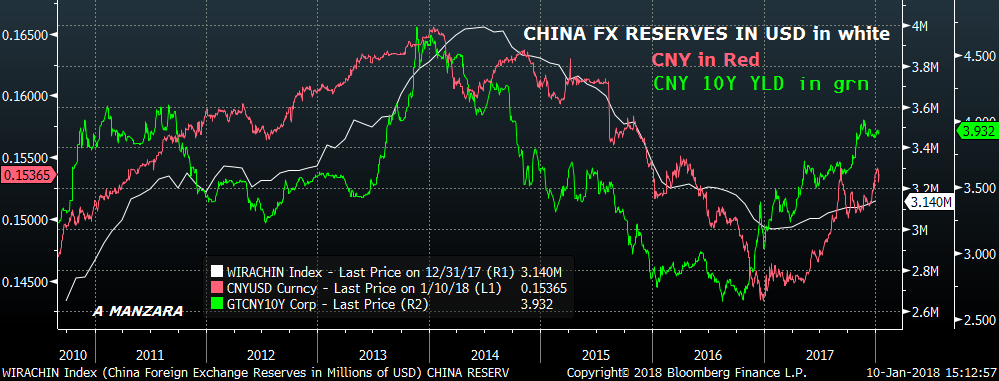
–By the end of the day early weakness in rate futures reversed due to heavy buying, with some well timed exits of structural shorts. Yields and vol were barely changed after the morning jolt from China. April Ten-yr 122.5 straddle sold at 1’42 early, settled 1’39.
Jan 10, 2018. Ursa
–The idea of less CB bond buying going forward is seeping into the consciousness of the market as the BoJ yesterday said it would trim purchases of longer dated securities. In the US, the ten year note jumped 6.2 bps to close 254. The curve steepened, with 2’s only up 0.8 to 196.4, and 30y bonds +7.1 to 288.1. Other bearish factors included a strong rally in oil (up 1.09 late to 62.81 and higher this a.m), and supply in the form of today’s 10y note auction followed by 30s tomorrow.
–Near eurodollar calendars made new highs. The peak one-year spread, March’18/March’19 is nearing 1/2% closing at 48.5 yesterday. EDZ8/9/0 fly settled 13.5 (sold heavily on Friday down to 14.5). General steepening caused back month ED calendars to perk up, but green to blue pack spread is still under 7 bps.
–WSJ reported yesterday that the SNB made $55 Billion Last Year, “…record profit on higher global equity and bond prices and a weaker Swiss franc.” Or as friend JJ said, ‘the SNB discovered that printing money out of thin air and buying financial assets is profitable.’ SNB made $55b; nearly 10% of Swiss GDP (2016).
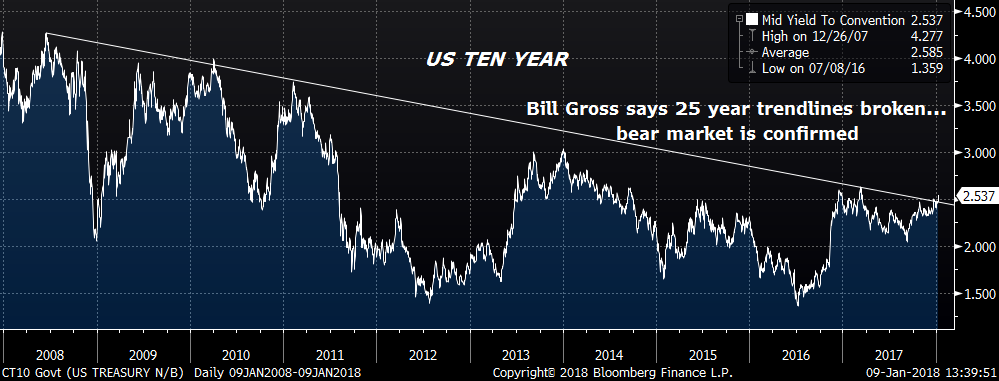
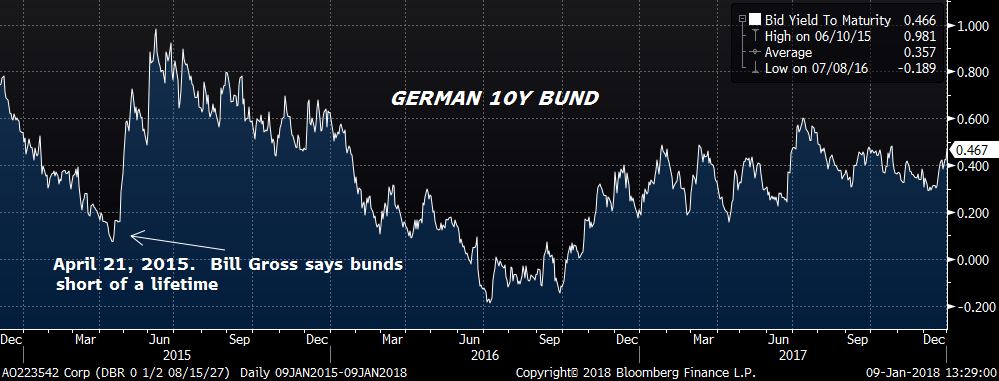
–In April of 2015, Bill Gross tweeted that bunds were the short of a lifetime. The bund yield jumped from around 10 bps to nearly 100 by June. Yesterday, he said the bond bear market is confirmed, due to 25 year trendlines being broken. Gundlach is on the same page but thinks Gross is early (Gundlach watching corporate spreads to widen for indications of economic weakness). The swing in CB asset buying is a key factor for JG negative outlook.
–A general shift to bearish sentiment in fixed income should cause an upward reset in implied vol. Keep in mind that the composition of the Fed has changed. Having said that, today we have speeches by uber-doves Evans and Bullard, who are likely to echo Kashkari’s comments yesterday…no matter how hard they look they just can’t find inflation. Don’t be swayed by Fed doves who are now on the fringe of policy…
Gross: German 10yr Bunds = The short of a lifetime. Better than the pound in 1993. Only question is Timing / ECB QE
Gross: Bond bear market confirmed today. 25 year long-term trendlines broken in 5yr and 10yr maturity Treasuries.
Jan 9, 2018. The Mullet
–Interest rate trading was uneventful yesterday, with most settles within a basis point of Friday’s close. Treasury premium selling was an early feature, for example TYH 122.5/124.5 strangle sold at 29, 5k (settled 28). TYH 123.5^ was 1’11 bid early but settled 1’09. USH 152 straddle settled 3’02, right at 7%.
–Atlanta Fed President (voter this year) gave a vanilla speech about the outlook. Short on details, but a couple of things stood out: First, he cited a recovery in capital spending as a welcome development: “…equipment spending [is] on track to post double digit gains in the 3rd and 4th quarter.” About a year ago, soft (and unexplained) weakness in capex was a constant topic, but it seems to have magically recovered. In the same way, economists now bemoan low and unexplained weak inflation.
–The other thing that Bostic mentioned is that smaller firms seem to express more optimism than larger firms. (This is pretty clear from NFIB surveys). I would suspect skewed results…surveys of small businesses probably are answered by the top guys, who see results first hand. In larger companies, surveys probably go to the information desk… “Just tell them it’s a little better than last year. We don’t want to make any waves.”
–By the way, consumer credit, released yesterday afternoon, exploded $28b to an 8.8% annual pace.
–This next part is repetition of a note yesterday, with a bit more detail. With little fanfare, the exchange opened a 5th midcurve quarterly for trading. There was an immediate f-up.
–The 5th midcurve is on the 9th quarterly contract, currently EDH20, and the option expires in March of 2019, rather than in March 2018 (like the midcurve on the EDH19 contract). The exchange, in its wisdom, has designated this as E0H19 to distinguish it from E0H18 which is the short (red) March symbol. On screen, someone placed a 1 bid for eight thousand E0H19 9725/9700 put spread. The E0H18 put spread of same strikes was 0.5 offer. Apparently, market makers sold the 1’s, not realizing there was an additional YEAR of time value with a different underlying contract. They complained to the exchange.
–Keep in mind at this point, that in days of old, you had to memorize about ten trading rules before you could sit in front of a panel who had to approve your membership to the exchange. One of the rules (for open outcry): you cannot bid or offer outside the current bid/ask. Another: you cannot do anything to intentionally confuse other members about the market.
–In any case, the sellers complained, as the ACTUAL market then posted of 5.0/6.0. The exchange let the trade stand, but (arbitrarily?) changed the premium to 4 from 1. It was NOT an active underlying market. According to the volume sheets, 13670 of this put spread traded. It settled at 5.25.
–The pit has nicknamed this midcurve ‘the MULLET’, (short in the front, long in the back). This might be one of the guys that thought he was selling SHORT March.

Jan 8, 2018. Interesting articles
–Friday’s NFP of just 148k swung in the opposite direction (relative to expectations) of ADP’s explosive 250k print. An initial rally in fixed income was quickly snuffed, and rates closed higher on the day, with tens +2.5 bps to 247.4. Trade of the day was a sale of 125k or more EDZ8/EDZ9/EDZ0 butterflies down to 14.5. (settled 14.5, -2 on the day, with EDZ8/9 at 20.0 and EDZ9/0 at 5.5). In spite of this trade, near one-year calendars settled at new highs. EDH18/EDH19 closed at 47.5 (+1.5) and FFF8/FFF9 at 57.25.
–A few interesting news snippets today. Bloomberg has an article about government shutdown:
The WSJ features a chart of the ten year inflation indexed note vs treasury as a sign that inflation is perking up (I marked the spread at a new recent high of 203 bps on Friday).
–These last two aren’t exactly market related, but the Wired story is WELL worth a read.
Washington Post has a piece on facial recognition in China, which has benefits, but also allows for complete surveillance
Wired has a fascinating piece as well, regarding consumer acceptance of paying by phone and generating social ranking ‘scores’ (thanks RHB). This piece also highlights the role of technology in terms of population control and surveillance, by simply harnessing human behavior.