Push and pull on the Fed’s timetable for ease
January 18, 2024
******************
–Price movements continue to be outsized. For example, on Jan 10, SFRZ4 settled 9608. On Friday the 12th, the settle was 9637.5, 29.5 bps higher. Yesterday’s settle was 9609, a round-turn of over one-quarter percent in a few days. The overall theme of the last several days seems to be that the Fed is now gently pushing back on the idea of a Q1 ease, but option flows are overwhelmingly hedging or speculating on fairly aggressive cuts. For example, yesterday there was a buyer of over 30k SFRJ4 9543.75/9568.75/9593.75c fly for 3-3.5. Settled 3.5 ref SFRM4 9533.0. From the standpoint of futures settle, it seems quite reasonable as the lower strike is only 11 away from the bottom strike. However, the yield on that strike is 4.56%, just over ¾ percent lower than the current Fed Effective.
–Yesterday’s Retail Sales and Ind Production slightly stronger than expected. Today we have Jobless Claims, Housing Starts and Philly Fed Mfg. The latter was -10.5 last, expected -7; we’ll see if it mirrors the plunge in the Empire State survey.
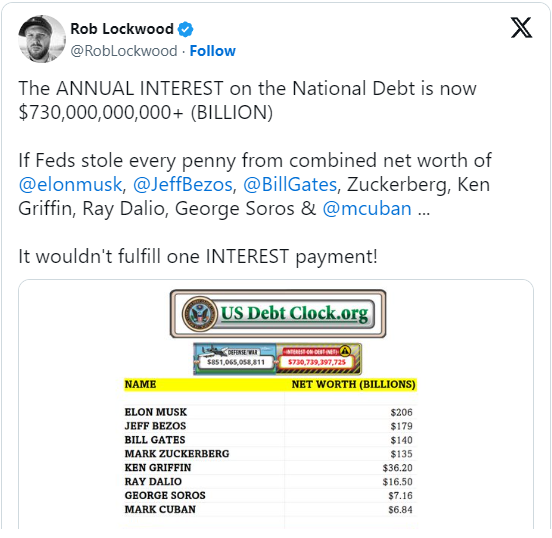
–Stephanie Kelton, the driving force behind MMT is fond of saying that the US gov’t budget isn’t at all like a household budget. I agree, as the gov’t numbers are staggeringly large. However, this little tidbit captures the gargantuan parameters of gov’t (and why “tax the rich” has lost even a slender thread of connection with “paying their fair share”).
Waller pushes ease further back
January 17, 2024
******************
–Waller indicated yesterday that while inflation is within striking distance of target, he’s in no hurry to ease, and he doesn’t see any real urgency to taper QT (and doesn’t want MBS on the Fed’s balance sheet). As a result, SOFR strip was down 8.5 to 12.5 across the board, with noticeable long liquidation in near contracts. SFRH4 settled 9494.5, -8.5 with open interest down 31k. SFRM4 9546, -11.5, OI -73k. SFRU4 9591, -11.5, OI down 42k. However, there are still huge buyers of call spreads in H4, for example 9493.75/9500cs 3.0-3.25 paid 50k (2.75s). SFRH4 9512.5/9518.75/9525c fly 0.25 for 10k. SFRJ4 9531.25/9556.25cs 11.75 – 13.0 paid 20k. It’s worth noting that Empire State Mfg was a huge downside miss, expected -5 but actually -43.7, easily the lowest print outside of the worst of covid.
–From Nick Timiroas of WSJ: Also, small but important: Waller says he’s already circled Feb. 9 on his calendar. That’s when the BLS will release recalculated seasonal adjustment factors, which last year suggested the declines in inflation over the turn of the year had been illusory.
–Lagarde also suggested ease in the summer, later than market expectations. While US equities sometimes react to bad news as good news with the idea that the Fed will save the day, in China bad news is bad news. Q4 GDP slightly missed expectations and China’s population fell 2 million last year. From CNBC, “…CSI 300 fell to an almost five-year low…fell 2.18%. Hong Kong’s Hang Seng tumbled 3.68%.” From the high around 31k in HSI at the start of 2021, it’s now 15275, down 50%. Shanghai Comp is thru the lows of 2022; it started that year around 3600 and is now 2833. A similar decline of just over 20% in SPX would send shockwaves through the US economy.
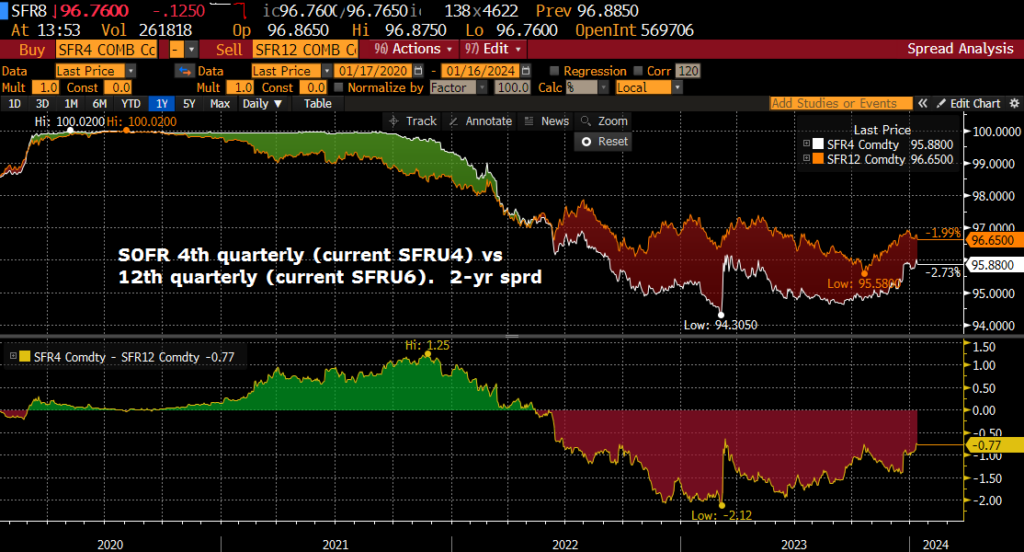
–Attached chart relates to a trade yesterday: +20k SFRU4 9675c vs -20k 2QU4 9750c, pay 3 for front Sept. Synthetic long U4/U6 spread which settled -76.5 (diff between strikes is -75). This trade should work fabulously well if the Fed eases aggressively this year, the earlier the better.
— Retail Sales today expected 0.3 to 0.4. Industrial production 0.0%. 20 year auction, Beige book, several Fed speakers.
Rate cut trades
January 15, 2024
******************
Heavy SOFR options trade Friday. Below are some selected plays.
New low in SFRH4/SFRH5 one-year calendar at -163.5 bps. Every spread from SFRU4 forward made new highs. Rolling red/green SOFR pack spread was pretty much between -40 and -55 from July to the Sept expiration, and between -20 and -35 from early Nov to Dec expiration; it settled Friday just above zero, the first positive settle since early 2022.
–SOFR options trades Friday:
+80k SFRH4 9525.0/9537.5/9543.75/9556.25 c condor for 0.75
+20k SFRH4 9537.5/9543.75cs 0.5
+20k SFRG4 9500/9506.25cs 2.25
+30k SFRG4 9512.5/9525/9537.5c fly for 1.0
-50k SFRH4 9487.5/9500/9512.5/9525 call condor vs 9462.5p sold at 5.5 (exit)
these trades reflect the idea that the Fed will be forced into early rate cuts. SFRH4 settled 9501. Recall first ease in 2007 was 50 bps.
SFRU4 settled above the 9600 strike at 9602.5. Recall in several contract months including U4 there were large buyers of 9600/9700 c spreads for 8 to 13 bps. Settled 39.75/13.0 or 26.75.
+8k SFRZ4 9650/9700/9750c fly for 6.0 (settled 5.5 ref 9637.5). This trade targets 3% by year end. The Fed’s SEP projects an end-of-year FF target at 4.6%.
+250k 2/14/24 expiry VIX 17 calls ~0.79. (underlying 14.46).

Markets with high uncertainty giving me the blues
January 14, 2024 – Weekly Comment
**************************************

Blue Monday is said to be the most depressing day of the year, typically the third Monday in January. It’s on top of us. But, spin a little bit of BB King, and you’ll shake it off pretty fast.
I don’t quite feel like I can trust any of the news or data that’s been spinning out, so I thought ‘Nobody Loves Me But My Mother (and she could be jivin’ too)’ might capture that skepticism. That’s the world we’re trading in.
In the three months since the middle of October every treasury yield from tens in fell over 100 bps. The two-year yield dropped from 5.22 to 4.134 as of Friday’s futures settlement. Same with fives, high of 4.96 to 3.83. Tens hit 4.99 in October, posted a low of 3.79 in December and are now 3.95. Thirties reached 5.11 in October, plunged to 3.95 in late December (so over 100 bps at the low), and are now 4.19.
The first SOFR contract which is lower in yield than the five year is December’24 at 9637.5 or 3.625%. SOFR contracts are above 9617, or 3.83, the 5-yr yield, all the way out to September 2031 (SFRU’31 = 9617). That means positive carry; the yield on longer dated paper can be profitably financed with shorter term borrowing. (High point is SFRZ’25 at 9689)
From BBG: “Over the next several weeks, governments from the US, UK and the eurozone will start flooding the market with bonds at a clip rarely seen before. Saddled with the kinds of bloated deficits that were once unthinkable, these countries – along with Japan – will sell a net $2.1 trillion of new bonds to finance their 2024 spending plans, a 7% increase from last year, according to estimates from Bloomberg Intelligence.”
The White House projects a US deficit of $1.8 trillion in 2024, which is, of course, the bulk of what is cited in the BBG article. The last SEP, from the Dec FOMC, projected end of 2024 Fed Funds at 4.6%, end of 2025 at 3.6%, and end of 2026 at 2.9%. The market has airbrushed 2024 out of the picture, and gone right to 2025. The 2025 projection of 3.6% is right where SFRZ4 settled on Friday, 9637..5 or 3.625%. SFRZ5 is approaching the 2026 FF estimate of 2.9 at 9689 or 3.11%. How does the US government shove another 1.8t of debt down the market’s gullet? The Fed can make the whole thing happen with positive carry. Et voila, foie gras.
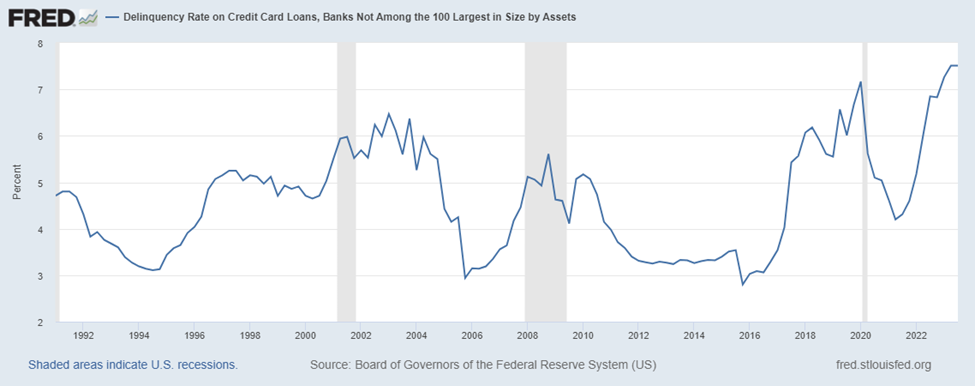
However, accommodating Federal fiscal largesse likely crowds out the private sector and could easily re-ignite smoldering inflationary embers. On the other hand, the household sector is showing increasing signs of stress on the frayed edges. The delinquency rate on credit card loans (all commercial banks) is 3%, which hasn’t been this high since 2012. The delinquency rate on credit cards loans (not among banks in the 100 largest) is a record 7.5%.
A Fortune article from last week sports this headline:
2023 was a worse year for corporate bankruptcies than 2020 – and the highest since the GFC – after a stunning 72% surge, S&P Global finds
At the start of the subprime mortgage crisis in 2007, many labeled problems in that little corner of the market as “a mile wide and an inch deep”. Analysts thought it just wasn’t large enough to spill over into the broader economy. I skimmed through a few articles about subprime in 2007. This one outlines many of the problems quite succinctly. It’s from 1-November 2007.
I love the concluding paragraph:
Now attention focuses on the wider economy. So far, the business sector has acquitted itself decently, manifesting an underlying strength. The global economy also keeps booming. While spreads have narrowed in the wake of the rate move, it will take months to see how consumers react. Will mortgage delinquency rates continue to rise, and trigger financial markets to lose confidence again? Will Wall Street scare Main Street enough for consumers to stop buying? If that doesn’t happen, and we avoid a recession, the credit crunch may go down as a summer squall, rather than a force 10 storm.
Now it’s all about “landing” scenarios rather than perfect storm analogies. Don’t worry comrades, the storm comparisons are right around the corner.
In 2007 stocks topped in mid-October, right after a 50 bp cut in September from 5.25 to 4.75%. A pullback ensued in late October, and another run for the high occurred right at the end of Oct, corresponding to another rate cut of 25 bps to 4.5%. That rally failed. It’s right when the article above was published. We know what happened next. A proper storm.
There are many complicating factors in the present environment. At the top of the list, in my opinion, is the threat of expanding military and terrorism conflicts. Domestically, I think that Stephanie Pomboy (in an interview on Thoughtful Money) synthesizes a huge issue. She said it’s well known and accepted that the government inflated moral hazard relating to banks and the corporate world in the aftermath of covid. But she cites current non-payment of student loan debts and rising credit card delinquencies as akin to a household payment strike, awaiting (another) government bail-out. After all, even after the moratorium on education loan payments ended, the Biden administration keeps dangling out hints that loans will be forgiven. Given the circumstances, and the likely lack of penalties, those who are dutifully making payments are chumps. That mindset is a huge problem going forward.
There’s a lot of talk about the Fed pivoting in order to influence the election. I don’t personally believe that’s in Powell’s DNA. However, the Fed does have to walk the line between the possibility of defaults crushing the economy, and the idea that easier policy feeds into fiscal stupidity (in an attempt to kick a heavier can a bit further down the narrowing road). In any event, the market is forecasting increasing geopolitical risks and a weaker global economy to result in rate cuts. Look back at 2007: 75 bps of cuts in two meetings. On Friday SFRH4/SFRM4 settled at a new low -56.5 (9501/9557.5). SFRH4/SFRH5 settled at a new low of -163.5 (9501/9664.5) down 21 on the week. FFG4/FFG5 settled -182.5! Maybe these spreads aren’t as crazy as they look, even if certain Fed members continue to jawbone higher-for-longer.
The defiant Taiwan election adds to uncertainty of the Middle East.
OTHER THOUGHTS / TRADES
The curve steepened by a lot last week. On 5-Jan 2/10 closed -34.5. On Friday I marked it at -18.6. Last year in July, the low in 2/10 was -108.5. By the end of October it rallied to -16, nearly 100 bps. Recent low in mid-Dec is -53.5, and it’s now back testing last year’s high.
In 2007, 2/10 went from around -15 in March to around +50 in August, before the first ease. By March 2008 It was 200. So, a move of over 200 bps in a year. A similar magnitude would put 2/10 at ~ +100.
On Friday, Feb VIX 17 calls were bought in size 250k. I believe price was 0.79. BBG lists open interest at 91k (cover short and double up the other way?) The highest OI in Feb VIX calls is the 20 strike at 334k, with premium of 0.51. Spot VIX ended last week at 12.7, pretty much at pre-covid levels. In April 2007 VIX was around 12.7. In October it hit 80. I’m not sure that 2007 is the right template for today, but it wouldn’t surprise me at all to see VIX hit 20 before Feb expiration.
Last week I suggested buying SFRH4 9481.25p delta neutral (3.75, -0.29d vs 9493.0). Given Logan’s assertion that we’re no longer in a super-abundant reserve regime, I thought vol might firm significantly in near contracts. It didn’t. However, Friday’s settles showed a small profit due to gamma: puts settled 2.0 and futures 9501. Lose 175 bps on puts per hundred, make 232 on futures.
20-year auction on Wednesday. Ten-year tips on Thursday. There was very heavy trade in SOFR options Friday, weighted heavily to upside. Will summarize on tomorrow’s daily.
| 1/5/2024 | 1/12/2024 | chg | ||
| UST 2Y | 438.7 | 413.4 | -25.3 | |
| UST 5Y | 400.7 | 383.0 | -17.7 | |
| UST 10Y | 404.0 | 394.8 | -9.2 | |
| UST 30Y | 420.0 | 419.5 | -0.5 | |
| GERM 2Y | 256.8 | 251.7 | -5.1 | |
| GERM 10Y | 215.6 | 218.4 | 2.8 | |
| JPN 20Y | 136.0 | 130.7 | -5.3 | |
| CHINA 10Y | 252.0 | 252.2 | 0.2 | |
| SOFR H4/H5 | -142.5 | -163.5 | -21.0 | |
| SOFR H5/H6 | -34.0 | -21.0 | 13.0 | |
| SOFR H6/H7 | 6.5 | 13.0 | 6.5 | |
| EUR | 109.43 | 109.51 | 0.08 | |
| CRUDE (CLH4) | 73.86 | 72.79 | -1.07 | |
| SPX | 4697.24 | 4783.83 | 86.59 | 1.8% |
| VIX | 13.35 | 12.70 | -0.65 | |
Conflict escalates, curve steepens
January 12, 2024
******************
–Solutions are becoming painfully obvious. China CPI was -0.3 in December from a year earlier. All you need is a dysfunctional government that dominates economic activity, crushing debt, and a property bust (CRE). Fold in equity market weakness. The US is on the right path to quell inflation…just need the equity market to buckle.
–CPI in the US was a bit higher than expected, yoy 3.4%. Rate futures sold off post-data, but late buying materialized by those with knowledge of the Houthi bombing plans, and futures closed at the highs. Strongest SOFR contracts were Dec’24 and March’25, both up 14.5 to 9622.5 and 9651.0. As an example of the volatility, SFRZ4 was 9613.5 pre-CPI, traded down to 9605.5, and then soared late in the day to 9624.5. As the US and UK are drawn deeper into the chaos of the mideast, there’s a flight to the safety of shorter maturities. The two-year was down over 10 bps at futures settlement, to 4.26%. Tens fell 5 bps to 3.977%. This morning CLG4 is near $75/bbl, up around $3, and Feb Gold is 2050/oz, up over $30. It’s not clear to me that global military conflict hastens the need to ease monetary policy, but the move toward safety is dominant. FFJ4 settled 9486 or 5.14%, vs what would be 5.08% in EFFR on a 25 bp cut. So, the market is about 75% certain of a 25 bp cut. Taiwan election is this weekend.
–News today includes PPI expected 0.1 with yoy 1.3% from 0.9% last.
–The curve steepened as shown on attached chart. 5/30 made a new high for January at +29, and has taken out highs from October.

–High of last year in 2/10 is -16, set on Oct 31. Subsequent low was -53.6 on Dec 15. We’re now at the highest levels since early Nov at -28.3.
The pattern is a bit different on 5/30. The high was set early in the year on May 10 at 40.8. The Oct high corresponding to the year’s high in 2/10 was 27.4. Yesterday (12-Jan) we exceeded that high at 28.9.
Williams tempers Logan
January 11, 2024
******************
–CPI expected 0.2 m/m and 3.2% yoy vs 3.1 last. Core expected 3.8% from 4.0 last.
Jobless Claims 210k. Budget Statement. 30y auction.
–NY Fed’s Williams pushed back on expectations for a near term decrease in QT, saying there’s currently “no signs of adverse effects on market functioning”. He noted that the FOMC said “…it intends to slow then stop the decline in the balance sheet when reserve balances are somewhat above the level it judges to be consistent with ample reserves” adding, “…we don’t seem to be close to that point.”
–Yesterday USH settled 122-05, down 8, but this morning it’s up 17 at 122-22, even as thirties are auctioned this afternoon.
–Option plays in SOFR continue to target upside. For example, a buyer of about 45k SFRH4 9606.25/9612.5cs for 0.75 (Settled there vs 9493.0). Open interest in March SOFR calls rose 95k on the day. There was also a seller of about 20k SFRG4 9500c at 5.0 (settled 4.75). Upside plays on SFRZ3 prior to option expiration ultimately fizzled, but hope springs eternal (for a crashing economy).
Tens and Williams today, CPI tomorrow
January 10,2024
*****************
–SEC site was compromised, leading to erroneous info about bitcoin etf approval. Though it caused a bit of volatility in bitcoin, price action wasn’t easily discernible from any other day’s activity. Of course, they could NEVER hack the BLS right? On the other hand DoD is pretty good at keeping secrets, so we got that going for us.
–Rates were boring yesterday. Tens up 2 bps to 4.019%. Solid 3-year auction, with tens today and thirties tomorrow. NY Fed’s Williams speaks today, shortly after futures settlements are posted, 3:15 EST.
–CPI is tomorrow. Jan midcurve options expire Friday. Both 0QF4 and 2QF4 atm straddles settled 15 (midcurve straddles on SFRH5, 9636.0s and SFRH6 9670.5s). There was a block yesterday, +SFRU4 9500/9450p 1×2 which settled 3.25 (8.75/2.75). This trade works if the Fed just stays on hold and doesn’t ease. Of course, there are also a lot of trades predicated on cuts starting as soon as March, for example a buy of SFRH4 9500/9512.5/9525c fly for 1.25 (settled 1.0 ref 9491.5). SFRZ3 went out at 9463 on option settle, a rate just above EFFR of 5.33%. A cut in March would mean EFFR of 5.08 or 9492.0; the next FOMC is May 1, about six weeks into the period. The 9500 strike could be in play, and of course the contract just traded at that price, but time is starting to bring final settle for H4 into focus (in the absence of large outside catalysts).
–Yesterday, Barr, Fed Vice Chair on banking supervision, indicated that the BTFP would likely NOT be renewed when it ends on March 11. This program was put in place for the regional banking emergency last year. Funds may be borrowed for 1 year; current level isn’t huge at $141 billion. Perhaps a takeaway is that the Fed is slowly pulling back the banking safety nets. Over the weekend, Logan noted that bank reserves are no longer super abundant, and said that repo rates might display some volatility as liquidity is distributed through the system. At the margin there might be a bit more pressure on the banking system. Possible that the de-stigmatized discount window comes back into play?
Digital value
January 9, 2024
****************
–Yields a bit lower yesterday, tens fell 4.4 bps to end just under 4%.
–News today includes NFIB Small Business Optimism expected 91 from 90.6. Trade balance. 3 year auction. 10s and 30s Wed and Thursday. CPI Thursday.
–New all-time high NVDA, up 6.4%. Bitcoin future soared over $3k, now over $47k. CLG4 was down just over $3/bbl to 70.77 at settlement. From Kobeissi letter: Since this morning [Jan 8], the S&P 500 has added ~$500 billion in market cap.
–Consumer Credit released yesterday for Nov was up $23.7 billion, with the total surpassing $5t for the first time. In comparison Home Mortgage Debt is around $13t. Revolving was up $19.1b at a blistering 17.7% annualized pace. A bit odd in a world of 22% credit card rates. Somehow I don’t think the credit card users are the same ones that own NVDA and bitcoin.
Financial Turbulence Ahead?
January 8, 2024
****************
–Once again, a couple of summary points from Lorie Logan, Dallas Fed President.
First, noting that financial conditions (long end rates) eased significantly since October, the Fed may have to hike FFs.
Some model-based term premium estimates remain higher than levels seen last summer, but I’m mindful that all else equal, a lower term premium leaves more work to be done with the fed funds target.
Second, some pressures in repo are normal:
The emergence of typical month-end pressures suggests we’re no longer in a regime where liquidity is super abundant and always in excess supply for everyone. In the aggregate, though, as rate conditions demonstrate, the financial system almost certainly still has more than ample bank reserves and more than ample liquidity overall.
Third, the Fed is going to slow, and likely end QT:
So, given the rapid decline of the ON RRP, I think it’s appropriate to consider the parameters that will guide a decision to slow the runoff of our assets. In my view, we should slow the pace of runoff as ON RRP balances approach a low level.
–Friday’s headline Employment number was solid, with NFP 216k and a rate of 3.7%. However, some of the internals were apparently weak. In stark opposition to NFP, the employment component of Service ISM was just 43.3, the lowest since Covid, and 5 points lower than any reading since 2021. In any case, tens closed back above 4%, up 5.1 bps to 4.042%, and thirties ended at 4.20%. Auctions will be a test this week, 3s, 10s and 30s, Tues, Wed, Thurs.
Like a lot of stocks, Boeing had a spectacular run, jumping over 50% from the late Oct low of 176 to the Dec high 267. With aircraft problems seen over the weekend, pre-market it’s around the 38% retrace, which is 232. JPM had a similar, though smaller magnitude, straight up run since end of October, +28% from 135 to last week’s high 173. Possible that we’ll see financial market turbulence affecting the big banks/XLF?
If You Build It…
January 7, 2024 – Weekly Comment
**************************************
I’m coming right out with an admission that I am lifting this idea from Doomberg, so that I can hopefully tiptoe around the plagiarism peril that plagues our “cut-and-paste” world. I didn’t realize the extent of the construction boom until I saw the Doomberg charts, (copied below). Of course I recall that Lorie Logan, President of the Dallas Fed, made these comments in a speech in October of 2023: [more on Logan and her momentous speech from this weekend below]
Some of my contacts highlight a significant increase in manufacturing and nonbuilding construction, both nationally and in this region. The number of manufacturing construction projects in Texas is the highest in 22 years. With so many projects in the pipeline, construction contract values are also at record highs. Some of this activity appears related to initiatives to spur clean energy, infrastructure and the domestic semiconductor industry.
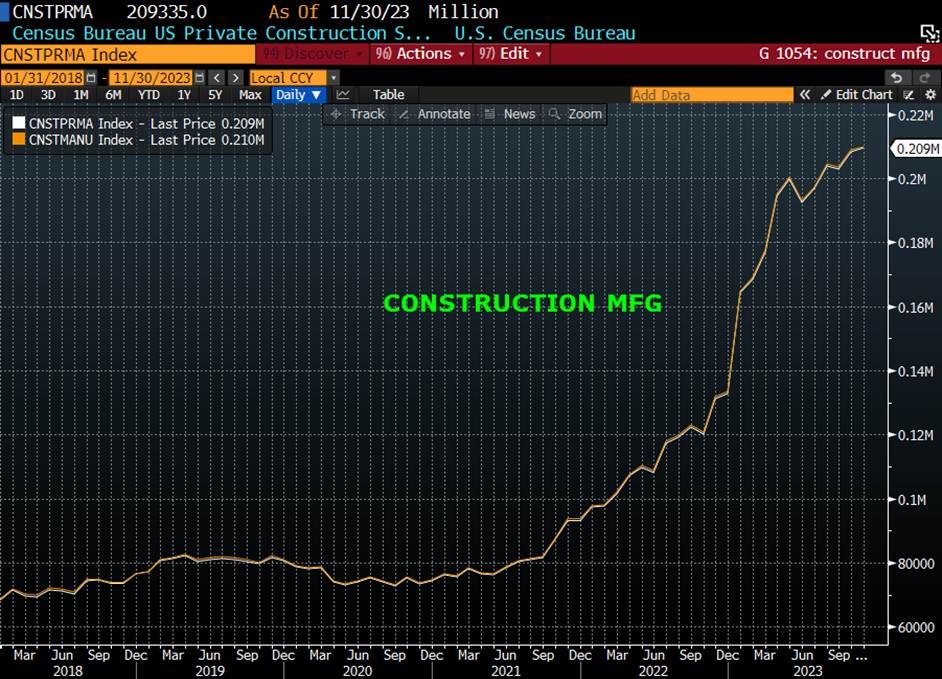
Last summer, in June 2023, this article from the Treasury Dept cited the surge in construction spending for manufacturing facilities. From the article: “Real manufacturing construction spending has doubled since the end of 2021. The surge comes in a supportive policy environment for manufacturing construction: the Infrastructure Investment and Jobs Act (IIJA), Inflation Reduction Act (IRA) and CHIPS Act each provided direct funding and tax incentives for public and private manufacturing construction.”
[CHIPS ACT signed in August 2022]
- The boom is principally driven by construction for computer, electronic, and electrical manufacturing—a relatively small share of manufacturing construction over the past few decades, but now a dominant component.
- Manufacturing construction is one element of a broader increase in U.S. non-residential construction spending, alongside new building for public and private infrastructure following the IIJA. The manufacturing surge has not crowded out other types of construction spending, which generally continue to strengthen.
Again from Doomberg:
With the country awash in cheap hydrocarbons and the federal government throwing a gusher of cash at the manufacturing sector through laws like the Infrastructure Investment and Jobs Act, Inflation Reduction Act, and CHIPS and Science Act, a boom in manufacturing construction is underway, and this “surge in construction will eventually translate into a surge in hiring for manufacturing jobs.”
I suppose one can make the argument that extraordinary deficit spending by the gov’t has sparked the boom in mfg construction, which will lead to a seamless hand-off of renewed growth to the private sector, which might help pay down the deficits.
Not yet, it seems.
The payroll report was released Friday. Manufacturing payrolls were up just 6k (26k in Nov). From the BLS, “In December construction employment continued to trend up (+17k)… Construction added an avg of 16k jobs per month in 2023, little different [but lower] than the 2022 avg of 22k.”
Over calendar year 2023, payrolls increased by an average of 225k per month. (The outsized month was January at 472k). Of that, government added an average of 56,000 jobs per month in 2023, more than double the average monthly gain of 23,000 in 2022. So, 25% of all jobs added were in government. Still feeling positive about forward growth?
In December, health care added 38k jobs; the average growth was 55k in 2023, compared with the 2022 average monthly gain of 46k. Nearly half of job gains in ’23 were gov’t and health care. A cynic might claim that outsized deficit spending simply added another layer of government on top of government, a likely impediment to forward growth. And it’s making people sick.
**************************
Dallas Fed President Lorie Logan gave a momentous speech Saturday. Here’s the link:
https://www.dallasfed.org/news/speeches/logan/2024/lkl240106
First, from the Dec 13 FOMC minutes:
Several participants remarked that the Committee’s balance sheet plans indicated that it would slow and then stop the decline in the size of the balance sheet when reserve balances are somewhat above the level judged consistent with ample reserves. These participants suggested that it would be appropriate for the Committee to begin to discuss the technical factors that would guide a decision to slow the pace of runoff well before such a decision was reached in order to provide appropriate advance notice to the public.
It’s clear that Logan was a major participant in that part of the discussion, and that slowing QT will likely be announced at the Jan 31 FOMC. From her speech on Saturday:
The emergence of typical month-end pressures suggests we’re no longer in a regime where liquidity is super abundant and always in excess supply for everyone. In the aggregate, though, as rate conditions demonstrate, the financial system almost certainly still has more than ample bank reserves and more than ample liquidity overall.
…
So, given the rapid decline of the ON RRP, I think it’s appropriate to consider the parameters that will guide a decision to slow the runoff of our assets. In my view, we should slow the pace of runoff as ON RRP balances approach a low level. Normalizing the balance sheet more slowly can actually help get to a more efficient balance sheet in the long run by smoothing redistribution [of liquidity] and reducing the likelihood that we’d have to stop prematurely.
In addition, she warned about easing financial conditions since October and said another hike could be needed to counteract the stimulative effects of looser conditions.
Yet over the past few months, long-term yields have given back most of the tightening that we saw over the summer. We can’t count on sustaining price stability if we don’t maintain sufficiently restrictive financial conditions.
Part of what appears to be happening is that when the data are strong, as occurred over the summer, market participants perceive a wider range of potential rate outcomes and require compensation for that risk in the form of higher term premiums. And when the data soften, as happened recently, that term premium comes out because market participants perceive more of an upper bound on policy rates. Some model-based term premium estimates remain higher than levels seen last summer, but I’m mindful that all else equal, a lower term premium leaves more work to be done with the fed funds target.
On Friday, SFRH4 atm 9493.75 straddle settled 18.75 ref 9493.0. There are 68 days until expiration, and the market currently assigns significant odds of an ease at the March 20 FOMC (> than 2 in 3). Logan’s comments about the ‘normal’ return of month-end pressures, and the possibility of a hike, along with uncertainty related to QT, suggest to me that SFRH4 vol is too low. An undercurrent of Logan’s comments is that liquidity distribution may entail some friction, or stress, but in an environment where liquidity is generally ample, some evidence of stress is a feature, not a bug. Logan’s speech is sort of a counterpoint to Powell’s tacit acceptance of easier financial conditions. This was an important speech. It will be interesting to see if her comments are echoed by other Fed officials.
Logan ran the NY Fed’s desk. She is likely more experienced, knowledgeable and connected to the markets than any other Fed President, or board member for that matter. Most Board members are academics.
*****************
Does a 15-17 bp back-up in yields last week suggest enough of a concession for auctions to sail through this week?
3y on Tuesday, $52b
10y Wednesday, $37b
30y Thursday, $21b
CPI is on Thursday. Expected 3.2% yoy with Core 3.8%.
Taiwan election on January 13.
| 12/29/2023 | 1/5/2024 | chg | ||
| UST 2Y | 426.0 | 438.7 | 12.7 | |
| UST 5Y | 385.0 | 400.7 | 15.7 | |
| UST 10Y | 388.0 | 404.2 | 16.2 | wi 404.0/03.5 |
| UST 30Y | 403.0 | 420.0 | 17.0 | wi 420.0/19.5 |
| GERM 2Y | 240.4 | 256.8 | 16.4 | |
| GERM 10Y | 202.4 | 215.6 | 13.2 | |
| JPN 20Y | 138.2 | 136.0 | -2.2 | |
| CHINA 10Y | 256.0 | 252.0 | -4.0 | |
| SOFR H4/H5 | -156.5 | -142.5 | 14.0 | |
| SOFR H5/H6 | -35.0 | -34.0 | 1.0 | |
| SOFR H6/H7 | 8.5 | 6.5 | -2.0 | |
| EUR | 110.38 | 109.43 | -0.95 | |
| CRUDE (CLG4) | 71.65 | 73.81 | 2.16 | |
| SPX | 4769.83 | 4697.24 | -72.59 | -1.5% |
| VIX | 12.45 | 13.35 | 0.90 | |
https://www.dallasfed.org/news/speeches/logan/2023/lkl231009