QRA and FOMC
January 31, 2024
******************
–Today’s news includes Treasury Quarterly Refunding Announce at 8:30, FOMC at 2:00 followed by 2:30 Press Conference.
In addition, ADP at 8:15, ECI at 8:30, Chicago PMI 9:45 (all EST).
–Yesterday featured a pre-data buy of 51k TYH4 111.25/110.25ps for 21, settled there ref TYH4 111-20. JOLTs higher than expected 9026 vs 8750. (However, UPS lays off 12k and there have been other significant layoff announcements). Employment data is on Friday.
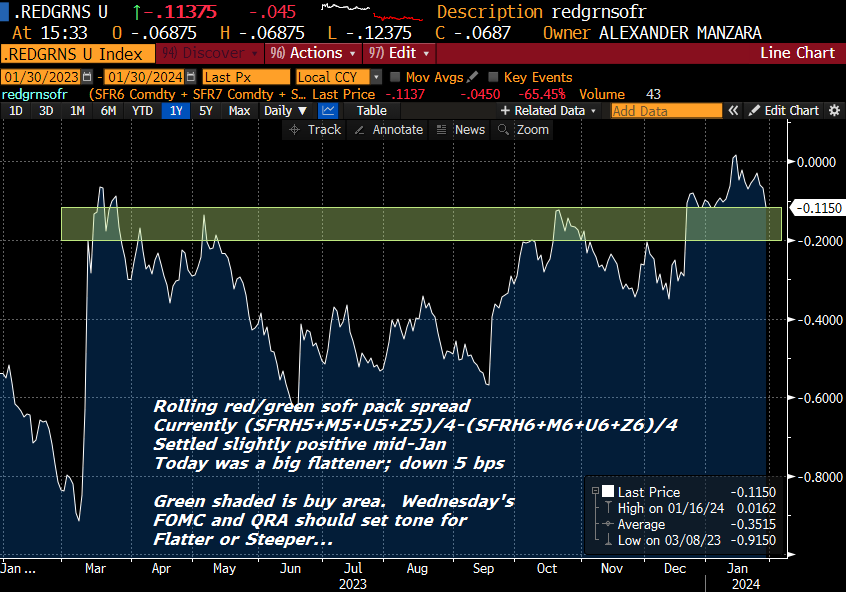
–At futures settlement (but prior to GOOGL and MSFT earnings) the curve had flattened significantly as odds for a March ease were trimmed slightly. For example, FFJ4 was sold down to 9477 and settled 9477.5 (-1.5) or 5.225, closer to the current EFFR of 5.33 than an ease of 5.08. SFRH4/M4 settled at a new recent high of -40 (9485.5, -2.0 vs 9525.5, -4.0). As the attached chart shows, the red/green SOFR pack spread fell almost 5 bps to -11.75. In treasuries, the 2y yield rose 3.7 bps to 4.357% while 30s sank 5.2 bps to 4.278. I marked tens at 4.057% at futures settle, but down another couple of bps later in the electronic session. All indicative of a slight decline in confidence regarding a March cut.
–Disappointment with GOOGL’s results (and MSFT to a lesser extent) has caused a pullback from all-time-highs. Nasdaq futures currently -1.2% and GOOGL is -5.7% pre-open.
–Fed still likely to set the table for a March ease as inflation levels have neared target. Real rates are significantly positive. 5 and 10 year inflation indexed note yields have been around 1.75% for a month and a half. QT trimming also will be a topic at the press conference, likely to be implemented after the March FOMC.
Treasury shaves borrow estimate
January 30, 2024
******************
–Early trade: buy of 70k TY week-1 110.75/100.00 p spread for 9/64. Expires Friday, so captures FOMC, QRA, NFP and earnings reports. Open interest in the two puts +66k and +59k. Settled 8 vs TYH4 111-165.
–Late trades (post-Treasury borrowing estimate) two block buys of TU (+7.6k 102-218 and +15k 102-223) appear to be exits as OI in TUH4 declined 21k. Block buy of 21742 FVH4 107-30 vs sale 4432 WNH4 126-30 also looked like exit. OI in WNH4 fell 6.8k.
–The late bid in treasuries, which has carried into this morning, was sparked by Treasury’s reduced borrowing estimate for the quarter. ($760b from original estimate of $816b). Actual composition of issuance will be released Wednesday. From Treasury:
- During the January – March 2024 quarter, Treasury expects to borrow $760 billion in privately-held net marketable debt, assuming an end-of-March cash balance of $750 billion.[2] The borrowing estimate is $55 billion lower than announced in October 2023, largely due to projections of higher net fiscal flows and a higher beginning of quarter cash balance.[3]
- During the April – June 2024 quarter, Treasury expects to borrow $202 billion in privately-held net marketable debt, assuming an end-of-June cash balance of $750 billion.[4]
–Of course, Blinken referring to the MidEast situation as “incredibly volatile” probably adds to treasury buyers at the margin, and China’s ten year yield at a new historic low of 2.45% (just below the 2020 low of 2.47) underlines economic woes there.
–Dallas Fed Mfg was notably weak at -27.4. Outside of Covid there’s but one slightly lower reading from last year. Today’s news includes Consumer Confidence, strong at 110.7 last, JOLTS, expected 8750k vs 8790k last. Earnings post-close from MSFT and GOOGL. MSFT closed at an all-time high yesterday and is > $3T mkt cap. It has doubled 3x since 2016 when it was ~50, now 409.72. GOOGL also at an all-time high yesterday 153.51. Market cap near $2T. So, adding the market cap of those two equates to around 17% of US GDP. The change in Treasury’s borrowing estimate of $50 billion is a 1% change in value of MSFT + GOOGL.
–Ten year yield fell 7.2 bps yesterday to 4.087%…nearing 4 again.
..
https://home.treasury.gov/news/press-releases/jy2054
Fed week
January 29. 2024
*****************
–Yields rose Friday in a relatively quiet session, net changes on the week in rate futures were small. On Friday the weakest contracts were the first two reds, SFRH5 and M5, both down 8 at 9629.5 and 9648.5. On the week those two contracts were -0.5. The ten year yield was up 3.1 on Friday to 4.159%. PCE Core prices yoy +2.9%, but just 1.9% six-month annualized, below target.
–Today’s news includes Dallas Fed Mfg expected -11.8 from -9.3 last. Treasury releases its financing estimate for the quarter; QRA is Wednesday. FOMC also Wednesday.
–China’s Evergrande has been ordered to liquidate, but there’s a news bullet this morning: *China to step up support for listed firms, Vice Premier He Says. SOFR and treasuries trading modestly higher this morning; ten year yield currently 4.10%.
Big Week
January 28, 2024 – Weekly Comment
******************
There’s a lot going on this week. FOMC and Refunding Announcement on Wednesday. Payrolls on Friday. Earnings announcements by MSFT and GOOGL on Tuesday, AAPL, AMZN, META on Thursday.
Not much change in rates last week. SOFR contracts were 1.5 bps on either side of unchanged out four years. Treasuries Fri to Fri: FVH4 107-217 to 107-207. TYH4 111-04 to 111-01, USH4 120-00 to 119-18.
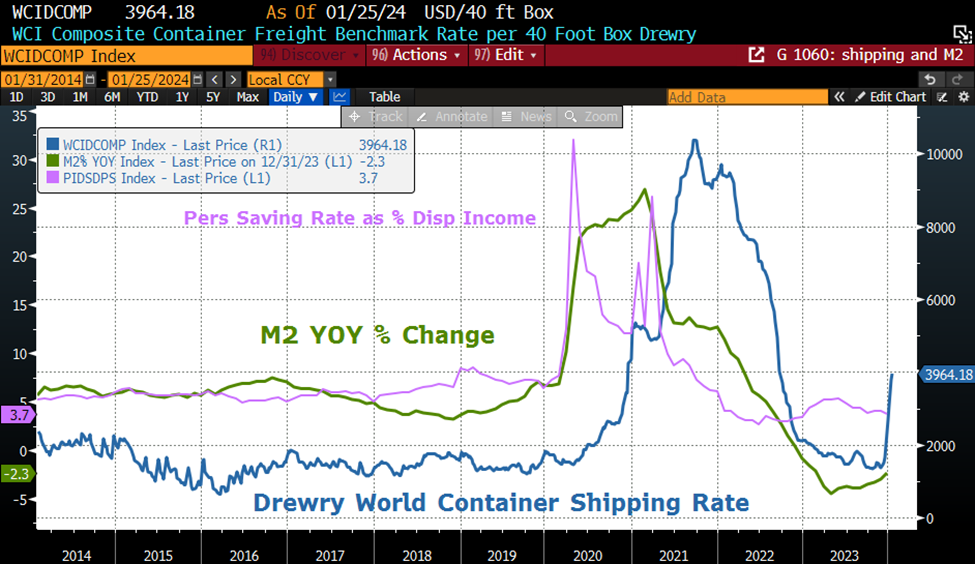
One thing that did have a significant move was oil, with CLH4 settling 78.01, up 4.76 or 6.5% on the week, highest since November. Of course, that move is due to Red Sea attacks and other geopolitical issues. I saw a chart of Container Shipping Rates which is included on the chart below. The recent surge is thought to be inflationary as oil prices and shipping/insurance costs jump.
Many charts over the past five years follow the same basic pattern: a huge spike associated with covid shutdowns and stimulus, followed by reversion lower. What’s interesting about the Shipping chart is that it is making a new run. However, I included M2 yoy growth and the Personal Savings rate (as % of Disp Income) on the chart below. M2 is negative and well below pre-covid. The Savings rate is just 3.7, also below covid levels, and that’s with much higher interest rates which should encourage saving.
I also include the chart below from the St Louis Fed, Commercial Banks Loans and Leases, % change yoy. It’s a bit difficult to see, but it begins 2014, the shaded area is, of course, the covid recession, which corresponded with large draws on credit lines. The most recent reading of +2.3% is the slowest growth outside of the post-covid reversion.
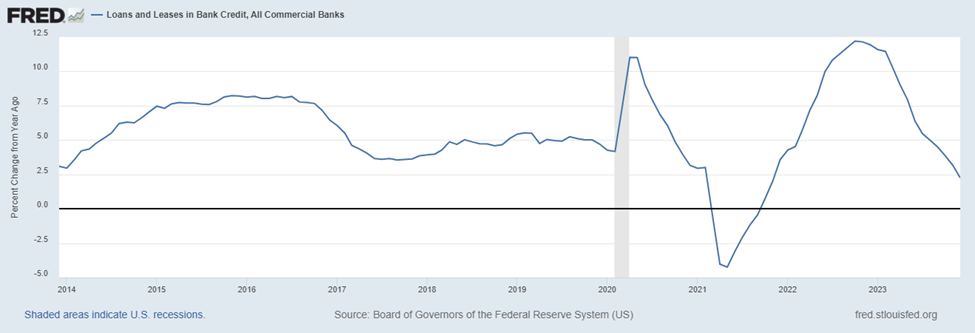
My point here is that oil and shipping costs may have a temporary effect on inflation, but without support from M2 (or a large jump in velocity) and without credit growth, it’s difficult to see a sustained increase. The low savings rate suggests that consumers are already stretched, and not likely to create a big new surge in demand.
However, that’s not to say that yields can’t move significantly higher, especially on the long end. Both the quarterly refunding plans and the Fed’s discussions about scaling back QT will likely have a large impact. Treasury’s financing estimate for the quarter will be released Monday, Jan 29. The expected composition of issuance is released Wednesday.
Last quarter’s recommended financing table is included below. In the lower section, provisional indications for the upcoming quarter are included.

Total funding needs are huge. According to provisional indications, 7s and 10s could increase $3 billion per month, and 30s $2b per month larger than Q4.
Last quarter the Treasury weighted issuance more heavily toward t-bills. I don’t think that’s as likely this time. The long bond yield topped at 5.11 in October, and plunged in the next two months to sub-4%. However, it appears as if the 4 handle has been rejected, and Friday ended at 4.39%.
Core PCE prices yoy were just 2.9% (released Friday). Payrolls are expected to show lower growth, with NFP expected 180k on Friday. In my opinion, both inflation and growth are trending moderately lower and are inclined to continue along that path (regardless of temporary Red Sea problems). Wednesday’s FOMC is likely to support an ease at the March meeting, though many analysts are emphatically saying it would be a policy error. The Feb/April FF spread at -11.5 (9468/9479.5) currently leans slightly toward ‘no ease’. Of the five huge stocks reporting this week, MSFT, META and GOOGL are at all time highs and AAPL is only 3.5% away. There are clearly arguments to be made both ways. However, longer dated treasuries must contend with supply which could easily push yields higher over the next couple of months.
| 1/19/2024 | 1/26/2024 | chg | ||
| UST 2Y | 438.9 | 436.5 | -2.4 | * no roll adjust |
| UST 5Y | 408.0 | 405.9 | -2.1 | * no roll adjust |
| UST 10Y | 415.0 | 415.9 | 0.9 | |
| UST 30Y | 436.0 | 438.8 | 2.8 | |
| GERM 2Y | 273.0 | 263.3 | -9.7 | |
| GERM 10Y | 234.0 | 229.9 | -4.1 | |
| JPN 20Y | 146.0 | 151.7 | 5.7 | |
| CHINA 10Y | 251.6 | 250.2 | -1.4 | |
| SOFR H4/H5 | -144.0 | -143.0 | 1.0 | |
| SOFR H5/H6 | -29.0 | -30.5 | -1.5 | |
| SOFR H6/H7 | 10.5 | 11.5 | 1.0 | |
| EUR | 108.98 | 108.55 | -0.43 | |
| CRUDE (CLH4) | 73.25 | 78.01 | 4.76 | |
| SPX | 4839.81 | 4890.97 | 51.16 | 1.1% |
| VIX | 13.30 | 13.26 | -0.04 | |
Delusions
January 26, 2024
******************
–Once again, GDP stronger than expected with Q4 Advance reported at 3.3%. ZH notes that in nominal dollars, Q4 GDP rose by $329b, but the US budget deficit over the same period rose $510b…”In other words it now takes $1.55 in budget deficit to generate $1 of growth…” As I mentioned after the last employment report, in calendar year 2023, 25% of all new jobs added were by government.
–Today brings the Fed’s preferred inflation data. PCE prices expected 0.2 m/m and 2.6 yoy from 2.6 last. Core expected 0.2 with yoy expected 3.0 from 3.2 last.
–Attached chart shows 2/10 (amber) and 5/30 (white) with the vertical line being the last Qtrly Refunding Announcement. The initial move was flattening as funding was shifted toward the front end. Currently, 5/30 is actually near a new high at 36.2 (accentuated by a few bps due to the switch to the new 5y). The high in the spread last year was 41 bps in May, in the aftermath of the regional banking crisis. That level has been the highest since March 2022. My bias is for further steepening as the Fed begins to cut rates, though the refunding composition and changes to QT are also important factors.

–Despite GDP, yields were lower on the day. Tens fell 4.8 bps to 4.128%. On the SOFR strip, reds rose over 7 bps and greens 6 bps.
–Next week includes FOMC and Treasury Refunding Announcement on Wednesday. Alphabet and MSFT report on Tuesday, AMZN, AAPL, META on Thursday. Payrolls on Friday.
–I don’t often stray into the political sphere, but here’s a clip from Yellen’s speech yesterday, emphasis added:
“Real wages have risen from their pre-pandemic levels—especially quickly for middle-income households. And because wages have risen more than prices, middle-class Americans now have more purchasing power. New Treasury analysis shows that a worker earning the median wage can today buy the same goods and services as in 2019, with nearly $1,400 left over to save or spend. And families are now putting their extra income and their accumulated pandemic-era savings back into the economy.
Put simply, it’s been the fairest recovery on record.”
In my opinion, the public at large doesn’t seem to view it as a fair and booming recovery. Perhaps it’s a bit closer to Dean Phillips’ characterization:
Rep Dean Phillips, Presidential Candidate: “We have a duopoly, a two-party system that is literally working against voters…. my party is completely delusional right now“
Policies, politics and provocations
January 25, 2024
******************
–ECB meeting today. As usual, news articles are advancing the idea of a Central Bank push-back against near term ease. Reasonable enough, I guess. But calendar spreads in futures continue to signal significant rate cuts. At yesterday’s settles, ERH4/ERH5 -143.5 (9616/9759.5) and SFRH4/SFRH5 -146.0 (9484/9630).
–The Fed announced yesterday it will not renew the Bank Term Funding Program and immediately raised the rate going forward until the program expires in mid-March. This band-aid was instituted due to the regional bank crisis in March of last year. Banks could pledge treasuries at par (even at market prices well below par) and borrow up to a year at OIS +10 bps. This created positive carry as t-bill/ff rates are significantly higher. In December the Fed approved Norinchukin NY branch as a participant; balances increased from about $114b in December to $161b now. I suspect political pressure to end the program started at the same time. The size really isn’t large enough to have a major market impact in my opinion, though discount window usage is likely to surge. The fact that treasuries have rallied and prices are closer to par probably eased some pressure as well.
–Reports this morning that Ukraine hit a Rosneft Refinery. CLH4 currently up over a dollar at 76.26.
–Poor 5y auction: 4.035% at 1:00pm, actual result 4.055, a 2 bp tail. Bid/cover just 2.31. Sevens today.
–Q4 advance GDP expected 2.0. Atlanta Fed GDPNow at 2.4% as of Jan 19. Jobless Claims 200k from 187k last. New Home Sales expected 649k
–A surge to new highs failed in ESH, from up 38 points at high to slightly negative at end of day. After the close TSLA warned of slower growth, down 2.3% in the afternoon and about 7% now.
–Yields a bit higher across the board yesterday. On the SOFR strip reds to golds down 2.5 to 5 bps. In treasuries 10s and 30s up 3.6 bps to 4.176% and 4.411%.
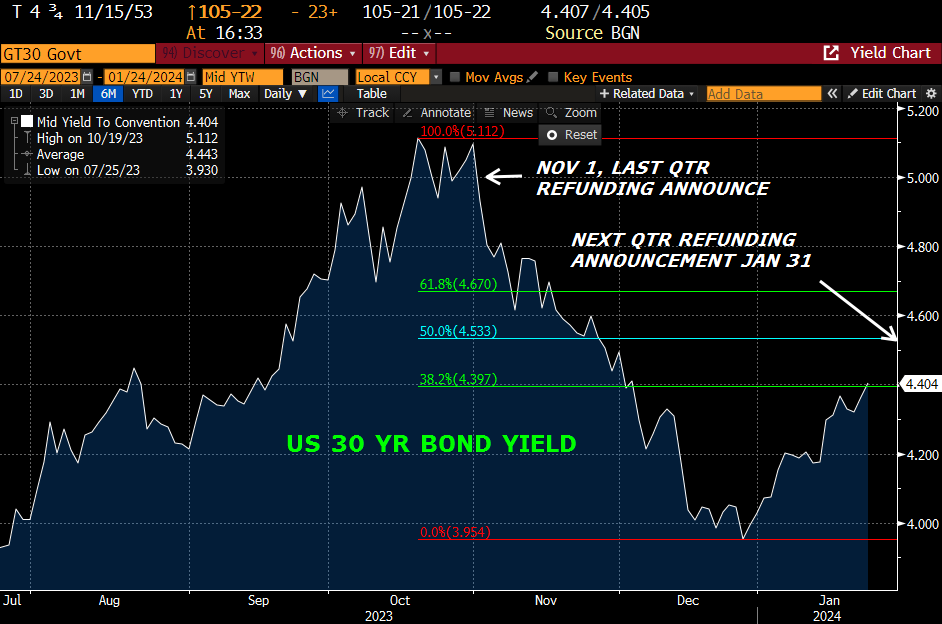
–Attached chart shows the > 100 bp drop in the 30y yield from end of October to end of December, the start of which corresponded to the Treasury’s Quarterly Refunding Announcement which weighted new issuance toward the short end. All yields dropped, so while the auction details may have had an impact, it’s just one factor of many. In any case, the next QRA is January 31, same day as FOMC. Certainly the FOMC will also include discussions about trimming QT. My thought is that 30’s will go into that meeting around the halfway point of the previous two-month rally, that is, around 4.53% or about 12 bps higher than late yesterday. I would guess around 117-16 in USH. If using highs and lows on the USH4 contract, 10/23 low was 107-03 and 12/27 high was 125-30, so halfway is 116-16.
FOMC in one week
January 24, 2024
******************
–Big buyer +23754 TUH vs -9817 UXYH about $895k DV01. Steepener likely works best on rate cut signal at the Jan 31 FOMC, but may also be impacted by the Quarterly Refunding Agreement. Open interest in TU was up 39.6k and UXYH4 OI was up 11.7k, so substantially due to this trade. Prelim open interest also shows a whopping increase of nearly 58k in the FV contract in front of today’s 5y auction. If those were pre-auction hedges I would expect the 5y auction to be solidly bid. Treasury curve did steepen, with (old) 2y up about 0.5 bps to 4.38 and tens +4.6 to 4.14%. 30s + 6 to 4.375%.
–After countless thousands of call fly and condor purchases on March and June SOFR contracts, finally a significant put buyer: on block SFRK4 9475p bought for 3.0 in size 108k. SFRM4 is underlying contract, settled 9527.5. Option expires 10-May, so captures May 1 FOMC. Open interest up just shy of 110k in that put. The pit graciously settled the option at 2.25, though in fairness it did trade 2.5 in the pit after the block. This trade is likely just a protective play for no ease.
–News today includes S&P PMIs expected 47.6 from 47.9 in Mfg, 51.5 from 51.4 Services and Comp 51.0 from 50.9
–Netflix beat and China cut RRR to arrest the freefall in stocks.
–This is sort of a fun chart comparing the size of country’s shares on Global GDP to equity market shares: (Japan’s equity share in the 1980’s is a real stunner)
Is 150 bps six cuts?
January 23, 2024
******************
–Yields eased in quiet trade on Monday; SOFR curve became slightly more inverted. For example, SFRM4 was unch’d at 9527, but M5 was +4.5 at 9653.5 and M6 was +6.5 at 9665.5. SFRM4/M5 settled -126.5. For the past month on settlement basis it’s been between -120.5 and -131.5. The most inverted one-year spread is the front SFRH4/H5 at -148.5. Near one-year calendars: FFG4/G5 is -150, SFRH4/H5 is -148.5, FFJ4/J5 is -154 and SFRM4/M5 is -126.5. The unsurprising conclusion by analysts is that there will be about 150 bps of ease over the year. The January meeting is NOT priced for an ease, and there are 8 FOMC meetings a year, so that pretty much means an ease of 25 bps at every meeting after Jan. While the 2004/2006 tightening cycle followed the 25 bp per meeting schedule, easing tends to be a bit more disjointed.
–There was an interesting Odd Lots podcast (BBG) with Jason Cummins, chief econ at Brevan Howard. His bias is that the Fed will begin to ease, that the labor market is weaker than it appears, and that inflation is likely to undershoot the Fed’s expectations. He notes that in June’23 the Fed’s projection for Core PCE was 3.9% for year end, and it actually finished at 3.2%. The point is that it was a fairly large miss from the Fed. Key points are 1) the Fed has a deep aversion to being forced into quick policy reversals. 2) The employment part of the dual mandate is becoming much more important and 3) the 2007/2008 experience may provide a reasonable template for this year.
–BOJ kept policy steady but noted a gradual firming of inflation. China is unleashing new measures to support its relentlessly offered stock market. Today’s US news includes Philly non-mfg which was 6.3 last. Two-year auction today, wi was 4.34% at the time of futures settlement.
–Yellen slated to give a speech touting the administration’s infrastructure spending/success on January 25, Thursday. FOMC is Jan 31, as is the Quarterly Refunding Announcement.
The Rime of the Ancient Mariner
January 21, 2024 -weekly comment
******************
Day after day, day after day,
We stuck, nor breath nor motion:
As idle as a painted ship
Upon a painted ocean.
-Samuel Taylor Coleridge
I don’t know enough about shipping (and military) affairs to determine how much weight should be placed on current issues. All I do know is that supply chain problems were a large contributor to the initial surge in inflation. I’m sure the current disruptions won’t be nearly as bad as 2020/21, but many analysts have opined that inflationary aspects can’t be ignored. I’m just clipping a bunch of notes together so that I personally have a better understanding.
From the Council on Foreign Relations regarding Houthi attacks in the Red Sea (Jan 12)
The Red Sea is one of the most important arteries in the global shipping system, with one-third of all container traffic flowing through it. Any sustained disruption in trade there could send a ripple effect of higher costs throughout the world economy. This is particularly true of energy: 12 percent of seaborne oil and 8 percent of liquified natural gas (LNG) transit the Suez Canal.
From CNBC (Jan 11) about the Panama Canal and low water levels:
In an advisory to clients, Maersk informed shipping customers that vessels that use the Panama Canal will no longer be traversing the canal with freight from Oceania (Australia and New Zealand) because of the ongoing water situation.
Forty percent of all U.S. container traffic travels through the Panama Canal every year, which in all, moves roughly $270 billion in cargo annually.
From ZeroHedge (Jan 20)
On Thursday, top container shipper AP Moller-Maersk sent a memo to customers, warning how the global shipping network is fracturing because of the elevated risks in the Red Sea:
“While we hope for a sustainable resolution in the near-future and do all we can to contribute towards it, we do encourage customers to prepare for complications in the area to persist and for there to be significant disruption to the global network.”
From Thoughtful Money with guest Jim Bianco (Jan 19)
Sailing around the Horn of Africa rather than traversing the Red Sea takes an additional 3300 miles and ten days.
Obviously the factors above entail significant cost increases in terms of shipping goods. Now let’s move more to the military aspects.
From Geopolitical Futures by George Friedman (Jan 16)
But it is not only the Pacific with which it is concerned. The Atlantic is not at risk right now, but just as it was a central figure in both world wars, so too could it be in the future. AUKUS [Australia, UK, US] members understand that any existential threat they face will come from the sea.
On December 14, Navy Sec’y Carlos Del Toro “called on the nation to help the Navy return to being a global leader in shipbuilding.”
“History demonstrates a clear pattern: no great naval power has ever existed without also being a dominant commercial maritime power, encompassing both shipbuilding and global shipping,”
Del Toro referenced a series of statistics: China dominates the global commercial shipbuilding industry today with over 40 percent of the market controlled by its shipyards. In just 20 years, the People’s Liberation Army Navy has tripled in size and is projected to have a fleet of over 400 warships by 2030.
China also has the world’s largest fishing fleet and third largest merchant marine fleet, exceeding 7,000 ships, compared to the United States’ 178 , which ranks 70th. China controls a significant portion of the global commercial maritime supply chain, he said.
Del Toro envisioned a multi-pronged approach to putting the United States on top in shipbuilding, including investing in the revitalization of the U.S. shipbuilding industry and merchant marine fleet; developing innovative technologies to maintain its naval edge; strengthening partnerships with key allies to counter China’s growing influence; and promoting fair competition.
From Marine Link (marinelink.com Jan 21)
The United States and Japan are looking to make a deal for Japanese shipyards to regularly overhaul and maintain U.S. Navy warships so they can stay in Asian waters ready for any potential conflict, U.S. Ambassador to Japan Rahm Emanuel said on Friday.
China has more than 370 ships and submarines, up from the 340 ships they had in 2023, according to an annual report released by the Pentagon in October, making it numerically the largest navy in the world.
I don’t know what the market implications are, besides higher shipping prices at the margin, and increased hoarding of inventories by businesses and (aware) consumers. It seems to me that no matter which political party wins the upcoming election, shipbuilding is going to be a growth industry, and there are probably a myriad of specialized suppliers that will see large increases in orders.
Like one, that on a lonesome road
Doth walk in fear and dread,
And having once turned round walks on,
And turns no more his head;
Because he knows, a frightful fiend
Doth close behind him tread.
OTHER THOUGHTS
Last week the short end of the curve once again trimmed odds of near-term easing. Twos and fives (both being auctioned this week) rose about 25 bps in yield, while the 30y yield rose 16.5.
SFRH4/SFRM4 three-month calendar has had a huge round-turn move in the past couple of weeks. On Friday, January 5 it settled -41 (9493/9534), obviously reflecting ease in Q2. One week later, on Jan 12, it settled -56.5 (9501/9557.5) as military activity heated up in the Red Sea. On Jan 19, it came right back to -41 (9486/9527). BIG moves for a three month spread. The bias is still heavily weighted toward ease, but the panic of the previous week abated as economic data gives little reason to support lowering rates.
There’s a lot of talk about trimming QT; I think consensus is that the Fed will trim the size of treasury sales right after the March FOMC. Last week Waller indicated that MBS sales should continue at the current pace of $35b per month, saying there’s no reason for the Fed to have MBS on the balance sheet. Since the Fed doesn’t hedge and the private market does, I suppose there’s an argument for slightly higher bond vol.
This week includes 2, 5 and 7-year auctions starting Tuesday. Q4 Advance GDP estimate on Thursday, expected 2.0%. Atlanta Fed GDP Now is 2.4%. New York Fed Nowcast is also 2.4%.
Friday brings Core PCE Prices, expected +0.2 on the month and 2.6% yoy. Core expected +0.2 on the month and 3.0 (from 3.2 last).
| 1/12/2024 | 1/19/2024 | chg | ||
| UST 2Y | 413.4 | 438.9 | 25.5 | |
| UST 5Y | 383.0 | 408.0 | 25.0 | |
| UST 10Y | 394.8 | 415.0 | 20.2 | |
| UST 30Y | 419.5 | 436.0 | 16.5 | |
| GERM 2Y | 251.7 | 273.0 | 21.3 | |
| GERM 10Y | 218.4 | 234.0 | 15.6 | |
| JPN 20Y | 130.7 | 146.0 | 15.3 | |
| CHINA 10Y | 252.2 | 251.6 | -0.6 | |
| SOFR H4/H5 | -163.5 | -144.0 | 19.5 | |
| SOFR H5/H6 | -21.0 | -29.0 | -8.0 | |
| SOFR H6/H7 | 13.0 | 10.5 | -2.5 | |
| EUR | 109.51 | 108.98 | -0.53 | |
| CRUDE (CLH4) | 72.79 | 73.25 | 0.46 | |
| SPX | 4783.83 | 4839.81 | 55.98 | 1.2% |
| VIX | 12.70 | 13.30 | 0.60 | |
https://www.poetryfoundation.org/poems/43997/the-rime-of-the-ancient-mariner-text-of-1834
That’s a lot of derivatives
January 19, 2024
*****************
–Yesterday’s price action featured little change in the front end, but higher yields along the back with pronounced weakness in the long bond. Two-yr yield up 0.5 bp to 4.357, 10s +4.0 to 4.142 and 30s +5.9 to 4.369. Similar changes on SOFR curve, SFRM4 +1 to 9610, M5 -1.5 to 9654.5, M6 -4.0 to 9658 and M7 -5 to 9646. My bias is that this steepening will develop into a strong trend in the back end of the SOFR curve, but more about that later.
–A friend called yesterday in an exercise to try to peg June’24 SOFR. His base assumption is that once the Fed begins easing, it will do so in 25 bp increments at every meeting. The main question became whether the first ease comes March or May. My personal bias is that the first ease will be in March, but of course there are strong arguments against that scenario, some being made by Fed officials. Recall the first ease in 2007 was a 50 bp cut, and we all know that the recent hikes weren’t in clean increments of 25, so the base assumption could well be faulty.
–When Dec’23 options expired, the market pegged the 9462.5 strike exactly. A lot of calls above that level went out worthless. Currently, SFRH4 is 9489.5. The 9487.5 straddle settled 16, so b/e 9471.5 and 9503.5. Open interest in the future contract is 1.16 million, the most of any contract on the strip. What’s somewhat interesting is that open interest in H4 calls (not including Fed serials) is 6.8 million, 4.25x as much as the future. The call strike with the largest OI is 9500c at 774k, settled 3.75. (Call your Congressman and warn her about $7 trillion of derivatives on March SOFR. Her reply, “What’s that? I only trade NVDA”). Anyway, everyone knows that there have been massive buys of call condors and butterflies to peg the March 15 option settle of SFRH4. The FOMC meeting is March 20. It’s almost all about the ease, not much about the ‘hold’. According to settles one could almost sell the straddle and buy the 9500c for 12.5. Complete protection on the upside. But open risk below 9475…
–Blue midcurves don’t really trade much, but IF steepening starts to take hold, then nominal levels of blue straddles should start to converge toward reds. From yesterday’s settles, 0QM4 9650^ settled 70.0 ref SFRM5 9654.5. 2QM4 9662.5^ settled 62.0 ref SFRM6 9658, and 3QM4 9650^ settled 60.5 ref SFRM7 9646.0. Not recommending anything here, but I think blues are a bit low on a relative basis.
–One trade of interest, SFRZ4 9625/9700/9775c fly bought vs selling 9487.5p, paid 5.0 for 20k. Settled 4.0. Max profit at 3% (9700) by the end of the year. SFRZ4 is 9610; the Fed’s FF projection for end-of-2024 is 4.6%.