Fuel crisis
October 11, 2021
–CLX1 is up 2.00/bbl this morning at 81.35, a new high. A skim of headlines is all about energy prices and crisis. Coal prices at all-time high in China as “floods swamp mine hub”. FT leads with a story about gas shortages in Europe. Lebanon was plunged into darkness as electrical grid operators ran out of fuel. Reuters has a piece about Japanese inflation 10-year breakeven having moved up to 36 bps last week from about 7 bps in July. With the start of earnings season, the impact of higher costs is a hot topic. Last October, one year ago, CLZ1 was just under $40/bbl. It’s now more than double that price. If it doesn’t double again by next year we can safely say that the rate of change has slowed, therefore, transitory.
–EDM2 was sold in size over 100k on Friday at 9978 to 77. Open interest rose by a like amount or 109k. This morning the contract prints 9975.5 as a modicum of uncertainty has crept into the front end. All yields are a bit higher this morning in front of auctions tomorrow and Wednesday (3’s, 10’s, 30’s). CPI is out on Wednesday.
–On Friday near euro$ one-year calendar spreads posted new recent highs. For example, EDZ1/EDZ2 settled 38.0, up 1.5 on the day and EDU2/EDU3 (peak spread) settled 74, up 2 on the day. Both rose 8.5 on the week. The ten year yield closed just above 1.60%, up 3.4 on the day.
–Stocks are also lower this morning, but ESZ is still 100 points above the important lows made in the beginning of the month (4260 to 4273). In 1492, Columbus sailed the ocean blue… On what used to be a holiday, conditions might be thinner than usual.
Unemployment rate supports taper
October 10, 2021 – Weekly Comment
The unemployment rate is back where it was in 2006-2007, having printed 4.8% on Friday. In this earlier period, U-rate fell as the Fed hiked rates every single meeting for two years from 2004 to 2006. In May 2004 the unemployment rate was 5.6%. The Fed began its tightening campaign in June 2004, starting from a FF target of 1% and ending in June 2006 at 5.25%. By October 2006 the unemployment rate had fallen to a low of 4.4%. In Q3 2006, CPI also peaked, at 2.9%. Employment is a lagging indicator.
In December of 2015, when the Fed gingerly started its last hiking effort, unemployment was 5.0%.
Currently, the FF target is between 0 and 0.25%. Unemployment is 4.8%. CPI is 5.3% and PPI is 8.3% and there is lingering uncertainty over whether Friday’s data can support the start of tapering, It’s absurd.
Yields finished Friday at recent highs. The five year ended (at futures settlement) at 1.05%, (+11.5 bps on the week), tens at 1.603% (+14) and thirties at 2.162% (+12.6). It’s been three years since the last peak in rates. Below is a table showing highs and lows:
5 YEAR 10 YEAR 30 YEAR
2018 HIGH 3.09 3.24 3.45
2020 LOW 0.19 0.51 0.99
HALFWAY 1.64 1.875 2.22
5 year avg 1.62 1.97 2.48
NOW 1.05 1.60 2.16
This week features inflation data and auctions. On Wednesday, CPI is expected 5.3% with Core 4.1%. FOMC minutes also released on Wednesday. On Thursday, PPI expected 8.7% with Core 7.1%. Friday features Retail Sales, with a slight anticipated decline of -0.2%.
Auctions of $58b 3-yr notes and $38b tens on Tuesday, followed by $24b thirties on Wednesday. According to the TBAC schedule only $27 billion is maturing, so these auctions of $120b represent new funding of $93 billion. (Where’s THAT money going to come from?) The increase in yields last week might make these sales more attractive, but the severity of the negative real return highlighted by inflation data might still make buyers pause. Crude oil closed the week at its highest level since 2014, with CLX1 settling 79.35. The Bloomberg Commodity Index is at its highest level since early 2015, now 102.62.
On the week, several Eurodollar one-year calendar spreads posted new highs. The peak spread is still EDU’22/EDU’23 which encompasses the libor transition, it closed at 74, a new high for the year, up 8.5 on the week. The weakest part of the ED curve was the green pack (3rd year forward) which fell nearly 15 bps in price to an average of 98.59 or 1.41%. The red pack (2nd year forward) fell just over 11 bps to an average of 99.20 or 1.80%. On the Fed Fund curve, Jan’22/Jan’23 calendar, which captures an expected hike before the end of 2022, rose 6 on the week to 32. So there is now actually a bit more than one hike being priced. EDZ’21/EDZ’22 closed at 38, up 8.5 on the week. The most aggressive curve projecting near term hikes is Short Sterling, where Dec’21/Dec’22 closed at 70, up 10.5 on the week and up 35 in the past month. The Short Sterling Dec’21/Dec’22/Dec’23 butterfly closed 52.5, a new high, indicating front-loaded hiking. By comparison, EDZ’21/Z’22/Z’23 fly settled NEGATIVE 30.5 as rate hikes aren’t expected until tapering ends. (The near Z1/Z2 spread is 38, while Z2/Z3 is 68.5). EDZ’22/Z’23/Z’24 is POSITIVE 25 (68.5 vs 43.5).
There has NOT been panicked reaching for puts in US rate futures, but almost all other factors indicate that higher rates are in store. Another 25 bps in the ten year to 1.87% would only put us at the 50% retrace of 2018’s high to 2020’s low. Monday’s Columbus Day will probably be less liquid than usual, with the possibility of more of an auction concession being priced.
OTHER MARKET THOUGHTS/ TRADES
On Friday there was a seller of over 100k EDM2 at 99.78. The contract settled 9976.5. With total volume over 518k, this was the most heavily traded contract on the strip (13% of all ED futures volume). The next nearest contract in volume was EDZ’22 with 459k trading. Open interest in EDM2 rose 109k, so this was a new seller; total OI in dollars up 213k. 3-month libor has been anchored at 12 to 13 bps. EDM2 at 9976.5 is a rate of 23.5. Perhaps that rate could be achieved without an actual hike, if credit problems cause a libor re-set. However, even with issues permeating China’s property sector, Investment Grade CDX remains below 54 bps, well within the year’s range of 46 to 58.
The IMF’s Global Outlook is released Tuesday, sure to devote a large section to China’s current travails and to global debt to GDP levels (unsustainable).
Last week I suggested 3EH 9775p for 4.5 or 4EH 9750p for 5.0. 3EH 9775p settled 6.75 and 4EH 9750p have not yet opened, but BBG lists nominal settle at 6.75. I would currently favor blue or green midcurve puts as the curve is showing signs of bear flattening going forward.
| 10/1/2021 | 10/8/2021 | chg | ||
| UST 2Y | 26.2 | 31.6 | 5.4 | |
| UST 5Y | 93.1 | 104.7 | 11.6 | |
| UST 10Y | 146.2 | 160.3 | 14.1 | |
| UST 30Y | 203.6 | 216.2 | 12.6 | |
| GERM 2Y | -70.4 | -69.1 | 1.3 | |
| GERM 10Y | -22.4 | -15.1 | 7.3 | |
| JPN 30Y | 65.6 | 69.2 | 3.6 | |
| CHINA 10Y | 287.7 | 290.4 | 2.7 | |
| EURO$ Z1/Z2 | 29.5 | 38.0 | 8.5 | |
| EURO$ Z2/Z3 | 62.0 | 68.5 | 6.5 | |
| EURO$ Z3/Z4 | 43.5 | 43.5 | 0.0 | |
| EUR | 115.97 | 115.77 | -0.20 | |
| CRUDE (active) | 75.88 | 79.35 | 3.47 | |
| SPX | 4357.04 | 4391.34 | 34.30 | 0.8% |
| VIX | 21.15 | 18.77 | -2.38 | |
https://home.treasury.gov/system/files/221/TBACRecommendedFinancingTableQ42021-08042021.pdf
The taper report
October 8, 2021
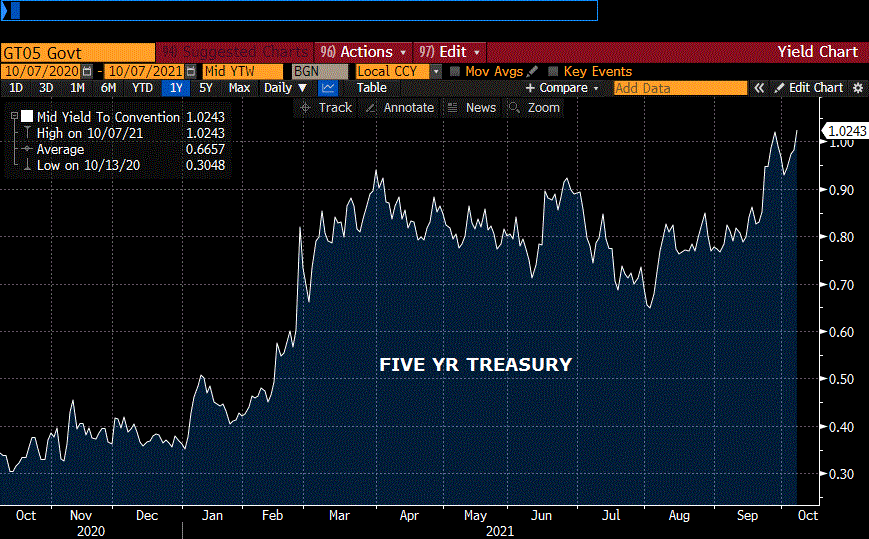
–Going into the ‘taper’ employment report, with oil near new highs and yields at their recent extremes. NFP expected 450 to 500k, which should be adequate to guarantee the onset of taper in November. Attached is a chart of the US 5y yield, 1.02% late yesterday and printing 1.04% this morning. Tens added 4.8 bps yesterday to end at 1.569% at futures settlement; TYZ settled 131-125 but immediately slid another few 32’s, trading 131-07 now. New highs in a couple of the near eurodollar one-year calendars, with EDZ’21/EDZ’22 rising 3 bps to 36.5. The peak one-yr is still EDU’22/EDU’23 at 71.5. CLX is above $79/bbl this morning as the idea of releasing oil from SPR (strategic reserves) was reversed.
–In late September the last gold euro$ contract (20th quarterly, now EDU’26) fell below 9800 with settles of 9796.5 and 9797.5. It now prints 9795. High yield for US tens this year has been around 1.75%, 18 bps away from yesterday’s settle which is about 1.5 points in futures, approximately 129-29. Good size buying in TYX 131p yesterday; settled 20/64 with an increase of 26k open interest. TYZ futures added 37k new positions, indicating hastily placed downside hedges. Again, fives are already at new highs for the year.
–NFP below 400k would leave a question regarding taper, but given what appear to be increasing inflation pressures, the week’s high of 132-08+ is likely safe.
Balanced
October 7, 2021
–A short-term debt limit extension helped ESZ burst out of the 4265/4360 range of October, now at 4380. Energy Sec’y Granholm suggested tapping strategic reserves, a factor in WTI pulling back from new highs.
–Rate futures were relatively quiet with tens easing slightly to 1.521%. ADP data was stronger than expected at 568k, but the previous month was revised down 34k from 374 to 340. On the dollar strip, the red pack (2nd year forward) was weakest on the board settling down 2 on the day. The average price of the reds is just above 99.26 or about 75 bps, versus current 3m libor of 12.5 bps. I have tracked FFN’22/FFN’23 as a spread which brackets the end of next year (when many expect rate hike liftoff). That spread rose 2.5 yesterday to 51.5, telegraphing 2 hikes over that one-year time period. High settle for this particular spread has been 54, at the end of last month.
–Tomorrow is the employment report, with NFP expected 450 to 500k. Week-2 treasury options expire tomorrow. Open interest gives no particular lean as to direction, 131.5/131.25/131.0 puts have about 74k of combined open interest. 132/132.25/132.5c have a bit over 75k. With TYZ having settled 131-23, both the 131.25p and 132.25c settled 5. There were a few decent size bond put lifts. USZ settled 159-15, USX 157p (20d) settled 26 and the 162c (19d) settled 22. Treasuries feel fairly well balanced around the 1.5% yield level.
No one likes higher energy prices
October 6, 2021
–I saw a few morning bullet points yesterday about inflation breakevens making new recent highs in the US and Germany. The US ten-year note vs inflation-indexed note yield spread hit 245 bps yesterday, a recent high but below the May peak of 257 bps. Energy prices continue to surge with new highs in Natgas and CLX1. Unsurprisingly the peak on the Natty curve is Jan22 at 6.467; the near contract is the highest since 2008, when it was on its way back down from 13.57. The high in 2014 is 6.06. Some are pointing to energy prices as a reason for the stocks breaking lower early this morning…as of this writing ESZ is 4277, down 57 on the day and nearing the recent low of 4260. Maybe it’s just October.
–The 10 year gilt reached the highest yield since the middle of 2019 at 1.08%, almost exactly at the 0.618 retrace from the 2018 high of 1.72% to the Q3 2020 low of 0.08%. The German bund was -18.8 bps yesterday; the high of the year has been -10.3 bps, but this is near the high end of the range for the past 2 1/2 years.
–There is little reaction in US bonds to equity weakness, futures are slightly lower this morning as we await ADP expected around 425k. This report carries some extra weight as the St Louis Fed suggested the payroll number Friday could be weak. Implied vol was slightly firmer yesterday.
Li Index
Oct 5, 2021
–Nasdaq fell 2.1% yesterday while the ten year yield rose 2 bps to 1.481%. Interest rate trading was quiet. WTI continues to make new highs, with CLX1 at 77.60 late in the day, up 1.72, through the high of 2018. Next big test would be the 2014 high around 107.50. BBG Commodity index (BCOM) closed at the highest since 2015.
–Contagion is seeping through China’s property sector. Fantasia, a property developer, was unable to make a payment and Sinic Holdings has been downgraded by Fitch. If only there had been some clue, like the 2018 videos of China’s ghost cities. The attached chart and description concerns the Li index: Chinese Premier Li Keqiang, rather than using ‘official’ data to get a sense of the economy, preferred to use three easily measurable inputs: Electricity usage, bank lending, and rail freight. The index has recently fallen sharply to 5.87, in the era of struggles and common prosperity. Taiwan provides a useful diversion.
–On a day when Citadel’s Ken Griffin compared Chicago violence to Afghanistan “on a good day”, Mayor Lightfoot finally used the word “accountability” (according to the Tribune headline).
Lack of charges in fatal West Side shootout leads Mayor Lightfoot to criticize prosecutor Kim Foxx: ‘We can’t live in a world where there is no accountability’
The case in question involves a west side “wild west” shootout. From the SunTimes, “The police report acknowledged that victims of the shootout (more than 70 shell casings were found) weren’t cooperating [of course, some were dead]… But the report also framed the state’s attorney’s office’s decision to decline charges in a different light. ‘Mutual combatants was cited as the chief reason for the rejection.’ Mutual combat is a legal term used to define a fight or struggle that two parties willingly engage in.”
Maybe the next ‘ghost city’ video will feature Chicago’s empty office buildings as companies like Citadel leave.
Weakness in Asian shares
October 4, 2021
–Kospi at a new low since March, down 1.6%. Nikkei down 2.5% having completely erased the early September rally which had eked out a new high for the year. ESZ had been positive Sunday evening, but is now lower on the day, perhaps on continuing Evergrande issues. China’s incursions into Taiwan airspace may be another factor for weakness in Asian shares. Hang Seng is down 2.1% but not quite through recent lows made in September.
–Friday featured a solid rally in US rate futures. Tens fell 6.2 bps to 1.462%. Thirties were down 5.2 bps and are still above 2% at 2.036%. This morning yields have rebounded a couple of bps. News today includes Durables and Factory Orders, though it may be that shortages are impacting these figures.
–Jim Bianco noted that betting odds for Powell to be re-confirmed as Fed Chair had fallen since disclosure of Clarida’s covid trades. This morning on PredictIt, Powell is at 64 cents, Brainard at 26% and Roger Ferguson is at 7 cents.
https://www.predictit.org/markets/detail/7398/Whom-will-the-Senate-next-confirm-as-Chair-of-the-Federal-Reserve
–Bullard takes part in a panel discussion of the economy. From TheHill: “…Schumer on Sunday said he hopes to pass the bipartisan infrastructure bill and a reconciliation package in the next month…”
Chance – Monopoly
October 3, 2021- Weekly Comment
President Xi, from September 2, “Don’t expect an easy life and be ready to struggle.”
“Central banks should try their best to avoid asset purchases because in the long run they will ‘damage market functions, monetize fiscal deficits, harm central banks’ reputation, blur the boundary of monetary policy and create moral hazard,’ People’s Bank of China Governor Yi Gang said.” (BBG 9/28/21)
Here’s John Yarmuth, Chairman of the House Budget Committee:
“This country, because we issue our own currency, and because we borrow and spend in our own currency, we can pay for whatever we want to pay for. We just tell the treasury to pay the bills, to write the checks when the bills come in…”
“We are not like businesses, we are not like families, we are not like state governments, we are not like local governments. We don’t have to balance our checkbook. We are like the banker in Monopoly. We create the money, we hand out the money…everybody else plays the game with it.”
Like the banker in Monopoly.
The initial part of Yarmuth’s quote is directly from Stephanie Kelton’s work on Modern Monetary Theory. Her thesis is that the federal government should not worry about “how to pay for it” but rather should make political decisions about using available resources to accomplish goals in the economy. The limitation, according to what I have seen from Kelton, is inflation. That’s when we know that resources are being stretched.

On Friday, the Fed’s preferred measure of inflation was released. PCE Deflator, 4.3% and the Core measure 3.6% yoy, both the highest in 30 years (since 1991). The PCE deflator has not had a down month since November of 2020, when it registered 1.1%. From 1.1% to 4.3% in less than a year. I would call that acceleration rather than transitory. The key point is that it’s a fly in the ointment of MMT. Resources are obviously constrained; that’s why shortages are being reported everywhere and prices are rising. That’s why China is instructing companies to secure energy supplies “at all costs”. BBG reports that ‘France Steps in to Contain Energy Prices…’ in part by cutting taxes on power. “A tariff shield.” Yet the Fed’s Summary of Economic Projections has PCE inflation at 2.2% in 2022.
There’s a fair amount of press noting that economies are not having a demand issue, but rather a supply problem. For example, consider this tweet from Frances Donald (Manulife Chief Economist): “The Fed can hike interest rates all it wants, it’s not going to make it rain in Brazil, open ports in China, find truck drivers in the UK, change covid-0 policies in Australia. Bet that the Fed will hike rates if you want, but don’t bet it will help this supply-driven inflation.”
I happen to think that the Fed, by holding rates at zero while monetizing Federal spending, has a lot to do with creating the conditions that lead to shortages. Of course there are always instances of specific shortages which are absorbed and alleviated over time, whether due to natural disasters or created by man. These are one-off events that don’t lead to an increase in the general level of prices. However, widespread shortages across the economic landscape are sparking price increases which suggest more of a root cause in monetary policy. Housing prices simply don’t go up 19% a year because people want to move.
According to the Fed’s Z.1 quarterly report, Federal Debt ended 2019 at $19.04T. As of Q2 2021 it’s $24.73T. That rise is almost matched by the increase in the Federal Reserve’s balance sheet, from $4.17T to $8.1T at the end of Q2.
Speaking of Monopoly rules, this snippet is worthy of mention in light of Fed officials’ trading:
One player is the Banker. All assets of the Bank should be separate from the Banker’s own assets. [It’s called conflict of interest]
I guess that particular rule has become blurred. From Reuters: “US Federal Reserve Vice Chair Richard Clarida traded between $1 million and $5 million out of a bond fund into stock funds one day before Chair Jerome Powell issued a statement indicating potential policy action due to the worsening of the COVID-19 pandemic, BBG news reported on Friday.” I guess that was by ‘Chance’? Well, the next draw is from Community Chest:

Finally, here’s what happens when the music stops, for example for Evergrande.
The rules of Monopoly state, if you do not have enough money to pay Rent or other obligations during your turn, you may choose to sell houses, hotels, or property. Buildings may be sold to the Bank for one-half of the purchase price.
You get 50 cents on the dollar. That’s kind of like the guy that bought stock in Peloton in late January at 160, now 87. What would you rather do, take a virtual bike ride or play a good old-fashioned board game?
Here’s a final note regarding Monopoly:
In 1934, Charles B. Darrow of Germantown, Pennsylvania, presented a game called MONOPOLY to the executives of Parker Brothers. Mr. Darrow, like many other Americans, was unemployed at the time and often played this game to amuse himself and pass the time. It was the game’s exciting promise of fame and fortune that initially prompted Darrow to produce this game on his own. With help from a friend who was a printer, Darrow sold 5,000 sets of the MONOPOLY game to a Philadelphia department store. As the demand for the game grew, Darrow could not keep up with the orders and arranged for Parker Brothers to take over the game.
It was a depression-era game. The cards COMMUNITY CHEST and CHANCE are said to refer to Atlantic City: the Community Chest was a welfare organization and Chance was related to gambling.
OTHER MARKET THOUGHTS/ TRADES
The Clarida news is probably the last straw in terms of Powell’s re-nomination. I’m sure Pelosi (notwithstanding her husband’s timely investments) will be appropriately horrified by personal trading of public officials directly associated with monetary policy and jump on the Warren “Powell is a dangerous man” wagon train. Wait a second, that last sentence is quite awkward. I didn’t really mean that Pelosi engages in trading of public officials. On the other hand… you know what I mean.
We’re on the cusp of a potentially big change in Federal Reserve composition. The risk is that the new Fed will be more likely to cave in to political pressure.
More immediately, we have the all-important employment report on Friday, about which Powell said he didn’t need a “blockbuster” report for taper conditions to be met. The expectation is for NFP to be 400-500k. A concern is that the St Louis Fed put out a paper suggesting the possibility of a negative NFP print. Perhaps that’s part of the reason that yields, apart from the long end, eased by a few bps on the week. If NFP were to print negative, it would likely throw taper into question. The knee-jerk would be a rally in all treasuries, but I would expect the rally to be transitory, and a steeper curve would result.
A couple of weeks ago I suggested buying EDH’25/EDU’25 for 10 or less. Settled 12.5 Friday. This spread is blue March to blue Sept, but I would note that the blue/gold pack spread is highly correlated to movements in 10/30 treasury spread. Blue/gold settled at a new low for the year on Sept 22 at 15.75, but has since rejected that level and is now 24.25.
| 9/24/2021 | 10/1/2021 | chg | ||
| UST 2Y | 27.2 | 26.2 | -1.0 | |
| UST 5Y | 95.5 | 93.1 | -2.4 | |
| UST 10Y | 145.8 | 146.2 | 0.4 | |
| UST 30Y | 198.5 | 203.6 | 5.1 | |
| GERM 2Y | -68.6 | -70.4 | -1.8 | |
| GERM 10Y | -22.8 | -22.4 | 0.4 | |
| JPN 30Y | 67.4 | 65.6 | -1.8 | |
| CHINA 10Y | 286.9 | 287.7 | 0.8 | |
| EURO$ Z1/Z2 | 33.5 | 29.5 | -4.0 | |
| EURO$ Z2/Z3 | 65.5 | 62.0 | -3.5 | |
| EURO$ Z3/Z4 | 41.5 | 43.5 | 2.0 | |
| EUR | 117.21 | 115.97 | -1.24 | |
| CRUDE (active) | 73.98 | 75.88 | 1.90 | |
| SPX | 4455.48 | 4357.04 | -98.44 | -2.2% |
| VIX | 17.75 | 21.15 | 3.40 | |
At all costs
October 1, 2021
–Weak close in stocks to end the month as both ES and Nasdaq show signs of a broad topping pattern. While Congress wrangles with the debt ceiling and social spending bills, and the Fed hangs on to the tattered narrative of transitory inflation pressures, the message from China is blunt: “China orders energy firms to secure winter fuel supplies at all costs.” Would there even be an ‘energy crisis’ across the globe if not for central banks having turbo-charged demand? Of course, the move away from fossil fuels is also a factor.
–Jobless claims yesterday were higher than expected at 362k. A report yesterday from MNI (cited by Jim Bianco on twtr) says the St Louis Fed model sees a LOSS of 818k jobs in September. Apparently, a renewed surge in covid cases and shortages of materials is the reason. The report is based on real-time data from Homebase. https://joinhomebase.com/data/national/
–Consensus for next week’s NFP is 400 to 500k, which is the bar set for taper. A negative print would almost certainly cause a re-think. It’s amusingly circular, the Fed has created demand through monetary stimulus, which has helped create conditions leading to shortages, which negatively impacts output, which sparks the Fed to ‘fix’ it by continuing stimulus.
–Tens are back below 1.5% this morning as funds flow from stocks to fixed income. Another 30k 0EZ 9962.5/9950p 1×2 bought for 2.0. Settled there vs 9950.5 in EDZ2 (13.5 and 5.75). The 9950 straddle settled 12.0 which is probably priced appropriately for perceptions of one hike by the end of next year, but if I was forced to make a buy or sell decision I’d choose the former. By comparison, 2EZ atm straddle is double the price at 24; of course the strike price of 9887.5 is more than double the yield (50 bps vs 1.125%).
–In error I mentioned today’s data releases on yesterday’s note: Today PCE Core prices yoy expected 3.6%, same as last month. ISM Mfg expected 59.6 and Michigan Inflation expectations also released.
…
a few morning news snippets…..
German inflation hits 29-year high of 4.1%
The price of polyvinyl chloride or PVC, used for pipes, medical devices, credit cards, vinyl records and more, has rocketed 70%. The price of epoxy resins, used for coatings, adhesives and paints, has soared 170%. Ethylene — arguably the world’s most important chemical, used in everything from food packaging to antifreeze to polyester — has surged 43%, according to ICIS figures.
China orders energy firms to secure winter fuel supplies at all costs.
It’s temporary
September 30, 2021
–Schumer says the Senate reached a deal to avert a government shut-down through December, but the debt limit needs to be raised before October 18, according to Yellen (two separate issues). Stocks appear to be responding positively.
–Energy shortages continue to dominate headlines. China’s Mfg PMI slipped to 49.6 indicating slight contraction as power outages crimp production. From Reuters, “The two indexes of high energy-consuming industries…are both lower than 45.0 indicating a significant drop in supply and demand.” Spain’s inflation data is the highest in 13 years, in part due to high energy costs. Google ‘UK energy crisis’ and there are a host of articles, including BBG, ‘Three more UK Power Suppliers collapse as Energy Crisis Deepens’. CLX1 again above $75/bbl this morning. Brent Crude Dec’22 200 calls trade 11 cents yesterday.
–Everything now is dependent on cheap delivery, but delivery consumes energy. The crack in the dam: Dollar Tree raising prices over $1. However, central bankers still see prices increases as temporary, and late yesterday SF Fed’s Mary Daly says she doesn’t see conditions in place for a rate hike in 2022.
–Yields eased on the eurodollar strip with greens (3rd year forward) leading the way, up 4 on the day. The 5y treasury fell 1.4 bps to 1.01%, while tens were unch’d and the thirty year bond rose 1.5 bps to 2.087%. I’m not predicting this as a likely scenario…but if infrastructure passes and the debt ceiling is raised, while the Fed’s composition changes to tilt more toward Kashkari and Daly as energy prices explode, then the slight steepening seen yesterday will turn into an avalanche.
–New buyer yesterday 35k 3EV 9837.5/9825ps vs 9850c covered 9839.5 with 50 delta for 1 bp. EDZ’24, the underlying, settled 9838.0. It wasn’t long ago that the short call leg of this type of structure caused problems. Midcurve Oct expires 15-October.
–Today PCE Core prices yoy expected 3.6%, same as last month. ISM Mfg expected 59.6 and Michigan Inflation expectations also released. Payrolls are one week from tomorrow.

In: Eurodollar Options