Rates locked
September 25, 2020
–Once again activity in rates is moribund. Tens closed at a yield of 66.4; the range has been between 64.5 and 69.5 for the past ten sessions. October treasury options expire today.
–After perhaps reading too much into the EDZ0/EDH1 sale Wednesday at -6.5, to my consternation someone paid -6 and -5.5 for about 40k yesterday, causing a new recent high settle in the spread of -5.0. (total volume dec/march was 48k). EDZ0/EDZ1 one-yr calendar spread also closed at a new recent high of -3.5 (9973.5/9977.0). That is the lowest one-year spread on the curve, each one thereafter gently moves more positive, with EDZ1/EDZ2 same magnitude as the front, but with a positive sign (9977/9973.5). Powell said a couple of times this week that negative rates are not appropriate for the US and would harm money markets, a sentiment the euro$ strip grudgingly accepts, although there are still buyers of EDH1 100 calls. Fed fund contracts have barely reacted to repeated dismissal of negative rates. The Nov’22 contract is the peak on the strip settling at 100.00, or exactly zero. The lowest contract on that curve is the expiring front Sept contract, FFU’20 at 9991.25. The Fed effective (EFFR) has been 9 bps every day in Sept. Open interest in EDZ0 was up 42k according to prelim figures. In spite of weakness in banking stocks, the thought appears to be that EDZ can roll up to the current October (EDV0) level of 9977.5. By the way, the gap between the valuation of US banking sector and SPX is said to be at a recent record wide.
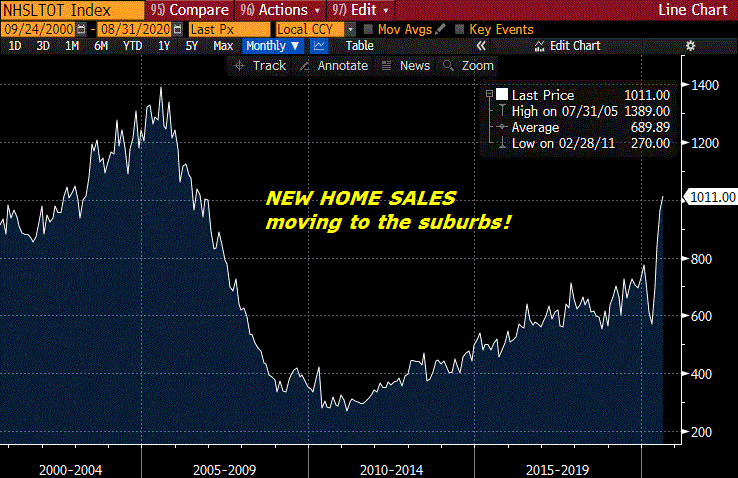
–New Home Sales yesterday were over 1 million, a level not seen since 2006. If one only considered this data they’d be hard pressed to justify record low rates for many years to come.
–Today’s news includes Durable Goods, Capital Goods Orders.
In: Eurodollar Options
Banks dragging down stocks
September 24, 2020
–Stocks were pummeled yesterday but yields barely budged, with tens at 67 bps. Precious metals also came under heavy selling pressure.
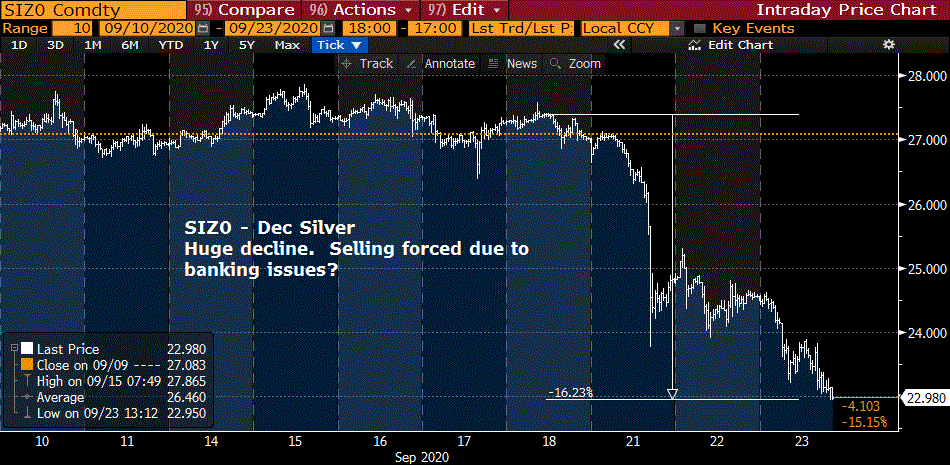
–On Monday large US bank stocks opened with a gap lower (JPM, C, BAC etc) and closed on new recent lows yesterday. The attached KBW global bank index chart is representative. On Sunday, allegations of money laundering and illegal transfers were leveled at the banks, which explains the price action. JPM was fined $1 billion yesterday for spoofing; the ramifications of protecting criminals in the financial system is more serious. Bitcoin was slammed Sunday on the laundering news (chart attached). Selling spilled over into precious metals Monday. I’ve often thought of these assets as a hedge against turmoil in the organized banking system, but in this case it almost appears as if mass liquidations occurred in products used in the avoidance of the official financial architecture. Silver is down an astonishing 16% since Friday. Of course, dollar strength is also a factor, and the Fed appears to be taking a step back to force more of a response from the fiscal side. Additionally, gold was getting support from declining real yields (as evidenced by the plunge in the ten-yr tip yield to -112 bps). That yield has now rebounded to -94 and the ten-yr inflation breakeven made a new recent low yesterday of 161 bps, having been over 180 at the end of August.
–In short, big problems in the banking system seem to be percolating, casting a negative aura over stocks in general. Interestingly, there was a large seller of 60k EDZ0/EDH1 calendar spread at -6.5 yesterday. Recent range has only been -9.5 to -5.5, but the spread had popped to the high on Poszar’s observations that turn pressure should be muted this year. Yesterday, someone faded that sentiment, selling EDZ0 and buying EDH1, (open interest +1k in EDZ0 and +27k in EDH1) which fits with the idea of broader bank issues creating funding stress. While yields didn’t move much, 5’s were auctioned at a record low of 27.5 bps on solid demand. On tap today is $50 billion in 7’s. Also worth noting is that junk bond issuance hit a record $329 billion for the year, previous high was $321b. Jobless claims expected 840k and New Home Sales also released today.


In: Eurodollar Options
Central Bank Communication
September 23, 2020
–Little reaction to Powell yesterday. His prepared testimony emphasized the Fed’s lending function as a backstop, and said the Main Street program might not be appropriate for many COVID-impacted businesses, but that the Fed has done a lot to make general credit conditions looser. In my opinion he’s placing responsibility for targeted action on fiscal agents.
–Small changes in rates with tens down 0.5 to 66.4. New all-time 3m libor low yesterday at 0.22250. Euro$ curve was flat to +1.0 on light volume. New recent low in bond straddles with USZ 177^ settling 5’16, a full point lower than a week before, when USZ 176^ settled 6’16. The contract has traded between 173-16 to 178-16 for a month and a half.
–Markit PMIs today. The Composite was 54.6 last, which was a new high for 2020. More supply today with $22 billion in 2yr FRN and $53 billion five-years.
–“When inflation is stable and predictable, that’s the way to go.” I think that’s Powell’s message, but it’s communicated with a bit more panache by the Bank of Jamaica, which, by the way, is targeting 4 to 6%. If only we could get Ozzy to sing a little song to convince the public that inflation is going to run hot…
In: Eurodollar Options
A little help?
September 22, 2020
–Powell and Mnuchin testify in front of Maxine Water’s House Financial Services Committee today. While the panel is likely to press for more direct support to small business, Bullard yesterday helpfully said that there’s enough fiscal stimulus in the pipeline to encourage a self sustaining recovery. Stocks are apparently of the opinion that more is needed in the efforts to prop up asset values; at one point the Dow was down 3% before a late day rally shaved the loss to 1.8%.
–There were several large short-end trades yesterday, all of which were accompanied by declines in open interest; possibly one player exiting positions? First, an aggressive seller of EDM1/EDM2 in size of about 30k from 1.0 to 0.5. This spread settled at a new recent low of 0.5, down 1.5 on the day. Next, a seller of about 30k EDZ0 9975c at 2.25 covered 9973.5, equivalent to 6.0 in the straddle which is the lowest it has traded. Finally a seller of 50k FFX0 at 9992.5. Fed effective has been 9 bps since late August, so in all likelihood this contract rolls down to 9991. If one had these several positions on, it would have expressed a view for more vigorous and immediate Fed easing, where both EDZ and FFX would pop higher, and the June/June spread might even widen as near contracts outperform. On the other hand, if the Fed is less inclined to do more, perhaps USD will rally, which is indeed what occurred yesterday.
–In spite of stocks testing the downside, long end yields were little changed, with tens -2.3 to 66.9 and thirties -2.6 to 1.425%. Two year auction today.
In: Eurodollar Options
All the good news is out
September 20, 2020 -Weekly comment
Last week featured the FOMC meeting. Here’s the summary: funding rates will be held near zero for the next several years in support of our new inflation-averaging scheme. We will continue our QE buying at around the same pace as currently. The economy needs more fiscal support.
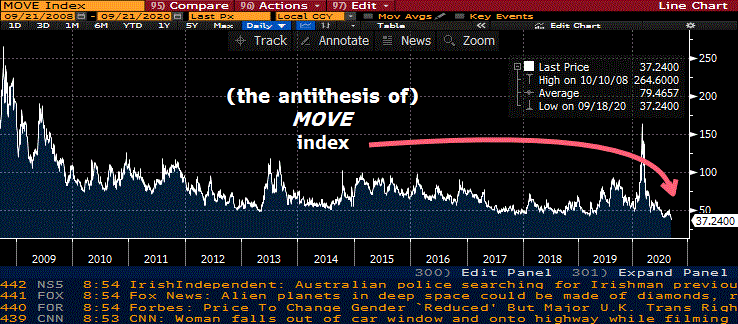
Let’s take the first part. Rates stay near zero. The market had already substantially priced that outcome. On the week the two year note rose 1 bp to 13.7 and fives rose 2.7 to 27.7. The green euro$ pack, (the third year out, EDZ’22 thru ED’23) settled on Friday at 99.70875 or just above 19 bps. The previous Friday it was 99.73375, so the change in yield was an increase of 2.5 bps. It’s true that the MOVE index made a new all-time low, so in terms of perceived forward volatility, the market did give a nod towards the Fed’s new inflation-averaging framework. But yields had already priced the outcome of “low for long” and actually increased slightly. No additional help.
Now for the second part. QE at the same pace (~ $120b per month). This could almost be thought of as a modest tightening of conditions. The amount of bond supply is growing, both from government and corporates. Through August $1.7 trillion of corporates have been issued. Spreads remain remarkably tight. This week the Treasury auctions $52b in two-year notes, $53b fives, and $50b sevens, and an additional $22b 2y FRNs. Same amount of Fed buying, more supply. No additional help.
The Fed wants more economic support from fiscal policy. A package should be forthcoming, but is currently the victim of political wrangling, which is only going to get more contentious with the fight to replace Justice Ginsburg. Fed and fiscal policies provide a good deal of the oxygen to stoke the flames of asset appreciation. The air supply is being cut back. The Fed’s balance sheet has gone sideways for the past three months.
Last week I considered equity options and highlighted large open int in Sept AAPL 112.5p of 115k. Closed at 106.84 so those puts were 5.66 in the money. On the week AAPL declined 4.6%. From the close on Sept 1 of 134.18 (almost immediately after it began trading on the split adjusted basis), it is down 20%. Is the price action from the largest market cap company in the world a signal to take a more cautionary stance in general?
Now let’s shift from macro to micro. Zoltan Poszar changed his opinion and now says turn-of-the-year funding pressures will be muted. The reason has to do with the Fed’s scoring of capital ratios for big banks, but for our purposes the market reaction tells the story. The December euro$ contract rose 2.5 bps on the week to 99.735. Spreads encompassing the turn declined. For example, EDZ0/EDZ1 one-yr calendar jumped 5 bps on the week, from -9 to -4. The spread between FFF’21 and EDZ’20 (a proxy for FRA/OIS) settled at a new low on the year of 19.5 bps. In March this spread had surged to 38. There was a reaction in terms of direction, but the magnitude was modest at best.
In the grand scheme of things, this week’s moves in rates across the curve don’t have much bearing. The broader theme is that rate markets are not providing any additional fuel to support long dated assets. If investors are inclined to buy duration (including stocks), they really have to depend on Powell’s promise of low funding rates. However, if you trust the Fed on that score, don’t you have to put equal faith in the idea of the Fed generating inflation over 2%? And might that not negatively impact the value of long dated assets (including long bonds and equities)? All of the supportive factors have reached temporary limits. Short rates are not going negative. QE buying is not likely to accelerate for a while. Fiscal stimulus is deadlocked. Spreads are tight. Even with respect to year-end funding, the good news is out.
On Thursday. Powell and Mnuchin will testify before the Senate banking Committee to beg for more support from the fiscal powers. The next FOMC is Nov 5, just under seven weeks away and just after the election. It’s highly unlikely that the Fed will change its stance on bond purchases before that time as it could be construed as political meddling. Longer duration assets are likely to be weighed down over the next several weeks, not so much because of the election outcome, but because there will be no overt additional financial help.
OTHER MARKET/ TRADE THOUGHTS
Capitulation on display this week with the crumbling of implied volatility. We bow to the premise of total control of the short end by the Fed overlords. The MOVE index has made an all time low.
Even if one isn’t an option trader, here’s a price that should seem intuitively cheap to even those that aren’t involved in markets at all: Eurodollar contracts price a forward three month libor rate into the future. Currently, three-month libor is around 23 bps with the Fed Fund rate around 9 bps. The September 2023 contract, three years forward, is at a price of 99.665 which is a yield of 33.5 bps. In other words, it is only 10 bps higher in yield than the current libor rate. The 9962.5 straddle for this contract is 50.5 bps, the lowest I have ever seen for a straddle that far out in time; there are 1093 days until expiration on Sept 18. 2023. When one considers all the crazy events that have taken place in 2020, pricing for almost no change in the next three years seems somewhat presumptuous. On Friday, the EDU’23 99.50 put, a 50 bp strike price, settled 18.5 bps. If the Fed were to hike by just two 25 bp increments, with a mid-point target in FF of 62 bps, these puts would be in the money by more than their initial premium as the ED future would likely trade around 9915 to 9920. Cheap insurance over three years if you have any exposure to higher rates.
Below is a five year chart of the Bloomberg Ag Index (Soybeans, Corn, Wheat, Sugar, Bean meal and oil, Coffee, Cotton). There’s been a lot of talk recently about commodities having their day in the sun, and this chart supports that idea.

| 9/11/2020 | 9/18/2020 | chg | ||
| UST 2Y | 12.7 | 13.7 | 1.0 | |
| UST 5Y | 25.0 | 27.7 | 2.7 | |
| UST 10Y | 66.6 | 69.2 | 2.6 | |
| UST 30Y | 141.7 | 145.1 | 3.4 | |
| GERM 2Y | -69.3 | -69.6 | -0.3 | |
| GERM 10Y | -48.1 | -48.5 | -0.4 | |
| JPN 30Y | 57.8 | 58.3 | 0.5 | |
| EURO$ Z0/Z1 | -9.0 | -4.0 | 5.0 | |
| EURO$ Z1/Z2 | 3.5 | 3.5 | 0.0 | |
| EURO$ Z2/Z3 | 13.0 | 12.5 | -0.5 | |
| EUR | 118.48 | 118.40 | -0.08 | |
| CRUDE (active) | 37.65 | 41.32 | 3.67 | |
| SPX | 3340.97 | 3319.47 | -21.50 | -0.6% |
| VIX | 26.87 | 25.83 | -1.04 | |
In: Eurodollar Options
Rates unch’d; new high beans
Sept 18, 2020
–Just be a few snippets to end the week. Not much of a theme in rates; little movement or net change. Tens unch’d at 68.2 bps. In dollars there was some noticeable buying of 100 calls at 0.75. Settled 1.0 on volume 75k vs 9980, but open interest was only up 5600. Yesterday’s 3m libor setting was 0.22738, just above the all-time low on May 1, 2014 of 0.22285. No agreement on fiscal package, near record low libor, BOE: buy zero strike calls.
–Today is quad witching. Yesterday ESZ0 held the 9/9 and 9/11 lows, while NQZ0 broke the 10924 double bottom and squeezed out a low of 10904.25 before squeezing out shorts and ending with a loss of only 179.75 at 11075.25.
–BOE meeting resulted in a settlement of 100.09 in red Dec (L Z1), the highest ever settle in short sterling. Dec’20/Dec’21 settled at a new low of -14.5 The bank is considering a policy move to negative rates, which is beginning to be priced in futures.
–Soybeans (S X0) closed at a new high for the year 1028 31/4… up 16% in a month, said due to Chinese demand. The chart looks like the stock of a vaccine wonder drug. Straight up.
–Attached is a chart of 3 month FV vol…new low at 1.4%. So yes, the market believes the Fed. NOTHING is going to HAPPEN. But it’s sort of instructive to look back at a long term chart like this. See the previous low in 2013 around this level? That was right before the May 2013 taper tantrum. Not that there’s anything on the horizon like that…but when the market is beaten down into complacency the awakening gets ugly.

In: Eurodollar Options
Gamma warning
Sept 17. 2020
–Markets not overly enthused with the FOMC meeting yesterday. Tens closed slightly higher in yield at 68.5 bps. Eurodollar curve was more or less unch’d out to blues. Fed holding rates low until inflation exceeds 2% for some time. Eurodollar options believe it…most back straddles lost 1.5 to 2.5 bps, which doesn’t sound like much, but percentage declines at these levels are high. For example, on Tuesday EDH’22 9975^ settled 21.5, and yesterday 20.5. EDH’23 settled 43.0 on Tuesday and 40.5 yesterday. Without more commitment to QE than continuing at the current pace, some saw the meeting’s outcome as less dovish than expected. In any event, stocks slid into the end of the day and are lower this morning with quadruple witching tomorrow.
–In yesterday’s note I expressed some surprise at strength in near ED contracts. The reason was revealed in the morning as CS’s Zoltan Poszar reversed his stance and said that year-end funding pressure is likely to be muted, as capital constraints on GSIB’s were less than expected. FFF1 to EDZ0, which is a proxy for FRA/OIS fell 1.5 bps to 21.0 matching the low from Aug 6. The intervening high has only been 25. This change in sentiment opened the door to selling of EDZ premium, with at least 25k EDZ0 9975 straddle sold at 7.0 (settled there vs 9972.5 with 88 dte).
–Today and tomorrow may be more about positioning than anything else. Stock futures have traded lower this morning, but have held important lows from Sept 9 and Sept 11. In SPZ those lows are 3286 and 3298 and in NQZ it’s more of a double bottom, 10925 and 10924. AAPL was weak yesterday closing at 112.13; its critical low was 110 on Friday. If these levels break to the downside, then expect possible violent gamma-driven follow-thru. Press reports about Softbank have heightened awareness of this issue, at the same time that liquidity has become noticeably absent.
–News includes Jobless Claims expected 850k. Housing Starts. Philly Fed expected 15.0 from 17.2 last.
In: Eurodollar Options
With fingernails that shine like justice
September 16, 2020
I want a stock with a smooth liquidation
I want a stock with good dividends
At Citibank we will meet accidentally
We’ll start to talk when she borrows my pen
Cake – Short skirt/Long jacket
–I had recently read that Powell & Co would prefer to address the risk of equity market froth with macroprudential tools rather than tighter monetary policy. They’ve put on a clinic with Citi. The stock is down 12% in the past two days on talk of regulatory action to address inadequate risk control. Going into today’s FOMC, stock indexes remain near all-time highs, but the Fed is widely expected to keep rates near zero for the next three years. There is some talk of going out further on the curve in terms of bond purchases, but a resulting flatter curve would probably work at cross-purposes: the Fed needs a strong banking system in order to transmit policy objectives, and a flatter curve encourages financial intransigence. Already, the Fed owns something like 20% of all mortgages: Z.1 report coming out today, the last one showed household mortgages outstanding at $10.6 trillion and the St Louis Fed reveals that the Fed owns $2T of MBS. In some ways it’s ironic that the Senate kicked Fed nominee Judy Shelton to the curb; her views have been associated with a less independent Fed and a gold standard. Maybe that’s just too conservative for this QE infinity Fed? https://fred.stlouisfed.org/series/WSHOMCB
–By the way, it’s not just the Fed doling out macroprudential justice. NFLX has been on the receiving end of cancellations due to its show Cuties which is said to depict young girls as sex objects (NFLX down 14% from 9/1 to 9/14). And Kim Kardashian is jumping on the bandwagon with her #StopHateFor Profit cancellation of Facebook.
–Interestingly, front October ED contract was heavily bought yesterday with volume of 75k and an open interest increase of 12.5k, the largest OI change of any contract on the curve. It traded 9975.5 but settled 9975.25, just one bp below the just expired EDU0 settle of 9976.27, even though Oct covers the turn. Perhaps a hedge for more aggressive accommodation by the Fed today?
–There was a note on ZH yesterday citing BofA which concerned the value of book value as a useful metric. From the article:
But, BofA asks, what’s more intuitively valuable to a company like Google: the physical buildings and the network servers inside them, or the intangible algorithms running on those servers? In other words, whereas traditional book value makes sense in an economy composed of factories, farms, and shopping malls, it is increasingly irrelevant in an economy driven by intangibles like patents, licensing agreements, proprietary data, brand value, and network effects.
And the punchline: from just 17% in 1975, the total value of corporate intangibles has risen to over $20 trillion, representing a record 84% of all S&P assets!
Intuitively we all know of this change to intangibles, but it’s still a pretty stark stat!
In: Eurodollar Options
Man the harpoons
September 13, 2020
On a week that featured over $100 billion in treasury note/bond auctions, and an announcement that the deficit hit $3 trillion with a month to go in the fiscal year, and with government spending at a record $6 trillion, the ten year yield eased 5.6 bps on the week to 66.6. The week ended with April’22 thru July’22 Fed Funds settling at 100.015, slightly negative yields, going into this week’s FOMC. These were the highest settles so far in September. On the Eurodollar curve, the peak contracts are EDM’21 and EDU’21, both at 9982.5 or 17.5 bps. The first eight ED contracts besides the (new) front Dec’20 are 9980 or higher. Fed officials have repeatedly poured cold water on the idea of negative rates, but the market appears to be pressing for ever more accommodation. SPX has pulled back just 7.5% from the all-time high set at the start of the month, and inflation data appear to be firming. The ten-year breakeven (10y yield – 10y inflation-indexed note yield) has steadily marched upward since March, ending August at 180 and now at 167 (perhaps part of the pullback related to this week’s upcoming auction on Thursday of $12 billion TIPS).
VIX continued to subside from the peak set on Sept 3, closing at 26.9. In a sign of easing stress, the spread between October and Dec VIX contracts narrowed from a high of 7.45 (on 9/3 Oct VIX was 39.0 and Dec VIX 31.55) to just 2.45 Friday (Oct 31.87 and Dec 29.42). We’re going into quadruple witching this week on Friday. The topic of single name equity options trading has recently become hot, with a lot of the discussion concerning Softbank’s positions. In early August, I had heard of some substantial positions being initiated during Asian hours in FB, MSFT, GOOGL and ADBE call spreads, all Nov expiry apart from ADBE in Oct.
75k MSFT Nov 220/240cs
35k FB Nov 250/275cs
20k ADBE Oct 450/490cs
6k GOOGL Nov 1475/1620cs
I am only speculating, but I think those were Softbank buys. Nothing particularly dangerous in being long call spreads. Since then I have read that Softbank’s positions may have been collars, selling puts or put spreads and buying calls or call spreads. Given all the talk of gamma sparking outsized moves, I thought it might be instructive to look at put open interest in expiring Sept options in large cap tech and determine if anything stands out in high gamma positions. On Friday there will be a lot of options with deltas of either one or zero.
I want to insert a disclaimer here: What I am doing is just scanning things on BBG. This was not exhaustive research of going through every strike and position. I am just trying to get a sense of large positions and exposure, because the whole Softbank situation seems to be fraught with dubious information, and stock index futures appear vulnerable to further declines.
First, I looked at Sept AAPL puts. The stock trades 112. The largest open strikes are 112.5p and 115p at 115k and 43k respectively. Just for the sake of math, 1 put is 100 shares, 100,000 puts are 10 million shares. Let’s just use 100,000 options as the example. At a strike price of 112, the notional value is $1.12 billion. On Friday these puts were 3.50 so the total premium in the strike is $35 million (just sticking with the idea of 100,000 open interest rather than actual 115k). These puts are just in-the-money. This strike is of further interest due to volume. As can be seen on the attached chart, the largest daily volume was on August 11, right around the time we suspect Softbank was becoming active in their operations. The volume that day was 50k (red circle), open interest surged to 81k and the premium was just over 7. This information doesn’t tell us whether the initiator was a seller or buyer, but from press reports I am going to guess a seller. Late last week Softbank said they had closed positions. So either this is not them, or they are not being completely truthful. By the way, at least one of the trades mentioned earlier, Nov MSFT 220/240 call spread, is still clearly open from looking at open interest. Oct ADBE call spread still open as well.

As an aside, in this world of interconnectedness, I thought I would ask a couple of interest rate option market makers that work at large multi-product shops, if they had received information from their equity option colleagues regarding large-cap-tech options. Of the few I asked, there hadn’t been communication as to these outstanding positions, which, in my tin-foil covered head, could have ramifications throughout markets. Again, there’s the possibility that conversations did take place and they simply didn’t think it was appropriate to share. My larger thought here is only this: there is a lot of market specialization that in some ways precludes putting together a big picture.
OK so that’s the conspiracy theory. Now I will just mention a couple of other peak open interest Sept put positions. FB closed 266.61, peak puts are 265 and 260 strikes at 15k and 17k OI respectively. MSFT closed at 204, the 230 p is peak at 24k, these appear to have been traded on August 4, and in MSFT’s case there are a decent amount of other strikes with OI of 10-15k. In GOOGL peak is 1500 put with 2600 open, the stock ended Friday at 1515. These were also traded in early August. ADBE trades 471.35, the Sept 450 p has 6k open as the peak; these were traded Aug 7. NFLX 500p have 5.3k open with the stock at 482. There is a fairly large spread of OI across lower strikes. A good deal of volume in the 500p came on Sept 10, when the stock opened 503 and closed 480. Open interest rose on that day in the puts, so they appear to have been protective buys and to have contributed to weakness in the underlying.
The point of this little exercise is only this: Sometimes, it’s just all about positions. Nothing to do with earnings, or business prospects, or macro variables. When the professionals sense a wounded whale with large positions, they get the harpoons out. I am no where near close enough to equity options to know whether that is the case here. However, I suspect it. As Inspector Clouseau said, “Facts, Hercule, facts! Nothing matters but the facts. Without them the science of criminal investigation is nothing more than a guessing game!” In this particular situation, trading action this week will reveal whether there are vulnerable put shorts or not.
Of course, it’s not all just facts. It’s assumptions and bias, greed and fear. We like to think it’s scientific. For example, the Fed on Sept 4, put out a press release regarding stress test results saying it had corrected “…an error in projected trading losses and as a result, revised [lower] the capital requirements for two [large] banks.”… “The loss rates for certain public welfare investments made by large banks were initially miscalculated, resulting in an overestimation of hypothetical losses for those investments.” Capital requirements were trimmed by 1 tenth of one percent for Goldman and 2 tenths for Morgan Stanley. Translation: Worst case scenario you probably won’t lose as much as we thought. (Because over time, housing and stock prices only go up).
OTHER MARKET/ TRADE THOUGHTS
Implied vol in rates ended the week with a thud. I marked TYZ0 139.5 straddle at just 3.7 vol, 1’50 vs 139-19. As mentioned, VIX declined on the week as well, and the treasury auctions sailed through clear waters. What does bear watching is the persistence of bond vol being relatively high as compared to shorter maturities. For example DV01 on TYZ is $91 per contract and on USZ is $216, so 2.4x. TYZ vol is 3.7. Multiplying that ratio by TY vol is 2.4 * 3.7 or 8.9, while USZ vol is actually 10.4. This is one of the few pockets of the market that seems to strongly convey the idea that either inflation might take hold, or that supply might actually cause a price concession, or perhaps both.
| 9/4/2020 | 9/11/2020 | chg | ||
| UST 2Y | 14.9 | 12.7 | -2.2 | |
| UST 5Y | 30.1 | 25.0 | -5.1 | |
| UST 10Y | 72.2 | 66.6 | -5.6 | |
| UST 30Y | 146.5 | 141.7 | -4.8 | |
| GERM 2Y | -70.0 | -69.3 | 0.7 | |
| GERM 10Y | -47.2 | -48.1 | -0.9 | |
| JPN 30Y | 60.6 | 57.8 | -2.8 | |
| EURO$ Z0/Z1 | -5.0 | -9.0 | -4.0 | |
| EURO$ Z1/Z2 | 5.5 | 3.5 | -2.0 | |
| EURO$ Z2/Z3 | 14.0 | 13.0 | -1.0 | |
| EUR | 118.40 | 118.48 | 0.08 | |
| CRUDE (active) | 39.77 | 37.33 | -2.44 | |
| SPX | 3426.96 | 3340.97 | -85.99 | -2.5% |
| VIX | 30.75 | 26.87 | -3.88 | |
https://www.federalreserve.gov/newsevents/pressreleases/bcreg20200904a.htm
In: Eurodollar Options
Worlds apart
September 11, 2020
–From Greenspan yesterday, “My overall view is that the inflation outlook is unfortunately negative and essentially the result of a huge increase in entitlements that are crowding out private investment and productivity growth, which is slowing down to about a 1% annual rate.”
–An early morning stock rally Thursday gave way to sellers in the afternoon as wrangling over stimulus measures continues. Several reports have noted the stark drop in equity index liquidity recently; I would note that NQU0 is now routinely just 2 contracts per side bid/offer. While volume continues to be relatively solid, large orders can easily push index futures with exaggerated moves.
–Midcurve euro$ options expire this afternoon. EDU0 will settle to libor on Monday; it settled 9975.25 yesterday. Several ED straddles were sold 0.5 to 1.0 under previous settlement yesterday. EDU’21 9975 straddle settled 14.5 bps vs 9980.5. So, over the next year, if nothing changes and libor remains around 25, a seller of the EDU’21 straddle could pocket just over 1 bp per month. Doesn’t exactly forecast a year of trading opportunity in the short end.
–Core CPI this morning expected +1.6 vs 1.6 last. Grains are showing a solid rally. Nov’20 soybeans print 985 this morning, a new high for 2020 in this contract. Previous high settle for the year was set on January 2 just over 980, the intervening low was 839 in April; it’s been a round trip. Dec Corn settled 365 yesterday, highest since late March. From a ZH article yesterday citing Rabobank and Bloomberg: “…here is something to study. China has announced it plans to boost its strategic commodities reserves to assuage anxiety over energy and food security. Starting in 2021 it will make what BBG calls “mammoth” purchases of crude, strategic materials, and farm goods…” I don’t know if that’s part of the reason for grain and copper strength, but it doesn’t seem to be doing much for WTI, where the Oct contract has fallen from 43 on Sept 1 to 37 now.
–It seems like a world ago when I was on the CME trading floor for the 9/11/2001 attack. I was on a direct line with a client in midtown Manhattan who said that something had happened with a plane crash at the World Trade Center. That was the initial information I rec’d and it was pretty vague. News flow just wasn’t as instantaneous as it is now. The actively traded front ED contract was right in front of me. The pit was packed but prices initially did nothing. Then the second plane hit and that same direct line lit, and I grabbed it (that part did happen instantaneously) and all I heard was “BUY! BUY!”. I tried to buy 500 of the front contract and I think I bought something like 300 as the floor exploded with noise and ED contracts began to surge in price. I recall thinking we could be the next target as the CME towers were near Sears Tower, the tallest buildings on the west side of Chicago’s loop. It was a time of great uncertainty but stronger social cohesiveness. We mend and proceed.
In: Eurodollar Options