Soft bank… getting softer
Sept 8, 2020
–Yields surged Friday as stocks rebounded, with tens up 9.4 to 71.6 and thirties up 12.2 to 1.463%. Curve steepened. However, the bounce in stocks off Friday’s lows has failed, with Nasdaq currently down 260 to 11289. There have been a lot of stories about Softbank having been the ‘Nasdaq whale’ that took outsized call positions ($4 billion in premium), thus causing a gamma squeeze, which has now played out. I saw a news report this morning claiming that Softbank had exited all positions. I do not believe that, and what’s more, price action in the stock itself suggests it’s not true, Softbank (9984 JY <equity>) was slammed yesterday by 7%, and is down 14% from Wednesday’s close to today’s low.
–Currency wars aren’t likely to provide a tailwind. Here are a few quotes from a Reuters article yesterday, going into the ECB meeting this week. “The dollar (DXY) has already weakened by over 10% against a basket of currencies since mid-March to a more than two year low, prompting ECB chief economist Philip Lane to warn last week that the exchange rate mattered, even if the ECB didn’t target it. “If there are forces moving EURUSD around. that feeds into our global and European forecasts and our monetary policy setting” Lane said. “Emerging market economies, which are largely dollar funded, will benefit, at least initially,” former ECB board member Benoit Coeure said. “Europe may need to find new ways to support its economy in the face of permanently lower US rates.” Trump’s comments about decoupling from China are also a weight on US stocks.
–NFIB small biz optimism was already released this morning at 100.2, stabilizing after a bounce off the low. Consumer Credit this afternoon.
Failure of democracy
Sept 6, 2020- Weekly comment
Paul McCulley is a legend in the financial industry. Incredibly thoughtful, with brilliant depth of knowledge of economics and history woven into a grand worldview. He was on an Odd Lots BBG interview with Joe Weisenthal and Tracy Alloway this week. I am highlighting this interview because I believe it has bearing on how the Fed has been thinking about its new framework. The quote that captured my attention is this:
“If the ideas that have worked over the last forty years work going forward, then democracy has failed.”
This was in response to Weisenthal’s question about whether a 60/40 investment split between equites and bonds was still relevant. McCulley framed his response in the context of the broader investment and economic landscape. I will quickly summarize how he reached his conclusion.
He started by saying that the last 40 years have been dominated by monetary policy, by the Federal Reserve, partially made possible due to that institution’s independence and technocratic decisions (“the adults in the room”). Because of that, capitalism has dominated democracy. He sees these two forces as somewhat incompatible but able to co-exist due to rule of law. Capitalism is ruthlessly efficient, “win or lose based on smart or dumb” and has been heavily supported by monetary policy. MonPol can be very efficient and can move quickly, in part because it’s separate from the sausage-making of politics. Here is the crux of his argument: MonPol can’t channel support directly into main street, which he equates with democracy. The Fed transmits its efforts through the banking system and monetary architecture which bypasses main street, thus exacerbating wealth inequality. Financial assets have done well over the past 40 years due to a disinflationary backdrop. However, when the economy arrives at the Zero Lower Bound (ZLB), the Fed must willingly become the partner of fiscal policy. He says democracy has an inflationary bias, as politicians want to spend more than they tax. (The Fed has the power to cut off that inflationary “fat tail”). He further claims that capitalism has a DE-flationary bias, especially when abetted by the Fed, because capital triumphs over labor. However, when the economy reaches the ZLB because the Phillips curve is flat as a pancake, then the Fed must become the subservient supporter of fiscal policy. He says it unequivocally becomes the Fed’s job to “SAY YES” to larger fiscal deficits, in order to target wage growth. In short the Fed must support fiscal efforts to shift the balance of power to LABOR over CAPITAL because labor represents democracy. If it doesn’t, we’ve failed.
When I re-read my summary, I think it’s crazy. It’s a roundabout defense of Modern Monetary Theory, and frankly, Stephanie Kelton does a much better job at explaining and supporting her proposals. I think McCulley is brilliant, but he has rounded the bend with this one. Not once does he mention the role of high tech with respect to its disinflationary impact, or for any other reason. Not once does he mention demographics. Not once does he mention the ramifications to general standards of living if his vision bears out. He equates inflation with an increase in wages, an increase in wages benefits labor over capital, labor is Main St and capital is Wall St, the former is democracy and the latter is unfettered capitalism, therefore higher inflation is good. Period. The Fed can’t generate inflation when at ZLB, so it must serve the fiscal masters, which entails enormous deficits. “Let the data tell us when we’re wrong.”
Allow me to briefly remove a step. You’re wrong.
Stephanie Kelton views an unwelcome overshooting in inflation as the limitation on her theory of MMT as well. Wayne Gretzky is famous for saying. “skate to where the puck is going, not to where it has been.” I know and you know the puck bounces off the boards and sticks and skates. I guess McCulley and Kelton see a flat sheet of ice with no walls and no opposing players, just flip the puck forward and it will frictionlessly glide forward towards an untendered goal. Powell constantly refers to inflation expectations as a major determinant in actual inflation. At least the Fed acknowledges walls and obstacles and possible second derivative ramifications.
McCulley’s ideas represent a school of thought that has clearly influenced the Fed. At Powell’s Jackson Hole speech he said the new framework statement will be informed by our “assessments of the SHORTFALLS of employment from its maximum level” rather than by “DEVIATIONS from its maximum level” as in our previous statement. I.e. we’re fine with labor running hot. It’s actually how the Fed has viewed stocks, and why there’s perception of an embedded Fed put: We react to a LOWER market but if it runs hot we’re all good. Now the Fed is articulating some sort of labor/wage put. Does that conversely imply that the Fed might now be a stock market CALL seller? Hey, great timing Softbank!
It’s not that I personally don’t want to see labor gain in relation to capital. I would applaud rebalancing. I just don’t think government as it stands is likely to do a good job in effecting the transition. In a country that is so rigidly divided along political faultlines, does It make sense to hand things off to the political class? For either side? About half the country will think any given policy is simply WRONG, whether it leads to inflation or not, (and there’s no guarantee that inflation equates to wage gains). We are currently in a period which unambiguously requires more stimulus, and even now the parties aren’t able to agree on terms.
Stephanie Kelton is sincere and convincing, and I believe there’s a good deal of sense in her argument, which is basically this: ‘If deficits aren’t having an inflationary impact, doesn’t it make sense to run them in order to put people to work? Let’s make the conversation about societal goals rather than how to pay for programs that aren’t generating inflation in any case.’ McCulley takes it a step farther and specifically advocates wage inflation and a shift in power to labor over capital.
About ten years ago I received a traffic citation, for which I appeared in court to contest, and lost. The magistrate informed me that she was just sitting in and didn’t regularly work that jurisdiction, and that I could appeal her decision, which I decided to do. I went to the imposing fortress known as Chicago City Hall, with its magnificent limestone pillars of justice, to file my appeal and request a new date. The operative word, in this case, was not “justice” but “file”. I was directed to an office on the fourth floor, and pointed to a desk in a vast room that consisted of long counters fronting endless rows of old metal filing cabinets and inquired as to how to file my appeal. You get the picture, an oscillating fan in the corner gently rustling papers as it made its sweep of the realm. The woman behind the counter was a sharply dressed middle-aged black woman, friendly and helpful, who handed me a ballpoint pen and the forms to fill out, and charged me the fee. “Make sure you press hard on those forms honey, because there’s four sheets with carbon paper and we need to make sure we can read the bottom page.” What could I do besides smile (and press hard)? CARBON PAPER. FILING CABINETS. I’m not going to make the generalization that Chicago City Hall represents democracy and labor in a larger sense. I will however, venture to say that a dollop of capitalistic technology to move things along can be helpful. End result, after another experience (like a Kafka novel) of sitting in a crowded court awaiting the judge, who came in and suggested that anyone who wanted to avoid an additional delay could pay their fine and have court costs refunded could do so, I got up, paid my $250 and walked out into the warm summer morning in the City that Works.
Just a couple of anecdotal notes to wrap up this section. First, Friday’s employment report included yoy wage growth of 4.7% (Avg Hourly Earnings). The growth in wages this year has been higher by far than any other year in the past ten. Second, even with stocks falling on Thursday and Friday, bonds (TYZ, USZ, WNZ) had their lowest settlement of the week on Friday. Many analysts have commented that these yield levels provide no measure of protection if stocks falter. So maybe McCulley is right and we’re NOT looking at the inevitable failure of democracy: wages are going up and 60/40 isn’t working.
OTHER MARKET/ TRADE THOUGHTS
This week starting Tuesday, treasury auctions $108 billion, of which $87 billion is new cash: Tuesday $50b in 3’s, Wed $35b in 10s and Thursday $23b in 30’s. On Tuesday the Fed is buying $1.75b in 20-30 yr treasuries and on Friday, $6 billion of 4.5 to 7 yr treasuries. Also during the week, the Fed will buy over $21 billion in 15-30 yr MBS/agencies.
On the week ending Friday August 28, many measures of the curve closed at or near new highs for the year. For example, 5/30 had ended at 123.4 bps on 8/28. By the middle of last week, gains had evaporated, with 5/30 back down to 110 on Thursday. However, on Friday, steepening again took hold, and 5/30 ended at just over 116. 2/10 closed the week at 56.7 down just 2.6 from the previous Friday’s close. On the Eurodollar curve, some of the nearer calendar spreads actually closed higher on the week. As an example, EDZ’21/EDZ’22 which had been bought in good size at 3.5 a couple of weeks ago, closed 5.5 on Friday, up 1 on the week. The short leg of this calendar, EDZ’22, had seen additional pressure in the previous week with a buy of 125k 2EZ 9962/9950ps for 2.5 (ref 9973). This week that put spread settled 2.5 vs 9970.5.
One other note that I find quite interesting. Over the past few years, aggregate open interest in the Ultra-bond WN contract exceeded that of the classic bond (US). This year, that relationship has changed. In 2019, WN hit a peak OI of 1.28 million but averaged around 1.2. US, by comparison, averaged around 1 million. However, this year in late Feb when WN spiked to 1.375 million, US surged to 1.49. Over the active life of the Sept contracts (June to end of August), US steadily increased from 1 million to 1.2. WN did the same, but the surge was only during the calendar roll. Since the roll, WN dropped back down to 1.001m contracts, while US remains relatively high at 1.147m. I attribute this change to the fact that ultras never developed an option market, and the US contract is seeing renewed interest in option activity/hedges (as had been predicted by option market maker RK, thanks). There is virtually no open interest in WN options. Bond vol has also been the strongest thing on the board. Dec treasury options expire 20-Nov, after the election. Current DV01 on USZ0 is $215 for one contract. Shorter term historical vol measures are now catching up to Dec implied, which may have implications for the shape of the curve.
| 8/28/2020 | 9/4/2020 | chg | ||
| UST 2Y | 13.3 | 14.9 | 1.6 | |
| UST 5Y | 27.4 | 30.1 | 2.7 | |
| UST 10Y | 72.6 | 71.6 | -1.0 | |
| UST 30Y | 150.8 | 146.3 | -4.5 | |
| GERM 2Y | -66.5 | -70.0 | -3.5 | |
| GERM 10Y | -40.9 | -47.2 | -6.3 | |
| JPN 30Y | 61.7 | 60.6 | -1.1 | |
| EURO$ Z0/Z1 | -7.0 | -5.0 | 2.0 | |
| EURO$ Z1/Z2 | 4.5 | 5.5 | 1.0 | |
| EURO$ Z2/Z3 | 13.5 | 14.0 | 0.5 | |
| EUR | 119.07 | 118.40 | -0.67 | |
| CRUDE (active) | 42.97 | 39.77 | -3.20 | |
| SPX | 3508.01 | 3426.96 | -81.05 | -2.3% |
| VIX | 22.96 | 30.75 | 7.79 | |
https://www.newyorkfed.org/medialibrary/media/markets/ambs/AMBS-Schedule-082820.pdf
In: Eurodollar Options
Soft stocks flatten curve
Sept 4, 2020
–DJIA down 2.8%, SPX -3.5% and Nasdaq dumped 5.0%. So of course yields pressed somewhat lower, with tens ending down 2.7 to 62.2. Curve continued its retreat from last Friday’s highs, with 2/10 now just below 50, lower by 1.7 on the day.
–Today brings the Employment report, with NFP expected 1.35 million and the jobless rate at 9.8%.
–Earlier this week TSLA said it would sell up to $5 billion in shares from time to time. A big tailwind for investors has been share buybacks. After the stock split TSLA was $500, now $400, a quick 20% power outage. Could it be that when companies are BUYING their own shares, stock prices are supported and when they are SELLING, the stock price is vulnerable?
–Then why didn’t that seem to work yesterday when China said it might whittle down its US Treasury holdings to $800 billion from a bit over $1T? Here’s how THAT phone call might go: “Hello, China Treasurer? This is Lorie Logan at the NY Fed. I understand you might want to sell some treasuries? Yes, ok well I am bid. Yes, in your size. Yes, I understand that you didn’t specify, but I did. In your size. Yes, whenever you’re ready. UmOK, let me know…” Click.
–Having said that, the US Treasury is auctioning over $100 billion in 3, 10 and 30 year paper next week at very skinny yields. Possible indigestion?
A boring double butterfly story
September 3, 2020
–In spite of a 1.5% surge in SPX and 1% in Nasdaq to new highs, longer end yields fell with tens down 2 to 64.8 and 30s down 4.3 to 1.374%. Curve flattened. After Powell’s Fed framework speech last Thursday, 5/30 had posted a new high for the year, ending at 123.4 on Friday. Yesterday it was down to 112 as the market appeared to conclude that the Fed’s mindless buying of assets will never allow inflation to take hold. The dollar rebounded, bitcoin was pummeled.
–Jobless Claims and ISM Services today in front of tomorrow’s payroll data.
–A colleague mentioned a trade to me yesterday (thanks LL, I guess), 5k EDH’23/EDU’23/EDH’24/EDU’24 double butterfly at -1.0. You may want to stop reading right here. A sale of a butterfly is -1/+2/-1. A double is one fly against another, so -1/+2/-1 vs +1/-2/+1, or aggregated, -1/+3/-3/+1. These trades were popular with the locals for exploiting the turn, or for forecasting possible Fed activity. If legs are equidistant, as they are in this case ( a 6-month double) then it’s the middle spread, which is 3x as large, which determines the double. In this case, just imagine that the Fed is on hold, but is guaranteed to raise 25 at every meeting beginning in Dec 2023. Then EDH’23 to EDU’23 might be nearly flat, but EDU’23 vs EDH’24 might go as high as 75 and EDH’24 to EDU’24 also to 75. In this case, the double would be Negative 150 (0 -75*3 + 75). In reality, a back month double is quite stable as the attached chart of ED11-3*ED13+3*ED15-ED17 shows, although there can obviously be roll dynamics over time.
–In any case, there are a couple of odd things about this trade. First, on Tuesday it had settled -2.0. Yesterday, it traded -1 and was small -1 bid into the end of the day. However, it settled -2.5. Paper must have thus been a buyer of the double. Open interest changes, -9k, +4k, +7k, -400. Doesn’t reveal much, although from my chart it appears to be smack-dab in mid-range, so there’s no “edge”. (Now tell him the GOOD part Mortimer). I would also note EDH’22 was down 9k in OI, so since EDH’23 was down 9k, it looks like someone exited EDH2/EDH3 one-year. From my vantage point, it’s worth selling the dbl at -1, figuring on a settle at -2 and then legging out over time. Of course, why go to all that effort when you can just buy Nasdaq?
Settles:
EDH1 9979.0
EDU1 9980.0
EDH2 9979.5
EDU2 9977.5
EDH3 9973.5
EDU3 9967.5
EDH4 9959.0
EDU4 9950.5
EDH5 9940.0
so
H1 6-m dbl 0.00
H2 6-m dbl 0.00
H3 6-m dbl -2.50

Fated
September 2, 2020
–Stock futures are at new highs this morning, causing modest pressure on fixed income. Yesterday tens ended at 67 bps, down 2.3. Curve edged flatter, implied vol fell. Brainard gave a boilerplate speech outlining the new Fed framework…basically that the Fed fell short previously and will be flexible going forward, in the form of FAIT (Flexible Avg Inflation Targeting). Which is part of Fait accompli. Which means we’re F’ed. Fated, I guess.
–“They pretend to pay us. We pretend to work.” There were two stories yesterday that give an indication of where we are in terms of market signals. One, the CDC halted evictions of renters through the end of the year to prevent disease spread. Two, the Federal Reserve now owns 30% of outstanding MBS. According to the Fed’s Z.1, Household Mortgage Debt totaled $10.7 trillion at the end of Q1. Just since March, the Fed has bought $1 trillion of MBS. These are staggering numbers. By the way, you might recall that after the last crisis, there were a lot of empty houses. According to the Atlantic, “…the gov’t incentivized Wall Street to step in. In early 2012, it launched a pilot program that allowed private investors to easily purchase foreclosed homes by the hundreds from the gov’t agency Fannie Mae.” Blackstone, among others, became huge landlords. Now the CDC tells lessees don’t bother with rent, but the Fed tells landlords, ‘not to worry, we’ll cover your interest carrying costs’. No WONDER stocks are going up. Of course, I am joking. But when Fed officials continue to say that more fiscal stimulus is essential (Barkin chiming in this morning), it highlights the fact that traditional payment agreements and markets of all sorts have ceased to function at the margin. The question is, how big is the margin? I don’t know, but if a risk should now develop that endangers the new “wealth” created in equities, that margin will get bigger, and so will the Fed’s role.
–News today includes ADP, Factory Orders, Durables and Fed’s Beige Book. ISM mfg yesterday at 56.0 was the highest since late 2018, and Prices Paid at 59.5 also highest since late 2018.
Expected vs Actual Inflation in the time of mostly peaceful protests
September 1, 2020
–Yields fell yesterday with tens down 3.3 bps to 69.3, but the largest move was in the ten year inflation-indexed note, which dropped 6.3 bps to a new low of NEGATIVE 1.112%. The dollar index fell and hit a new low this morning at 91.75. The breakeven tip/treasury spread reached a new high for the year of 180.5 bps, just eclipsing the level at which the year started. Somewhat interesting with respect to Clarida’s speech yesterday, in which he said, “With regard to inflation expectations, there is broad agreement among academics and policymakers that achieving price stability on a sustainable basis requires that inflation expectations be well anchored at the rate of inflation consistent with the price-stability goal. This is especially true in the world that prevails today, with flat Phillips curves in which the primary determinant of actual inflation is expected inflation.” In my opinion, the needle is moving on expected inflation, likely due to a combination of fiscal and monetary policy.
–Implied vol eased along the curve as prices rallied. However, there was another 20k clip bought in 3EM 9925/9875ps for 7.5 vs 9950.5 in EDM’24; settled 7.25 vs 9953. Also new buying of EDZ0 9962/9950ps for 0.75, which led to an open interest increase in the top strike of 40k, settled 1.25 vs 9971.5. In conjunction with the blue June put spreads, consider these levels: In late 2012, the EFFR was around 16 bps as opposed to 9 now, the first ED quarterly was around 9970 vs EDZ’20 at 9971.5 now, but the 16th ED contract, currently EDM’24, was around 9850, and this was prior to 2013’s taper tantrum. Of course, at that time the tip b/e was around 250 bps…
–Today we get Brainard’s take on the new Fed framework. Also ISM Mfg, expected 54.8 from 54.2, with Prices Paid 54 from 53.2. The highest Prices index since 2019 is 54.3.
Atonal Music
August 30, 2020 – Weekly Comment
There’s a comedy from 1979 called The In-Laws. Peter Falk plays rogue CIA agent Vince Ricardo, who is trying to thwart a Central American dictator’s plans to set off a panic in the western world by printing off trillions of dollars of major currencies (having stolen the necessary engravings), thus upending the global financial system. Alan Arkin plays NY dentist Sheldon Kornpett whose daughter is engaged to marry Ricardo’s son. Vince explains the situation to Sheldon in a cafeteria…
Vince Ricardo : What do you think will happen when they run off this dough… and there’s trillions of extra dollars, francs, and marks floating around? You’ve got a collapse of confidence in the currency. People are gonna panic. There’s gonna be gold riots, atonal music… political chaos, mass suicide. Right? It’s Germany before Hitler. You can see that. Jesus, I don’t know what people are gonna do… when a six-pack of Budweisers costs $1,200. That’ll be awful.
Prescient. Except this time it’s not a lovable dictator who is trying to destroy the value of the US currency, it’s the Fed.

From a paper on Atonal Music: “We further argue that neural correlates of uncertainty estimation could represent a central mechanism for engaging with Atonal Music and that such contexts engender a comparatively weak predictive model in the listener.” Hard to argue with that… because I have no idea what the hell it means. But I have come up with some thoughts relating to a predictive model having watched Powell’s pirouette to inflation averaging. And for those I rely heavily on Vince Ricardo. Gold riots, collapse in confidence, political chaos. I just hope we can avoid atonal music.
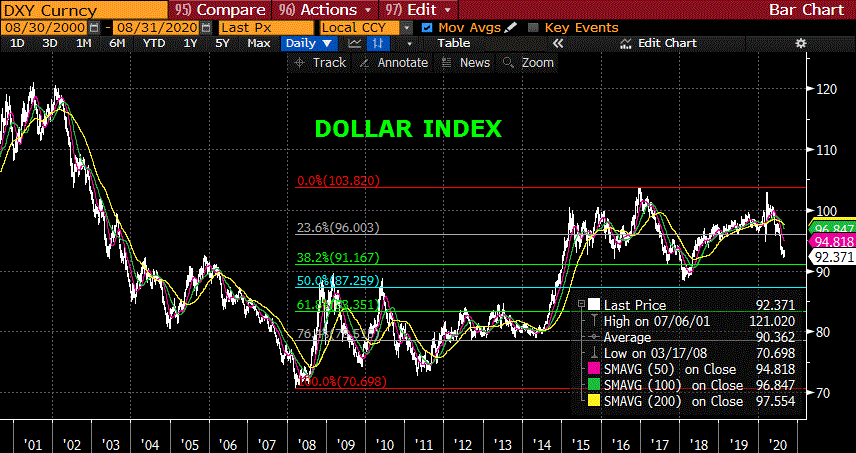
In terms of the dollar, it has recently been weakening but is nowhere near the low set in 2008. As shown below the low in DXY during the GFC was 70.70 vs 92.37 now. The halfway back level from the 2008 low to the high just after Trump’s election is 87.25 which would likely correspond to EUR around 1.30 vs 1.19 now. In 2017, after a similar sell-off there was a bounce off the 91.00 area which could easily occur again. However, the Fed is overtly providing wind at the back of dollar shorts as it seeks to create inflation, that is, to diminish the purchasing power of dollars. They’ve been fairly successful with this strategy when it has come to Nasdaq, and have recently chalked up some success in the gold market.
However, they’re looking for a broader inflation, one that seeps into wages and services and lessens the burden of crushing debt. Liz Ann Sonders of Schwab notes, “Debt keeps piling up…total-debt-to-EBITDA ratio for investment grade companies climbed to 3.53 in Q2 (5.42 for high-yield) which is the highest since 1998 (inception of data).” Needless to say, government debt-to-GDP is off the charts. Currently Congress and the administration are bickering about new stimulus measures. But vocal protests have now taken a turn towards outright threats, especially in transportation. American Airlines publicized the need for more government money or it will cleave 19k employees. Delta has joined the chorus. From BBG regarding NY’s public transit service, “The MTA says it is now preparing for a ‘doomsday scenario’ that could include a 40% cut in service for both commuter trains and busses, resulting in longer wait times, lane closures, fare hikes and massive job cuts.” This agency is reportedly losing $200 million PER WEEK and wants $12 billion to see it through year end. From an official, “Without question there is no economic recovery without a healthy MTA and there is no national recovery without a healthy New York,” Foye said during the meeting. “That is why investment in the MTA is in the national interest.”
Wow! That is an amazing stretch of logic. However, it also points to a change in mindset. There currently must be great incentive to signal price increases to competitors in a bid for collaboration. ‘We don’t have ridership but the Feds are forced to save jobs so let’s take this opportunity to jack prices.’ The Fed and the Federal gov’t are concerned about jobs. When focused on a primary goal, price becomes less of a restraint. The private sector needs the flow of government funds, both to consumers and in the form of outright grants or low interest loans to specific businesses. My perception is that the long end of the bond market is starting to transmit potential ramifications. USZ implied vol closed at the high of the month on Friday in spite of a bounce in price off new lows set in the early morning.
When I was kid on the old Chicago Board of Trade floor, I worked in “the financials”, the old room located directly behind the limestone façade that anchors the base of LaSalle Street. The grain floor was ironically moved to the modern south annex, and was a state-of-the-art facility. In the old room, the price chalkboards were still visible around the perimeter of the catwalk. The grain room had none of that, just some sleepy pits surrounded by FCM booths and massive walls of glowing price boards, and Jay Homan there early every day with impeccably combed hair, single-handedly representing the Oat pit with his massive deck of orders, wearing saddle shoes. Yes. Saddle shoes. And never a scuff on them. Nothing, it seemed to me, happened in the grain markets. Until, that is, the drought of 1988. This set off a bid for grains and provided a tractor beam draw for retired grain traders. The grains opened at 9:30. I recall going for coffee around 9 and seeing old guys, some with canes, marching to the grain pits with their bright yellow full membership badges, going back to re-live the glory days of a bull market. Well friends, dust off your Commodore Amiga 1000s and make sure the floppy drive still works so you can log into Globex. “Beans in the teens!! Orders bid for 5 million!” (Because in those days they traded in bushels and not contracts). But remember, you can’t yell at the box, you still have to click the mouse.
Could this be the time and place where we determine if the Fed is really finding success with inflation averaging? I mean, look…if I were running the Fed, having taken in junk bonds and flailing municipal debt, I would throw a bone to the farmers and start buying bushels of corn. And bushels of wheat. Support farmland prices. Support ADM and Bunge and Cargill and Deere…A, B. C. D right through the alphabet. Isn’t the American farmer the symbolic heart of the country? Forget the atonal music and crank up some John Cougar Mellancamp, Rain on the Scarecrow, at full volume. I did, and my neighbors love me for it. Or maybe they don’t. But they should. Anyway, here’s a picture of the Bloomberg grain index. Corn, beans, wheat. “Hey Esther. The KC Fed couldn’t properly sponsor Jackson Hole because of Covid, but we’d like to put you in charge of the new Fed facility, Grain Order Department, GOD. Don’t stop until you catch up with Bullard, who we’ve put in charge of lumber.”

I’ve already sort of gone off the tracks with this note, so below are some specifics relating to rates.
OTHER MARKET/ TRADE THOUGHTS
Here’s something you don’t see too often: EDH1 settled 9979.5. EDF 9987c settled 1.25. EDH 9987c settled 1.50. There is no open interest in Feb calls yet but they are listed, so Bloomberg provides a modeled settlement of 2.0. They have crushed the March 9987c due to the 9975/9987c 1×2 such that its price according to model is ridiculously cheap. And no, you can’t buy the Feb/March call calendar for a credit, but it’s a nice thought.
The EDZ0 9975 straddle traded some 7.75’s last week before settling at 8.0 vs 9971. Three and a half months to go. I know the Fed’s not in play, but selling that straddle doesn’t strike me as an ideal financing vehicle.
The trade of the week was a buyer of 125k 2EZ 9962/9950 put spread for 2.5 on Friday. Open interest rose 111k in 2EZ 9962p and fell 30k in the 9950p so it appears to be a roll-up. Expiration is 11-Dec and underlying is EDZ’22 at 9973.5. Dec FOMC is 16-Dec, not that it matters. Settles in options were 4.25 and 2.25. On 9-July there was a buyer of around 35k 2EZ 9950p for 4.25 (synthetically) vs 9974. So in less than two months, the next strike up is now the same price at the same futures level. There was also a sizable buy of some 30k EDZ1/EDZ2 calendar spreads at 3.5. This spread settled 4.5. There are now no FF contracts above 100 (that is, at negative rates). Steepeners are becoming more popular, although expressing that bias within 3 years on the ED curve may not be the best bet. But it’s a pretty cheap way to wager on a total loss of confidence in the Fed. How ya left on the Paul Volcker/Murat Uysal spectrum?
5/30 treasury spread made a new high on the year at 123 bps. 2/10 has a double top this year just above 68 bps (March and June), it finished the week just above 59, highest since mid-June.
Clarida speaks Monday and Brainard on Tuesday, both on the topic of the Fed’s New Monetary Policy Framework. Just in case the markets did not get the point with Powell last week. Fed officials often talk about Financial Conditions and Financial Stability. They’re not the same thing. The former represents the degree of looseness of policy as telegraphed by rates, the stock market, the dollar, credit spreads. The latter is almost a third mandate. The trick is being as generous as possible on the first without endangering the second. It’s a hard enough job without the uncertainty of fiscal policy, but I think they’ve rounded the bend this time.
| 8/21/2020 | 8/28/2020 | chg | ||
| UST 2Y | 14.3 | 13.3 | -1.0 | |
| UST 5Y | 26.8 | 27.4 | 0.6 | |
| UST 10Y | 63.3 | 72.6 | 9.3 | |
| UST 30Y | 134.8 | 150.8 | 16.0 | |
| GERM 2Y | -63.3 | -66.5 | -3.2 | |
| GERM 10Y | -50.7 | -40.9 | 9.8 | |
| JPN 30Y | 61.3 | 61.7 | 0.4 | |
| EURO$ U0/U1 | -3.25 | -3.50 | -0.3 | |
| EURO$ U1/U2 | 4.0 | 3.5 | -0.5 | |
| EURO$ U2/U3 | 10.0 | 11.5 | 1.5 | |
| EUR | 117.96 | 119.07 | 1.11 | |
| CRUDE (active) | 42.34 | 42.97 | 0.63 | |
| SPX | 3397.16 | 3508.01 | 110.85 | 3.3% |
| VIX | 22.54 | 22.96 | 0.42 | |
https://www.mentalfloss.com/article/27971/10-classic-computers-you-had-kid
As subtle as a sledgehammer
August 28, 2020
–Yields jumped on Thursday with tens up 5.7 bps to 74.2 and 30s up 9.7 to 1.497%. The curve steepened with 2/10 up 5.3 to a new recent high of 58.6 and 5/30 nearing the high of this calendar year at 119 bps (hit 122 this morning). There’s a double top in 2/10 at 68 and the high so far in 2020 for 5/30 is just above 122, which had not been previously seen since 2017. The changes in money market funds offered by Vanguard was cited by Edward Bolingbroke of BBG as a catalyst for heavy selling volume in eurodollar contracts. The link below crystallizes the sentiment change; “…Vanguard believes it’s better to seek to provide clients with a higher yield through lower expenses on a secure government portfolio than incurring risk in the prime market.” They are changing one MM fund to a gov’t money mkt and letting commercial paper holdings roll off in other funds to be replaced with T-bills. Large operators are perceiving risk at these paltry yield levels. The front Dec EDZ0 contract settled 3 lower on the day, although EDH1 and EDM1 were only down 1.5. The spread between FFF1 and EDZ0 perked up by 3 to end at 25. This spread had been hanging around 21.5 to 22.0 and is a forward lib/ois indicator.
–Added to the mix was Powell’s speech outlining the change in the Fed’s policy framework to incorporate inflation averaging. It’s not as if this was unexpected, but market action both leading into and out of this announcement also reveals the possibility of a massive change. The Fed fears deflation expectations even though they don’t appear to be a present risk. Here’s an important snippet from Powell: “In addition, our revised statement says that our policy decision will be informed by our ‘assessments of the shortfalls of employment from its maximum level’ rather than by ‘deviations from its maximum level’ as in our previous statement. This change may appear subtle but it reflects our view that a robust job market can be sustained without causing an outbreak of inflation.”
–My personal experience is that subtle changes have a way of coming around to bite you in the ass. The market latched onto the shift and is starting to process the ramifications. My guess is that the smart guys have already positioned for a Fed trying to “buy inflation” (as Joe Carson put it) and are ready to press. There’s no question that a lot of things have gotten squirrelly this year. The curve was flattening recently, players were selling pre-election rate vol with barely a passing nod to the concept of risk, because we all KNOW the Fed’s on hold and that the Fed’l gov’t is pulling out all stops to support the economy. Except this: Vanguard perceives credit risks. Capital One is cutting credit cards limits and boosting reserves due to withdrawal of gov’t support of households. Airlines are demanding additional aid to forestall job cuts. The Fed is making not-so-subtle changes that could spill over into financial stability. The Fed’l government has reverted to a bickering stalemate because they’ve bought into the idea that a levitating stock market means things aren’t all that bad. Hmmm, maybe vol sales at these levels don’t really provide a cushion. Hmm, maybe credit spreads aren’t really providing any measure of safety. Hmm, maybe the Fed has inspired a move which has brought the discounted flow of future earnings WAY forward, and a steeper curve might cause our assumptions to fly out the window. We’ve already had a bone-crushing year. No, the capital markets are NOT back to normal, they’ve just been papered over with a monetary veneer.
–Oh, and have you ever heard the one about insurance companies selling bond holdings to pay claims, like those associated with Laura and CA wildfires?
https://www.prnewswire.com/news-releases/vanguard-announces-changes-to-money-market-fund-lineup-301119722.htmlhttps://
www.zerohedge.com/markets/feds-policy-mistake-buying-more-inflation-will-lead-financial-instabilityhttps://
www.zerohedge.com/markets/capital-one-cuts-credit-card-borrowing-limits-us-reduces-support-unemployed-americans
Powell today
August 27. 2020
–Powell today at 9:10 EST with new and improved Fed Framework. He’s expected to move towards inflation averaging,and emphasize forward guidance. A BBG headline notes ‘Fed seen holding rates at zero for five years’. The market already seems convinced of that as evidenced by yesterday’s stellar 5-yr auction at 29.8 bps. Positive carry of 20+ bps for 5 years, IF the Fed holds rates. Today we have $47 billion 7 years; the yield on the w/i is 48, so there’s a bit less certainty for years 6 and 7.
–In spite of the solid auction, yields were still slightly higher with a steeper curve yesterday. 2/10 ended at 53.3, up 0.7 bp. Longer end vol has remained bid going into Powell’s speech, with US (30yr) rising steadily through August. The eurodollar curve also gives an indication of increasing uncertainty, or perhaps I should say an increasing expectation of a Fed rate hike further out the curve. This can be observed in one-year pack spread calendars. Whites to reds (1st yr to 2nd yr) is -1.0, reds to greens (2nd to 3rd) is 6.125, greens to blues (3rd 4th) 13.5 and blues to golds (4th 5th) is 18.625.
–There has been good size selling of TYV 140c this morning pre-Powell, with volume near 60k, most large clips at 13 to 12 ref 139-07+/08. Open interest was 85k coming in. Perhaps a reasonable sale with expectation of a less well rec’d seven-year and a Fed hell-bent on boosting inflation, but it’s not going to look so good if one of those missiles China is firing accidentally hits a US target.

Foie Gras
August 26, 2020
–There seems to be a bearish sentiment shift occurring in bonds as Powell looms on Thursday. Yesterday tens rose 3.5 bps to 68 and 30s up 3.8 to 1.386%. New Home sales and Richmond Fed were strong while Consumer Confidence plunged to 84.8, the lowest since 2014. Ten year inflation-indexed breakeven edged to a new recent high at 170.6 bps. Curve was steeper with 2/10 up 3.3 bps to 52.6. Today treasury auctions $51 billion in fives and $22 b in 2-yr FRNs, and tomorrow $47b in sevens. Like a goose being force fed for foie gras.
–In euro$s, the sentiment change was mainly expressed through several large new put buys in blue and gold midcurves. Buyer of 22k 3EM1 9950/9912ps 11.5 to 12.0; settled 11.0 vs 9942.0 in EDM’24. Also, buyer of >15k 3EX0 9950/9925/9900 put fly for 3.5, settled 3.25 vs 9959.5 in EDZ’23. These settle on 13-November, after the (contested) Nov 3 election date. On June 5, strong employment data caused a low in the EDZ3 contract of 9926, which this fly targets. I suppose it’s worth mention that there is an FOMC meeting on Nov 5 and Employment report Nov 6, all just before Nov midcurves expire. In smaller size of 3k, a buyer of 4EX0 9937/9912/9887p fly for 4.5; settled 4.0 vs 9941.0. The June 5 low in this contract was 9901.5, so I would prefer adjusting strikes down by an eighth and paying 3 for the 9925/9900/9875.
–On the long end, Dec bond vol (USZ) seems to be firming every day, now 10.4. USZ0 177 straddle settled 7’10. Still low in historical context but a new high for August.