Borrowing from the Fed to repair broken windows
August 25, 2020
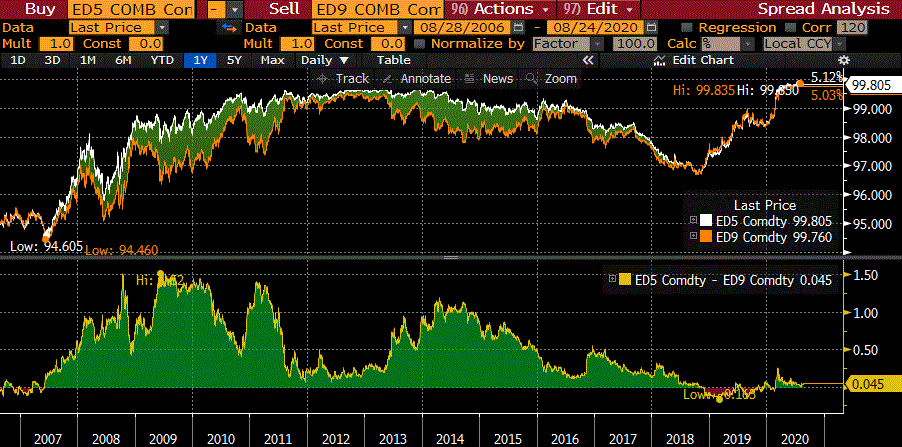
–Rates were little changed Monday in front of today’s 2y auction, with yields unch’d to +1 across the curve. In eurodollars, the two largest volume contracts, each at 112k, were EDZ1 and EDZ2. There was a buyer of approx 35k EDZ1/EDZ2 spread for 3.5, which traded up to 5 and settled 4.5. Open interest was -19k in Dec’21 and +2.5k in Dec’22, so it may have just been a trade to roll shorts further out the curve. In any case, I have attached a chart of ED5 to ED9 from 2007, the first red to first green, since Dec will be in the first quarterly slot within a few weeks. While this spread has recently traded negative, most of its history has been substantially positive, and with the Fed dismissing negative rates, it seems like a buy at 3.5 doesn’t have a lot of risk. The question becomes, “what are the odds for a rate hike in two years?” A large one-year red/green calendar buy like this also occurred several months ago and appeared to have perfect timing as the spread quickly went from 5 to 12.5 (I believe it was June’21/June’22). However, it just as quickly fizzled out to trade 3.
–Bloomberg cites Credit Suisse: ‘Bonds no longer work to diversify stock risks’. What risks?
–New Home Sales today along with Consumer Confidence, followed by the two year auction.
–Though the Fed’s website doesn’t appear to have updated, last week New York’s Metro Transportation Authority borrowed $450 million from the Fed’s muni facility at 1.92% for three years, initially having tried to sell into the market at a yield of 2.79%. “Oh, I don’t like the price of the market, maybe I can borrow from the Fed sub-2% too.” There is simply no reason the Fed should be lending to and subsidizing city services. Of course, this story comes with an added twist, as many NY subway train windows have been recently smashed in unchecked vandalism. Again, there’s no accountability in today’s public money flows. I’m sorry to bring it up again, but this situation absolutely begs for reference to Bastiat’s broken window fallacy. The Fed lending money to the MTA to repair broken subway windows absolutely does NOT help the economy. When Guiliani was mayor, the police were instructed to focus on even minor crimes with high visibility and low arrest tactics. These infractions included graffiti and other vandalism, turnstile jumping etc. Guiliani was credited with cleaning up the city. What typically isn’t mentioned is that economic conditions in general also contributed to a better quality of life, which makes today’s strife all the more complicated.
https://www.reuters.com/article/us-usa-newyork-fed-debt/new-york-transit-agency-turns-to-fed-for-450-million-borrowing-idUSKCN25E2R3#:~:text=The%20MTA%20is%20only%20the,blow%20from%20the%20coronavirus%20pandemic.
https://abc7ny.com/subway-vandalism-windows-smashed-7-train-vandal/6383247/
https://www.city-journal.org/html/how-new-york-became-safe-full-story-13197.html
| How New York Became Safe: The Full Story | Restoring Order in NYC – City JournalThe Mounting Evidence That Broken Windows Works. Twenty-seven years ago, James Q. Wilson and I published “Broken Windows” in The Atlantic, proposing that untended disorder and minor offenses gave rise to serious crime and urban decay.We also hypothesized that government and community action to restore order might reduce crime.www.city-journal.org |
| 2 more incidents of subway windows being smashed, more than 400 have been broken April – ABC7 New YorkNEW YORK (WABC) — The vandal believed to be responsible for smashing more than 400 windows on subway cars since April struck again Friday night. Sources tell Eyewitness News that two more …abc7ny.com |
https://mises.org/library/broken-window-fallacy
New high stocks
August 24, 2020
–New highs in stocks this morning as Covid relief appears to be right around the corner. Fixed income edging to marginally higher yields for the time being.
–Treasury option expiration on Friday pegged the 139.5 strike. October 139.5 straddle settled 1-06 with a month to go. This week Powell speaks on Thursday and Treasury auctions just shy of $150 billion in 2, 5 and 7 year notes starting Tuesday. Chicago Fed Nat’l Activity index today expected 3.7 from 4.1 last, a huge V-shape recovery from the low of -18.1, but all dependent on Federal gov’t generosity.
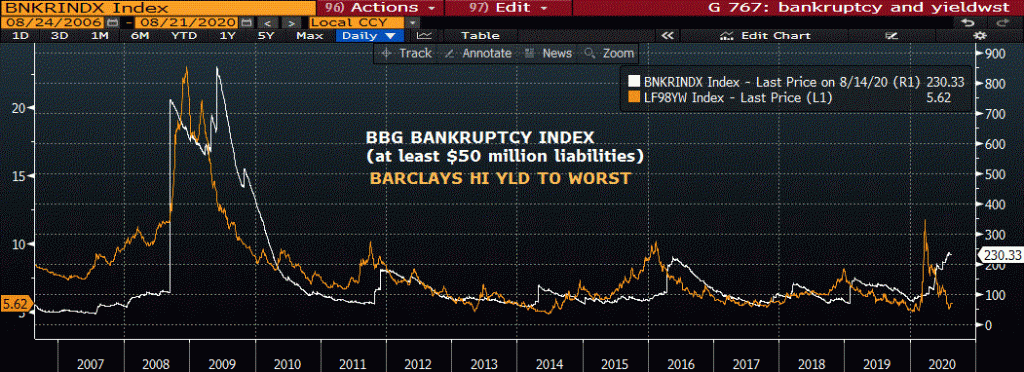
–There are a couple of ZH articles citing the FT and others noting that US bankruptcies are setting a record pace outside of 2009. I have attached a chart of the BBG bankruptcy index and Barclay’s hi yield to worst. By 2008-09 standards this episode hasn’t been too bad, but it has surpassed the oil patch problems of 2016. What is remarkable is how quickly the yield has come down. It used to take much longer for the market to shake off the demand for higher yields in order to be compensated for risk . The thesis I am going with is that if risk is suppressed in one place, it generally pops up with a vengeance somewhere else. This time it seems to have spilled over into social unrest.
No Hazards, Moral or Otherwise
August 23, 2020 – Weekly comment
Prior to the housing crisis, Freddie Mac securitized mortgages as participation certificates (PCs) and sold the interest rate risk to investors. Under this business model, Freddie Mac retained 100% of the associated mortgage credit risk.
In 2013, Freddie Mac engineered the STACR program, making them the first GSE to develop a structure to transfer mortgage credit risk to investors. Since then, Freddie Mac has introduced a suite of innovative CRT offerings that enable investors and (re)insurers to engage in the U.S. housing market. CRT has fundamentally changed the nature of housing finance by transferring credit risk from U.S. taxpayers to the private capital markets.
A Bloomberg article from July 23 by Joe Light notes that because the CARES act allowed mortgage forbearance, owners of the above securities could face losses of up to $2 billion. At the heart of the issue is Credit Risk Transfer securities. From the article, “The issue is an unintended side effect of the response to the global health crisis. As the US economy shut down in March, Congress rushed to pass the $2T CARES Act, which included a provision that allowed forbearance on loans backed by Fannie and Freddie for as long as one year if borrowers were impacted by the pandemic. The postponed mortgage payments will hurt investors in certain credit-transfer securities even if homeowners resume payments and Fannie and Freddie never suffer losses, a predicament that’s prompted bond holders to lobby lawmakers and federal officials for a fix. The situation has also soured some investors on CRT securities, a $50 billion market that was created in part to protect taxpayers from ever again having to bail out Fannie and Freddie.”
Man, that’s some pretty dry stuff. I was pulled into this vortex by a friend of mine who thought it could be important to the markets. So I continued reading articles about CRTs and mortgage forbearance. That’s a few hours I’ll never get back. Sure, $2 billion used to be a lot of money. But think of it in this context: Since April, AAPL has doubled in value, adding $1 Trillion to its market cap. TSLA has doubled in less than two months, adding about $200 billion in market cap. The quibbling about Credit Risk Transfers is thus 1% of the increase in market cap of Tesla. It’s a couple percent of what the Fed buys in MBS every week. It’s a rounding error. If you blinked, you’d miss it as an addition to M2.
However, it’s still important. Because of the name. Credit Risk Transfer. That concept has pretty much flown out the window. Capitalism used to require judicious weighing of credit risk. Now, corporate bonds barely have any yield premium. So… what happens when the government grants relief to the injured parties who willingly bought credit risk transfers and now can’t bear to have their returns impacted by the “risk” clause. Well, that part will now probably transfer over to the government. That is, to the taxpayer. Again. It seems somewhat unfair… that YOU bought a security that might have a loss associated with it, and WE have to pay for it. If only there was some clue, if only there was some sort of previous episode that could have alerted us to the stark possibility of loss. CREDIT RISK TRANSFERS. Nope, I don’t see anything in the fine print there. STACR. That seems innocent enough. Well, if you re-arrange the last two letters you get something that sort of sounds like “stark” but It looks like these things have a better yield than the other stuff in the portfolio. “Sounds like a winner boss. These guys at the agencies want to TRANSFER a few extra basis points to us.” “Very clever Smithers. Nice work on the due diligence. Buy everything you can for the endowment portfolio.”
So now it falls to the taxpayer. But wait a second, what the hell is THAT? It too has become a meaningless concept. Stephanie Kelton, the Modern Monetary Theory maven, actually does justice to the taxpayer part of the equation in one of her lectures. She draws government spending as a series of big circles, let’s just call them poker chips. Taxes are represented as poker chips as well. The government spends 10 poker chips, and then takes back 5 poker chips from the economy. It really doesn’t have anything to do with what’s right or fair. It is about as far from ‘pay-as-you-go’ as one can get. As the reserve currency, the US government can just print dollars.
Some people are trying to explain the bid in precious metals. Others are trying to wrap their heads around bitcoin. Think about the concepts of “risk” and “the taxpayer” in conjunction with the value of the dollar and the amount of debt. And then tell me why you don’t want to (anonymously if possible) own silver and gold and bitcoin.
Way back when NationsBank was still around, the chief executive was a guy named Hugh McColl, a former marine who kept a hand grenade on his desk. The trading desk had lost a large amount of money on some sort of technicality having to do with the bond contract, perhaps a squeeze on the cheapest to deliver. It was a lot of money, and at the time, it was well publicized. Other desks had also taken a hit on the trade, and there was talk of litigation to wiggle out. Not McColl. He said, “We’re big boys. We should have known the risks and we’ll eat the loss.” Semper Fi.
That’s a little different in tone from Stephanie Kelton who put out this tweet and chart over the weekend:
“Debt climbs. Rates fall.”

It’s not just a lack of taking responsibility. It’s pretending that nothing has consequences. For example, last week the New York Fed’s Liberty Street Economics blog featured a post, ‘Market Function Purchases by the Federal Reserve’. The discussion centered around current Fed heroics and several other historical instances of Fed intervention to restore functioning markets. The paper ends with this humdinger:
There may be other ways to forestall or mitigate the appearance of a disorderly, illiquid market, such as primary market auction sales of Treasury debt (which in the 1970s replaced the fixed-price offerings at the root of the 1958 and 1970 episodes) or improved clearing and settlement systems (which have been suggested in the wake of the 2020 purchase program), but the infrequency of Federal Reserve intervention suggests that relying on the Fed on those rare occasions when markets are in extremis has not materially exacerbated moral hazard.
Right. Got that? Fed intervention is rare and moral hazard is just a figment of our over-active imaginations.
************************
Fed Chair Jay Powell will give a speech at the virtual Jackson Hole conference on Thursday, Aug 27, at 9:10 am. The subject: “Monetary Policy Framework Review”
PCE Core Deflator and UofM Inflation survey on Friday.
Auctions of $50 billion 2’s and $22 billion 2yr FRNs on Tuesday, $51 billion 5’s, and $47 billion 7’s next week, beginning on Tuesday.
************************
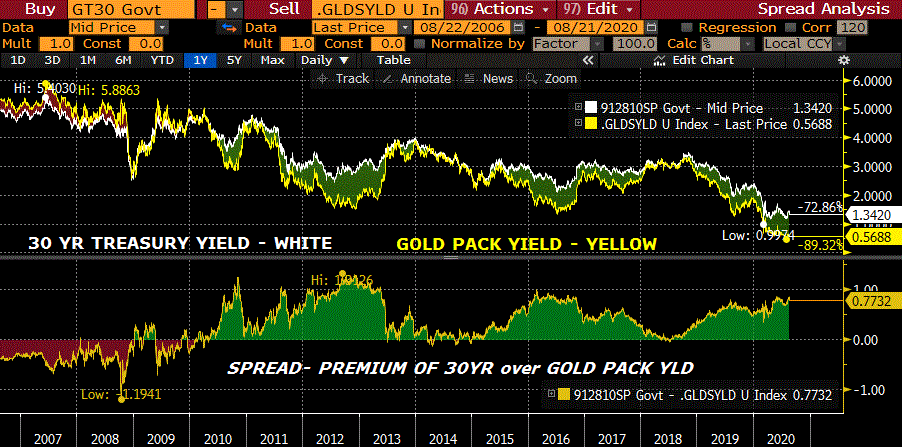
Last week I put out a chart which overlaid the yield of the gold euro$ pack on the 30 year bond. Below, that chart is updated with the spread between the two in the lower panel. Not quite to the 2012 high, but at 77 bps, only about ¼% away. By the way, QE3 was Sept to Dec of 2012 and that period also featured strong forward guidance.
| 8/14/2020 | 8/21/2020 | chg | ||
| UST 2Y | 14.7 | 14.3 | -0.4 | |
| UST 5Y | 29.8 | 26.8 | -3.0 | |
| UST 10Y | 70.8 | 63.3 | -7.5 | |
| UST 30Y | 144.2 | 134.8 | -9.4 | |
| GERM 2Y | -64.7 | -64.7 | -63.3 | |
| GERM 10Y | -42.1 | -42.1 | -50.7 | |
| JPN 30Y | 61.5 | 61.5 | 61.3 | |
| EURO$ U0/U1 | -3.0 | -3.25 | -0.3 | |
| EURO$ U1/U2 | 4.0 | 4.0 | 0.0 | |
| EURO$ U2/U3 | 12.0 | 10.0 | -2.0 | |
| EUR | 118.44 | 117.96 | -0.48 | |
| CRUDE (active) | 42.31 | 42.34 | 0.03 | |
| SPX | 3372.85 | 3397.16 | 24.31 | 0.7% |
| VIX | 22.05 | 22.54 | 0.49 | |
If you’re dying to learn more about CRTs:
https://crt.freddiemac.com/about-crt.aspx
https://www.fhfa.gov/Media/PublicAffairs/Pages/Statement-of-Dr-Mark-A-Calabria-FHFA-Director-Before-the-US-Senate-Committee-on-Banking-Housing-and-Urban-Affairs-06092020.aspx
https://info.loomissayles.com/covid-19-impacts-on-non-agency-rmbs-and-housing-finance
Hic sunt dracones
August 21, 2020

— Sept Treasury option expiration today. Ten year yield declined 3.1 bps to 64.3 and 2/10 also fell 3 as twos were unch’d, to 50.4.
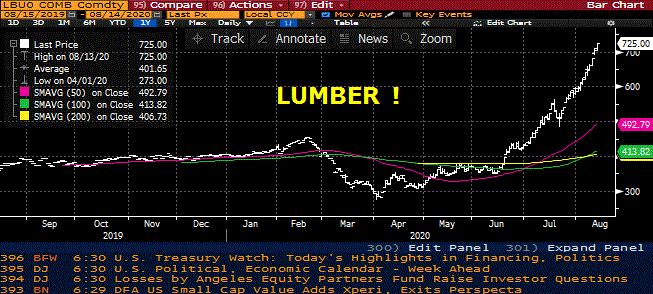
–Today’s news includes Markit Mfg PMI expected 52.0 and Services 51.0, which would both be slight improvements over last month’s data, but Europe PMIs came out on the soft side. Existing Home sales expected 5.4 million vs 4.72 million last. Sept Lumber, which was 300 in late April settled 801.90 yesterday, a new high. Interestingly, copper, which broke out above $3.00 on Wednesday, has now reversed lower. It now looks as though that move was false.
–Powell to give speech on ‘Monetary Policy Framework Review’ on Thursday August 27. (Virtual Jackson Hole Conference). The Fed minutes brushed back expectations of Yield Curve Control, but the new framework will likely encompass the idea of allowing past inflation shortfalls to be made up. I don’t want to run this analogy too hard, but all I will say is that sometimes changing the rules to make up for past injustices gets out of hand.
–Ten year vol eased slightly but Dec bond vol remains quite well bid with USZ straddle settling 6’62 or 9.8%. That’s 5.5 times the implied vol on FVZ even though the DV01 ratio between contracts is just 3.9. The situation of bond vol being extremely strong relative to the curve has been persistent this year. My interpretation is that the front end of the market, even extending past 5 yrs, has completely embraced the spirit of YCC. The long end is like maps in the dark ages, where oceans past known shorelines were simply labeled “Here be dragons”. I don’t know if those dragons mean fire-breathing inflation or a giant tails whipping around credit risks. I just respect the fact that they’re out there lurking around in year 2020.
Fed (and other) uncertainties
August 20, 2020
–Fed minutes from the July meeting caused some late pressure as yield curve control measures were dismissed. “Many of these participants also pointed to potential costs associated with yield caps and targets.” [The biggest concern is How do we get out once we’re in?] “In light of these concerns, many participants judged that yield caps and targets were not warranted in the current environment but should remain an option…” Also from the minutes: “There were also concerns that the anticipated increase in Treasury debt over the next few years could have implications for market functioning.” And finally “Participants noted that the Statement on Longer-Run Goals and Monetary Policy Strategy serves as the foundation for the Committee’s policy actions and that it would be important to finalize all changes to the statement in the near future.” Here comes inflation averaging…
–Stocks gave away some early strength even though Apple crossed the $2 trillion threshold. Tens ended at 67.4 bps, up 0.7 at futures settlement. Curve was slightly steeper. Going into tomorrow’s treasury option expiry it appears TYU is comfortable pegging the 139.5 strike. Implied vol firmed, perhaps a combination of uncertainties embedded in Fed minutes along with the political equation. As mentioned previously, post-election options trade at higher vols than those expiring before November. TYZ atm straddle closed 4.0% up a couple of tenths on the day. Oct also firmed to 3.5 having been as low as 3% earlier in the month.
–Late tweet yesterday from Hu Xijin of China’s Global Times is also worth noting: “The Taiwan Straits has started to smell gunpowder and risk of a conflict sparked by an accident is rising…” It was just an “accident”. While US and China are meeting again to discuss Phase 1 implementation, the US has kept up pressure in the South Sea.
–Portnoy sneezes and small caps catch a cold? (or Covid). Even Bloomberg noted “Portnoy rattles investors saying he’s sick”. Wouldn’t it be ironic if this guy’s ailment coincided with a market top? Nothing at all to do with Walmart’s warning that diminished stimulus checks from the federal government will have a negative impact on consumption…
Treasury sells 20s today, Fed buys them tomorrow
August 19, 2020
–Quiet session in rates yesterday; tens eased 1.5 bps to 66.7 and the curve edged flatter with 2/10 at 52.4. While volumes across the board were light, there were a couple of large lifts on the dollar curve with associated jumps in open interest. EDZ0 added 35k in open interest with new buying at 9972 (perhaps a fade of turn pressure) and EDZ22 added 9k in OI with buys at 9973 (settled 9974). August ED contract expired Monday at a price of 99.7322. As an indication of just how moribund the market is, I bought EDM1 9975 puts yesterday for 3.5 bps. EDM1 is now the highest contract on the curve at 9981, but there are 300 days until expiration and libor continues to set at 25 bps or higher.
–Today features a treasury auction of $25b 20-years and the FOMC minutes. Possible discussion of inflation averaging? In spite of a relentless bid in stock futures, treasuries are also up this morning, even though last week’s 30 yr auction seemed to indicate waning demand for long paper. Today’s NY Fed buying consists of $1.2 billion 7 to 30 year tips, and tomorrow $3.6 billion of 7 to 20 year treasuries. Once again, the ten year tip ended below negative 100 bps at -102. I marked the ten year breakeven at 168.6, a new high. Treasury rolls picking up somewhat with about 3% of tens having rolled into Dec.
–Yesterday’s housing starts showed an eye-popping 22% gain with associated new highs in home builder stocks. A part of the explanation is the flight from cities; I spoke with a friend who works for Wells who told me that 200,000 of 260,000 employees are now working from home.
Dollar down, mortgage delinquencies up
August 18, 2020
–Despite a record high in Nasdaq, yields eased and the curve flattened. Tens fell 2.6 to 68.2 and 2/10 to 53.3, down 2.8. The dollar index is making a new low this morning, currently at 92.54 with EUR printing 119. Gold and silver continue to recapture the ground lost last week, but aren’t yet at new highs. Bitcoin made a new recent high yesterday but has taken a breather today. However, TYU is still up slightly this morning at 139-12, perhaps due to US/China issues or other geopolitical flares like Belarus.
–Housing Starts this morning expected +5% to 1245k. Not that there’s any connection to the two, but the Mortgage Bankers Assn notes ‘Mortgage delinquencies spike in the second quarter of 2020’. “The delinquency rate for mortgage loans on one-to-four-unit residential properties increased to a seasonally adjusted rate of 8.22 percent of all loans outstanding at the end of the second quarter of 2020, according to the Mortgage Bankers Association’s (MBA) National Delinquency Survey.” …up 369 bps from one year ago. FHA loans are seeing a delinquency rate of 15.7%.
–It’s worth a mention that vols are much higher post-election than for options expiring before November. This shouldn’t be particularly surprising given moves seen after the 2016 election. As an example, TYX (Nov) options expire Oct 23. The atm straddle is about 3.25% while Dec options, which expire Nov 20, are 3.8. The same dynamic is true in ED midcurves. (Of course, everything is ‘cheap’ in rates). There was a BBG article yesterday that suggested the Fed might overtly change inflation targeting from a cap of 2% to a “make-up” strategy of allowing overshoot. This has been a continuous theme in Fed speeches and isn’t much of a surprise, although it might be announced at the Sept FOMC meeting. If so, that might make Oct midcurves, which have already been depressed relative to post-election expiries, a reasonable Fed play. For example, 2EV 9975 straddle settled at just 9 vs EDZ’22 at 9973.0. 2EV 9962/9950ps settled 1.25. (Thanks BC).
August Monday
August 17, 2020
–Stock futures pressing higher this morning as the dollar eases, while fixed income is unch’d to small bid. Friday featured new highs in several curve measures, partially spurred by long maturity treasury auctions last week. 2/10 ended at 56.1, up 1 on the day, and 5/30 at 114.4, up 3.6, while the red/gold euro$ pack spread rose 1.75 to 42.25. Of these, 5/30 is closest to the year’s high at 122, with a 20 year bond auction scheduled for this week ($25 billion on Wednesday, just prior to FOMC minutes).
–Today’s news includes Empire Mfg, which has surged from a spike low of -78 to the year’s high at last reading of 17.2. It’s expected at 15 today. TIC data also released.
–The drumbeat of negative news regarding US big cities continues with several articles lowlighting the flight to suburbs in LA, San Fran, Chicago. ZH leads off with “49 people shot in last 72 hours in NYC…” while in Chicago last week, 76 were shot, 11 fatally.
–Once again worth a mention that some 25k EDM’25 were sold on Friday at 9929-30. Average daily volume in that contract is closer to 15k, but on Friday it was 63k with OI +7200. Settled 9926.5 and currently prints 9928.–Sept treasury options expire Friday. TYU0 currently 139-07+ with the 139.25 straddle last at 29/64.
https://heyjackass.com/
Golden age of Macro
August 16, 2020 – Weekly comment
Great interview of Ben Melkman, founder of Light Sky Macro by Erik Schatzker of Bloomberg last week. (All links at bottom). Quick summary of ideas: Covid has been a catalyst and has “upended big truths”. One core theme is that previously, exchange rates were more or less fixed and interest rates weren’t. The pandemic has forced huge government deficits, thus relegating central banks to a function of accommodation with rates near zero for the foreseeable future. Central bank independence is gone. We’ve gone from fixed exchange rates to fixed interest rates (at zero) which means that volatility will now spill over into FX. Because rates have gone to zero in a world with little growth, present value returns in equities have been pulled forward. Equities thus far have reacted as nominal assets like gold, but despite low rates will likely do poorly going forward. Think of the typical 60/40 portfolio. The bond portion has gone from an asset to a liability vulnerable to an inflation shock; the coupon cushion has evaporated. Equities can similarly be thought of as a long duration asset whose returns have been brought forward by the same dynamics, though that asset class could benefit from high nominal growth. Ironically, if CB’s are successful in their efforts to generate inflation both stocks and bonds could suffer. The virus has been a catalyst in changing structure going forward…big social movements. Fiscal policy is important in terms of rate of change, a 20% increase in deficit this year needs the same sort of increase next year just to keep things even. [I disagree on this point] There is an expanding debt profile with no way to adjust rates up, which will probably lead to curve steepening over time, but not in the near term. Dollar is quite vulnerable. Policy makers have been conditioned to allow deficits because there has been no inflation response. However, in recent history, monetary and fiscal policy were more or less working against each other. Now fiscal and monetary policies globally are moving in the same direction [when was the last time you heard complaints about fiscal austerity as a policy?] Melkman forecasts volatility in the largest most liquid markets in the world, bringing great macro opportunities. Schatzker asked an insightful question near the end: “What would be the most unpleasant surprise” to Melkman’s forecast? Answer was “Japanification”. Despite the goals of the authorities, the debt burden just keeps growing and casts a long disinflationary cloud.
Summary: a weaker dollar, zero to negative returns in equities, a steeper curve eventually as inflation materializes, large government deficits. Melkman surmises the US will begin to look a bit more like Europe.
Regarding the need to continuously grow gov’t deficits at a rapid rate, I don’t believe that’s necessarily true if the private sector can kick in. The pandemic created a huge hole in global economies that governments and Fed have attempted to plug. Perhaps as Covid fades, the private sector will reach escape velocity. However, the immediate question is how big should the response continue to be, and how can we come close to ‘getting it right’? Let me take a minor example: according to a Chicago SunTimes report, it cost $66 million to turn McCormick Place (Chicago’s convention center) into a hospital which could accommodate 2750 patients. However, only 38 patients were treated there before it was shuttered. Obviously a huge miss, but at the time it seemed completely necessary. The point is that both fiscal and monetary have potential to overshoot, but it’s hard to get the genie back in the bottle.
Now consider the suggestion of former Fed officials Simon Potter and Julia Coronado for “recession insurance bonds” that could be distributed to households and monetized by the Fed upon certain triggers like reaching the zero bound, or when unemployment goes up by 0.5%. Here’s Potter from the August 1 interview with BBG: “It took too long to get money to people, and it’s too clunky. We need a separate infrastructure. The Fed could buy the bonds quickly without going to the private market.”
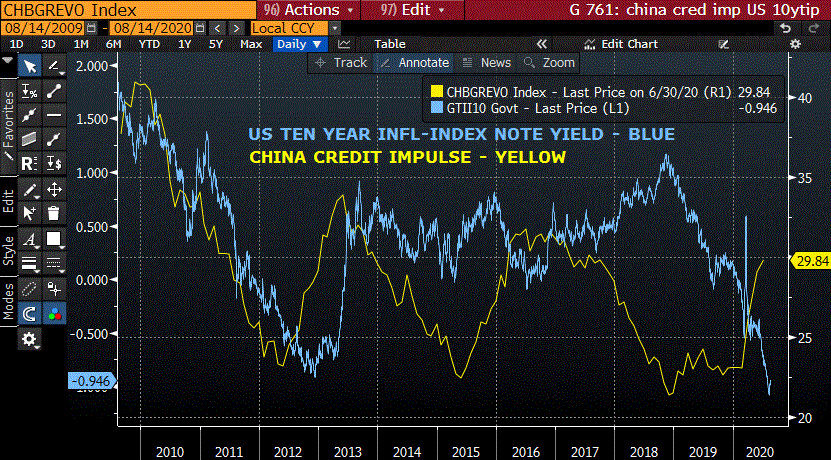
That sounds a lot like helicopter money which bypasses Congress. Perhaps it’s a long way away. But maybe not. As Lacy Hunt said this week (as a caveat to his disinflationary thesis) “There are folks who want to make the Fed’s liabilities legal tender. Now, if that happens, then the inflation rate would take off.” Lael Brainard this week gave a speech titled “An Update on Digital Currencies”. From the speech, “As part of this research, central banks are exploring the potential of innovative technologies to offer a digital equivalent of cash.” China is also deeply involved in the study of digital currency. On that topic, circling back to Melkman and the role of central banks, consider this picture (below) of China’s Credit Impulse overlaid with the US ten-year yield inflation indexed note yield (real yield). This idea is from a ZH article on Friday, “Is China About to Unleash an Inflationary Tsunami in the US”. ZH says China’s Credit Impulse leads US real rates by about twelve months. That appears to be the case in 2012, when China’s credit growth jumped and was followed by the May 2013 taper tantrum, and to a lesser extent in 2015. In any case, it’s clear from the chart that China’s credit growth again went into high gear in 2020 as US real rates made new historic lows.
Getting back to today’s markets, this past week the US ten-year yield rose 15 bps to 70.8 and the thirty year jumped 21.6 bps to 1.442% as the heavy US auction schedule finally caused a bit of indigestion. It’s worth mentioning corporate supply as well. From an August 12 BBG article, “Junk rated companies have borrowed $274.8 billion in 2020, exceeding the sum of cash raised during all of last year.” And from August 14, “High-grade new issue supply is up 76% YoY and less than $10bn away from breaking the new issue volume record of $1.333 tr set in 2017.” On Wednesday the Treasury auctions $25 billion 20-year bonds and on Thursday $7 billion 30-year TIPS. FOMC minutes on Wednesday.
OTHER MARKET/ TRADE THOUGHTS
Last week a client mentioned the need for a cheap hedge due to a structural flattening bias in his book. His concern was that something like the ‘temper tantrum’ could recur. I’m quite sure that Wednesday’s FOMC minutes will further solidify the idea of forward guidance at zero. “Not thinking of (in triplicate) raising rates.” However, when the sentiment changes, as it did in May 2013 when Bernanke hinted at a change in the Fed’s bond purchases, it can happen in a hurry.
In conjunction with this idea, and the growing inkling that inflation may take hold, it was interesting to see a large sale in EDM’25 on Friday at a price around 9930 to 9929. The contract settled at 9926.5, down 2 on the day. Individual contracts in the golds rarely trade in decent size; ordinary volume is 15 to 20k per day, but gold June (20th quarterly) traded 63k Friday with OI +7200 (suspiciously low).
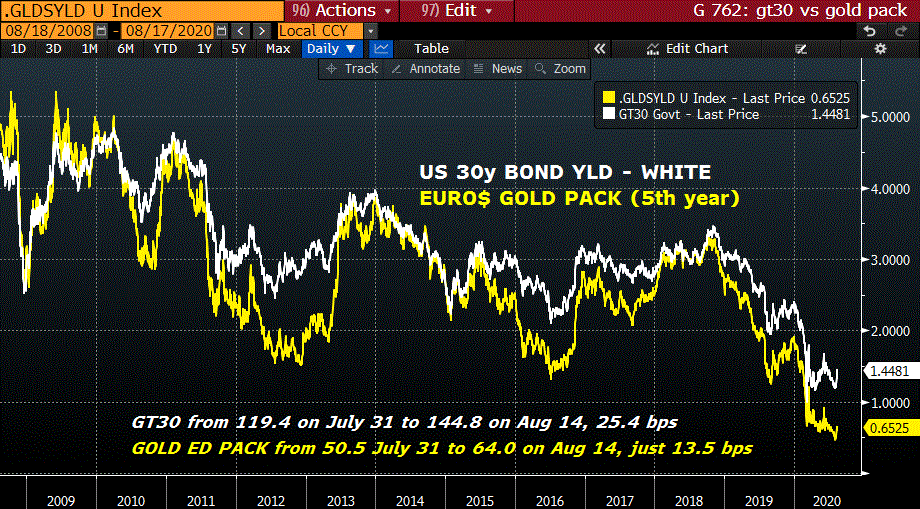
On the chart below I have overlaid the 30y bond yield with the yield on the gold euro$ pack (the average of the 17th, 18th, 19th and 20th ED contracts). Both have made record low yields this year with the gold pack dipping below 50 bps! It appears that every time there’s a turn in the market to higher long rates, golds way outperform on the way up. Not so far this month…the bond yield jumped 25 bps from July 31 while golds are only up 13.5. Looks like EDM’25 might have been a great sale, whether as hedge or spec.
| 8/7/2020 | 8/14/2020 | chg | ||
| UST 2Y | 12.5 | 14.7 | 2.2 | |
| UST 5Y | 22.6 | 29.8 | 7.2 | |
| UST 10Y | 55.9 | 70.8 | 14.9 | |
| UST 30Y | 122.6 | 144.2 | 21.6 | |
| GERM 2Y | -68.3 | -64.7 | 3.6 | |
| GERM 10Y | -50.8 | -42.1 | 8.7 | |
| JPN 30Y | 54.7 | 61.5 | 6.8 | |
| EURO$ U0/U1 | -3.5 | -3.0 | 0.5 | |
| EURO$ U1/U2 | 1.5 | 4.0 | 2.5 | |
| EURO$ U2/U3 | 10.0 | 12.0 | 2.0 | |
| EUR | 117.86 | 118.44 | 0.58 | |
| CRUDE (active) | 41.22 | 42.01 | 0.79 | |
| SPX | 3351.28 | 3372.85 | 21.57 | 0.6% |
| VIX | 22.21 | 22.05 | -0.16 |
(Melkman interview)
https://www.federalreserve.gov/newsevents/speech/brainard20200813a.htm
https://fortune.com/2020/08/10/china-digital-currency-electronic-yuan-bitcoin-cryptocurrency/
https://www.zerohedge.com/markets/chart-day-china-about-unleash-inflationary-tsunami-us
Got wood?
August 14, 2020
–Yields continued to rise Thursday as the 30 year bond auction tailed a couple of bps at 1.406. Bid to cover was 2.14, the lowest since July 2019, though that auction was much smaller, at $16 billion vs $26 billion yesterday. The ten year yield climbed 3.2 bps to 71.4 while bonds jumped 6.0 to 142.5. 5/30 now 111 at a recent new high; the year’s high of 122 occurred in June. The low 10-yr yield earlier this month was just under 51 bps.
–3 month libor was 0.28013 yesterday, the highest since early July. On the ED curve, only EDZ0 has a higher yield having settled 9970.5 or 29.5. All other contracts within the next two years have slightly lower yields until EDZ22 at 9970.
–By the way, Sept Lumber made another new high closing at 725. In March the near contract had traded below 300, so it’s now 2.4x higher. As a comparison, bitcoin had traded 5000 in March and is now 11700, not quite matching wood. Gold, though it has gotten some recent press, is a relative laggard. Just a double off March lows would put it over 3000 vs the current level of 1950. Gold is the financial sector as lumber is the commodity Nasdaq.
–Davey Day Trader met with the Winklevoss twins (twitter clip), thus forming an unholy trinity to shepherd the retail bros into a new arena, that of crypto. Other anecdotal pieces of news that may have a bit more macro flavor: the Nugget Diner in Reno which features the Awful Awful burger is closing, as is the Nugget Casino. In Chicago, La Sardine is closing after 22 years in the West Loop (Chicago). Businesses always close of course, but these are examples of places that just can’t hang on any longer. La Sardine is of interest because it’s near the relatively new Google office in the Fulton Market area that had seen property values and trendy restaurants explode the last few years. Uber says it may have to suspend ops in California due to new laws that say the company must treat its workers as employees, with insurance and benefits. The gig economy may face further headwinds depending on the outcome of the election. Finally, Softbank is lending WeWork another $1.1 billion. It’s a key question across vast sectors of the economy: Borrow more to try to wait out the collapse in demand, or pull the plug?
–News today includes Retail Sales expected +2.0%, but BofA is expecting a weaker number based on credit card usage. China’s retail sales (reported this morning) were soft, as were other econ data. Also in the US, after a stronger than expected CPI on Wednesday, we get the mid-month U Mich initial estimates for 1-year and 5-10 year inflation. which were +3.0% and +2.6% last.