They knew
June 9, 2020
–Many years ago I worked at Refco and covered a guy at a well-known hedge fund. I can’t recall the exact conversation, but we were talking about some type of legislation that could possibly have an impact on interest rate markets. What I do specifically remember is that he said this relating to the topic: “Our guys in Washington are telling us this…” Right then I found myself thinking, most people will never have the kind of information that these guys have, so it’s probably best to just watch how the markets trade and go with the flow. Often, I’ve heard (and used) the phrase, “We’ll find out later what the news was that caused this move.” That thought is crystalized by another old floor local friend who often observes when a big odd trade is going through: “They know something.”
–Well, in November and December, there was huge buying of EDU0 and EDZ0 9875/9925 call spreads and 9887/9937 c spreads. This was at the time when those futures contracts were around 9840 and FF were in the target range 1.50 to 1.75%. When the virus news was starting to really circulate in late January and February, my floor friend said, “those call buyers must have already known about the virus”. I replied that they couldn’t have, because the news wasn’t really known until January at the earliest. [Have I learned NOTHING?] Now there’s a news story that supports the idea that they DID know. From ABC news:
Using techniques similar to those employed by intelligence agencies, the research team behind the study analyzed commercial satellite imagery and “observed a dramatic increase in hospital traffic outside five major Wuhan hospitals beginning late summer and early fall 2019,” according to Dr. John Brownstein, the Harvard Medical professor who led the research.
Brownstein, an ABC News contributor, said the traffic increase also “coincided with” elevated queries on a Chinese internet search for “certain symptoms that would later be determined as closely associated with the novel coronavirus.”
“Something was happening in October,” said Brownstein, the chief innovation officer at Boston Children’s Hospital and director of the medical center’s Computational Epidemiology Lab. “Clearly, there was some level of social disruption taking place well before what was previously identified as the start of the novel coronavirus pandemic.”
Though Chinese officials would not formally notify the World Health Organization until Dec. 31 that a new respiratory pathogen was coursing through Wuhan, U.S. intelligence caught wind of a problem as early as late November and notified the Pentagon, according to four sources briefed on the confidential information.
If the Pentagon knew in November, then these guys knew in October, and probably sooner. https://abcnews.go.com/International/satellite-data-suggests-coronavirus-hit-china-earlier-researchers/story?id=71123270
–Anyway, we have the makings of a turnaround Tuesday after the recent fierce stock market rally. Bloomberg leads off with: Speculative fervor in US stocks surges to ‘stunning’ levels. (yes, I’ve noticed that).
Nasdaq closed at new all-time highs and SPX is around flat on the year. The dollar index is seeing a small bounce, as are treasuries, while stocks are paring back due to profit taking. The ten year fell 2.3 bps yesterday to 88.2 in front of today’s auction. FOMC is tomorrow, but the Fed already announced yesterday that lending support for smaller businesses will be expanded. And…North Korea severed the hotlines to South Korea. “Our guys in Pyongyang are telling us…”
Will jobs report instill confidence?
June 8, 2020
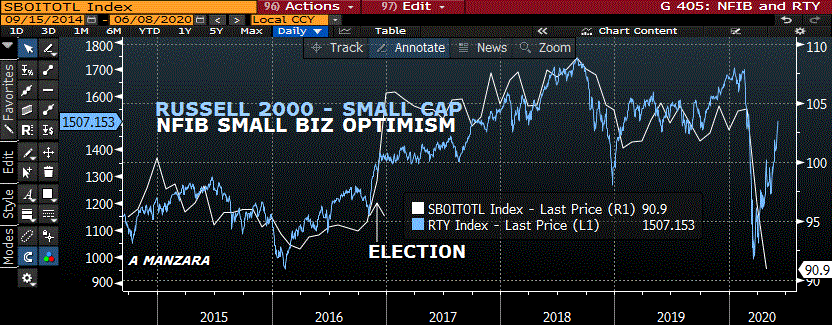
–Friday’s blockbuster employment number of +2.5 million NFP sent yields soaring and steepened the curve to new recent highs. Tens jumped 9 bps to 90.5. 2/10 ended at 69 bps, up nearly 7. Red/gold euro$ pack spread settled 62, up 7.5. This data release will almost surely be subject to large revisions, but stocks also surged on the news. I’ll believe the happy narrative when I see NFIB small business optimism (released tomorrow) rebound from its recent plunge. On the attached chart, I compare NFIB with the Russell index. Fairly strong correlation. The latter has exploded higher while the former is now below the depressed level before Trump took office. In the Q4 2018 stock pullback, the NFIB confidence drop was pronounced, and it never came close to the high set earlier in the year, even as RTY came back to test the 2018 high. Relating to business optimism or lack thereof, new bankruptcy filings are now at the highest level since the GFC.
–Three year auction today.
Bond Protest
June 7, 2020 – Weekly Comment
The long bond smashed a storefront window and ran away with yields this week while the authorities stood by and watched like a big city mayor. The thirty year bond yield screamed 27 bps higher to 1.676%. Tens rose 26 to 90.5. The Russell sprinted 8% on the week (new athletic shoes), with SPX lagging at just 5%, after a huge surprise in the jobs report showed an increase in NFP of 2.5 million versus an expected decline of 7.5 million.
This week is the FOMC meeting, with some expecting yield curve control, but as Mester intimated last week, that’s for the shorter end of the curve. We’ll control the things we can, like the direction of flow and checkout spacing in the grocery store. But the protesters are hand-in-hand in massive crowds. That’s what the bond market is starting to be, a protest. A protest of unfettered monetary expansion. A protest of huge deficit fueled supply (with the admin talking about another $1T support package). Maybe it will sputter out like previous attempts at higher yields. But there seems to be an uneasy turmoil below the surface.
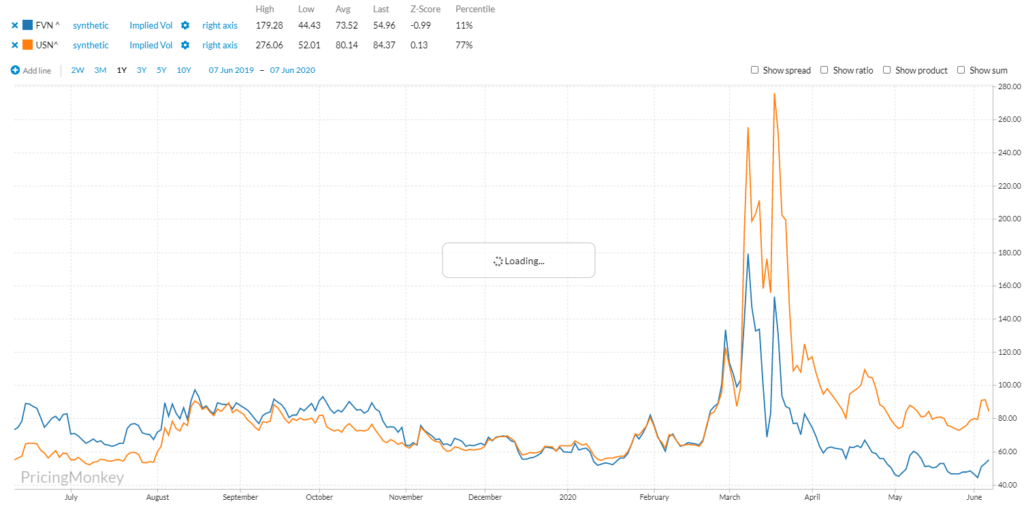
This week the Treasury auctions 3s, 10s and 30s on Monday, Tuesday and Thursday. FOMC announcement is Wednesday. According to initial TBAC estimates, the sizes are $46b, $27b and $18b against maturing amounts of $22.7, for a total of $68b raised in new cash. This, as the Fed has shaved their bond buying as of Friday to just $4b per day. The chart below (from Pricing Monkey) gives an indication of the divergence between FV (blue) and US (gold) vol. These tracked closely for eight months leading into March, then bond vol soared on a relative basis.
The St Louis Fed website indicates that the BBB option-adjusted corporate spread has collapsed from the late March high of 480 bps to 221 currently, closing in on the previous peak of 205 bps associated with the Q4 2018 stock swoon.
What might turn out to be a key issue for the Fed is Wall Street vs Main Street. Once again, the financial flows emanating from the Marriner Eccles Building seem to benefit financial engineers rather than small businesses struggling to come back from the pandemic. If Powell attempts to forcefully confront this topic at Wednesday’s press conference, it could spark a sharp pullback from last week’s stock rally.
On the euro$ curve, the red/gold pack spread closed at a new high of 62 bps, highest in three years, up 20 on the week. This is the second year vs fifth year, which correlates to 2/10 in treasuries. The 2/10 spread ended at a new high or 69, also +20 on the week, and the 5/30 treasury spread at 120, a new high but up only 9.5.
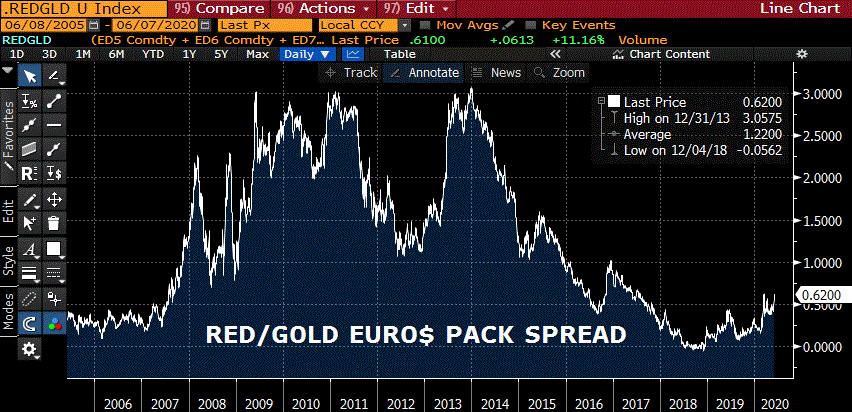
On the longer term chart, the current move doesn’t look all that dramatic. The 2012 to post-taper-tantrum 2013 surge was 200 bps. The 2007/08 crisis easing also sparked a run of around 200 bps. There is a triple top on this chart just over 300 bps, occurring in 2009, 2011 and late 2013. The last gold euro$ contract, currently EDH’24, settled exactly at 99.00 or 1%, the first time an ED contract has been at 1% or higher since late March. Keep in mind, if the red/gold spread were to reach 200, then the gold pack would have to be at least around 2.75%. As I noted during the week, on Tuesday there was a new seller of the 3rd gold, EDZ’24 in size of about 8000 at a price around 99.32. This contract settled Friday at 9905.5.
A fair amount of press has been given to the buyer of >100k EDM’21/EDM’22 spread from 6 to 7.5 bps over the past two weeks. This one-year calendar settled 12.0 on Friday, a nice winner. It’s somewhat instructive to compare this spread level to the one-year calendars further back. In the two week period from May 22 to Friday, EDM’21/M’22 rose 7 bps, EDM’22/M’23 rose 7.5 and EDM’23/M’24 rose 6.0. The spread settlements on Friday were 12.0, 22.0 and 23.0. The more deferred spreads are nearly twice as high as M’21/M’22, indicating that a move towards monetary policy ‘normalcy’ is perceived to be around three years away.
I can’t help but mention that Illinois (Wirepoints.org) has become the first state to borrow from the Fed’s Municipal Liquidity Facility, $1.2b at a rate of 3.82%. The first state borrower from the “lender of last resort”. As S&P Global Ratings said, Illinois’ budget “continues to be precariously balanced, and does not include measures to meaningfully address structural instability.” Shake Shack famously returned money to the Treasury after Mnuchin admonished large firms to tap the markets if they had access, rather than the government. Nothing more to see here.
Last note concerns a tweet by @Puff Dragon11: “Even more rare is that this one coming up on June 21st [the annular solar eclipse] is ALSO flanked by a lunar eclipse on June 5th and July 5th – 3 eclipse events all within a single ‘lunar month’. This has NEVER happened in the last 2000 years.”
A ‘strawberry moon’ eclipse followed by a ‘ring of fire’ solar eclipse followed by a ‘thunder moon’ eclipse. So we’ve got that going on for us. Which is nice.
OTHER MARKET/TRADE THOUGHTS
June midcurves expire Friday. 0EM 9975^ settled 3.5 vs 9974.5 in EDM1. 2EM 9962.5^ settled 5.5 vs 9962.5 in EDM2 and 3EM 9937.5^ settled 9.5 vs 9940.5 in EDM3. Once again, the blue straddle at nearly 3x the nominal value of the red indicates uncertainty on the back end of the curve.
Germany/Italy ten-year spread ended the week at 169 in the wake of extended and growing stimulus from the ECB, a fairly steady decline since the April 21 high of 263. Worth exploring a renewed widening of this spread, with good support around 158/160.
| 5/29/2020 | 6/5/2020 | chg | ||
| UST 2Y | 15.6 | 21.4 | 5.8 | |
| UST 5Y | 30.0 | 47.4 | 17.4 | |
| UST 10Y | 64.4 | 90.5 | 26.1 | w/I 90.7 |
| UST 30Y | 140.5 | 167.6 | 27.1 | w/I 168 |
| GERM 2Y | -65.9 | -60.1 | 5.8 | |
| GERM 10Y | -44.7 | -27.7 | 17.0 | |
| JPN 30Y | 50.3 | 56.2 | 5.9 | |
| EURO$ U0/U1 | -9.0 | -3.0 | 6.0 | |
| EURO$ U1/U2 | 8.0 | 15.0 | 7.0 | |
| EUR | 111.04 | 112.90 | 1.86 | |
| CRUDE (active) | 35.49 | 39.55 | 4.06 | |
| SPX | 3044.31 | 3193.93 | 149.62 | 4.9% |
| VIX | 27.51 | 24.52 | -2.99 | |
Steeper
June 5, 2020
–May jobs report today with nonfarm payrolls expected down 8 million and an unemployment rate of around 20%. You guessed it: BUY STOCKS. Stock futures are up this morning as the ECB heaped on stimulus yesterday and US is looking at spending another trillion to board up storefronts.
–Curve steepened to new highs, with 2/10 at 62.3 bps, up 6 bps on the day and 5/30 at 121.6, up 4. Ten-yr yield up 5.4 to 81.5 and 30’s rose 6.6 to 1.616%. Red/gold ED pack spread jumped nearly 6 bps to 54.5. Deferred one-year euro$ calendars made new highs from reds back. For example, there is continued heavy buying of EDM21/EDM22 which settled at a new recent high of 7.5 bps (now over 100k). However, the EDM22/EDM23 one-yr calendar settled 18.5, also a new high. And EDM23/EDM24 settled 21.5. Steepness on the dollar curve is further out because the Fed is jawboning forward guidance and may strongly hint at yield curve control at next week’s FOMC. But the market is beginning to indicate that unfettered stimulus combined with short end repression might cause the dam to break.
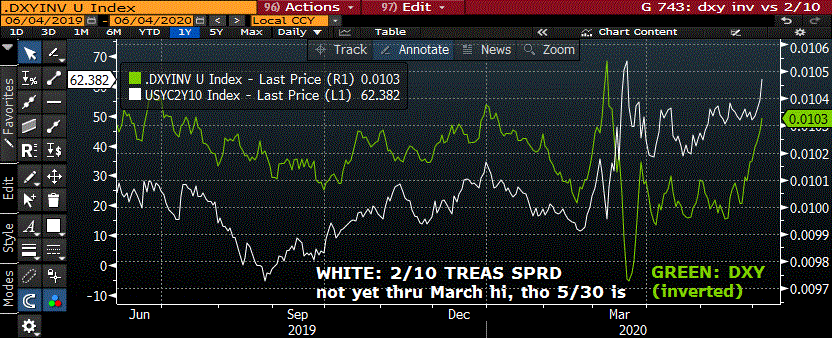
–Below I have included a chart of the dollar index inverted (green line, as it rises, the dollar is weakening) overlaid with the 2/10 treasury spread. As the dollar approaches the March low, the curve looks to re-test the March high. Of course, 5/30 has already taken out the March high. A steeper curve indicates a looser Fed, which undermines the dollar, providing a global boost in the form of easier financial conditions. It’s all great until higher treasury rates cause gov’t expenditures on interest to eat a growing portion of the budget. Which causes the Fed to emphasize forward guidance, further weakening the dollar…
–Yesterday only one US contract was at zero percent, and that was FFV’21 which settled exactly at 100. Happy Friday.
YCC won’t hold down long end rates
June 4, 2020
–Bear steepener yesterday as stocks continue to levitate. Nasdaq (NQM) is only about 1% from Feb’s all-time-high. The Fed meets next week with the idea of Yield Curve Control gaining currency, but I am guessing there will also be discussion about asset prices surging past earnings fundamentals.
–The ten year yield rose over 8 bps to 76 bps while thirties rose 7.3 to 1.55%. New highs in 2/10 at 56.3 (up 5) and 5/30 at 117.5 (up 4). Red/gold ED pack spread gained over 5 to 48.625. For confirmation of a move/trend, I like to see implied vol increasing, heavy volume and an increase in open interest. Implied vol did increase in long treasuries, for example the atm USU straddle was 6’34 on Tuesday but jumped to 6’54 yesterday (175 strike, 10.5%). Open interest barely moved in treasuries, but the euro$ strip showed an increase of 145k. Volume not quite supporting the thesis yet, but there were some large sales in TY.
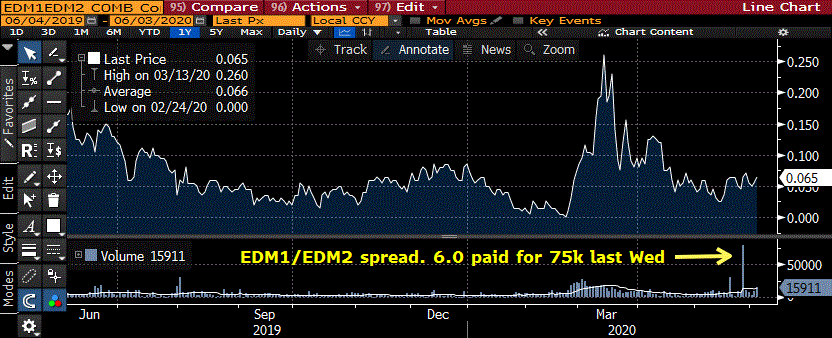
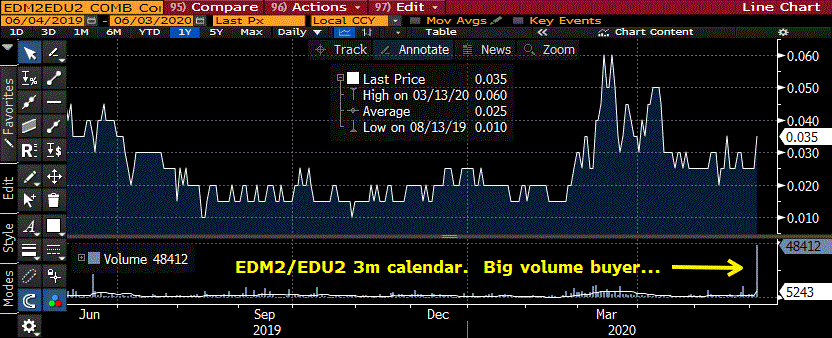
–One trade of note was a buy of EDM2/EDU2 calendar spread for 3 to 3.5 in size of >45k. Last week there was a buyer of over 50k EDM1/EDM2 spreads for 6.0 (red/green). This latter one-year spread settled 6.0 yesterday; I was a bit surprised to see someone pay over half the amount for a 3 month spread. Pay another 3.5 to extend out three months? Open interest is somewhat confusing as EDM2 was up 26k but EDU2 up 7.7k. With June midcurves having less than 2 weeks to go, maybe it was just a roll. In any case, it’s another small example of steepening.
–DXY made a new recent low yesterday, trading 97.30 late. A lower dollar eases financial conditions for the world. Trade balance today expected $49.2 billion. Jobless claims expected to be below 2 million as we’re running out of people to throw out of work. Nonfarm productivity and Unit Labor Costs as well, with the latter expected 5%. Inflationary connotation?
Tingling at the long end
June 3, 2020
–Bitcoin failed at the 10500 level, closing at 9580 (June contract). The high was 10565. Gold was hit as well, and has been trading sideways for the past month between 1700 and 1770 (GCQ -16/oz to 1734). These markets could be thought of as beneficiaries of excess liquidity but appear to have stalled temporarily. Capital has been flowing into stocks, with ESM up seven days straight. Yields, especially at the longer end have been testing higher levels. Tens closed 67.9 bps +1.8 on the day while the thirty-year ended at 1.477%, up 2.2 bps. 5/30 notched a new high close at 116 bps.
–Interestingly, in an overall quiet day, there was some noticeable activity on the longer end of the euro$ curve. For example, there was an early new seller of EDZ’24 which settled 9932.5. Open interest in the contract was up 9600 contracts (the most on any contract) to 84.7k. It’s not that this is a huge trade in and of itself. it’s just another small signal that the long end appears vulnerable to higher rates. There was also a block of 18k (reportedly buys) 3EU 9937.5p for 5.0 covered 9956.0. Settled 5.0 vs 9957, open interest rose 18k.
–Non-mfg ISM today expected 34 from 26 last. ADP as well, preceding the unemployment report on Friday.
Real rioting; virtual currency
June 2, 2020
–DXY is at a new recent low 97.45 and the long end of the treasury curve is simultaneously pressing to new high yields. Curve steepened yesterday with 5/30 above 115 (and 1.5 higher this morning). 2/10 closed 50.5, up 1.7 on the day. Little movement in euro$’s. Ten year yield ended at 66 bps.
–Bitcoin is back above 10000 as of this writing. High of the year has been 10500, the low in March was about 4000. Looks similar to Nasdaq, except that the decline in BTC was much deeper, and the rally will also likely be much more aggressive.
–Once again I note large buy last week of EDM’21/EDM’22 for 6 bps. Settled yesterday at 5.0, while the THREE-MO spread EDM’23/EDU’23 settled 4.0. Back end of curve is where the steepening bias is as Fed officials forwardly guide the near part of the curve to zero. This is making US vol a bit perkier than nearer contracts.
Ball of Confusion
June 1, 2020
–Protests, riots and looting give new meaning to ‘flight to safety’. However, equities have barely been dented.
–Friday saw yields fall as the month closed, with tens down 5.7 to 64.4 bps. Curve flattened with 2/10 down 3.9 to 48.8. Vol slightly firmer.
–Today’s news includes ISM Mfg expected 43.7 from 41.5 last. Prices paid expected 42 from 35.3. Friday’s release on UofM inflation expectations moved higher, with one-year 3.2% and 5-10 year 2.7%.–Fifty years ago, the Temptations released Ball of Confusion. Lyrics could have been from today. “Cities aflame in the summertime…” By the way, inflation in 1970 was 6.2%. And the band played on…
–Public transportation to and from the city has apparently been stopped. The building which houses the main office has been closed due to rioting. Therefore, service by the 24-hour desk may be curtailed.
Judgments of Value
May 31, 2020 – Weekly comment
Below are excerpts of a speech given by Alan Greenspan at Jackson Hole on August 27, 1999, ‘New Challenges for Monetary Policy’
On such judgments of value rest much of our economic system. Doubtless, valuations are shaped in part, perhaps in large part, by the economic process itself. But history suggests that they also reflect waves of optimism and pessimism that can be touched off by seemingly small exogenous events.
We can readily describe this process, but, to date, economists have been unable to anticipate sharp reversals in confidence. Collapsing confidence is generally described as a bursting bubble, an event incontrovertibly evident only in retrospect. To anticipate a bubble about to burst requires the forecast of a plunge in the prices of assets previously set by the judgments of millions of investors, many of whom are highly knowledgeable about the prospects for the specific companies that make up our broad stock price indexes.
Although many aspects of this issue deserve attention, let me cite a few open questions of particular importance. Efforts to differentiate between realized and unrealized gains, and the propensity to leverage both, may afford a deeper understanding of the consequences of asset price change. And differentiating between gains that arise from enhanced profitability and those that reflect changes in discount factors may also be useful. The former may be more likely to be sustained, given the tendencies of discount factors to revert back to historic norms.
There are important–but extremely difficult–questions surrounding the behavior of asset prices and the implications of this behavior for the decisions of households and businesses.
In August of 1999, Greenspan gave a speech at Jackson Hole, ‘New Challenges for Monetary Policy’. In it (linked below) he touched on new technologies and accounting practices, values for assets and their importance for the economy in general, and waves of confidence. Although Greenspan’s reputation has lost its luster in recent years, there is no denying this speech was prescient. On Aug 27, 1999, Nasdaq closed 2402. At the end of the year it was 3684. Having sailed through Y2K worries, by March 2000 it topped at 4816, astonishingly almost an exact double from the Jackson Hole speech. From there things went sour…but it took some time. At the end of May Nasdaq was 3180. At the end of 2000, it was just under the level when Greenspan delivered his comments, at 2341. The one year decline from the late March 2000 high to the early April 2001 low of 1348 was 72%. And it still wasn’t over. [chart below]
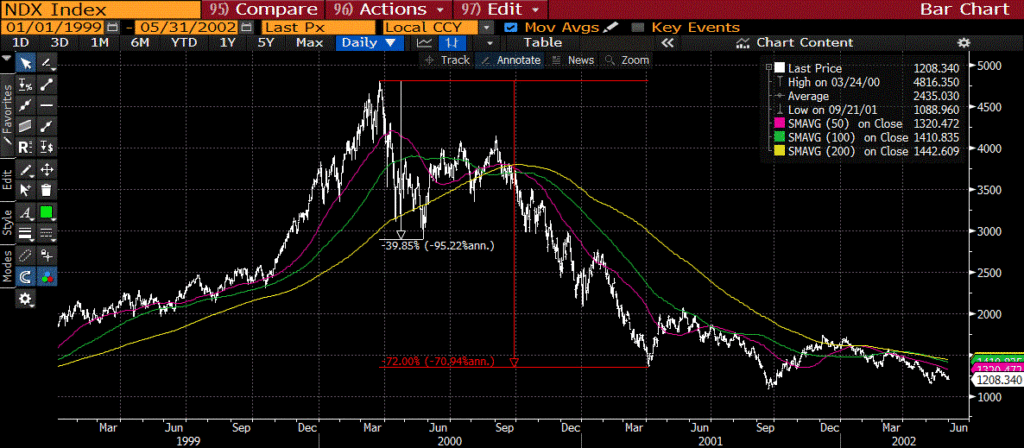
In 2000, the initial move in NDX from the March high to May low was a decline of just under 40%. By September, it had retraced just over the 61.8% level, and then a consistent sell-off ensued. In the current episode, the upside run to February’s high wasn’t nearly as dramatic. The initial leg down from the Feb high to March low was just 30%, also more shallow than 2000. However, the rebound has been quite fierce; as of Friday the index is testing February’s highs. This has been achieved with enormous support from the Federal Gov’t and the Fed itself. “Given the tendencies of discount factors to revert back to historic norms…” we might question the durability of the rally. However, the Fed is going to great lengths to assure the market that it won’t ALLOW rates to get back to historic norms. That point was especially driven home during the last attempt at ‘normalization’ which resulted in the stock market tantrum of Q4 2018. It’s no longer the judgments of millions of investors, it’s the injection of trillions in stimulus.
*****
I filled up in Wisconsin for $1.87 this weekend. I have a few friends, Lenny chief among them, that announce their cheap gasoline purchases like a badge of honor, as if they’ve rigged the pump price themselves. Well, I’m joining your ranks, comrades.
Once in a while an analyst remarks that it’s ambiguous now as to whether cheaper oil prices are good for the US economy, because while it helps Lenny and me, it hurts producers, and as we all know, the US is the top producer. According to the US Energy Info site, the US produces 19% of the world’s oil and consumes 20%. Maybe we should just call it a wash. You don’t hear much about the ambiguity of net positive or negative effects from other factors. Specifically, I am referring to financial conditions. According to former NY Fed chief Dudley, financial conditions consist of short term interest rates, long term interest rates, the level of stocks, credit spreads and the dollar. Clarida glowingly outlined easier conditions in a speech last week.
Is it clearly the case that the net economic effect of easier financial conditions is beneficial? Some officials are starting to address that question. For example, with respect to short term rates, Powell again said on Friday that negative rates will not work for the US economy. [There’s such a thing as too much rate cutting?] Many commentators have said that low long term rates help borrowers and home-builders, but also hurt savers and retirees that depend on interest income. The shape of the curve is another feature that can negatively impact the transmission of monetary policy if too flat or inverted. In terms of stocks, it’s great when they rise, but if not underpinned by profitability and innovation, instability can ensue. When credit spreads don’t reflect the reality of lending based on economic fundamentals, zombies arise. With respect to the dollar, the former mantra by treasury secretaries was that a strong and stable dollar is in the best interest of the US. Now, the world yearns for a weaker USD. Everything has become murkier. The thought extends to unemployment benefits where workers are making more from staying out of work than returning.
Another topic that seems to have fallen out of fashion is ‘equilibrium’. It used to be that economists talked about the market finding a new equilibrium when a shock occurred. In fact, I don’t hear the word much anymore. A google trends search for ‘economic equilibrium’ shows modest annual spikes in February, apparently coinciding with the initial leg of the semi-annual Humphrey-Hawkins testimony. Just another anachronistic footnote of what used to be the capitalistic system.
I’ll end with a note regarding Loretta Mester’s appearance on BBG on Friday. The interviewer asked her, regarding yield curve control, would she think about it as “focused on the front end to the belly of the treasury curve, or would you think about doing what Japan is doing, which is all the way out to ten years?” Mester responded that, while it’s not under serious consideration for this phase, her view is that it would be a support for forward guidance. She added that “right now the yield curve is very flat at the short end…maybe it’s not necessary to emphasize that forward guidance.” And concluded, “If we were to use it, I would view it as reinforcement to forward guidance on the short end.”
It’s perhaps worth noting that the thirty year yield in Japan hit a new ytd high this week just over 50 bps. I’d further mention that the US spread between 5’s and 30’s reached a new high over 111 bps, not seen since mid-2017. Control of the short end may not hold the long end down.
Finally, circling back to consumer pessimism and optimism and forecasts for confidence, note that the final readings for U of M’s inflation expectations were released Friday, with the one-year at 3.2% up from the preliminary release of 3% and the 5-10 year was revised up to 2.7 from 2.6! This, in spite of yoy PCE Core prices coming out at just 1% yoy. Another thing Mester said in her interview was that when the Fed considers new tools, we have to think about how to implement them and about how to exit from them. My guess is that the Fed is going to be spending a lot more time in the near future wrangling with the latter rather than the former.
OTHER MARKET/TRADE THOUGHTS
There was a buyer last week of 75k EDM1/M2 spreads for 6-6.5. This calendar ended the week at 5.5, up 0.5 on the week. Further out the curve, THREE-month spreads are nearly the same level. For example, EDU3/EDZ3 settled 5.0 and EDH4/EDM4 settled 4.5. EDM3/EDM4 closed 16.5, exactly 3x higher than the nearer version. These spreads give the impression that either inflation will begin to press higher over time, or that the Fed will cede control to the market. EDH’24 settled at 9949.5, just 4.5 bps lower than the lowest settle ever for the 16th quarterly, which was earlier in May.
I did a bit of review on spreads during the taper tantrum of 2013 which occurred in May. The second red, or ED6, went from around 9960 to 9920 from early May to end of June. (This period also encompassed a contract roll). The second green, ED10 went from 9940 to 9830, while the second blue, ED14 went from 9885 to 9740. Therefore, deferred contracts sold off harder. That period may or may not provide a good analogy for what is coming up in the US, but is worth noting.
Copper/gold ratio compared to the US ten year yield is one of Gundlach’s indicators. This week the former ratio ticked a bit higher while the ten year yield fell 1.5 bps. The divergence may not be enough to warrant a trade, but worth keeping an eye on.
| 5/22/2020 | 5/29/2020 | chg | ||
| UST 2Y | 16.6 | 15.6 | -1.0 | |
| UST 5Y | 33.3 | 30.0 | -3.3 | |
| UST 10Y | 65.9 | 64.4 | -1.5 | |
| UST 30Y | 137.0 | 140.5 | 3.5 | |
| GERM 2Y | -68.0 | -65.9 | 2.1 | |
| GERM 10Y | -48.7 | -44.7 | 4.0 | |
| JPN 30Y | 44.9 | 50.3 | 5.4 | |
| EURO$ M0/M1 | -11.3 | -10.8 | 0.5 | |
| EURO$ M1/M2 | 5.0 | 5.5 | 0.5 | |
| EUR | 108.98 | 111.04 | 2.06 | |
| CRUDE (active) | 33.25 | 35.49 | 2.24 | |
| SPX | 2955.45 | 3044.31 | 88.86 | 3.0% |
| VIX | 28.16 | 27.51 | -0.65 | |
https://www.newyorkfed.org/newsevents/speeches/2017/dud170330
https://www.federalreserve.gov/boarddocs/speeches/1999/19990827.htm
https://www.eia.gov/tools/faqs/faq.php?id=709&t=6
Lowest inflation data of year?
May 29, 2020
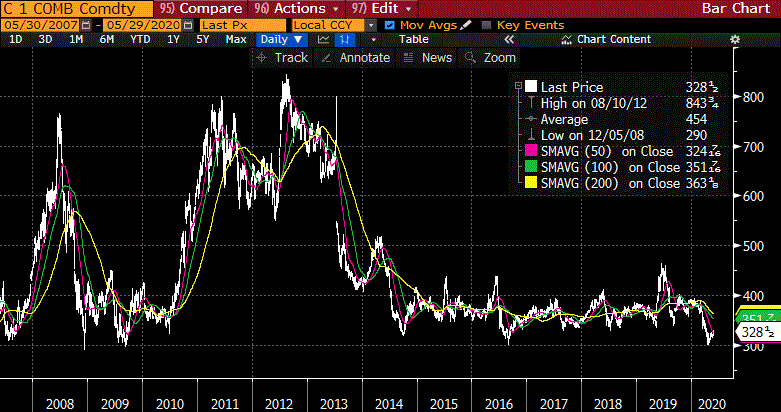
–I saw a note yesterday that Orange Juice was one of the best performing commodities this year. July (JON0) sank below 100 in March and soared over 130 in May, closing at 127.80 yesterday. Of course, crude oil has had a much larger percentage run off its debacle low in April (and is arguably somewhat more important to the global economy). In any case, it seems that commodities are perking up; I’ve attached a chart of corn, which appears to have put in a May bottom and is poised for a move higher. (C Z0 was 4.04 in January, traded as low as 3.25 in May and is now 3.41, still shy of the 38% retracement at 3.55. Maybe I’m simply trying to wrangle arguments in support of a broader inflation theme, but I would also note that DXY (dollar index) closed below the 200 DMA yesterday and is further weakening this morning to levels not seen since late March (current 98.10).
–Rate markets were lethargic yesterday. However, 5/30 posted a new high 112.5 bps and 2/30 at 129.5 is just a couple off of the spike high in March. A friend noted that NY Fed’s Williams reference to Yield Curve Control would likely cover the curve out to the belly, leaving the longer end to seek higher yields, with additional supply of 20’s figuring into the mix. Also worth mention is that the ten year treasury to tip breakeven made a new short term high just over 119 bps, still below April’s high of 130, but well off the spike low of 60. For context, this spread traded between 150 and 180 from Q4 through January. Slight steepening of ED curve, with reds -0.375, greens -0.625, blues -1.125 and golds -2.25. Red/gold pack spread at 43.75 is well below March high print of 60.
–Equities slid from new highs into the end of the session as Trump announced a speech for today addressing China. Modestly lower this morning with small-cap Russell leading the decline. Not sure as to time of Trump’s news conference.
–This morning we’ll get the Fed’s preferred inflation measure, Core PCE prices for April, expected at yoy 1.1% from 1.7% last. Also, UofM final May readings on expected inflation. In the middle of the month, the prelim numbers were surprisingly high, 3.0% for 1 year and 2.6% for 5-10 years.
–Sad to see the violence engulfing Minneapolis and hoping that societal tensions don’t boil over to other metros. Hope Matt’s is still safe so I can get up there for a juicy lucy this summer.
–And no. I am not going lead off a post with Frozen Concentrated Orange Juice without a Trading Places clip. “Of course, gold doesn’t grow on trees like oranges.”