Curve Implosion
June 19, 2026
***********
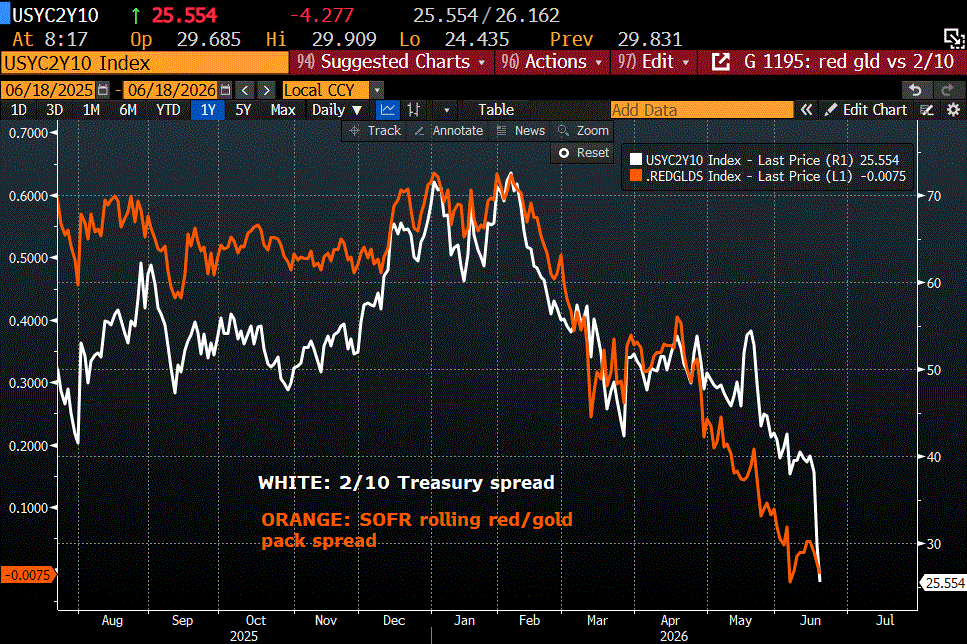
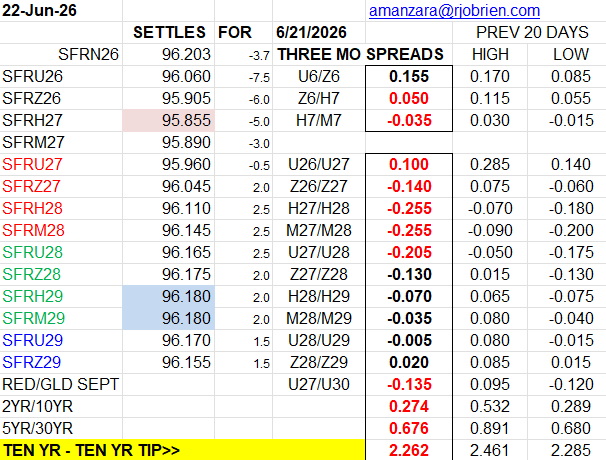
–Thursday featured continued curve flattening as the attached image shows. Since the beginning of Feb, red/gold SOFR pack spread has gone from 72 bps to zero. It settled +1.625 bps with the red pack 9606.5 and gold pack 9604.875. 2/10 is now 27.4, down 1.5 on the day; high in Feb was over 60. The 4% level has sort of been a cap with respect to the SOFR strip, although the weakest contract, now SFRH7, settled at a new low 9585.5 (4.145%).
–When the Fed started to raise rates in 2022, the near SOFR calendars were all positive, meaning that subsequent contracts traded at higher rates, because it was clear that more hiking would occur (not much of a stretch when starting from zero). But with the current Fed midpoint of 3.625%, the market is hesitant to price in a series of hikes. In fact, by Q2 of next year there’s a bias toward ease: SFRH7/M7 is inverted at -3.5 (9585.5/9589). The one-year calendars are illustrative: SFRU6/U7 is +10 (9606/9596) while SFRZ6/Z7 settled negative 14 (9590.5/9604.5) and H7/H8 is -25.5. Z/Z was as high as +8 trade prior to the FOMC, so that spread flipped by almost 1/4%.
–The weakest contract on Thursday was front Sept SOFR, 9606, down 7.5 bps. The 30y bond actually fell 2 bps in yield to 4.90%.
Red denotes new 20 sessions low.
Capability and Commitment?
June 18, 2026
***********
–Hard flattener as Warsh focuses on price stability. 2y up 13 bps to 4.176%, tens up only 3.9 to 4.465% and 30y bonds were nearly unch’d at 4.92%. 2/20 new low at 29 bps, 5/30 new low at 68. On the SOFR strip, the weakest contract was SFRH7 (also now the lowest), down 15.5 at 9590.5 (so 4.09% vs current EFFR 3.63, nearly 2 hikes). All calendars made new recent lows, reds, (2nd yr) -9.875 to just under 9605, greens -5.625 to just under 9616, blues -3.25 to 9613 and golds -1.25 to 9604. The red/gold SOFR pack spread settled at just +1 bp, nearing inversion, an indication of ‘tight’ central bank policy.
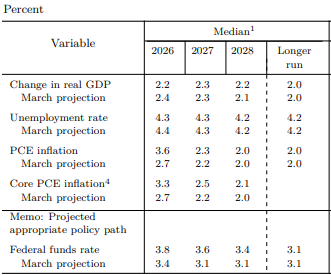
–SEP: PCE inflation marked higher, and a hike was penciled in for the end of this year.
–In response to a question from Colby Smith (NYT), Warsh said this: “…we have the capability and commitment to deliver on our price stability objective of 2%. That’s exactly what we’re going to do.”
Yet, as usual, the 2% goal is 2 years away on the SEP, just as it has been for some time. Warsh appears to have deftly navigated the first FOMC, as bonds are printing new recent highs this morning at 113-17, with the 30y yield at 4.878, just below the 50% retrace from Feb low 4.61 to May high 5.18 (4.90).
–Tim Cook of Apple says price increases are no longer avoidable is input costs surge.
–In an effort to sharpen communication Warsh has eliminated forward guidance and shortened the statement. As attributed to Mark Twain: “If I had more time, I would have written a shorter letter.” In the 1980’s, we needed ‘Fed watchers’ to determine whether the Fed had changed policy or not. The signals occurred through Open Mkt Operations. No statements. Just an unexpected ‘matched sales’ around 10:35 CST. The only clue I had was watching John Fife who ran the Dean Witter bond futures desk on the CBOT floor, flash large sell orders into the pit at ‘Fed time’. Warsh could easily attain 2% inflation quickly by jacking up rates in large increments, at the cost of higher unemployment and a stock market deflation. Pain is involved. Powell also vowed to reach 2% inflation…
Asset Price Inflation
June 17, 2026
***********
–CLQ6 is near 75/bbl this morning, helping to support bonds on the prospect of lower inflation going forward. Tens eased 4 bps yesterday to 4.426%. SOFR contracts rose 3.5 to 5.5 from reds through golds. Lowest SOFR contract SFRM7 settled 9606, +3.0 and peak SFRZ8 settled 9621.5. +5.0. The last two Fed SEP projections, in December and March, pegged end of-year FFs for 2026 and 2027 at 3.4 and 3.1 pct; one EASE embedded in each given current FF mid of 3.625%. SFRZ6 currently has one HIKE priced at 9611.5 (3.885) and SFRZ7 is 9613, with Z6/Z7 spread having once again inverted. Ten year tip breakeven notched a new low 230.6 bps.
–Today is Warsh’s debut as Fed Chair. A few hedges placed for possible hike/ hawkishness. New buyer 25k SFRN6 9600p for 1.0 (ref 9624 SFRU6) and seller of about 50k FFQ6 at 9635.0 (also worth noting that Fed Effective ticked up to 3.63 from 3.62).
–As mentioned yesterday, asset price inflation is likely a much bigger worry than goods prices for the Fed. This morning BBG has a story on Bank of Korea being concerned about soaring bonuses (wealth) at tech firms:
The Bank of Korea warned that soaring bonuses at major technology firms could fuel broader wage growth and stronger consumer demand, complicating the inflation outlook.
–Options on interest rates continue to see premium declines, indicating little expectation of a Fed surprise. Here’s an example: On Friday, SFRM7 settled 9599.5 and the 9600p at 38.75 (straddle 77.0). Yesterday, SFRM7 settled 9606 (+6.5 from Friday) and M7 9600p settled 31.5, down 7.25 from Friday (for a 50 delta option!). The 9600c went from 38.25 Fri to 37.25 yesterday, so calls actually lost a bp on a 6.5 bp rally. Straddle now 68.75. TYU atm straddle was around 2’04 several sessions ago, settled 1’44 yesterday.
Yields ease, rate vol sinks
June 16, 2026
***********
–Quiet trade in rate futures as yields continued to ease. Tens fell 2 bps to 4.465%. SOFR contracts from June’27 thru golds (5th year forward) were +3 to +3.5. SFRM7 is still the lowest near contract at 9603 or 3.97%, while the peak on the strip is U28 and Z28, both 9616.5 or 3.835%. 30-y yield 4.95 this morning, 50% target from Feb low 4.61 to May high 5.18 is 4.90.
–SpaceX continues to rise overnight, now with a market cap of over $2.5 trillion. The Wall St Journal has this helpful headline: ‘Stocks have even more room to fly if Hormuz reopens’. Unabashed cheerleading is something I thought was rare for WSJ, but the fever is everywhere. For Warsh, it’s back to a conundrum: Goods inflation may not be the problem, it’s ASSET price inflation. With record stocks comes record margin debt: $1.3t as of end of April. SBLOCs also growing (Securities-based line of credit) which I estimate at $500b.
–Implied vol in rates was marked significantly lower yesterday. For example, SFRM7 9600^ from 88.0 settle Friday to 83.25 yesterday. SFRU7 9625^ from 17 to 15 yesterday ref 9624.5. Current FF mid is 3.625% or 9637.5. A hike would be 3.875% or 9612.5. So I suppose the straddle covers both outcomes, unch’d to just one hike, with breakevens 9610/9640. But I’d guess something happens within the next 87 days to shake that assumption.
–BOJ hiked to 1% but $/yen remains pinned to the high, 160.34. At the same time RMB is also at a new high 6.757, with China Retail Sales ‘slumping to levels unseen since the pandemic, down 0.6% last month from a year ago.’ (BBG)
–CLQ6 this morning 77.85, down 1.59, near lowest level since mid-March.
–Housing Starts today expected 1430k from 1465. FOMC tomorrow.
All better
June 15, 2026
***********
–July Crude is down 4.75 this morning to 80.13 on news of a deal which opens the Strait of Hormuz. Stocks and bonds have soared, although bonds are more muted in their response. August gold +121 this morning to 4344, a bounce from the protracted slide since mid-April, when the contract was 4900.
–Given high official inflation readings recently, does this development tip the scales toward easing as Warsh steps into the Fed Chair role on Wednesday? Currently there’s little evidence on the SOFR strip, with red contracts only +4.5 to 5 this morning. For example, the lowest near contract SFRM7 is printing 9605 which is +5.5 (3.95%), but that’s still over one-quarter pct higher in yield than the current Fed Effective rate of 3.62. With ES and NQ again looking to test all-time highs, perhaps wealth effect spending will keep inflation perky even if oil drops.
–News today includes Empire Mfg, which was 19.6 last, strongest since 2022. Also Industrial Production, expected +0.3%. Housing Starts tomorrow, with Retail Sales and FOMC on Thursday.
–Foreclosure in the heart of Chicago’s Gold Coast: (Real Deal) The 267,800-square-foot Hilton Suites at 198 East Delaware Place… LNR Partners represents the bondholders who foreclosed on the 30-story hotel three years ago… Procaccianti, the previous owners, gave up the hotel through a deed-in-lieu of foreclosure tied to almost $70 million in debt on the property. CoStar data has the building pegged at a $48 million valuation.
–By comparison, a single family home at 1355 N Astor (a few blocks away from the hotel) is listed at $21 million.
https://www.chicagostarmedia.com/candid_candace/chicago-s-most-expensive-historic-home-for-sale-at-21m/article_a79df302-dbd7-433e-920b-6e6bdf78be88.html
https://www.redfin.com/IL/Chicago/1355-N-Astor-St-60610/home/14124756
Current Inflation High, Forward Measures Low
June 14, 2025 – weekly comment
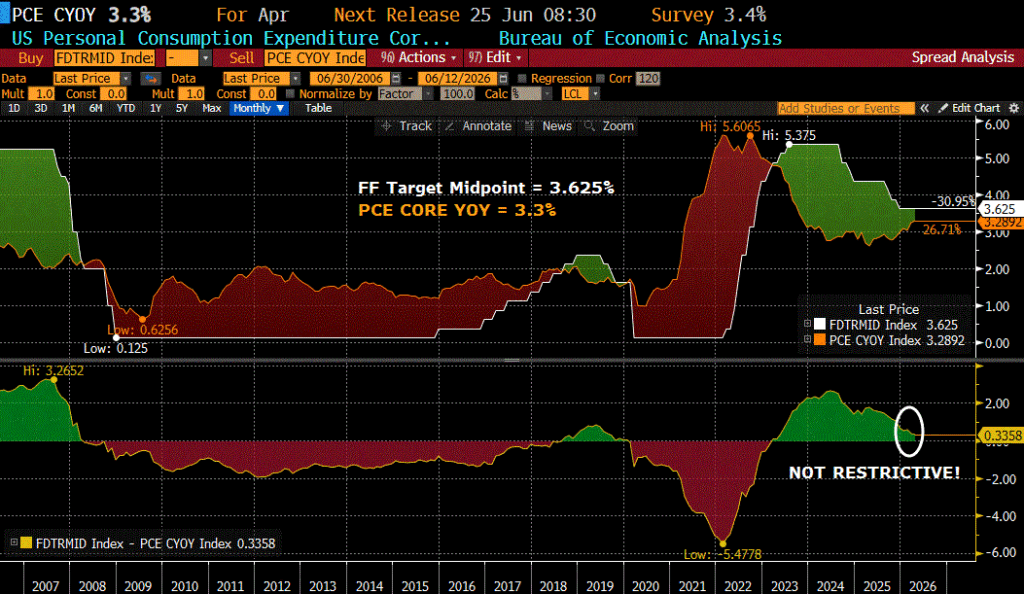
Last CPI 4.2. Last PPI 6.5. U Mich 1yr inflation expectations 4.6 and 5-10 yrs 3.4. Ten year treasury yield 4.485, suggesting tiny, if any, real yield. PCE prices yoy 3.8 last with Core 3.3. Core has been above the Fed’s 2% target for five years.
The spread between FFs and Core PCE is now just 33 bps as inflation measures have risen since the middle of last year. No longer restrictive. The 5y treasury yield and the last CPI are identical at 4.2%.
However, in the past month, the 5y breakeven has plunged from 271 bps to 241. Ten year from 252 to 232. The 5y/5y forward inflation swap from 249 to 239. The rolling front month WTI contract has fallen from 113 in April to 85 last. The WTI futures curve suggests 74 by next year. These moves imply the Fed can look through the most recent inflation data.
Jan Fed Funds are 9617 or 3.83, 21 bps above current EFFR of 3.62 (one hike by end of year). But SFRU6/SFRU7 settled at just 22. Again, maybe a hike over that year.
The unemployment rate has been 3.9 to 4.5% for the past two years, last 4.3%. The inflation mandate is clearly more dominant. However, recent market action suggests that inflation will recede even as Q2 GDP Now from the Atlanta Fed has the last estimate at +3.3%.
Warsh’s first FOMC as Chair is Wednesday. Several Fed members have recently said the Fed may need to be more restrictive given persistent inflation (Logan, Hammack, Kashkari…). What should Warsh do? My guess is that he will shift the balance of risks toward inflation without changing rates. Talk tough. Forward guidance in all but name, which would likely pressure the curve further and may cause long rates to decline.
The curve has already been flattening since February, with 2/10 peaking at 72 and now 39. Red to gold SOFR pack spread (2nd year forward vs 5th year forward) was over 60 in February and settled Friday at just 4.25. These moves have already telegraphed a Fed on hold. Despite the highest CPI and PPI readings since 2023 last week, US treasury yields actually eased slightly, with 2s down 7.2 bps to 4.083%, tens down 5.4 bps to 4.485%. The 10/30 treasury spread (rough proxy for term premium) is 49 bps, down 20 bps from the January high. MOVE index fell this week from 75.2 to 69.4, suggesting little stress in treasuries. VIX Friday to Friday, 21.51 to 17.68.
SPCX debuted with a market cap over $2T. However, from Friday to Friday, these 7 stocks lost nearly $700B in value: AAPL, MSFT, GOOGL, ORCL, AMZN, META and PLTR. Certainly indicates swapping out into the new IPO…and perhaps not as much access to leverage.
In sum, the week wasn’t particularly dramatic in terms of price action. FOMC and Retail Sales on Wednesday, expected +0.5%.
Below are a couple of interesting excerpts:
Pimco’s Richard Clarida, Andrew Balls and Daniel Ivascyn said in the firm’s latest annual secular outlook report that ‘the default cycle is reasserting itself, and we expect significantly higher losses in lower-quality credit such as leveraged and private direct lending’… Pimco said that backdrop clashes with ‘elevated secular uncertainty,’ and ‘we interpret this as complacency rather than strength.’ While the US economy has been resilient, ‘AI will disrupt old economy companies, especially highly levered ones.’” –From the Credit Bubble Bulletin
“S&P 500 index investors, or just people who own most of the mega-cap, Mag-7, big tech names, there is pretty much exposure to a lot of this IPO mania whether you like it or not, and whether the indexes you own include them or not. Not only do names like Nvidia, Meta, Microsoft, Google, and Amazon all have massive cap table positions in a bunch of these mega AI names, but it turns out an unfathomable amount of the “earnings growth” of the index last quarter was just these companies marking up the value of these private AI names that they own. $69.2 billion of “profits” were “other income” from just THREE companies (Google, Nvidia, Amazon). This accounts for a staggering 12% earnings growth year-over-year, making the “operating earnings” growth far, far more understandable (though still quite robust, it should be said).” — David Bahnsen as edited in John Mauldin’s missive.
OTHER THOUGHTS / TRADES
Big trade in bonds Friday was USN 111/110ps buyer; settled 10/64 ref USU6 112-12 (30y cash yield 4.972%).
Early buy: USN 111/110p 1×2 for 0 (25k) then buying of 111/110ps. Volume 133k 111p and 179k 110p. Settled 19/9 or 10/64, USN 111p delta -0.24. USN 110p delta -0.12. Two weeks until expiration 26-June. Open interest in both strikes is now 109.5k, up 93k on Friday in 111p and up 43.6k in 110p.
DV01 on USU contract is $134.30. 30y treasury 5.0% of 5/56 has DV01 $155.50. The bond future is closer to the 20y, with DV01 $125.70 (auction this week). In any case, the 111 strike is currently about 11 bps away. Given 30y yield 4.97, that would indicate 5.08 in the long bond, but on Thursday as USU printed 111-01 the yield was more like 5.04. High yield print May 20 was 5.20; futures printed a low of 108-31.
| 6/5/2026 | 6/12/2026 | chg | ||
| UST 2Y | 415.5 | 408.3 | -7.2 | |
| UST 5Y | 427.4 | 421.1 | -6.3 | |
| UST 10Y | 453.9 | 448.5 | -5.4 | |
| UST 30Y | 500.0 | 497.2 | -2.8 | |
| GERM 2Y | 268.8 | 261.5 | -7.3 | |
| GERM 10Y | 303.8 | 299.4 | -4.4 | |
| JPN 20Y | 356.7 | 352.6 | -4.1 | |
| CHINA 10Y | 171.6 | 174.1 | 2.5 | |
| SOFR U6/U7 | 28.5 | 22.0 | -6.5 | |
| SOFR U7/U8 | -14.0 | -11.0 | 3.0 | |
| SOFR U8/U9 | 0.0 | 2.0 | 2.0 | |
| EUR | 115.22 | 115.68 | 0.46 | |
| CRUDE (CLQ6) | 87.99 | 83.35 | -4.64 | |
| SPX | 7383.74 | 7431.46 | 47.72 | 0.6% |
| VIX | 21.51 | 17.68 | -3.83 | |
| MOVE | 75.20 | 69.36 | -5.84 | |
Space, the final frontier
June 12, 2026
***********
–Thing took off, well, like a rocket in front of the SpaceX IPO as Trump said the deal with Iran is done. Ten year note dropped 8.1 bps to 4.459% while the 2y fell 6.4 to 4.062%. New low in ten year breakeven (treasury minus tip yield) at 232 bps, back where it was in 2021 before actual hiking occurred. (four year range has been just above 200 to just above 250). WTI (CLN6) is just above 84 at this writing, -3.50 on the day. ESM6 +1.6% on the day at yesterday’s settle.
–June midcurve expiration in SOFR today. SOFR contracts from reds through golds were +7 to +8. Lowest near contract still SFRM7 which settled 9600.5. One early interesting trade was an outright new buyer of 60k SFRH7 9650c from 13.25 to 13.5; settled 14.5 vs 9602.5. I believe Citi stated earlier in the week that they see three rate CUTS coming, which would put the FF target 2.75 to 3.0%, so maybe a 3.5 strike makes sense.
–Mag7 stocks have been under pressure for the past week or so, probably to make room for SpaceX. Perhaps another indication that liquidity has to come from somewhere given voracious capital raises.
–Amazing to me that they marked Household Net Worth up by $113b, even with the Q1 decline of $1.82T of corporate equities. Real Estate and ‘Other’ came to the rescue with quarterly changes of +913b and +1.14t. (Really?)
–UofMich Sentiment and Inflation expectations today. Sentiment expected 46 from the historic low print last month of 44.8. One-year inflation expectation is 4.9% vs 4.8 last. Obviously the market is discounting current inflation readings given oil’s slide and possible disinflationary effects from AI.
CPI day
June 10, 2026
************
–CPI and 10y auction today. Yesterday featured a slightly steeper curve, with 2s -2.9 bps at 4.122% (50 over current EFFR) and tens down 2.2 to 4.526%. Lowest SOFR contract still SFRM7 which settled +4 at 9594.5 or 4.055%. CPI expected 0.5 m/m and 4.2 y/y. Last June the front CL contract was over 70 and this morning it’s 88.
–Huge swing in stocks, initially taking out Friday’s lows and then coming almost all the way back! ESM6 range 244 points, closed -23.25 at 7392.75. (Weaker this morning as US/Iran hostilities ratchet up again). Precious metals making new lows this morning with GCQ6 just under 4200, -86 on the day. $/yen at new high 160.45 this morning. BOJ chief Ueda hospitalized; will miss next week’s meeting where hike is expected.
–2yr options have been a bit more active in last few sessions. Yesterday a buyer of 5k TUN6 103.125/103.375c 2×3 for 6, 5k, rolling long to lower strike, settled 6 (7.5/3.0). TUU6 settled 103-017; the 103.125 strike (103-04) is about 3.5 bps otm, expires 26-June.
Worried about inflation…and shadow credit
June 9, 2026
**********
–Little net change in rate futures with tens up 1.6 bps to 4.548 and 30s up 2.6 to 5.024. Treasury auctions 3s today, followed by 10s and 30s Wed/Thur, with CPI tomorrow, all of which are keeping rate futures capped. News today includes trade and existing home sales. From 2015 thru 2019, existing home sales were 5-5.5 million with an average of about 5.4m Since 2023 that average is now just over 4 million after the surge in 2021 (6.5m), with today expected 4.07m.
–June SOFR options expire Friday, with 0QM6 9587.5^ settling 10.5 vs SFRM7 9590.5. Probably a fair price but if I HAD to do something I’d buy rather than sell.
–ESM rebounding a bit this morning. There have been many reports of circular financing relating to AI. This ZeroHedge article covers a $35b SPV arranged by Apollo and Blackstone for Broadcom to lease chips to Anthropic. According to the article, the sr tranches are backstopped by Broadcom (vendor financing). From ZH:
The two senior portions of the debt were split between banks and investors. Some $6bn of so-called A1 notes were sold to banks with an interest rate 1% over Treasuries. A further $24bn of A2 notes were sold on to investors in asset-backed credit markets, priced with a yield of 5.75 per cent…. The $4.5bn of junior debt, which is not supported by Broadcom and therefore exposes lenders more acutely to Anthropic, carried an interest rate of 8.5%.
Broadcom (AVGO) 5y CDS has steadily climbed this year from 35-40 bps to 52.7 last. The stock has retraced about 45% of Apr/May rally. (SPV is off balance sheet). By comparison ORCL 5y CDS 159 bps and Alphabet is 50.
Peace deal retreat
June 8, 2026
************
–KOSPI index has nearly tripled since September from just over 3000 to just under 9000, which occurred last week. This morning it’s down 15% from last week’s high settle (down 8.3% today). Currently 7484; May’s low print is still well below, 7054.
–DXY has added slightly to Friday’s gains, now 100.15. For a full year, the area from 100.25 to 100.60 has capped DXY. A close above would open the door for 105.
–Israel and Iran escalated attacks, causing CLN6 to pop nearly $4/bbl this morning to 94.50. Equity futures seeing a modest bounce as the admin considers taking ownership shares in AI companies. META reportedly considering an equity raise (out Friday-FT). Bonds slightly lower going into auctions this week. CPI is Wednesday, expected 4.2% yoy from 3.8%.
Below is a completely different topic…
–Chicago Bears announced a move to Hammond, Indiana. The Chicago’s Teachers Union was reportedly a major influence in the decision. (NBC) The Chicago Teachers Union (CTU) played a major role in stalling this bill [Megaprojects bill] by aggressively lobbying against the stadium’s property tax breaks, which they argued would divert vital funding from public schools.
here’s an interview with Chgo Teachers Union head Stacy Davis Gates, where she repeatedly says Chicago schools need more money from Chicago property taxes:
A couple of quotes:
“If those property tax dollars go to wealthy real estate interests, they won’t be going to the schools”
At 4:30, “I have no idea how what I said to you connects to the Bears leaving the state of Illinois.”
Here’s how Chicago’s schools are doing:
In Chicago Public Schools (CPS), statewide testing reveals that about 42% of students are proficient in reading and 27% are proficient in math. [Ms Gates appears to be in the 73% category].
And here’s how the political situation in Chicago/Illinois is driving “wealthy real estate interests” and related tax revenue out of the state:
From @FCNightingale citing Crain’s
Former Citadel HQ, 131 S. Dearborn St. Chicago, Illinois, trades at 76% discount from 2006 sale price. Sold for $137 million. Purchased for $560 million in 2006. German bank BayernLB led a $448 million refinancing of the property in 2020.