Dec 3. Party on Garth
Dec 2. ROLL TIDE
They got a name for the winners in the world
I want a name when I lose
They call Alabama the Crimson Tide
Call me Deacon Blues –Steely Dan, Deacon Blues
I couldn’t decide whether to go with ‘Roll Tide’ or ‘Winning’, popularized by Charlie Sheen, for the title to this note. Had to go with the decisively positive Roll Tide after the amazing come-from-behind win over Georgia on Saturday featuring the redemption of Bama quarterback Jalen Hurts. This is collegiate sport as religion. A scan of the stands after big plays captures the range of almost every human emotion of the fans: giddy elation, devastating deflation, nervous hopefulness.
This was a week of winning for Trump. First, the Fed’s Powell changed the narrative for future hikes, saying that the fed funds rate was near the lower end of the neutral range, in what some perceived as capitulation to Trump’s demand for an end to hikes. Then, he called a 90-day truce with China’s Xi on imposing further tariffs in January. Perhaps it’s a kick the can down the road victory, but for now it’s certainly a positive. China agreed to buy more US agricultural products, surely a boost for grains.
This should be a week of hopefulness and elation for stocks, and clearly the strong close to the week is a reflection of the mood. The funeral of former President Bush will focus national attention on the positive aspects of US. While it’s unclear whether the huge drop in oil prices will ultimately be a boost for the US economy, Trump claimed the decline as another win, both for himself and for the average SUV American. Winning, as defined by a lower cost of inputs for American businesses to gain global market share, and households, to support employment and consumption.
In comparison to news images of Paris rioting, it’s hard to argue that things are anything but relatively positive in the US. Fifty years ago major US cities experienced rioting, looting and arson after the murder of Martin Luther King Jr. That was during the Chicago rule of the original Mayor Richard Daley, and the response in April of 1968 was somewhat different than it is today:
“I have conferred with the superintendent of police this morning and I gave him the following instructions…. I said to him very emphatically and very definitely that an order be issued by him immediately and under his signature to shoot to kill any arsonist or anyone with a Molotov cocktail in his hand… because they are potential murderers… Above all, the crime of arson is to me the most hideous and worst crime of any and should be dealt with in this fashion.”
Trump may not always be politically correct, but it could be worse. In any case, while there are positives for risk assets, there are also changes in financial conditions that have yet to completely work their way through the system. The rise in rates will continue to bite corporates trying to roll over significant debt. The Fed’s balance sheet reduction is not being tweaked (for now). Inflation, which can roughly be thought of as business pricing power, is trending slightly lower, according to market measures like the breakeven between the ten year treasury and inflation-indexed note (now below 2% after having been above that level all year). Actually, as shown by the FOMC minutes, the Fed in November was already considering a change in language regarding “further gradual increases” in rates, by dropping the word “further” which would, according to Bloomberg, “ signal that multiple quarterly rate hikes are no longer a given.”
So we have an improvement in terms of forward Fed tightening prospects, possible relief regarding fears of an escalation in trade wars, lower energy input prices. The Core PCE price index year-over-year was slightly lower than expected at 1.8%. The employment report this Friday will probably show solid payrolls (200k) with average hourly earnings growth of 3-3.1%. This latter data, if on the high side, could temper enthusiasm of those that think the hiking cycle is drawing to a close.
In terms of market structure, there are issues related to libor/ois that are reverberating. New high this week in EDZ8/FFF9 spread at 40.25 bps. Deutsche Bank (NYSE listing) closed at a new low of 9.16. The German ten year bund is hovering just above critical support at a mere 30 bps; slowing EZ growth and continued concerns about financial system vulnerabilities are driving a bid to safety. In the US, Goldman made a new low on Friday. GE has no bounce, closing at 7.50, which is nearly half its level of just 1.5 months ago. On the Eurodollar curve, near calendar spreads all closed the week at new lows, with EDZ8/EDZ9 at just 22.75 bps (-5.75), and EDH9/EDH0 at just 17.0 (-4.5). Part of this is due to funding concerns related to libor/ois, but some is definitely due to a perceived economic slowdown on the horizon as the tax cuts and other government stimulus measures wane in effect. New low as well in EDZ9/EDZ0 to -2.5, meaning that the slowdown horizon is moving closer, rather the receding. In Fed Funds, January ‘19 to Jan ‘20 spread is still holding above ¼% at 31 bps, but after the March FOMC, the FF April’19/April’20 spread is just 19 bps, signifying less than one hike over that time frame.
While interest rates declined over the week, except for the 30 year bond which was unchanged at 3.31%, there was not a corresponding bid for implied volatility. That’s one of the largest changes; the market is withdrawing odds of a ‘crisis’ rally which could lead to easing. This market is pricing a slow glide deceleration. Consider the week over week crush in midcurve straddles which lost 5-5.5 bps:
| 9700 straddles | 11/23/2018 | fut price | 11/30/2018 | fut price | bp chng |
| 0EH | 32.0 | 9694.0 | 26.5 | 9698.5 | -5.5 |
| 0EM | 44.5 | 9695.0 | 39.0 | 9700.0 | -5.5 |
| 2EH | 33.5 | 9697.5 | 28.5 | 9702.0 | -5.0 |
| 2EM | 46.5 | 9698.5 | 41.0 | 9703.5 | -5.5 |
| 3EH | 32.0 | 9697.5 | 27.0 | 9703.0 | -5.0 |
| 3EM | 44.0 | 9696.5 | 39.0 | 9702.5 | -5.0 |
Stock investors long for the return to financial engineering and loose conditions that support buybacks and increased earnings per share. The Fed had leaned against the wind to take the froth out. Now there’s nervous hopefulness for risk assets, though some measures like VIX remain stubbornly high at 18. A slowdown in Fed tightening doesn’t mean it all goes back to the way it was.
The Fed calendar has Brainard speaking Monday on Treasury Market Structure. Should be interesting as it relates to QT and treasury market supply under the regime of large deficits.
Powell was scheduled to testify to Congress on the Economic Outlook on Wednesday, however, the national day of mourning for Bush may change that.
****************************
“Stock prices have reached what looks like a permanently high plateau. I do not feel there will be soon if ever a 50 or 60 point break from present levels, such as they have predicted. I expect to see the stock market a good deal higher within a few months.” – Dr. Irving Fisher, Professor of Economics at Yale University, one of the most important US economists of his day, speaking on October 17, 1929, a few weeks before the Great Crash.
“There’s really no reason to think that this cycle can’t continue for quite some time, effectively indefinitely,” -Fed Chair Jerome Powell On October 3, 2018.
OTHER MARKET/TRADE THOUGHTS
Feb/April FF spread settled 11.0, down another 1.0 on the week. May/July settled 6.0, also down 1.0. Spreads have pared back Fed hike odds for the past several weeks. EDZ8/EDH9 settled at just 5.25 (down 2.25 on the week).
Trade flows have favored Fed *pause* or *skip* ideas. For example both EDH and EDM 9712/9725/9737 c fly 1x3x2 were bought for 0.75 and -0.5, settled 1.0 and -0.25. The change in skew is reflected by a few trades. On Nov 21 there was a buyer of 60k EDU9 9725/9750c 1×2 for -0.5 (took credit by selling 2), that now settled 1.25 for the one leg. EDM9 9725/9737c 1×2 was bought for -0.5 after Powell, settled -0.25.
When the market perceives the end of hikes, the curve steepens. 5/30 closed just under 47 bps which is testing a downward sloping trendline. Watch for possible breakout in terms of Fed perceptions. Given low 30-yr bond vol it’s still worth selling FV puts and buying US puts. Call for pricing.
| 11/23/2018 | 11/30/2018 | chg | |
| UST 2Y | 281.6 | 280.9 | -0.7 |
| UST 5Y | 287.8 | 284.1 | -3.7 |
| UST 10Y | 305.2 | 301.0 | -4.2 |
| UST 30Y | 330.8 | 330.9 | 0.1 |
| GERM 2Y | -58.3 | -59.6 | -1.3 |
| GERM 10Y | 34.0 | 31.3 | -2.7 |
| JPN 30Y | 82.1 | 80.0 | -2.1 |
| EURO$ Z8/Z9 | 28.5 | 22.8 | -5.8 |
| EURO$ Z9/Z0 | -1.0 | -2.5 | -1.5 |
| EUR | 113.39 | 113.20 | -0.19 |
| CRUDE (1st cont) | 50.42 | 50.93 | 0.51 |
| SPX | 2632.56 | 2760.17 | 127.61 |
| VIX | 21.52 | 18.07 | -3.45 |
https://www.songfacts.com/facts/steely-dan/deacon-blues
https://www.youtube.com/watch?v=4NkSDpODJjo
Nov 29. Well played
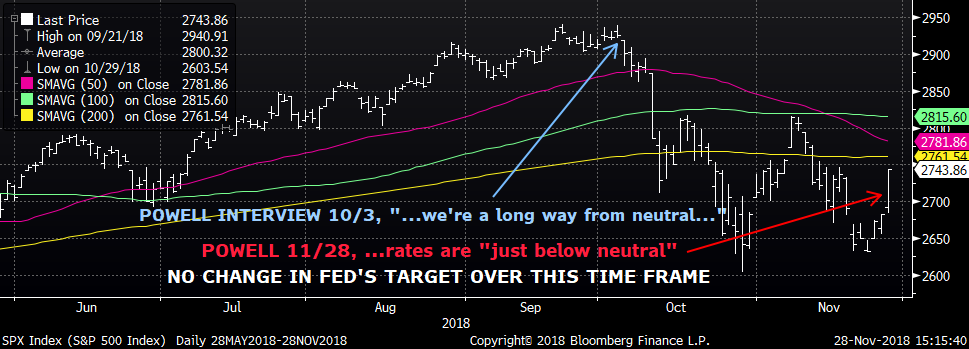
Powell flip. It’s amazing what a loss in equity portfolios does for perceptions of “neutral”
Chart below is SPX. When Powell said in an interview on October 3 that the Fed was a long way from neutral, stocks were near the highs. The front WTI Crude Oil contract was over $76/bbl. Now CLF is under $51/bbl. Large declines in both of these markets caused the Fed to re-think it, and we’re now “just below neutral”.

Nov 28. Powell – we can monitor financial stability as he speaks
Nov 27. Let’s Make a Deal
Animal Spirits – going into hibernation
I spent a lot of money on booze, birds and fast cars. The rest I just squandered.
–George Best. Northern Irish footballer who played winger.
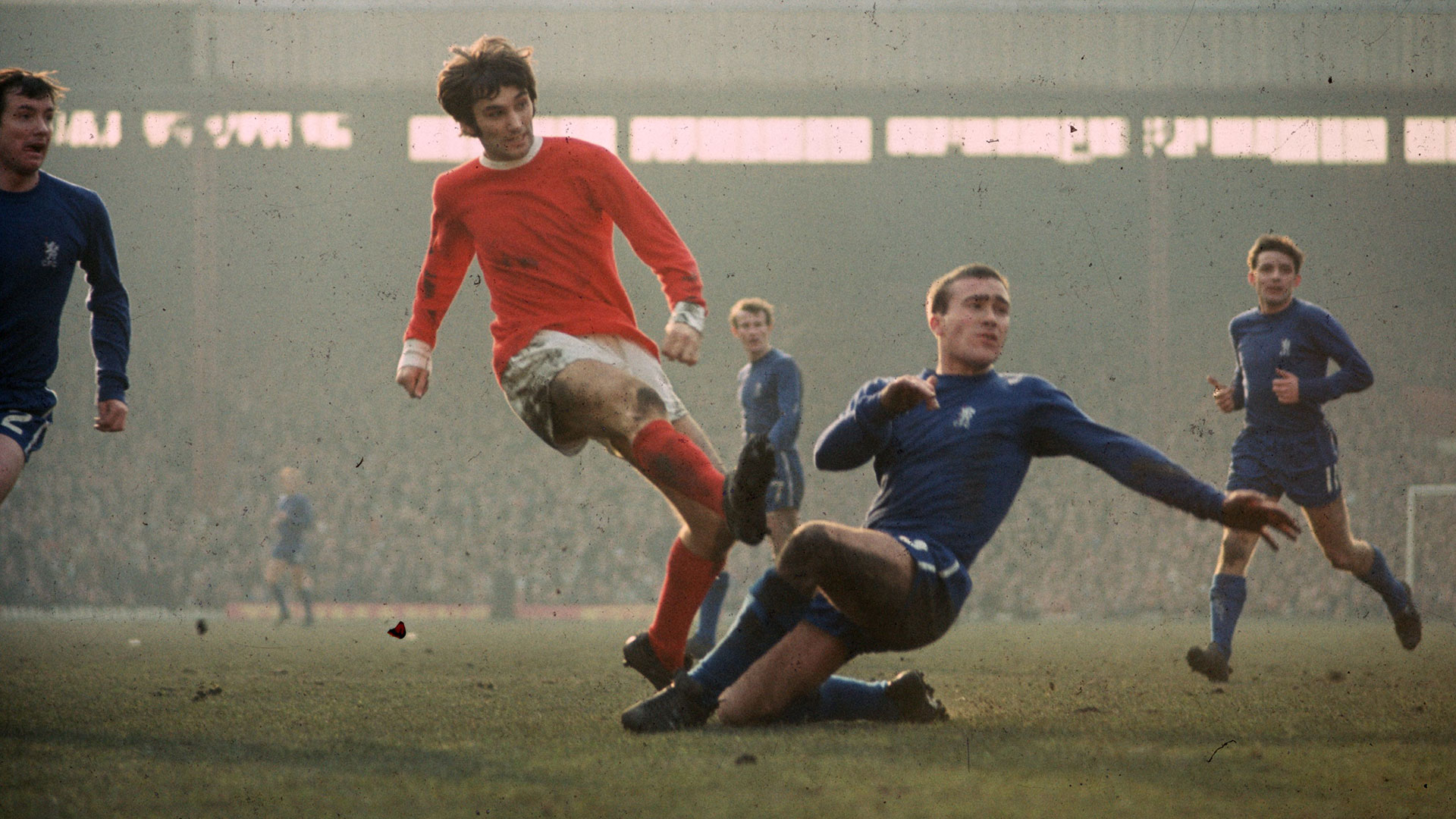
It’s the thirteenth anniversary of George Best’s death. I’ve always favored the quote above but there are a lot more. It would be easy to get carried away and just read stories and quotes and watch videos of George Best, and if you don’t care to read the rest of this note, I’ve added several links at bottom.
https://www.youtube.com/watch?v=uJWWA-h_-5g
Now, back to our regularly scheduled show… Here are a couple of other quotes.
“Let us show to Europe that we understand our own resources; let us immediately take the broad road to our liberation, instead of dragging ourselves along the tortuous and obscure paths of fragmentary loans.” -Matteo Salvini, Italy Deputy Prime Minister
“…the proposed issue of paper rests solely upon the judgment, the will, and the schemes for political success or personal gain of those Populist financiers who shall be put in control in Washington, and who will doubtless be astute enough to see and to use the enormous possibilities for stockjobbing and gambling in values which will accrue to those who, by controlling the issues of the circulating medium, can raise or depress the price of every share of stock, every bond, every yard of fabric, every ounce of every commodity within the United States.” -James Grant, as the Fed instituted QE
Fake news. Well, not fake news exactly, the quotes are real, but I have falsely attributed them to Salvini and Grant; they’re taken from a paper written in 1896 by Andrew D. White, titled, Fiat Money in France. How It Came, What It Brought, and How It Ended. Large excerpts could be sliced from this paper and applied to modern times, which I’ve done below, hopefully in moderation. (I have a link at bottom, if you can get past the George Best stuff).
It wasn’t all that interesting of a week –unless one happened to be short oil (CLF8 down 11% on the week!) There are a lot of geopolitical events coming up that have the potential to change or accelerate trends as we move towards the December FOMC meeting on the 19th. Although Trump (and certainly Pence) have kept a hard line on China, the temptation has to be great for Trump to unveil something unexpected at the weekend G20 meeting in order to arrest the decline of the US stock market that he previously embraced as a shining example of his brilliant policies. The Italy budget situation is still fluid, with the FT running this headline Friday: ‘Bank of Italy sounds alarm over banks’ stability.’ “Italian companies have also seen their financing costs increase. The rate they pay on new fixed-rate debt has nearly doubled from 1.5% in the first quarter of this year to 3.5% in the third quarter – the highest level since 2014.” EU Commission VP Dombrovskis said a few days ago, “With what the Italian gov’t has put on the table, we see a risk of the country sleepwalking into instability.” Salvini is urging citizens to buy Italy’s sovereign bonds. Of course it’s not just Italy’s banks. DB made a new low this week. Credit Suisse is right on top of the 2016 low and in the good old US of A, Goldman has plunged a stunning 30% since the January high. Prime Minister May signed the Brexit deal, which now faces the difficult task of getting through Parliament. If there was ever a time to take a step back from risk and park money in relatively high yielding US two-year notes at 2.8%, this would appear to be that time. Aside from international intrigue, Clarida speaks Tuesday on Data Dependence and US Monetary Policy, and Powell on Wednesday, on the Fed’s Framework for Monitoring Financial Stability. Draghi testifies to European Parliament on Monday.
There are all sorts of economic models and equations in our modern world, used by central banks and budget planners. Anyone who trades knows that on many occasions, the models go out the window, due to, oh, we’ll call them “exogenous shocks”. I guess we might as well throw them into the catch-all Keynesian economic category of ‘Animal Spirits’ which can be perhaps modeled from George Best’s guidelines of consumption. Sounds sort of official and blameless when you can chalk up your NatGas loss to an “exogenous shock”. One of my personal favorites was Jamie DImon on the treasury yield flash crash of 2014: “then on one day, October 15, 2014, Treasury securities moved 40 bps, statistically 7 to 8 standard deviations – an unprecedented move – an event that is supposed to happen only once in every 3 billion years or so…” In Dimon’s shareholder letter of April 2015, he wrote, “In a crisis everyone rushes into Treasuries to protect themselves. This will be even more true in the next crisis. But it seems to us that there is a greatly reduced supply of treasuries to go around.” Well, thank goodness the voracious borrowing appetite of the Fed’l Gov’t is providing plenty of paper to go around this time. Before we leave Dimon, it’s worth noting that in July he said that the Fed’s unwinding of the unprecedented QE program could backfire on the economy or spark a market panic. X You are here. The opposite of ‘animal spirits’ is winter hibernation. That’s where we may be currently.
So let’s get back to the 1896 essay, which describes the situation in France in 1789. It’s before the time of sophisticated economic modelling techniques and frameworks. But still filled with fascinating thoughts and arguments which apply right now. Here are a couple of excerpts:
Near the end of the year 1789 the French nation found itself in deep financial embarrassment: there was a heavy debt and a serious deficit. [sound familiar?]
Statesmanlike measures, careful watching and wise management would doubtless have led ere long led to a return of confidence and resumption of business…but this involved waiting, self denial, and sacrifice; and, thus far in human history, those are the rarest products of an improved political condition.”
There was demand in the Assembly for more “circulating medium” and the proposal was put forth that legal tender paper money should be issued in the amount of four hundred million francs. “The nation had just taken as its own the vast real property of the French Church, the pious accumulation of thirteen hundred years.” This was, in a way, backing for the currency.
No matter how skillfully the bright side of such a currency was exhibited, all thoughtful men in France knew something of its dark side. They knew too well from John Law’s time, the difficulties and dangers of a currency not based upon specie. They had then learned how easy it is to issue it; how difficult it is to check an overissue; how seductively it leads to the absorption of the means of workingmen…how surely it impoverishes all men living on fixed incomes, salaries or wages; how it creates on the ruins ot the prosperity of all workingmen a small class of debauched speculators… how it stimulates overproduction at first, and leaves every industry flaccid afterward; how it breaks down thrift, and develops political and social immorality. Check, check and check.
Oratory prevailed over science and experience. “…in April 1790 the four hundred million francs were issued in assignats – paper money secured by a pledge of productive real estate, and bearing interest to the holder at 3%.
“The first result of this issue was apparently all that the most sanguine could desire, the treasury was at once greatly relieved; a portion of the public debt was paid; creditors were encouraged; credit revived; ordinary expenses were met…trade was revived and all difficulties seemed past.” But soon there came another result: times grew less easy, by the end of August, within four months after the issue…the Gov’t had spent them, and was again in distress.” MORE QE. In August of 1790 Mirabeau made a speech, “We must accomplish that which we have begun” and declared that there must be one more large issue of paper guaranteed by the national lands and good faith of the French nation.
In the 29th of September, by a vote of 508 to 423, the deed was done; a bill was passed authorizing the issue of eight hundred millions of new assignats, but solemnly declaring that in no case should the entire amount put in circulation exceed twelve hundred millions. To make assurance doubly sure, it also provided that, as fast as the assignats were paid into the treasury for land, they should be burned; and thus a healthful contraction be constantly maintained. [The original ‘normalization’ plan]
France was now fully committed to a policy of inflation; and, if there had been any doubt of this before, it was soon proved by an act of the Government, very plausible, but none the less significant, as showing the exceeding difficulty of stopping a nation once in the full tide of a depreciated currency.
Nearly all Frenchmen [central bankers] now became desperate optimists, declaring that inflation is prosperity. Throughout France there came temporary good feeling. The nation was becoming fairly inebriated with paper money. The good feeling was that of a drunkard after his draught; and it is to be noted, as a simple historical fact, corresponding to a physiological fact, that, as the draughts of paper money came faster, the periods of succeeding good feeling grew shorter.
It all collapsed in the succeeding years, culminating in 1796. As the paper concludes: “Manufacturers at first received a great impulse, but ere long, this overproduction and over-stimulus proved as fatal to them as to commerce.” Of course assignats had depreciated upon new issuance. Can we draw a parallel to the issuance of treasuries? Are not the central banks equating 2% inflation with national prosperity? I am not forecasting the destruction of the US economy, only noting that history rhymes and that those who called the tax plan a sugar-rush for the economy are looking prescient. I would also say that putting the QE toothpaste back in the tube isn’t as easy of a task as the Fed made it out to be. The one-two punch of Clarida and Powell this week will likely be throwing dovish marshmallows.
OTHER MARKET/TRADE THOUGHTS
Feb/April FF spread settled 12.0, down 1.5 on the week and moving to less than 50/50 odds of a hike in March. May/July settled 7.0, down 2.5. The front end of the curve has pared back expectations of further Fed hikes. EDH9/EDH0 closed at a new low of just 21.5 (down 3.5 on the week), which signifies less than one hike over that one-year period.
The libor setting has been rising fairly aggressively, up over 4.5 bps on the week. Since Sept 27, the day after the FOMC, to Friday the rate has gone from 2.3960 to 2.6912, a rise of 29.52 bps. This has helped EDZ8/EDZ9 crash 6.5 bps on the week to 28.5. The Jan’19/Jan’20 FF spread is still 34 bps.
EDZ8 9712.5p still trade 0.5 with three weeks to go. Given a global banking system that appears vulnerable and subject to a crack, I favor longs here. It’s a large hurdle when considering that the current libor setting is more like 9730, but a lot can happen in 3 weeks.
The plunge in oil and even the weakness in bitcoin foreshadow financial stress. Although nowhere near the carnage seen in late 2014 and into 2015, corporate spreads are starting to perk up, and this time it’s not just in energy names. Regarding bitcoin, there have been many articles about the huge power needs for mining. I watched a video that said total power usage for BTC mining surpasses that of smaller developed countries like Ireland or Austria. Obviously, those operations can’t possibly be profitable at BTC under 4000. Affects utility output globally? A CNBC story ran the headline on Nov 16: Nvidia nurses ‘crypto hangover’ as demand for mining chips evaporates. The stock has been cut in half and lost over $80b in market cap in less than two months. That’s a hell of a hangover.
This note has run a bit long. More trade thoughts on Monday….
| 11/16/2018 | 11/23/2018 | chg | |
| UST 2Y | 280.8 | 281.6 | 0.8 |
| UST 5Y | 289.2 | 287.8 | -1.4 |
| UST 10Y | 307.2 | 305.2 | -2.0 |
| UST 30Y | 332.7 | 330.8 | -1.9 |
| GERM 2Y | -58.5 | -58.3 | 0.2 |
| GERM 10Y | 36.7 | 34.0 | -2.7 |
| JPN 30Y | 85.4 | 82.1 | -3.3 |
| EURO$ Z8/Z9 | 35.0 | 28.5 | -6.5 |
| EURO$ Z9/Z0 | -2.0 | -1.0 | 1.0 |
| EUR | 114.18 | 113.39 | -0.79 |
| CRUDE (1st cont) | 56.68 | 50.42 | -6.26 |
| SPX | 2736.27 | 2632.56 | -103.71 |
| VIX | 18.14 | 21.52 | 3.38 |
https://www.telegraph.co.uk/men/the-filter/16-quotes-that-define-the-life-and-times-of-george-best/
http://www.nationalfootballmuseum.com/halloffame/george-best/
https://www.youtube.com/watch?v=dbVatiHiQrc
https://www.youtube.com/watch?v=uJWWA-h_-5g
https://oll.libertyfund.org/titles/white-fiat-money-inflation-in-france
Nov 22. TY adjustments going into TYZ option expiry
–Huge new buy of 60k EDU9 9725/9750 c 1×2 for -0.5 (took credit). Settled -0.75, 8.75 and 4.75. If the last hike were to be in December, then a slight tilt towards an easing bias over 2019 would make this position pay.
Nov 21. GETTING SCARY
–Continued buying of ‘Fed skips March’ trades. For example EDH9 9725/9737c 1×2 heavily bought 0.5 and the same call spread was bought 1 to 1 with the additional sale of the 9700p to finance. EDH9 9737c added 50k in open interest with 97k in 9737c. EDH9 settled 9717.