May 27 (Weekly). At-the-money expiration and other thoughts
On Friday, at the noon strike (Chicago time), FVM8 settled 113-22, TYM8 119-275 and USM8 143-22. As the 4:00 pm bell was going off (in my head), TYM8 ticked 120-00. Late prints in FVM8 113-2425 and USM8 143-30, right at strikes. In treasury options, calls that expired worthless can be exercised manually, even after the close. So it’s worth taking a look at expiring open interest: FVM8 113.75c just 16k. TYM8 120c 107k, and USM8 144c 11k. On the put side TYM 120p had 62k open; while FV and US were similar to calls. A large manual exercise of TYM 120 calls could set off a brief buying spree; the shorts don’t find out if they’ve been exercised until it’s too late to do anything about it. I called the exchange late Friday to inquire about how many manual exercises went through… holiday voice mail. I wouldn’t be surprised to see an upside flurry at Sunday’s re-open.
*******************
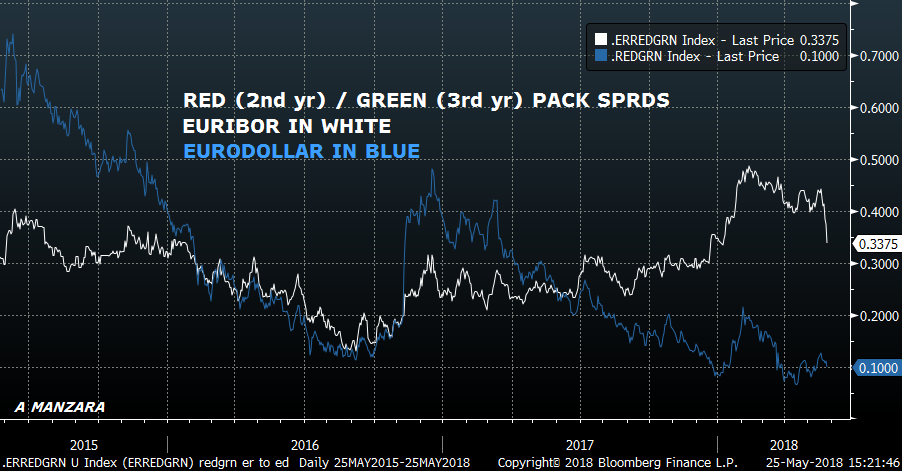
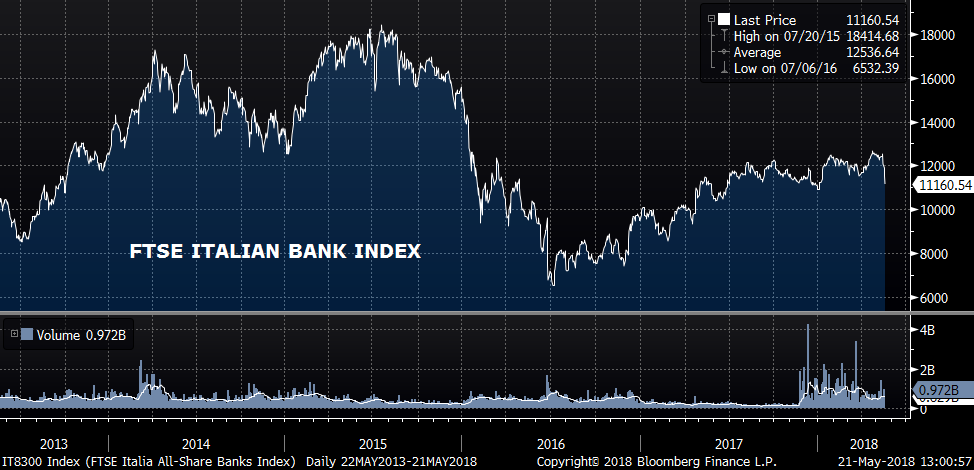
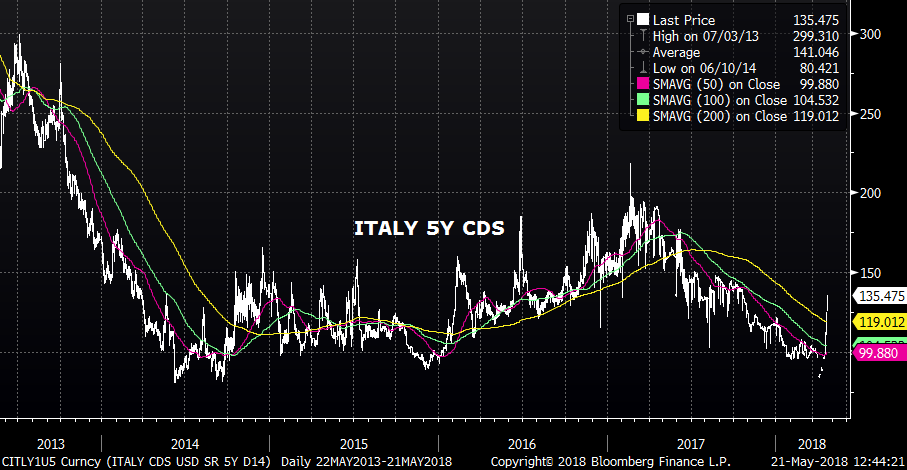
A couple of thoughts on EURUSD. Throughout 2017 into the beginning of 2018 the EUR generally strengthened (from 1.05 in Jan 2017 to 1.25 late Jan 2018) and of course, DXY weakened. Over the last month and a half, the dollar has strengthened, with many calling for further gains. In 2017, European data was coming out stronger than expected as the synchronized growth narrative gained traction. But the political situation in Italy has sharpened focus on credit concerns. Italy 5y CDS surged from 100 bps to 167 in the past couple of weeks. On Friday Moody’s said it may cut Italy’s Baa2 rating. Even Spain has jumped from 30 to 59. Of course, these levels are still relatively low; in mid-2013 they both were over 275 bps. However, the rapidity is quite unnerving. I would also note that Deutsche Bank closed at the lows (€ 10.38), and is now testing the low from 2016. The Italy bank shares index plunged 15% in the past week and a half. In light of these developments, there has been a repricing of odds for future ECB tightening. Decidedly lower. It’s informative to look at the forward curves in Euribor and Eurodollars. Below is a chart of red to green spreads in both ED and ER (2nd year to 3rd year). Perhaps unsurprisingly, throughout 2017 and into early 2018 the euribor spread was firming and the dollar spread was declining. This coincided with a weaker dollar. But since February, the euribor curve has flattened, dramatically this week, while the dollar curve flattened modestly. If one just looks at Dec’18/Dec’19 spreads, in the beginning of February, ERZ8/Z9 was 45 bps and EDZ8/Z9 was 36. In the past week and a half, the dollar spread went from 41 to 33.5, while in bor it plunged from 35 to 19.5. The crossover where the bor spread went to a discount was in late April, and that’s just when dollar strength commenced, as shown on the chart below. Top chart is Euro$ to Euribor red/green pack spreads. Lower chart is EDZ8/Z9 with ERZ8/Z9 with EURUSD in the lower panel.
************************************************************************************

Now for a couple of thoughts on corporate credit quality. From Almost Daily Grants (May 25th) comes this:
Indeed, according to S&P Global Intelligence’s LCD unit, the ratio of “covenant-lite” loans rose to a fresh record of 82% in April, up from 20% in 2011. Christina Padgett, a loan analyst at Moody’s, struck a stoic tone, telling the Financial Times that: “There is no point in talking about financial covenants any more, or calling a deal ‘cov-lite’. They are all cov-lite. Cov-lite is the new normal.”
From John Mauldin’s Thoughts from the Frontline – High Yield Train Wreck series comes this: “Almost half of investment-grade companies are rated BBB, just one step above junk, up from just one-third in 2009.” Articles warning about deteriorating credit quality are pretty common, so I won’t delve into statistics. Bond spreads have barely widened. For example, the option adjust BBB spread is just 1.46%, less than half the high in the early 2016 energy debacle and only 30 bps above the low of the past five years, set earlier this year. I will though, hop on the WeWork bashing bandwagon that both Grant Williams of Things That Make You Go Hmmm, and Mauldin use as a poster child for absurd valuations.
WeWork leases large amounts of office space, carving it up into smaller pieces allowing flexible leases for smaller start-up tenants, and mixes in support and services. Not the most novel idea in the world, but the company was able to float a $700 million unsecured bond in April with a coupon of 7.875% (which fell below 93 cents to the dollar in the beginning of May).
One thing that caught my attention was a chart showing Independent Workforce as % of the Total Workforce in the US. (data apparently from WeWork). In 2008, 30% or 45 million people were categorized in this way. In 2014, 33% or 45 million people. The company’s estimate for 2020 is 40% or 60 million people. “The driving force has been the surge in freelancing and small business formation since 2008…” [I think the use of the word ‘driving’ also captures Uber freelancers]. One analyst, Credit Sights’ Jesse Rosenthal deemed the company’s “community adjusted” earnings number as “sketchy” and noted WW has “a massive asset/liability mismatch that is usually a recipe for disaster.” So what’s the problem? Only this: VALUATION. The market is valuing this company at $20B, far surpassing other established companies in this ‘space’. There were buyers into dreams and technology in the dot.com era as well, but shakeouts can be violent. I don’t know if WeWork is a great example, or if Tesla is more appropriate, but investors in these and other companies have bought into the vision of the leaders, Adam Neumann and Musk. There’s a quote in the Hmmm article, “Adam’s explanation for the [$20b !! ] valuation of WeWork speaks for itself.” Community and lifestyle.
A nation of freelancers and a world of cov-lite debt. Like a fortress right? This kind of reminds me of a conversation I was involved in long ago, with a sizable local in the heyday of Eurodollars and a couple of other pit guys. Kenny was incredulously saying that a family member was trying to give him money to ‘invest’ since he seemed to be so good at it. He might have been making a lot of money, but he laughed aloud at the notion that what he did was ‘investing’ and with a goofy grin he said he told his relative, ‘That’s not really what I do. Do you want some money? Because I can just give you some. Here. How much do you want?” (And he wasn’t making the offer sarcastically). Kenny had no illusions about his ‘investment and vision’ ability. But he did know he could walk out of the pit and go golfing in the summer at 9:30 am, so you might say he had the ‘lifestyle’ part lined up. In our current investment landscape, that’s what we’re buying into, heavy on the vision part.
It’s here that I’ll add a shameless plug for my friends Angela and Stel, who own a business called Creative Coworking with locations in Evanston and the north side of Chicago in the restored Colvin House mansion on Sheridan Road. They offer flexible communal leasing spaces for freelancers and start-ups and artists. And, you can rent out the opulent first floor for receptions. Sound familiar?
http://creativecoworking.com/
www.creativecoworking.com

OTHER MARKET THOUGHTS/ TRADES
Oil took a large tumble Friday, down over $3/bbl late (CLN8 settled 67.88, -2.83). The contract put in an outside week on heavy volume, which will likely limit upside from here. If EM couldn’t rally with stronger oil and other commodities, this move probably won’t help.
The release of Fed minutes last Wednesday that suggested IOER would only rise by 20 bps on a target FF hike of 25 bps sparked a strong rally in rate futures. Combining that with other factors concerning EM and the EU, odds for future rate hikes were trimmed. For example, Oct 2018 FF contract closed Friday at 9793.0 having traded as low as 9784.5 the previous week. While some of that move can be attributed to an expected decline in the Fed Effective rate, 6 or so bps can be chalked up to a less aggressive Fed. At 9784.5, odds of a Fed hike in Sept (after June) were around 80%. Now I would estimate a Sept hike at around 55%. The bar to skip a June hike in two and a half weeks is very high.
News this week could have some interesting ramifications in terms of inflation expectations. Wed brings a revision to Q1 GDP. More importantly, on Thursday PCE Core yoy prices are released, expected at 1.8 vs last at 1.9; edging away from target. On Friday the Employment Report is released with Avg Hourly Earnings expected +0.2, yoy 2.6%. Also on Friday is ISM, expected 58.1. The ‘Prices Paid’ component is expected 77.9 from 79.3 last, which was the highest since 2011.
| 5/18/2018 | 5/25/2018 | chg | |
| UST 2Y | 254.5 | 247.8 | -6.7 |
| UST 5Y | 289.2 | 276.3 | -12.9 |
| UST 10Y | 306.7 | 293.3 | -13.4 |
| UST 30Y | 320.9 | 309.3 | -11.6 |
| GERM 2Y | -58.4 | -62.2 | -3.8 |
| GERM 10Y | 57.9 | 40.6 | -17.3 |
| JPN 30Y | 76.0 | 73.6 | -2.4 |
| EURO$ Z8/Z9 | 39.0 | 33.5 | -5.5 |
| EURO$ Z9/Z0 | 8.5 | 7.0 | -1.5 |
| EUR | 117.71 | 116.45 | -1.26 |
| CRUDE (1st cont) | 71.48 | 67.88 | -3.60 |
| SPX | 2712.97 | 2721.33 | 8.36 |
| VIX | 13.42 | 13.22 | -0.20 |
http://www.mauldineconomics.com/frontlinethoughts/high-yield-train-wreck
May 25. US stocks recover early sell-off, but fraying at the periphery continues
May 23. Five year auction today provides safety and liquidity
May 22. EM fx and crude oil….diverging
From 2013 to the energy crash of late 2015/early 2016, oil and EM FX were strongly correlated. Currently, oil is making new highs as many emerging market currencies make or test new lows. I believe this divergence has to do with increased debt levels in EM, and of course, political factors in some instances. 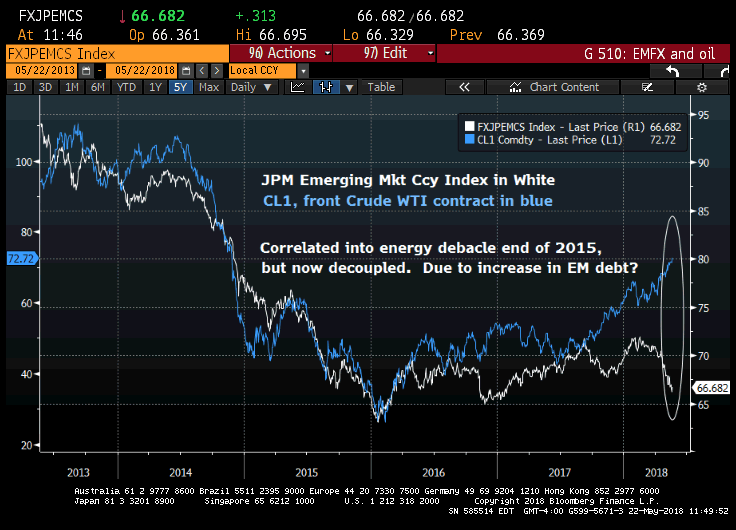
May 22. No worries
May 20. Culling the Herd
I watched a riveting documentary on PBS the other day. I just happened to put on the tv and the program had already started, chronicling the life and discoveries of Dr Marian Diamond. From Wikipedia: Marian Diamond (nee Cleeves; November 11, 1926 – July 25, 2017) was a pioneering scientist and educator who is considered one of the founders of modern neuroscience. She and her team were the first to publish evidence that the brain can change with experience and improve with enrichment, a paradigm-breaking study that was the first hard data confirming what we now call plasticity in the brain.
The title of the show was My Love Affair with the Brain: The Life and Science of Dr. Marian Diamond (2016). In 1964 when she first released her findings that the brain’s composition can change and improve with environmental enrichment, she found hard set resistance by some scientists. Her research involved years of painstaking dissection, creating microscope slides for study and comparison. Such was her stature that she was allowed to take a part of Einstein’s brain for study in 1985, finding that he had a higher ratio of glial cells in relation to neurons than other brains. Of course, now we accept her discoveries on plasticity of the brain as common knowledge. The phrase, “Use it or lose it” may not have been coined by Dr Diamond, but it certainly became her rallying cry. Now in the new scientific realms of the internet and social media, we’ve moved on to more important topics like whether you hear “Yanny or Laurel”.
What does this have to do with Eurodollar options and markets? Not much. But recently, this pit has been the antithesis of ‘enrichment’. Amidst some of the most mind-numbingly boring days we’ve seen, the ‘use it or lose it’ mantra has taken its toll. I’ve found over the years, some of the most brilliant and crudely funny people I’ve ever met have been trading options on the floor. Now, with low vols and microscopic edge, some are leaving.
I might as well insert here one of my favorite theories on brain health, as know-it-all postman Cliff Clavin explained it to his drinking buddy Norm on the tv program Cheers (set in a Boston bar). “Well ya see Norm, it’s like this… A herd of buffalo can only move as fast as the slowest buffalo. And when the herd is hunted, it is the slowest and weakest ones at the back that are killed first. This natural selection is good for the herd as a whole, because the general speed and health of the whole group keeps improving by the regular killing of the weakest members. In much the same way, the human brain can only operate as fast as the slowest brain cells. Excessive intake of alcohol, as we know, kills brain cells. But naturally, it attacks the slowest and weakest brain cells first. In this way, regular consumption of beer eliminates the weaker brain cells, making the brain a faster and more efficient machine. That’s why you always feel smarter after a few beers.”

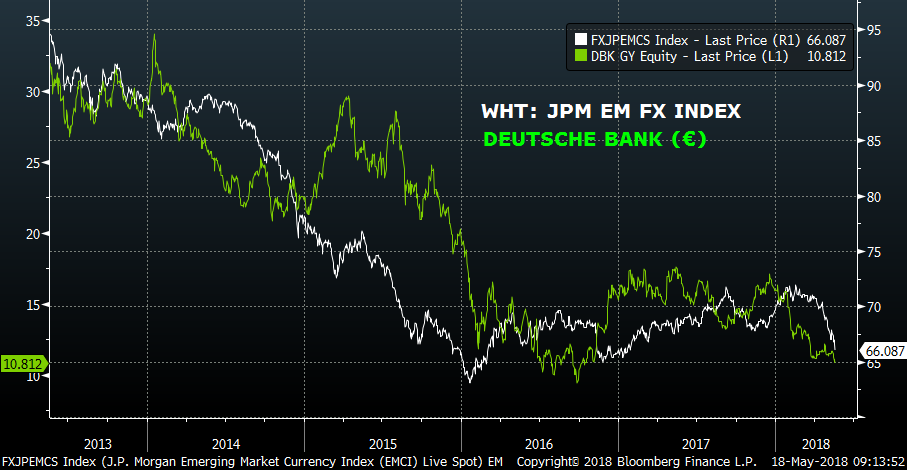
The week was not without interesting moves. New high yields were made in US ten and thirty year bonds, at 3.11 and 3.245. The combination of supply concerns, firming inflation, and waning CB support have finally conspired to slightly steepen the curve and make buyers more circumspect. Emerging market currencies continued to weaken and an index of EM FX (FXJPEMCS on Bloomberg) appears likely to test the low set during the energy market debacle of late 2015 early 2016. This was when front month WTI crude was $25/bbl; it’s now nearly 3x higher. EEM, the emerging market etf, is well off the high of the year but not quite through February’s low. In the energy induced sell-off in 2016, it traded a new low below 30. Since then it rallied to this year’s high just above 52 and is now 46. EMB, the Emerging Mkt bond etf, trades more like fx, and is making new lows. So there seems to be substantial divergence between EM fx/bonds and stocks/energy. According to a Bloomberg article, “Outstanding debt securities from developing nations have ballooned to $19 trillion from $5 trillion a decade earlier.”
On Tuesday, Franklin Templeton’s global bond fund, run by Michael Hasenstab, reportedly bought $2.25 billion of Argentine debt. I suppose those funds could have been put to an alternative use. Not only is EM debt under pressure, on Friday the Italy/Germany 10 year spread closed at the high for the year, 165 bps. Once again the idea of government borrowing “crowding out” the private sector may come into vogue.
So far, little stress has been noted in the US corporate bond market. A couple of weeks ago Louis Gave released a piece on liquidity and said that in 2008, the US had about $2.8T of corporate bonds outstanding, while dealer inventories totaled about 1/10th of that at $260B. Now the US corporate market is $5.3T, but dealers, due to regulatory changes, hold only $40B, a sliver of the outstanding market. Corporate bond etfs hold $300B. The point is that dealers are unlikely to cushion the fall, and when liquidity is most desired, it can disappear very quickly. As mentioned last week, corporate debt as a % of GDP is at a record high over 45%. According to the Fed’s Z1 report, TOTAL corporate debt as of the end of 2017 was $8.95T. A Bloomberg article (citing Wells) notes that companies will need to refinance an estimated $4 trillion bonds over the next 5 years. That’s easy in a yield-starved, low funding rate world, but might not be as simple going forward.
The current environment should make for a robust euro$ option market, with more reasonably inflated premium levels. Perhaps that’s just around the corner. For now, there are still large trades that get done at a price, for example a block buyer Friday of 60k 0EH 9675p 12.5, 36d covered 9693.0 (new). However, David Stein is again leaving the pit, and I’ve heard that some of the other market makers are paring back for the summer months. One of the European shops earlier this year decided to cease ED option activity due to lack of opportunity. Does this make a difference in a market that is increasingly institutionalized? Perhaps not, and maybe fewer players will be unnoticeable in a benign, low vol, environment. But if demand for insurance premium should pick-up, then size at a price may vanish.
For now, let’s wrap up the week with a couple of beers, and we can all start Monday with fresh, more efficient brains.
May 18. EM FX spillover?
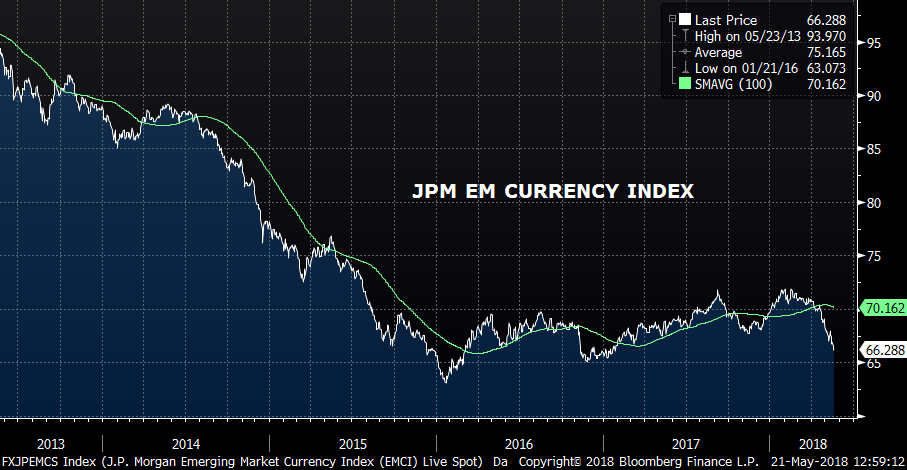
The impetus for this chart is the continued slide in EM ccy’s. BBG symbol for JPM index is FXJPEMCS Index.
This chart covers 5 years, but there has clearly been a renewed slide since Q1 of this year. I thought the chart reminded me of DB so I decided to overlay for fun (DB at new low for this year).
Not much of a conclusion to draw… weakness in EM not really spilling over to US equities for now, but anyone who remembers Asian crisis in late 1990’s might want to keep in mind.
May 18. Bond bids are dispersing
–Yields continue to grind higher with notable weakness in the long end. Thirty yield bond yield pushed to a new high of 3.245%, +3.2 bps on the day. Perhaps also worth mention is that ten year tips closed at a multi year high of 93 bps. While the moves were small, eurodollar calendars also squeaked out new highs. for example, red/gold pack spread closed 20.875, +1 on the day; it hasn’t been above 20 for two months. EDZ8/EDZ9 which had been churning around 32-33 in the early part of May closed at a new high of 41.0. 2/10 treasury spread closed 54.
–Large exit buyer of 100k EDH9 9800c for 1 yesterday vs 9720.5-21.0. Open int dropped in that strike by 50k.
–Not much in the way of economic news today and the early part of next week looks quiet as well. Aside from the inflationary implications of higher oil prices, perhaps bonds are finally facing the cold reality of massive supply.
May 17. I dunno if she can take any more, Captain
–The grind to higher yields continues. At the futures close tens were up 1.5 bps to 3.09% and edged higher thereafter, with continued put buying. For example, there was a late 20k block buy of TYN 117.5 put vs TYM 11817 for 20/64. In euro$’s red to green calendar spreads eked out new recent highs, with the pack spread +0.75 to 12.375.
–Article on Bloomberg cites Fitch as warning about vulnerability of EM due to high levels of debt as the Fed is expected to continue to hike.
https://www.bloomberg.com/news/articles/2018-05-17/fitch-says-emerging-markets-vulnerable-as-debt-hits-19-trillion
Concerns about Italy are also resurfacing with the new government, with heavy selling of btp contracts, though the ten year yield in Italy remains 100 bps below that of the US. The global system is showing increased signs of stress.
–EDM19 trades a new low of 9705 this morning. A few days ago there was commentary concerning the size of open interest in the midcurve 9712.5 puts (now 477k OI), but it looks like the 9700 put will be the strike of interest shortly (403k OI). 0EM 9700p settled 2.75 vs 9706.5 with 29 days to go. The question now is whether shorts (long put holders) are anxious to monetize, or whether they press. We’re just one 3.0% Average Hourly Earnings print from a cascade lower. There are almost always buyers of puts in front of employment reports, and although the next NFP is two weeks away, there’s likely to be heavy trade in June midcurves between now and then.
–In terms of the very front end, the fever seems to have broken with respect to the lib/ois compression. EDZ/FFF9 popped up 1.5 bps to 37.5 yesterday and EDM8 fell 3 bps. EDU8/FFV8 closed at just 33. Risk/reward heavily favors the upside in this spread.
May 15. BOJ wants higher bond yields?
–Libor/ois compression continued to be the main story, with EDM8 +2.5 on the day and all contracts from EDU19 back either unchanged or lower. EDZ8 to FFF9 spread had been 39/39.5 last week and closed yesterday at 34.0, -1.5 on the day. This move appears to have been accentuated by strategy exits; while near euro$ contracts closed up on the day, Fed Fund contracts were lower. For example, FFN8 fell half a bp to 9805.0 on an open interest decline of 12k. With a current Fed Effective of 1.70, a hike in June would be expected to put FedEff at 1.95, exactly where FFN8 settled. Prelim open interest in EDM8 was surprisingly +32k, but the large buyer of EDM8 9762/9775c spds for 7.5 was an exit, with OI down 22k and 7k respectively.
–China data this morning said to be weaker than expected, though yoy retail sales of 9.4% isn’t exactly weak, especially when compared to today’s US release, expected +0.3 and +0.4 less autos/gas (month-month). What’s significantly more important is a Reuters article relating to the BOJ: “But central bank policymakers have begun brainstorming ways to raise bond yields from near-zero levels as a first step toward ending crisis-mode policy, sources familiar with the BOJ’s thinking say.”
https://www.reuters.com/article/us-japan-economy-boj-analysis/bojs-kuroda-shifts-into-lower-gear-on-stimulus-policy-idUSKCN1IG0WN
–The tide of global liquidity is slowly receding. Another interesting side note comes from BBG: “The delinquency rate for subprime auto loans more than 60 days past due reached the highest since 1996 at 5.8 percent, according to March data, the most recent available from Fitch. That compares with default rate of around 5 percent during the financial crisis in 2008.” According to the handy chart, subprime auto loans as % of ABS are at a record high over 20%. But I’m sure there’s plenty of salvage value left in that 2016 Kia Soul.
–Once again near ED one-year calendars notched new highs. Peak EDM8/EDM9 closed 57.5, +2 on the day, and EDU8/U9 rose 1 to 48.5.