Feb 13. Adjustments back to normal?
–Rates were slightly higher as equities rebounded. Tens rose 3 bps to 285.7. In dollars, greens, blues and golds were down 3.5 bps. It was an adjustment day. Open interest in ESH was -89k. Implied vol across the interest rate curve plunged. For example, On Friday, 3EH 9712^ settled 25.0 and yesterday just 21.5. 2EU 9725^ settled 47.5 on Friday, and 45.5 yesterday.
–On a longer time frame comparison, on Nov 12, there were 33 days until expiration for the front Dec midcurves. ATM straddles were 0EZ 9800^ 11.5, 2EZ 9787^ 15.5 and 3EZ 9775^ 17.0. Currently, with 32 days to go ATM March straddles are: 0EH 9762^ 14.0, 2EH 9725^ 19.5 and 3EH 9712^ 21.5 (of course this is after yesterday’s declines). After adjusting for the higher strikes, premium is barely elevated. As a simplistic example, 17 bps for the blue dec straddle at a strike of 2.25% (9775) is 7.55% (17/225). The current blue march straddle has a strike of 2.875%, and 21.5/287.5 is 7.4%. What is probably a pretty high probability trade…well, I will put that out when I get to the desk. What I will say is this, libor is going away as a benchmark in 2022 and the golds don’t have much in the way of additional premium. In any case, the next month has some potential market moving events: CPI tomorrow, Powell testimony at the end of the month, Italian elections, and run-of-the-mill escalations in military conflicts. I would actually say vol is getting back towards cheap in the interest rate arena.
Feb 12. Stockman’s been sounding that same warning (for the past 33 years)
–In an echo of Ronald Reagan’s administration, US Budget Director Mick Mulvaney said larger deficits this year may cause interest rates to “spike” and said further, “…rising budget deficits are “a very dangerous idea, but it’s the world we live in.” In Reagan’s day the budget director was David Stockman, the supply side guru who said in a magazine article, “None of us really understands what’s going on with all these numbers.” He, like Mulvaney, was concerned about deficit spending. He resigned in 1985, critical of the Congress; he had favored “a reduction of government spending to offset large tax decreases to avoid the creation of large deficits and an increasing national debt.” Sound familiar? Today the administration is set to unroll its infrastructure program (WSJ).
https://en.wikipedia.org/wiki/David_Stockman
–On Friday rates eased slightly with the ten year down 2.7 bps to 282.6. This morning stocks are trading a bit higher, fixed income again under pressure due to Mulvaney’s comments and concern about this week’s inflation data, with CPI on Wednesday. The bond market is increasingly uncomfortable with the idea of growing supply in an era of QT. However, there are flashes of disaster insurance purchases, for example, a buyer of >100k EDJ 9812c for 1.25 on Friday. New highs in many curve measures, with red/gold pack spread gaining 3.25 bps to a new recent high just over 42 bps. 5/30 jumped 7.5 bps to 62.3.
Feb 11, 2018. The Gibraltar Aluminum Siding Company (aka The Fed)
This past week, the actor John Mahoney passed away. Though famous for larger roles, I always liked him as Moe Adams, an aluminum siding salesman in Barry Levinson’s Tin Men. The movie is a nostalgic look at early 1960’s Baltimore, in the days of classic 20 foot long Cadillacs with tail fins. Because these salesmen ran so many scams, they ended up having to testify before the newly formed Maryland Home Improvement Commission regarding deceptive sales practices, with many losing their licenses. Moe tells the story of another sales pro, who cut the middle few inches out of a yardstick and glued it back together so square footage would be higher when he measured a job, “Nobody looks at a yardstick to see how long it is.”

As Tilly (Danny Devito) says to his partner Sam in front of the commission, “What’s he talking about? The man got the job for $2400 which is what it cost in aluminum siding… I don’t know if this is deception…” https://www.youtube.com/watch?v=3T89tMPDLwk
If the stock market sell off continues, we’ll see a replay of the above scene, except the Congressional panel will be interviewing sponsors of various volatility products. “Sir, our prospectus clearly states that our products attempt to capture moves in the VIX index. These products have many beneficial characteristics for homeowners investors.” (In answer to a question posed by a stern Congressman, reading glasses halfway down his nose, a derisively incredulous look on his face).
Aluminum siding simply covers up the exterior flaws on a home; it doesn’t address core structural issues. The central banks of the world have done much the same thing. By slashing rates, they overtly forced investors out the risk curve. In an attempt to generate yield that disappeared from conventional products, investors increasingly turned to volatility strategies to add a few basis points. I think they call it “alpha”. Complacency peaked, with corporate spreads tight and yields low. Debt levels increased, the curve flattened, and volatility fell across all markets. Conditions were ‘easy’ for financial engineering. The rally in paper assets was indeed a stimulant for the real economy, but by some, was mistaken for BEING the real economy. This sentiment was embraced most heartily by President Trump, who took credit for the rise in equity wealth at every opportunity.
Now central banks are trying to engineer a graceful reversal of policy, led by our very own Gibraltar Federal Reserve. The tax cut stimulus and related stock market blast-off is something the Fed had to respond to. The factors causing various market reversals are clear, and have been articulated by many large investors, Fed officials, think tanks, and ratings agencies (Moody’s) well before last week’s wild ride. NY Fed President Dudley, in a BBG interview Wednesday termed the move so far “small potatoes”, saying “magnitude and duration is the issue for central bankers”. In that same interview he clearly laid out conditions that are negative. He has repeatedly warned about the US government’s fiscal position. He said that gov’t “debt service costs are likely to go up a LOT” as deficits double and rates rise. Just last week that theme was echoed by none other than Paul Tudor Jones, “If I had a choice between holding a US Treasury bond or a hot burning coal in my hand, I would choose the coal. At least that way I would only lose my hand.” He further wrote, “It is incredible that at full employment we have passed a tax cut that will push our deficit to 5% of GDP. Can you imagine what will happen to the deficit and debt in the inevitable downturn? This is what the dollar is sensing.” Even I have written about it, and no one is going to accuse me of having the news first. As Dudley said last week, bond yields are going up with the view that monetary policy around the world is going to become less accommodative.
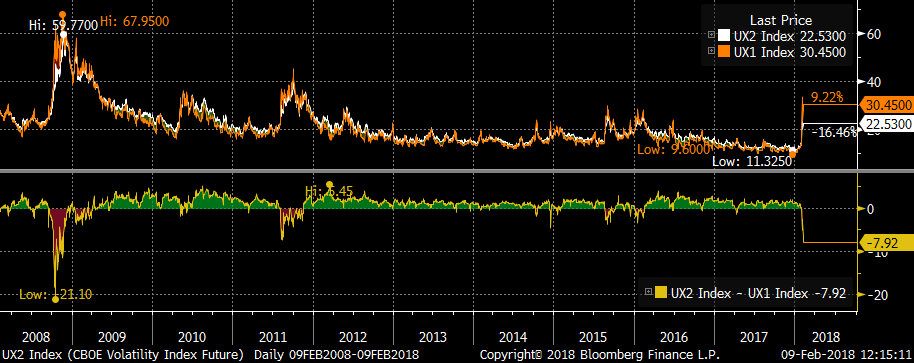
I could blab on and on about concise warnings that have fallen on deaf ears. However, now I will focus on market clues that may put the idea of “duration and magnitude” in context. First, here is a long term chart of the VIX spread, 1st contract to 2nd contract. As you can see, the typical configuration is that the first contract trades at a discount so the spread is positive (represented by green on the lower panel). During times of panic, the near contract trades at a premium. This premium, at 7.9 late Friday, shown as a negative value, is as high as it has been since the 2008 crash. To my way of thinking, that indicates more to come.
The next thing I will note is that the curve steepened hard this week. The two year yield fell 9.4 bps and the 30y bond yield rose 3.9. It’s instructive to observe the way TYH traded in relation to stocks. On Monday’s plunge below 2550, TYH rallied to just above 122-16. Flight to quality. On Tuesday’s ESH rebound to 2725, TYH fell to 121-12, and continued down on Wednesday to post the week’s low at 120-17. But on Friday, as ESH again spiked below 2550, TYH could only briefly poke above 121-16, a full point below Monday’s high. In other words, maybe the ten year isn’t exactly the ‘quality’ haven it used to be. This captures the bearish sentiment regarding the long end of the treasury market. Stocks initially started to sell off due to concerns about rising interest rates. For the third week in a row, I will cite Dalio who warned, “It just takes a little change in interest rates to have a bear market.” So what are bonds concerned about? 1) Less accommodative central banks 2) a huge prospective jump in the deficit which means more bond issuance 3) continued QT 4) higher commodity prices and a weaker dollar, both of which contribute in increased inflation expectations 5) higher wages due to tight employment markets, also adding to inflation concerns 6) a stimulative jolt due to tax cuts. As we say on the floor, “It’s not rocket surgery.”
The next question is, are stocks therefore likely to rebound if rates retrace lower? The answer is, maybe, but probably not. As noted, the big themes are bearish for rates, especially if inflation starts to accelerate (and we’ll have CPI and PPI this week Wed and Thurs). However, increased supply of treasuries is a given. Tightness in labor markets is another factor that’s not likely to change quickly. And the tax cut is now law. What might change is the Fed’s response to falling asset prices, particularly if ‘magnitude and duration’ grow. In that case, one would expect that near Eurodollar calendar spreads would decline relative to more deferred, as the back end of the curve is likely more responsive to inflation expectations. And, that is exactly what has occurred. For example, a week ago Friday the EDH8/EDH9/EDH0 butterfly was 29.5, with EDH8/EDH9 60.5 and EDH9/EDH0 31.0. This week the fly settled 20, with EDH8/9 at 46.0 and EDH9/0 26.0. In treasuries the same thing is reflected by the 2/5/10 fly. 2/5 went from 44.6 to 45.6, an increase of 1 bp, while 5/10 went from 25.1 to 31.3, +6.2. As I have said in the past, the new Fed is not as likely to come to the defense of the stock market as rapidly (and that’s just what Dudley meant by the ‘small potatoes’ remark). But even if they do slow down projected hikes, negative factors for the long end remain. And IF inflation becomes an issue (be careful of what you hope for…) then both stocks and bonds will face additional headwinds.
(Chart below shows EDM8 97.875p and the recent decline in open interest)
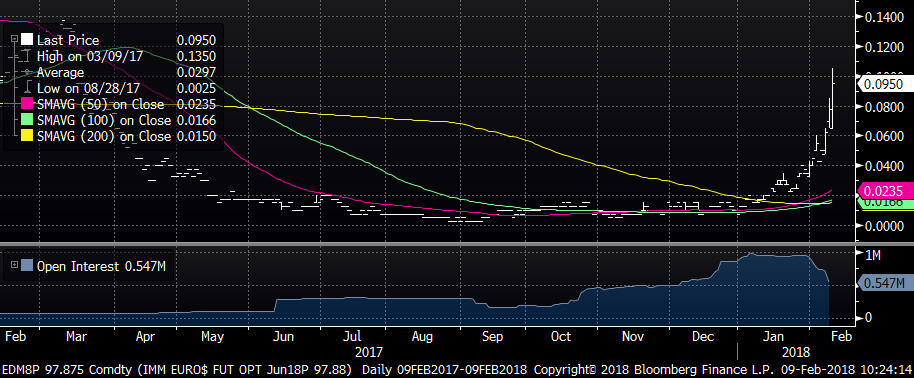
The short end of the market has issues as well, related to both positioning and an increase in fra/ois spread. A surge in t-bill issuance is expected to widen this spread further. There’s been huge liquidation of short positions in EDM8 9787.5 puts, as shown on the chart above. These puts have soared from 1 bp at the start of the year to over 10, settling at 8.75 Friday. Open interest declined from nearly 1m to 519k as of Friday’s close. The same thing has occurred in EDH8 puts.
The next chart shows the fra/ois spread. It’s not as high as the money market reform spike of October 2016, but it appears to want to test that level. Again, the idea of funding stress is a nagging concern, and that fear is reflected by heavy selling pressure on the first two Eurodollar contracts.
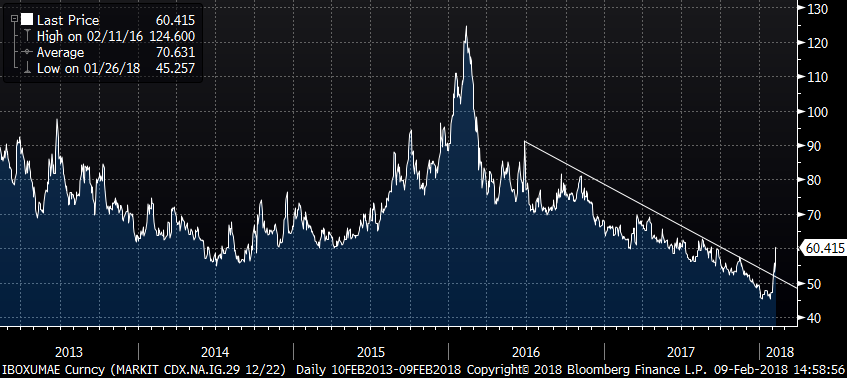
Another indicator to watch is corporate spreads. Gundlach consistently pointed to relative weakness in HYG (the junk bond etf). It plunged this week, though it still has a long way to go to reach depressed levels associated with the energy disaster in early 2016. Another interesting feature late last week was a jump in Investment grade CDX. Absolute levels are still low, as the long term chart below shows. However, the trend appears to have changed. The cost of bond protection is increasing. Corporate spreads are sure to follow.
In summary, stocks were initially spooked by interest rate concerns. Prior to Chairman Powell’s testimony before Congress on Feb 28, the Fed will likely resist taking steps to overtly support stocks. Unless inflation data are decidedly weak (CPI and PPI released Wednesday and Thursday), pressure on bonds is likely to continue, and rallies in stocks will find willing sellers.
_______________________________________________________
| 2/2/2018 | 2/9/2017 | chg | |
| UST 2Y | 215.1 | 205.7 | -9.4 |
| UST 5Y | 259.7 | 251.3 | -8.4 |
| UST 10Y | 284.8 | 282.6 | -2.2 |
| UST 30Y | 309.4 | 313.3 | 3.9 |
| GERM 2Y | -54.0 | -56.7 | -2.7 |
| GERM 10Y | 76.7 | 74.5 | -2.2 |
| JPN 30Y | 81.7 | 80.5 | -1.2 |
| EURO$ H8/H9 | 60.5 | 46.0 | -14.5 |
| EURO$ H9/H0 | 31.0 | 26.0 | -5.0 |
| EUR | 124.59 | 122.52 | -2.07 |
| CRUDE (1st cont) | 65.45 | 59.20 | -6.25 |
| SPX | 2762.13 | 2619.55 | -142.58 |
| VIX | 17.31 | 29.06 | 11.75 |
Feb 9, 2018. Cost of protection is going up
-SPX closed -3.755 as contagion from the VIX blow-up spreads. Late yesterday I sent CDX IG attachment which shows a surge of increased demand for CDS protection. Implied vol in treasuries exploded yesterday, for example, with a net change of only 4/32’s in TYM8, the April 120.5 straddle went from 1’36 to 1’44, and was higher after the close on a huge block trade. Block details below. With only 2 weeks to go, USH 144 straddle settled 2’34 (10.9), up from atm of 2’20 Wednesday. Eurodollar midcurve straddles up a couple of bps yesterday.
–So we have the vix surge, falling stocks, and now added ‘insurance costs’ with both CDS demand and interest rate vol strengthening. In addition, eurodollar futures reflect funding strains, with near contracts under heavy selling pressure. EDM8 9787p bought in size of 150k yesterday at 8.0-8.5. These puts settled at 7.75 vs 9785.5 with a huge drop in open interest of 158k. (Shoulder tap to reduce risk?). EDZ8 9737p bought in size of 70k 3.5 to 4.0, settled 4.0 vs 9760.5, but in this strike open interest rose 59k.
–Clearly, what appeared to be ‘contained’ is now seeping outward. I mentioned HNA, the Chinese conglomerate yesterday, putting $4 billion of property in the US on the selling block (according to BBG). This company had already been cut off from several banking relationships including HSBC, and was issuing short term debt at high rates. It owns 10% of Deutsche Bank which has fallen to a new low of €12.61 today. Volume is heavy; DB was near 17 in December. Shanghai Comp has fallen over 13% since the end of January.
–Dudley yesterday referred to the fall in asset prices yesterday as “small potatoes”, which is another indication that the Fed isn’t going to be so quick to ride to the rescue unless data from the real economy deteriorates. Powell testifying before Congress on Feb 28.
LATE BLOCK:
-23916 TYH 122/120ps
-23916 TYH 122/120.5ps put spreads as a package settled 1’62 and were sold at 1’60, appears to be a roll of longs into lower strikes
+62855 TYJ 119.5/118ps 22/64 (settled 22 ref TYH 120-28.5s)
all covered TYH 120-29.
Feb 8, 2018. Reach for yield morphs into panic for funding
–The two year budget deal reached yesterday sparked a fresh bout of selling in fixed income, with the ten year yield up over 7 bps to 284.2, and a slight new high in 2/10 spread at 71 bps. Increased spending is going to translate into higher debt issuance, even as the Fed continues QT. This morning Kaplan noted financial turbulence and said the Fed would be vigilant about spillovers into the real economy, but said his ‘base case remains the same’. Rate futures weak across the curve. EDH8 prints a new low of 9805 this morning and the bond contract at 144-12 is threatening new lows. By the way, a few days ago EDH8 9812.5 straddle was trading 4.0, now it’s 7.5 intrinsic with 40 days to go. EDH8 9787.5 puts went 0.25 bid late in the day! While there was selling in treasury vol from the early part of the session Wednesday, the front end is feeling a bit panicky. I’ve seen some research trying to quantify vol strategies as a percent of the entire market (I think I saw 6%), but it reminds me of the subprime crisis – at that time people thought subprime wasn’t significant enough to ripple through the financial chain. The problem with optionality is that it can get big in a hurry. In any case, it feels like a problem in funding markets could be percolating. By the way, I’ve attached a chart of the ten year inflation indexed note yield which is now 72 bps… does an increase in real yield provide competition for stocks? In a broader scope, I would note that all of these vol selling strategies were part of the REACH FOR YIELD that the Fed engineered by forcing the investing public into riskier assets. Huge expansion of balance sheet, force yields down and move the public further out the risk curve, and now someone lit a match.
–Thirty year bond auction today.
Feb 6. Forced hand
–War’s over man, Wormer dropped the big one.
–What?! Over? Did you say ‘over‘? Nothing is over until we decide it is! – Bluto
–Welcome to your first day as Fed Chair Mr Powell. I’ve often said that markets test a new Fed chief, but Yellen slipped through with impeccable timing. A lot of people had already been making comparisons to 1987, and that particular crash was just two months after Greenspan had been installed. At that time, the Fed issued this statement: “The Federal Reserve, consistent with its responsibilities as the nation’s central bank, affirmed today its readiness to serve as a source of liquidity to support the economic and financial system.”
–I don’t know how many times I’ve read that the market had gone without a 3% correction in so long. Well now it happened and there’s utter astonishment. Why? The real problems are now entwined with the idea of “volatility as an asset class”. It’s easy when stable with a downward bias across products. Not so easy now.
–Interest rate futures rallied. The ten year yield fell nearly 9 bps by the 2pm floor close to 276.4, and more afterward. There was a buyer during the day of some 50k FVH 115c early for 4/64’s. These settled at 10.5 vs 114-25.25 (nice), but later in the day were 22/24 vs 115-05. Wow. On 29-Jan, a week ago Friday, someone paid $0.49 for 50k March VIX 25c. I saw a price on these of 6.20.
–There were some amazing moves, and now there is likely to be a LOT of rebalancing and forced exits. Several of the short VIX etns will likely not survive. However, treasury vol remained subdued overall. Late quote in the TYH atm straddle was 1’03/1’04 vs 121-29, only around 4.9. (TYH 121.25^ settled 0′;63 v 121-08.5). Similarly, the market is NOT really repricing the idea of a March hike by the Fed. It’s still there; the bar is pretty high. However, the path of forward hikes is now questionable, with near ED calendar spreads shedding recent gains. For example, EDZ8/Z9 was 36 early yesterday and ended the day at 29 (33.0s).
–Not much more to say except this. Trump owned the stock market rally, taking credit whenever possible for the rise in ‘wealth’. His lawyer’s are advising (BEGGING) him not to submit to an interview with Mueller. Will it now all devolve into political blamesmanship?
Feb 4. The dance between stocks and bonds
“No mistakes in the tango Donna, not like life. It’s simple. That’s what makes the tango so great. If you make a mistake, get all tangled up, just tango on.” –Lt Col Frank Slade
It was a pretty important week, so I was just going to stick to the big market moves, without any corny movie references, but… I just couldn’t shake the idea of a dance between stocks and bonds out of my head. So of course it brings me to one of my favorite movies, Scent of a Woman, and the tango scene between Frank and Donna. Frank Slade of course, is the blind cantankerous retired Lt Col from the army, played by Al Pacino. A youtube link is at the bottom. What does this have to do with the market? Nothing really, but there’s some tension between stocks and bonds right now; how will they respond to each other’s steps? As an aside, Chris O’Donnell is the main character in the movie; his brother was a filling broker in the euro$ options pit, as charming of a guy as you’ll ever meet in the business.

Are markets spooked by the new Fed? Over the last few weekly notes, I mentioned the risk that the Fed may move the strike on the ‘Fed put’ down a bit. A friend put it more succinctly to me Friday: “Now they’re afraid that the Fed won’t come to the rescue.” When’s the last time anyone talked about the PPT (Plunge Protection Team)? Last week I cited Ray Dalio, who specifically linked financial asset prices to the rate used to discount the stream of future cash flows to their present value: “It just takes a little change in interest rates to have a bear market.” Dalio said it’s important how the Fed responds to changing conditions…that the amount of tightening priced into the curve wasn’t much, but that if we were to get more hikes than priced, it would have a large impact. While Dalio wasn’t concerned about inflation, I suggested last week that price acceleration may become a problem for markets. Dalio’s main focus (in this particular interview) was on the Fed, but other famous investors are looking at market action itself. For example, Gundlach pointed out relative weakness in junk bond ETFs way before this week’s bloodbath. Both HYG and JNK had huge purges this week, taking out the spike lows of last November. In terms of forward pricing reflected in the curve, the market was aggressive in forecasting higher rates, as all euro$ calendar spreads made new highs and the ten year yield jumped 19 bps to 2.85%. January’19 FF contract settled 9789.5, 68.25 bps below Feb’18, so 3 hikes are essentially priced.
This is where the dance comes in. Will stocks see follow through from Friday’s break? If so, will yields begin to decline? Or are bonds so weighed down by issues of supply and possible inflation acceleration that even asset price drops won’t have much impact? Who’s leading? Will markets force the Fed’s hand?
I believe the Fed won’t blink on the QT schedule, and wants to lean against inflation given consistent gains in employment data. Furthermore, the new Fed may feel it’s building credibility as its projections on hikes for the year finally hit target. On Friday, Dallas Fed President Kaplan said he’s concerned tax cuts will leave the US more leveraged, and “If we wait to see actual inflation, we’ll be too late.” From Wednesday’s FOMC statement: “Market-based measures of inflation compensation have increased in recent months but remain low” an upgrade from December’s announcement. Prices paid in Mfg ISM last week were at a new high of 72.7, “…indicating higher raw materials prices for the 23rd consecutive month”, and of course, Friday’s 2.9% yoy gain in Average Hourly Earnings was the icing on the cake. I contend that the bond market is leading this dance, and will turn a blind eye to stocks. After all, besides rates, other ‘financial conditions’ are only just now beginning to turn, namely stocks and perhaps the dollar. Of even greater importance might be the other factor with respect to financial conditions, credit spreads. There’s relatively high leverage in the corporate sector, and borrowers have enjoyed tight spreads which perhaps take the edge off market discipline. The decline in junk prices bears watching…
Let’s take brief look at some changes. The five year yield rose 14.7 bps this week, while tens were up 19 and bonds 18.3. Big moves. The Dow lost 2.5% and other indexes were down around 2% on Friday, with a related jump in the VIX to 17.3. The easy trades of buying stocks, selling VIX for the *inevitable* ride down the curve and buying bitcoin are one by one being shredded.
While the move this week has been strong, it’s worth looking a bit further back. Since the September low in yields (related to peak N Korea concerns) the five year yield has risen nearly 100 bps, from 1.62% to 2.597% on Friday. On the Eurodollar curve, all near one-year calendar spreads rose to new highs and were higher every single day for the past six sessions. I’ll just focus on the most heavily traded spread for the moment, which is EDZ18/EDZ19. It started January at 19 and closed Friday at 36. A week ago Thursday it was 26. Just looking at both prices in relation to the Fed dots is interesting as well. The projected FF rate by the Fed for the end of 2018 is 2.1%. EDZ18 is 9758.5 or 2.415%, more or less consistent with a spread of 31.5 bps. EDZ19 is 9722.5 or 2.775%, while the Fed’s projection is 2.7%. Getting close. By the way, the Fed’s 2018 projection for PCE Inflation is 1.9%, and it’s beginning to appear as if we’ll exceed that level.
This week we have supply in the form of 3, 10 and 30 years, which may be more important than usual as the treasury’s borrowing needs are increasing. We could easily see a further concession in bond prices in the early part of the week, and a rally out of the third leg.
Interesting footnote to Yellen’s last day were the ‘macroprudential’ restrictions on Wells Fargo’s growth. The bank won’t be allowed to grow assets until it cleans up its act. Is this a sign of things to come at the Powell/Quarles Fed? Or is it the last vestige of regulation that’s likely to be scaled back? It’s also worth noting Deutsche Bank, which again reported a yearly loss (3rd consecutive) and saw the stock close down over 6%. Several factors including DB and the upcoming March 4 Italian elections could weigh on the euro this month.
________________________________________________________________
| 1/27/2018 | 2/2/2018 | chg | |
| UST 2Y | 211.6 | 215.1 | 3.5 |
| UST 5Y | 247.0 | 259.7 | 12.7 |
| UST 10Y | 266.0 | 285.1 | 19.1 |
| UST 30Y | 291.1 | 309.4 | 18.3 |
| GERM 2Y | -54.4 | -54.0 | 0.4 |
| GERM 10Y | 62.4 | 76.7 | 14.3 |
| JPN 30Y | 81.0 | 81.7 | 0.7 |
| EURO$ H8/H9 | 57.0 | 60.5 | 3.5 |
| EURO$ H9/H0 | 21.5 | 31.0 | 9.5 |
| EUR | 124.27 | 124.59 | 0.32 |
| CRUDE (1st cont) | 66.14 | 65.45 | -0.69 |
| SPX | 2872.87 | 2762.13 | -110.74 |
| VIX | 11.08 | 17.31 | 6.23 |
https://www.youtube.com/watch?v=kCnB05GrUgc
Feb 2, 2018. The bond groundhog sees his shadow
–Big day yesterday in front of today’s payrolls. NFP expected 175-185k and Avg Hourly Earnings +0.3. Yields rose and the curve steepened on large volume. Implied vol firmed. Total ED volume was 4.77m and open interest was up 217k. TY volume 2.1m with open int +61k. The ten year yield jumped 5.5 bps to 277.3 and the 30y bond gained 6.7 to end just thru 3%. Put buying continued after the floor close, for example a buyer of 30k 0EM 9725p for 6.0.
–All ED calendars once again posted new highs. EDH18/EDH19 settled 60 bps (should be resistance around 65/66). EDZ8/EDZ9 settled 34, +3 on the day. There was heavy buying of EDZ9/Z0 for 10.5 (30k), came back to settle 10.0 but that’s still a new high, with Z/Z/Z fly 24. Red/green ED pack spread started January at 8.5 bps, just a month later it’s 19.0.
–I just took a quick skim of news this morning, but the impression that I get is that the world is shunning bonds. HYG and JNK had terrible days yesterday; gap open lower, closed at the low and now testing the spike down from late November. There’s an article on ZH (citing Citi) that notes both private individuals and banks in Italy are selling sovereign bonds in front of the election, to the ECB of course. Another article says the BoJ offered to buy unlimited JGBs for 11 bps. To top it off, Benoit Coeure said “The next crisis may well force the ECB to test the limits of its mandate.” (RTRS) Way to boost confidence Benoit!
–At the beginning of last year several high profile investors warned about a possible stock downturn. There have been several warnings about the ‘bond bubble’ recently as well. While stocks have absorbed every shock gracefully, the bond market feels rather unruly. Today’s data may not make much difference, there’s likely to be a wall of offers on any rally.
February 1, 2018. Macro issues
–It would be completely reasonable to see a dollar bounce from these levels. As shown on chart below, DXY has achieved the 61.8% retrace in an environment where the Fed maintains its tightening bias. The interest rate curve is also suggesting dollar support, as euro$ back calendars continue to firm. All one-yr calendars from EDH8/H9 to EDU9/U0 made new highs yesterday (on settlement basis). For example, EDM19/EDM20 is now 19.0, having risen 10 bps since the beginning of January. (Peak is EDH8/H9 at 58.5 bps). Previously, the back end of the curve had flattened at the suggestion of further tightening; that’s starting to change. If the dollar does have a bear market bounce, the impact on stocks is likely to be negative. The question is, ‘how will fixed income react?’ My opinion is that bonds are now focused on supply issues and potential inflation, rather than equity prices. As mentioned yesterday, I thought the Fed might upgrade its inflation assessment, and the statement DID note “market based measures” increasing, but softened the message with survey evidence:
–A concern for my outlook is that 5/30 flattened to a new low of 41.6 bps, and as a result, bond vol was hit. However, blue midcurve straddles maintain a strong bid, as does five year note vol (on a relative basis). The issue for the Fed is whether or not to lean more aggressively against what Greenspan yesterday termed as ‘bubbles’ in both stocks and bonds. Cleaning up after speculative excess isn’t as easy as the Fed once thought it was…
–Decent amount of news today, including Productivity and Unit Labor Costs, expected +0.7 and +0.9. Jobless claims 235k. ISM Mfg 58.6 from 59.7, with Prices Paid 68.8. Highest prices paid over the past year has been 71.5 in September.
–Interesting post from www.themacrotourist.com
which notes that MBS holdings by the Fed haven’t yet decreased as outlined by the QT guidelines. The reason given is that MBS redemptions were incorrectly modeled by the Fed (wait, what? the Fed’s models are off?). If so, the adjustment will add more supply at the margin as the Fed tweaks its assumptions.

Jan 31, 2018. Bond fundamentals
–Going into Trump’s State of the Union address SPX fell 1.1% and VIX firmed to 14.26. Dollar is weaker this morning, stocks have stabilized.
–The long end of the market did not respond to equity weakness yesterday; tens rose 3.2 bps to 272.4 and 30’s rose 4.1 bps to 297.9. All eurodollar calendar spreads made new highs, with EDH8/EDH9 squeezing out a gain of 0.5 to 57.5. Notable buying in EDZ9/Z0 yesterday at 9.5, it closed 10.0. Red/gold pack spread +2.375 to 31.25, a new recent high as well. For the fixed income market, it’s not about other asset prices and their influence on economic activity, it’s the possibility of INFLATION and SUPPLY. Ten year tip/treasury b/e now up to 210 bps and the 5y5y inflation forward is 242 bps. Today is Yellen’s last FOMC, For the most part, the Fed’s been running around like the tin man in the Wizard of Oz trying to figure out the lack of inflation. What IF inflation starts coming back simultaneously with fiscal stimulus and increased supply. The Great Oz has given you a diploma; bond yields will go up.
–Perhaps it won’t just be treasury yields. Gundlach late yesterday mentioned the junk bond etf JNK, which closed lower on year. It was in November when we last had concern about junk bond outflows; price action suggests this issue will again move to the forefront.
–The NY Fed announced it has started its search for Dudley’s replacement, underscoring the change in the Fed’s composition. Janet Yellen’s tenure was unscathed, but it might not be so easy for Powell.