Let’s give this libor can a kick
December 1, 2020
The Board of Governors of the Federal Reserve System, the Office of the Comptroller of the Currency, and the Federal Deposit Insurance Corporation (collectively, the agencies) are issuing this statement to encourage banks to transition away from U.S. dollar (USD) LIBOR as soon as practicable. 1 Background and Discussion The FFIEC’s “Joint Statement on Managing the LIBOR Transition”2 noted that the LIBOR transition is a significant event that banks should closely manage. The FFIEC statement further explained that new financial contracts should either utilize a reference rate other than LIBOR or have robust fallback language that includes a clearly defined alternative reference rate after LIBOR’s discontinuation. Separately, the agencies recently issued a statement that says a bank may use any reference rate for its loans that the bank determines to be appropriate for its funding model and customer needs. 3 The administrator of LIBOR has announced it will consult on its intention to cease the publication of the one week and two month USD LIBOR settings immediately following the LIBOR publication on December 31, 2021, and the remaining USD LIBOR settings immediately following the LIBOR publication on June 30, 2023.
–The announcement above caused significant turmoil and position adjustment on the euro$ curve. Contracts from EDH’22 thru EDM’23 exploded higher (+4 to +5.5) as the ‘libor fallback’ was apparently extended to the end of June 2023. This adjustment was most notable when looking at the ‘old’ libor fallback trade when participants expected libor (thru previous guidance) to end at the end of 2021 vs the ‘new’ libor fallback. The old trade was EDZ’21/EDH’22 calendar spread which went from +4.0 to -1.0 (Z1 9976s, +0.5 and H2 9976.5s, +5.0). Huge one-day move for a 3-month calendar! The new spread is EDM’23/EDU’23 which jumped 3 bps from 4.0 to 7.0 (M3 9964.0 +4.0 and U3 9957.0 +1.0).
–It’s somewhat ironic that the Fed minutes from November repeatedly mentioned the restoration of “smooth market functioning” as a goal of emergency covid funding measures, and then they drop this bomb. I guess the market did adjust in an orderly way on large volume, though I don’t think the pnl was particularly smooth for some players. For example, remember the massive sales of EDZ2 9962.5c at 11 when the contract was trading 9963.0? The contract settled yesterday at 9970 (+4.0) and those calls at 15.75 (+3.25). The other large position that was partially exited is the EDH2, EDM2 and EDU2 9975/9962p 1×2’s. There had been a buyer of the 1×2’s, buying the 9975 and selling 9962 twice, crushing the lower strike across the reds. Here’s how the settlements changed yesterday:
–EDH2 9975p fell 2.5 bps from 7.75 to 5.25, while 9962p were unch’d at 2.0. The 1×2 went from 3.75 to 1.25.
–EDM2 9975p fell 3.0 from 10.25 to 7.25, while 9962p ROSE 0.25 to 3.25. The 1×2 went from 4.25 to 0.75!
–EDU2 9975p fell 3.75 from 12.5 to 8.75, while 9962p fell 1.0 to 4.5. The 1×2 went from 1.5 to -0.25.
That, as they say in the business, is gonna leave a mark.
–So while EDU2 9962.5 straddle had been settling around 17 the past several sessions, it settled 20.5 yesterday and the new atm 9975^ settled 16.5 with 659 days to go.
–The contract with the largest change in open interest was the ‘new’ end of libor contract, EDU’23, which added 36.5k contracts. It might be considered a coincidence that last week the EDU’23 puts became a bit more active, with a buyer of the 9950/9900 put spread for example. Not large enough to be egregious, and actually not a winner unless done hedged. I’m just saying there are some people out there with *ahem* better information than others.
–This morning we have ESZ0 at all time highs and Nasdaq knocking on the door as stocks only go up. Dec bitcoin is above 20k, and even gold has joined the party, with GCG1 rebounding $27 off the lows to trade 1808.
–Powell testifies today in front of Senate Banking. Perhaps the libor switcheroo will come up. Certainly the topic of a fiscal lifeline will be emphasized.
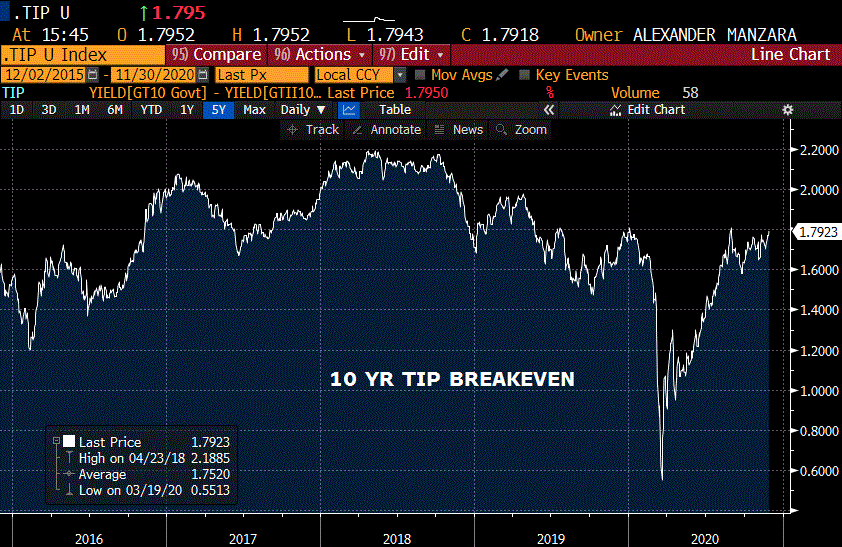
–One last note, the ten year treasury to tip breakeven closed at a new recent high of 179.5 bps. The high of the year has been just above 180, which occurred right at the start of year and again in August. Third time’s a charm. This is sometimes considered a proxy for long-term inflation expectations. While Fed officials continue to emphasize deflationary risks, the market is telling a slightly different story, while keeping an eye on USD weakness; DXY made a new yearly low yesterday and is currently 91.72.
Financial Conditions vs Financial Stability
November 29, 2020- Weekly Comment
The Fed minutes were released on Wednesday from the November FOMC. A few sentences summarized the underlying tension between financial conditions and financial stability:
A few participants indicated that asset purchases could also help guard against undesirable upward pressure on longer-term rates that could arise, for example, from higher-than-expected Treasury debt issuance. Several participants noted the possibility that there may be limits to the amount of additional accommodation that could be provided through increases in the Federal Reserve’s asset holdings in light of the low level of longer-term yields, and they expressed concerns that a significant expansion in asset holdings could have unintended consequences.
A few participants expressed concern that maintaining the current pace of agency MBS purchases could contribute to potential valuation pressures in housing markets.
Of course, this framework of differentiating between conditions and stability is not overtly identified in the minutes, but I believe it’s a subtext that increases economic vulnerability going forward. Recently, every Fed official that has given a speech or interview emphasizes the importance of increased fiscal support, the result of which will necessarily be increased debt issuance. The first sentence excerpted from the minutes above, essentially provides guidance that the Fed will continue to hold long rates down by monetizing government debt that the private market is unwilling to absorb. The next sentence represents a push-back.
Former NY Fed chief William Dudley defined financial conditions in terms of “five key measures: short and long term Treasury rates, credit spreads, the foreign exchange value of the dollar, and equity prices.” Obviously, every one of these criteria currently falls under the umbrella of highly supportive conditions. The minutes refer to spreads being back to pre-pandemic levels. Stocks are near all time highs, the dollar’s value is declining. The risk, as noted by some members, is that attempting to juice financial conditions from these levels will foster future financial instability.
As William White, former chief economist of the BIS notes, “Every [previous] crisis was met with monetary easing that caused debt and other imbalances to accumulate over time, and that caused the next crisis to be bigger than the previous one. The next crisis then needed more punch from central banks. But since interest rates were never raised as much in upturns as they were lowered in downturns, the capacity to deliver that punch was decreasing.” White’s view is that risks of instability are high. Also worth noting is that Fed staff considers risks currently tilted to the downside. Later in White’s interview (linked below) he is asked about the possibility of a tipping point. “One of the conclusions of the complexity literature is that the trigger itself is irrelevant. If the system is unstable, anything could be a tipping point, even if the instability goes on without incident for years.”
The final sentence that I highlighted from the minutes borders on naivete. The current pace of MBS purchases is MEANT to foster activity in housing markets. Push mortgage rates lower and you’ll generate transactions. This, at a time when many Americans are either trying to escape high costs and violence of major cities, or have found that work-from-home arrangements mean geographical independence. It’s obvious that prices in some jurisdictions will be pushed higher, maybe to unreasonable valuations! It’s also clear that the same dynamic has lifted stock prices.
In order to address potential instability brought on by bloated government and corporate debt, many have concluded that higher inflation is a key policy goal. Reaching this goal by definition means reducing the purchasing power of the dollar, and if that’s the stated objective, then it’s no wonder that bitcoin and prices of economic inputs should increase. I saw several articles mention that copper had hit a seven-year high last week. Below is a long term chart of both DXY (dollar index) and Bloomberg’s Base Metals index.

Note that in 2011 both base metals and DXY hit extremes. Trend lines drawn from those points reveal that both DXY and base metals have recently broken these trends. This example among others, suggests that the Fed will be successful in generating inflation. The question is whether it will be too successful.
A couple of other observations: Given the low level of yields, many asset managers concluded that bonds no longer were likely to provide much of a cushion in case of a stock break. Some even substituted gold for bonds as a hedge. Last week gold was dumped as risk-on sentiment strengthened. From the previous Friday close to Friday’s low gold fell $100 ($1871 to $1774). VIX dipped below 20 for the first time since February, though it ended the week at 20.84. The minutes repeatedly refer to a goal of asset purchases as “restoring smooth market functioning.” Clearly, there’s been mission creep, as Powell echoed Draghi by saying on November 17 that the Fed will use all available tools to support the recovery, “as long as it takes.”
There’s a decent amount of economic data out this week, culminating in Friday’s employment report. Chicago PMI and Dallas Fed Mfg on Monday, Mfg ISM on Tuesday, ADP and Beige Book on Wednesday. Powell appears before the Senate Banking Committee on Tuesday as well.
The assassination of the top Iranian nuclear scientist on Friday could prompt an escalation in hostilities in the region as Iran responds. In September of 2019, a large attack on Saudi oil installations caused WTI crude to surge around $10, from 55 to nearly 65, though it quickly fell back.
| 11/20/2020 | 11/27/2020 | chg | ||
| UST 2Y | 16.5 | 15.2 | -1.3 | |
| UST 5Y | 38.0 | 36.7 | -1.3 | |
| UST 10Y | 82.8 | 84.1 | 1.3 | |
| UST 30Y | 153.0 | 157.4 | 4.4 | |
| GERM 2Y | -75.1 | -75.5 | -0.4 | |
| GERM 10Y | -58.3 | -58.8 | -0.5 | |
| JPN 30Y | 62.5 | 64.8 | 2.3 | |
| EURO$ Z0/Z1 | -0.3 | -0.5 | -0.3 | |
| EURO$ Z1/Z2 | 10.5 | 9.5 | -1.0 | |
| EURO$ Z2/Z3 | 14.5 | 15.5 | 1.0 | |
| EUR | 118.56 | 119.61 | 1.05 | |
| CRUDE (active) | 42.42 | 45.53 | 3.11 | |
| SPX | 3557.54 | 3638.35 | 80.81 | 2.3% |
| VIX | 23.70 | 20.84 | -2.86 | |
https://ggc-mauldin-images.s3.amazonaws.com/uploads/pdf/20201116_OMS_cbanks-White.pdf
Selling bitcoin, buying copper
November 27, 2020
–This morning copper is making a significant new high, with HGH1 over 3.40. Yen denominated Nikkei futures also at a new high for the move. The dollar index is just under 92, sitting around the year’s lows. Bitcoin has seen a big drop, down 2000 this morning with the December future just above 17000. The Greyscale bitcoin ETF lost about half its premium on Wednesday as VanEck launches a competing “physically-backed” ETN on Deutsche Boerse. The premium compression in GBTC may have contributed to long liquidation. As is now often the case, derivatives of one sort or another dominate the price action, even though the VanEck product should lead to more demand. US equity index futures are higher. Somewhat surprisingly, yields are a bit lower this morning with the ten year yield at 87 bps.
–FOMC minutes on Wednesday were of interest due to discussion of asset purchases. No end in sight, though composition and communication about size and duration are continuing topics. “Most participants judged that the guidance for asset purchases should imply that increases in the Committee’s securities holdings would taper and cease sometime before the Committee would begin to raise the target range for the federal funds rate.” The increasing taper schedule with FF hikes at the same time was a major error in 2018.
–It’s a short day today. Enjoy the weekend!
No need to hedge
November 25, 2020
–The dollar index is probing the year’s low. The Dow hit 30k and Russell closed at a new record high. Copper made a new high for the year, grains are strong, crude has recovered levels last seen in March when covid fears were storming and the Saudis threatened to flood the market (CLF1 45.50). Financial markets suggest solid growth and an increase in inflationary expectations. However, tens only rose 2.8 bps yesterday to 88.3. The curve steepened slightly with 2/10 just above 72. Implied vol is soft. Gold has seen a vicious 2-day bloodletting, now around the 200-day moving average. Friday’s close in GCZ0 was 1872, yesterday 1804.60. Some had substituted gold for bonds in a search for non-correlated safety in the event of a renewed stock market decline, as bonds yields are so low that price gains are thought to be capped. Apparently gold hedges were jettisoned given the stock rally. Who needs a hedge anyway? For some reason, bonds just dip their toe into the water of higher yields, perhaps because the Fed is mopping up all the supply. A Powell/Yellen team only strengthens that perception.
–A lot of data out today: Job Claims, Q3 GDP, Durables, Core PCE prices (expected 1.4% yoy vs 1.5%). Fed releases the Nov minutes.
–Happy Thanksgiving! Beware of reduced liquidity this afternoon as many will start long weekends early.
Credit concerns
November 24, 2020
–Stocks responded positively to the news of Yellen’s selection as Treasury Sec’y and are higher this morning though not at new highs. Copper however, is at a new high for the move with HGZ0 over 3.30. In April HGZ was as low as 2.18. Action was muted in treasuries yesterday, though the curve had a small bounce. Tens ended at 85.5, up 2.7 bps on the day. Seven year auction today.
–New euro$ 1/16th strikes debuted yesterday with the featured trade being a buyer of 20k EDH1 9981.25/9987.5 c 1×2 for 0.5 to 0.75. Settled 0.75 (1.25 and 0.25) vs EDH1 9978.5. Euro$ premium remains diplomatically quiescent. Short Dec (0EZ0) 9975 straddle settled at 2 with futures right at strike with expiration 2 weeks from Friday.
–Both Bloomberg and FT ran stories today about China credit concerns. Other analysts have also noted increased default risks, which are accentuated by the recent interest rate increases. While China may have come out of the covid episode prior to other parts of the world, it seems as if underlying financial damage is only now coming bare. The US intends to sidestep any bankruptcy fears by keeping rates at zero. Forever.
–Here’s a clip from BBG: “While none of the companies [Pingdingshan Tianan Coal, Jizhong Energy, Tianjin TEDA Investment Holding, Yunnan Health and Culture Tourism Group] have missed debt payments, and all four are rated AAA by Chinese domestic ratings firms, their bonds have tumbled by at least 14% since Nov 10. That’s when a surprise default by a state-owned Chinese coal producer cast fresh doubt on the implicit guarantees that have long underpinned gov’t backed borrowers. ‘Most of the onshore bonds hit hardest this time share a common symptom: their profitability has lagged far behind their debt growth’ said Li Yunfei, credit analyst at Pacific Securities.”
–The specter of Triple A zombies! The “BBB cliff” has long been a story in the US, though credit spreads have returned almost to pre-covid levels. According to the St Louis Fed website, in January of this year the BBB option adjusted spread hit a low if 127 bps, and is now 148 bps (high of 396 bps in between). The low in February of 2018 was 115. Sort of ironic, China is moving nearer to the capitalistic model of letting badly run companies fail while letting more dynamic companies flourish, while the US hopes that zero rates save everyone.
Copper/gold ratio and heavy treasury supply point to higher yields
November 23, 2020
–Friday featured a late sell off in stocks which has reversed this morning, and a bid to fixed income in the context of a flattening curve, both of which have also partially reversed. Tens ended down 2.4 bps to 82.8. 5/30 treasury spread notched a new recent low of 115.7, down 3.6 on the day. Today’s news includes Chicago Fed’s Nat’l Activity Index and Markit Composite. Treasury auctions 2’s and 5’s today in size of $56 and $57 billion. 7’s are auctioned tomorrow.
–The next couple of sessions will see heavy roll activity in treasuries. About 21% of fives have already rolled, with tens being around 17%. With the expiration of December treasury options, expect wing replacement, perhaps as far out as March as vols remain quite low.
–Dec gold is at 1865 this morning, down over $7 even as the dollar trades near the year’s low. A break of $1850 would likely spark panicky long liquidation from weaker hands. Gold’s relative weakness is a bit surprising given bitcoin’s strength. Soybeans are making new yearly highs this morning with the Jan contract close to $12, and corn is also at the highs of the year. Dec Copper made a new high for the year on Friday, but has had a slight pullback this morning.
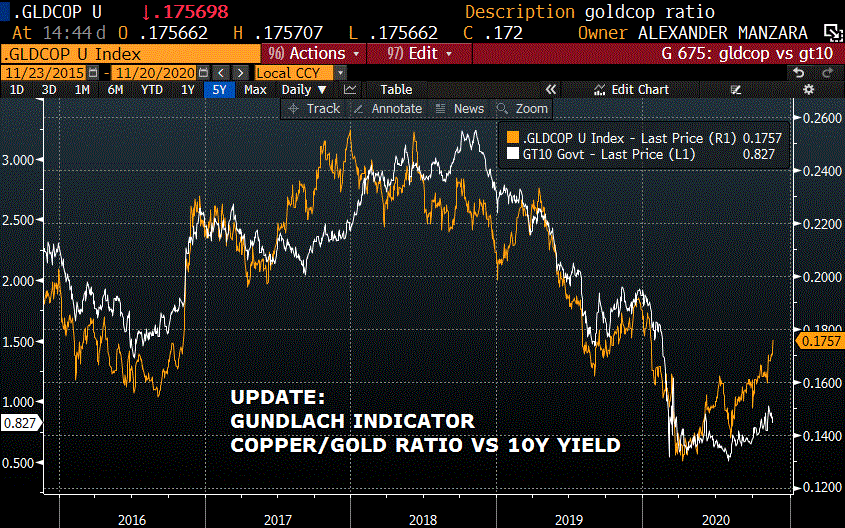
–Attached is Gundlach’s ten year treasury yield indictor: the copper/gold ratio. If this thing works, either gold has to rally relative to copper, or ten year yields need to start rising! The Copper/gold ratio is as high as it has been since late January…when the ten year yield was 100 bps higher!
Charade
November 22, 2020 -Weekly Comment
******************************************
“Oh no. For a few minutes they were mine. That is enough.” Monsieur Felix, the stamp dealer in the film ‘Charade’

This bit of dialogue is from a fabulous 1963 film called Charade. It is, of course, a period piece, starring Cary Grant and Audrey Hepburn. The basic plot is that Audrey Hepburn’s (Reggie’s) husband has suddenly died. Unbeknownst to Reggie, at the time of his death, he was in possession of a significant amount of money stolen during WW II, and his wartime compatriots are seeking their fair share of this fortune, which they believe Reggie now has and is concealing from them.
Through various plot twists, it finally strikes Reggie that the stamps on the innocuous envelope in her husband’s pocket WERE the fortune! But she has given the stamps to her son, who traded them to the above cited Monsieur Felix. When she goes to Felix’s office, he returns the stamps. “I’m not a thief madame. I knew there was some mistake.”
He describes the most expensive of these stamps: “Ah, the best for last. Le chef d’oeuvre de la collection. The masterpiece. The most valuable stamp in the world. It’s called the Gazette Maldave. It was printed by hand on colored paper and marked with the initials of the printer. Today it has a value of one hundred thousand dollars.”
I was reminded of this movie because a friend has a baseball card collection. According to him (and the website attached), the value of desirable cards has exploded. By way of example, he cites a Ricky Henderson rookie card (highly graded PSA9) that he bought for $350 a few years ago. It now has traded for $1300. The PWCC 100 index of the most highly rated cards has, since January 2008, returned 313% compared to 135% for the S&P 500.
I don’t know whether to describe that as a mania, but I do think it’s a product partially driven by the Fed’s monetary policies, and partially driven by demand for a store of value other than fiat currency. The goal of the central bank should be productive investment that leads to a general increase in living standards. What has actually transpired is stock buybacks and money shuffling that creates an illusion of wealth. A charade. A fixation on financial conditions as the reassuring data that all is well. Bitcoin has again attracted investment favor as a store of wealth of limited quantity, and a medium of transaction. Of course, in terms of the latter attribute, a corollary of Gresham’s law (bad money drives out good) is at work. Bad money the world over, made worse by the weight of unsustainable debts, is leading to the hoarding of bitcoin. (Now above 18000, testing the all-time high near 20000 in Dec 2017). According to Reuters, citing the Institute of Internat’l Finance (IIF) “Developed markets’ overall debt jumped to 432% of GDP in the third quarter, from a ratio of about 380% at the end of 2019.” Nice call by Paul Tudor Jones in May of this year as he outlined the case for bitcoin when it was trading half its current value. The dollar index on the other hand, is bouncing around the year’s low at 92.39.
Back to Charade. I’m quite sure that the story of the Gazette Maldave was a reference to the actual most famous stamp in the world, the 1856 British Guiana One-Cent Magenta. This stamp too, was traded by a Scottish lad Vernon Vaughn who had found it among his uncle’s possessions in 1873, to a dealer for six shillings. It ended up in the collection of Count Philippe la Renotiere von Ferrary, willed upon his death to Berlin’s postal museum. It was then seized by France after WW I as a part of war reparations. After several other owners, John du Pont paid $935000 for it in 1980. “Following du Pont’s 2010 death in prison, it was auctioned for $9.5 million [in 2014], four times more than any other single stamp has ever fetched.” This is the only known surviving stamp of its kind. Shown below, and with an infrared image.
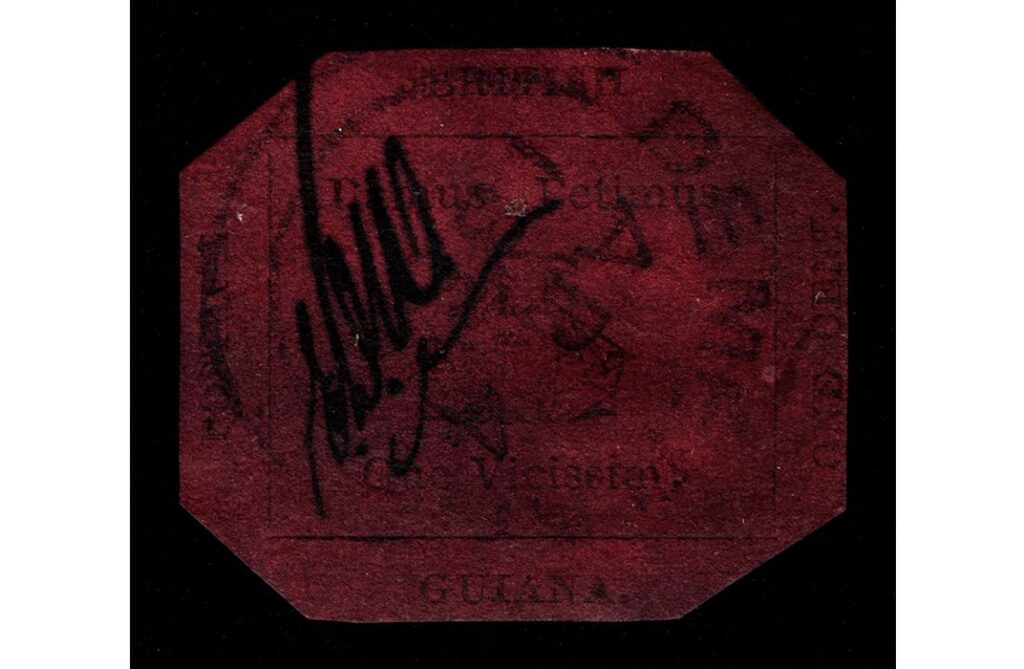

The One-cent Magenta has a ship at its center and includes British Guiana’s motto of the time, Damus Petimus Que Vicissim (We give and take in return). Nice paternalistic motto. It’s like the dance between the Treasury and the Fed. We sell bonds, and you buy them in return. However, this particular tango was interrupted by Mnuchin asking the Fed to close down several emergency lending facilities and remit the unused funds to Congress. The Fed responded that those facilities still might be necessary. As Powell often reminds, the Fed is a lender. Congress can appropriate targeted grants. I guess the market decided that the ultimate outcome would be more bond buying by the Fed, further out the curve. The thirty year bond fell 11.6 bps this week to 1.53% with tens declining 6.3 bps to 0.828%. 2/30 spread ended just under 137 vs the year and month’s high of 155.7. Should be great support between 127 and 132. Stocks ended Friday on a soft note, with SPX -0.8% on the week.
This holiday shortened week includes Chicago Fed National Activity and Markit Composite on Monday. On Wednesday, Jobless Claims, Q3 GDP and Core yoy PCE prices, expected 1.4% from 1.5% last. FOMC minutes are on Wednesday afternoon, and will likely include discussion of increased bond buying. Treasury auctions $56 billion in twos and $57b in fives on Monday, followed by $56b in sevens on Tuesday. Including 3- and 6-month bills the Treasury is auctioning $217 billion on Monday alone! According to the TBAC financing table, between last week’s 20y and 10y TIP, and this week’s 2, 5, and 7 auctions, over $128 billion in new cash is being raised.
OTHER MARKET THOUGHTS/ TRADES
On the Eurodollar curve, news of the week was uncertainty raised regarding the libor/SOFR transition in January 2022. Comments were released by ICE Benchmark Administration (IBA) and the UK’s Financial Conduct Authority. The result was that shorts in EDH2 (set in anticipation of the libor fallback) were pared back. EDZ1/EDH2 calendar has had a range of 3 to 7 this month, and closed at 4.5. There has been continued heavy trade in EDH2, M2, U2 and Z2 9962 strikes, both through call selling and through 9975/9962p 1×2’s. The long green Dec 9962 straddle settled 21.5 with 757 days to go; EDZ2 settled 9965.0. Since early August this contract has moved from a high of 9982 on Aug 4 to a low of 9960.5 on Nov 11, exactly the same number of bps as the straddle.
| 11/13/2020 | 11/20/2020 | chg | ||
| UST 2Y | 17.7 | 16.1 | -1.6 | w/I 16.5 |
| UST 5Y | 40.1 | 37.3 | -2.8 | w/I 38.0 |
| UST 10Y | 89.1 | 82.8 | -6.3 | |
| UST 30Y | 164.6 | 153.0 | -11.6 | |
| GERM 2Y | -72.7 | -75.1 | -2.4 | |
| GERM 10Y | -54.7 | -58.3 | -3.6 | |
| JPN 30Y | 64.9 | 62.5 | -2.4 | |
| EURO$ Z0/Z1 | 0.5 | -0.3 | -0.8 | |
| EURO$ Z1/Z2 | 11.5 | 10.5 | -1.0 | |
| EURO$ Z2/Z3 | 15.0 | 14.5 | -0.5 | |
| EUR | 118.38 | 118.56 | 0.18 | |
| CRUDE (active) | 40.40 | 42.42 | 2.02 | |
| SPX | 3585.15 | 3557.54 | -27.61 | -0.8% |
| VIX | 23.10 | 23.70 | 0.60 | |
https://www.pwccmarketplace.com/market-indices?sort=rank&order=&index=100
In: Eurodollar Options
Emergency backstops in question?
November 20, 2020
–Tens fell 2.8 bps yesterday to 85.2 and yields are a shade lower this morning going into Dec treasury option expiration. 5/30 notched a new recent low at 119.3, also down 2.8 on the day. As of this writing, expiring TYZ 138.5^ is 11/12 ref 138-135/14.
–Some parts of the economy are showing signs of strength, as reflected by the Cass Transporation report yesterday: “The V-shaped recovery continued in the latest reading of the Cass Freight Index. …shipping volumes were back in the black, with the index posting a positive year-over-year change for the first time since November. …freight shipments showed the best growth we’ve seen since October 2018.” However, the new covid wave is again crushing the service sector, which argues for targeted fiscal relief. Cleveland Fed’s Mester added her voice to the chorus of Fed officials urging fiscal action. In this context, Mnuchin’s letter to the Fed asking to return unused powder to Congress from several emergency lending programs is problematic. The Fed immediately responded that the programs are still needed. This rift is almost certainly politically motivated and not engineered by Mnuchin. I can’t help feeling that Illinois, as the only state that has tapped the Muni Liquidity Facility and is (was) thinking about going to the well again, is in the crosshairs. In any case, with Brainard or Yellen as Treasury Sec’y, Fed relations will be repaired soon. In the meantime, a bit of uncertainty regarding emergency financial backstops is a net negative for equities, while the McConnell/Shumer resurrection of Covid relief talks provides a ray of hope.
–Late yesterday EDZ0 9975 puts traded 1.25 with three weeks until expiry and EDZ0 trading 9975.25/75.5. Not much concern about funding reflected in that price… This morning EDZ prints 74.75.
Loquacious Libor
November 19, 2020
–As I’ve gotten older, I’ve learned a couple of things. One, if legging a trade, leg into the illiquid side FIRST. Second, (speaking of liquidity) don’t try to tackle plumbing problems. About the only plumbing job I will handle on my own is changing out a washer on the outdoor hose. When I have attempted the big stuff, I invariably spend a ton of time and a few trips to the hardware store on something a plumber (or my brother) does in ten minutes. It’s stupid.
–Yesterday, EDZ1/EDH2 spread traded 123k in a range from 6.5 down to 4.0, as the powers that be issued statements on libor. Those who had entered libor fallback trades scrambled to pare back, compressing EDZ1/H2 which had traded from -1 to +7 in the past month and a half. Huge volume traded in multiple ED calendar spreads. All this new plumbing is costing hedgers money with random moves, time and money in new legal contracts, regulatory burdens, changed clauses. It’s like a guy running back and forth to the hardware store…and still having a leak. I am not at all confident that a repo blow-up like Sept 2019 couldn’t occur again. Recall, the repo surge at that time is what the Fed used to anguish over. Now there are bigger … and BIGGER fish to fry. I just wonder about the cost of the original “libor rigging” versus these new costs with the improved market-transparent SOFR. Might have been easier to reform libor and keep the credit component. In any case, volumes in ED calendars were huge: 123k in EDZ1/H2 which settled 5.0 (4.5/5.0 late). 93k in EDH2/EDM2 which settled 1.5 and was 1.5/2.0 late. I guess we can score all the lawyers and regulators working on the SOFR transition as economic “growth”.
–Yesterday’s net moves in rates weren’t large, tens ended just 1 bp higher at 88. However, as mentioned there was some jostling around on the ED curve, which makes super low straddle levels seem unwarranted.
–Covid fears are knocking back stocks as NY closed schools.
–I saw a quote from the Fed’s Barkin yesterday: “Total leverage is not at historical levels. That’s what I’m watching.” I had also seen blaring headline that mortgage debt exceeds $10 TRILLION. Barkin’s right, at least on the mortgage side. In 2007 mortgage debt peaked at $10.625T. As of Q2 2020, it’s $10.618T. Mortgage debt hasn’t increased for households, and I think that’s because we’ve turned into a nation of renters in the aftermath of the GFC. So now these apartments are in the Commercial Real Estate column I suppose. With Covid rent moratoriums. We FIXED it. https://www.federalreserve.gov/releases/z1/20200921/html/d3.htm
–Buyer added to TYF 139.5 calls yesterday in 20k. He paid 6, settled 5 ref 137-255. The strike is about 18 bps away, or a yield of 70 bps.
–One last somewhat interesting observation. As mentioned yesterday, the 9962 strike in long dated red straddles has been crushed. For example, EDM22 9975 straddle settled 16.0 ref 9968.5 while the 9962 straddle settled just 14.0. Now look at the blue June midcurves. EDM24 settled 9937.0 and the atm 3EM 9937.5 straddle settled 27.5. The 9950 straddle settled at 28.0, barely different from atm, while the 9925 straddle settled 31.0. Just another reflection of fear at the longer end for higher rates, while reds are convinced the Fed has it all covered.
Amid liquidity promises, worries persist
November 18, 2020
–November bitcoin comfortably above 18k this morning at 18185, having been around 11k in October. Soybeans at new highs this morning with Jan 1174/bushel vs 880 as recently as August. Dec copper is 3.23, having been in a continuous rally since May when it was 2.33. While bitcoin has had a stunning 63% rally recently, 30 to 40% rallies in other economically sensitive products are worth note as well, even if the time frame has been longer
–Against this backdrop of a liquidity driven tailwind, interest rates remain quiet with a bias toward a flatter curve yesterday. Tens eased 3.4 bps to 87 while twos fell just 0.4 to 17.3. On the euro$ curve, reds rose 0.75 bp to avg 99.69375, while greens (3rd yr) rose 2.375 (avg 99.60375). There is a determined seller of long dated red 9962 calls helping to cap reds. Early in the day a block sale of 10k EDM2 9962c at 9, followed by pit sales of U2 9962c at 10 ref 9966 and Z2 at 11 ref 9963.5. To give an idea of 9962 strike depression, note that EDH2 9975 straddle settled 14 vs 9969, and EDM2 9962 straddle also settled 14.0 ref 9968, with 91 days more time value. EDH2 9975^ 14.0, EDH2 9962^ 12.5, EDM2 9975^ 17.5, EDM2 9962^ 14.0. March 3m SOFR is 9992.5 and June 3m SOFR is 9992.0. These sales of 9962c starting past the libor transition date appear to target a SOFR/libor spread > 23 bps.
–In terms of liquidity, on Monday Clarida hinted at a change in bond buying, and yesterday Bostic essentially said the same thing, with Powell noting emergency lending programs likely need to be extended past year-end. Additional bond buying will be announced at the Dec 16 FOMC, I’m quite certain. While these measures help homebuilder confidence (new record highs yesterday), other parts of the economy can’t be patched without targeted support.
–There was a buyer yesterday of 50k TYF1 139.5c for 5. Settled there vs TYH1 137-29. Early in the day there were some directionally bearish trades in Jan options, but the 139.5c appears new (open int +22k). Maybe someone is spooked by Softbank’s Masa Son warning yesterday about the possibility of a Lehman-like crisis.
https://www.nytimes.com/2020/11/17/world/masayoshi-son-chief-executive-of-softbank-prepares-for-a-worst-case-scenario-as-cases-rise.html#:~:text=%E2%80%9CCash%20is%20very%20important%20in,a%20vaccine%20is%20widely%20distributed.