More
July 21, 2020
–EU deal for more stimulus was agreed upon today, sending stocks and precious metals to new highs for the move (or very close to new highs). However, rate trading is increasingly lethargic. To get a sense, look at the one month ranges in ED one-year calendar spreads: from Sept’21/Sept’22 at a current level of -7.5, to Sept’22/Sept’23 at a current level of 12.5. There is no spread with a monthly range larger than 3.5 bps and most have moved only 1.5 or 2. Large trade yesterday was buyer of 40k 0EZ0 100 calls for 3.0. This option has EDZ’21 as underlying contract, which settled 9979.5, so 20.5 away. It expires on 11-Dec of this year. This trade may be a spec for negative rates, or a stock crash play for post-election, but more likely is just to cap upside risk. There has been buying in various contracts of 9975/9987 call 1×2’s which leaves open-ended risk above 100. For example, yesterday there was a buyer of 20k 0EU 9975/9987 c 1×2 which settled 4.25 ref 9981.5.
–Once again, ten year inflation-indexed note made a new low yield, now at negative 86 bps. The breakeven for CPI inflation is 1.478, which is the difference between the tip yield and the regular ten year treasury at positive 61.8 bps.
–Chicago Fed National Activity Index today expected 3.2 from 2.61 last. August treasury options expire Friday with TYQ 139.5 straddle having settled 23 yesterday. The Sept version settled 1’03; we’re right back to atm TY straddles being around 1 point with one month to go.
Vanity
July 18, 2020 – Weekly comment
“This attracted a large youtube following, with thousands of views. Young men were particularly attracted to his message, which promised a new order, and a rejection of the suits who ran investment funds.”
I know. It sounds a little bit like Portnoy. But the actual quote refers to a date long ago. There is no shortage of historical periods of upheaval where a disenfranchised public succumbs to a message in which the old symbols and rules are excommunicated. In this case, 1497.
Savonarola spent the early 1490s working crowds in Florence, introducing into his preaching set apocalyptic prophecies and fiery exhortations for listeners to free themselves from the burden of sin. This attracted large crowds, who regularly attended his sermons. Young men were particularly attracted to his theology, which promised a new world order and a rejection of the old men who ran the city.

Savonarola Preaching Against Prodigality
The city was Florence. The Dominican friar was Girolamo Savonarola. The message was righteous indignation with the trappings of social excess and privilege: artwork, sculptures, tapestries, ancient books and poetry, musical instruments, fine clothing and cosmetics. His followers, known as the Piagnoni (weepers), collected these items from the public, including paintings by Sandro Botticelli, and on February 7, 1497, a pyre was constructed in the Piazza della Signoria and all was set ablaze. The Bonfire of the Vanities.
Interestingly, Lorenzo de’Medici was one of Savonarola’s original benefactors, but in 1494 mobs inspired by the friar burned down the Medici’s bank and the family fled the city. (Sound familiar?) Shortly after the Bonfire, in May 1497, Pope Alexander VI excommunicated Savonarola, and in another year he was executed, burned to death on a cross in the same piazza.
Now the righteous indignation is leveled against all perceived transgressions past and future. I am just going to touch upon the vanity of the Fed in thinking it can save the world, while in reality the heavy hooded robes of that sanctified institution are muffling the sounds of capitalistic cues.
Here’s a tweet from David Rosenberg: “Core retail sales are up while 14M jobs and $726B in wages have been lost. How? Personal income has RISEN at a 12% annual rate in 2020 (a $933B surge) – gov’t transfers have ballooned at a 229% annual rate (by $2T), funded by the Fed. It may be “money” but it’s not “income”. Big difference.”
That, I think, is the core problem. As Dire Straits would put it, “That ain’t workin’ that’s the way you do it/Money for nothin’ and chicks for free.” There is a difference in how money is earned, and what sectors of the economy attract flows, thus creating further productive investment. It’s the core of what constitutes a healthy economy with organic growth rather than one riddled with malinvestment. Chicks AREN’T free.
Some might say there’s no difference at all. Wealthy flight from formerly cosmopolitan and cultured cities to suburbs? Sure, it results in economic transactions, but is it positive? Expanded employment benefits filtering into stocks through Robinhood accounts? Sure, it helps boost ‘the market’ but is it a positive? Guns and ammo all out of stock. Sure, it represents consumer demand, but is it positive? It might seem great for the guy that was making $400 a week part-time now hanging out at home and getting $600/week, but the guy who is still working making $800 a week feels like a sap. Low interest and/or forgivable loans to maintain employees are surely a benefit, but it can’t simply go on forever. Or can it?
Here are a couple of excerpts of Lael Brainard’s speech last week along with my bracketed comments:
Several measures of default probabilities are somewhat elevated. It remains vitally important to make our emergency credit facilities as broadly accessible as we can in order to avoid the costly insolvencies of otherwise viable employers and the associated hardship from permanent layoffs.[viable or zombie?]
And with inflation exhibiting low sensitivity to labor market tightness, policy should not preemptively withdraw support based on a historically steeper Phillips curve that is not currently in evidence. Instead, policy should seek to achieve employment outcomes with the kind of breadth and depth that were only achieved late in the previous recovery.[credibly irresponsible?]
With the policy rate constrained by the effective lower bound, forward guidance constitutes a vital way to provide the necessary accommodation. For instance, research suggests that refraining from liftoff until inflation reaches 2 percent could lead to some modest temporary overshooting, which would help offset the previous underperformance. [forward guidance with inflation make-up]
Tim Duy wrote a BBG piece saying Brainard’s speech represents a major policy shift, and that the Fed will now choose to let the economy ‘run hot’. “Brainard is saying the Fed should not tighten policy until actual inflation reaches 2%. Policy lags — the time between the Fed’s actions and the resulting economic outcomes – mean inflation will subsequently rise above 2%. The Fed would thus overshoot the inflation target and then return to the target from above.” How realistic is that?
This to me seems like a move towards the self-righteous Paul Krugman *shudder*. In 1998 he argued that when a central bank (in this case BoJ) hits the zero-bound in a slump “the central bank needs to credibly promise to be irresponsible”. This theme was later expanded upon by Michael Woodford in a 2003 paper and alluded to by Bernanke in 2002 and 2003, and then echoed by Paul McCulley. The “piagnoni”. “Bernanke recognized that such a policy could unmoor long-term inflation expectations, creating a deleterious rise in long-term interest rates. But in his view, this was a risk worth taking…”
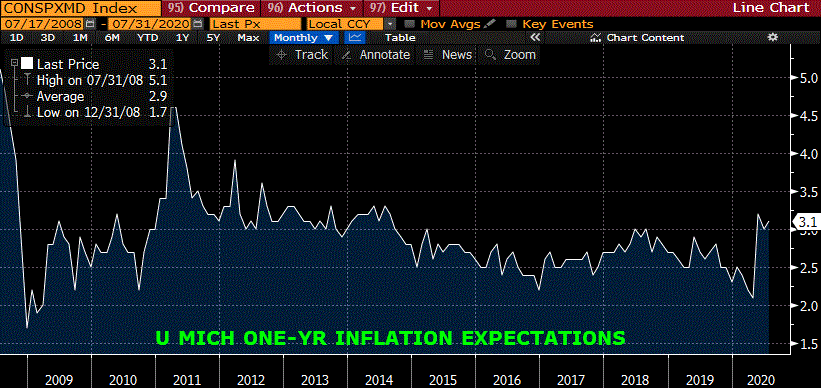
The markets have responded to the promise of undammed liquidity with flows being channeled into the quest for wealth of the damned. Gold and silver are making new highs. Stocks have responded. Yields are at rock bottom lows to encourage leveraged consumption. Real yields have descended to…you know… lower. On Friday the ten-year inflation-indexed note made a new low of -84.6. The lowest level in 2012 was -91; closing in. The thirty year tip is at a new record low of -28.7 bps. The five year is -108 bps. That’s well away from the 2013 low of -177, but it’s rapidly moving in that direction. Since the Fed’s aggressive response to the virus, the U of M survey of inflation expectations surged higher and hasn’t pulled back, in spite of every Fed official weeping about the possibility of deflation taking hold. The one-year expectation reported Friday was 3.1% with the 5-10 year at 2.7%.
The Fed’s core purpose is to foster maximum employment and price stability, with the vow to be a lender of last resort to viable entities. The embodiment of narrow and trusted responsibility. The leadership is now abandoning those core values like the Medicis fleeing Florence. Markets have sniffed out the initial ramifications: higher prices for financial assets, higher prices for commodities, risks being shunted aside for the shiny promise of quick returns associated with malinvestment. But risks have a way of flaring up like an out of control bonfire.
“I am the hailstorm that shall break the heads of those who do not take shelter.” –Girolamo Savonarola
OTHER MARKET/ TRADE THOUGHTS
As mentioned last week, “It has been sheer folly to bet against SPX or Nasdaq in the face of gigantic amounts of monetary and fiscal stimulus.” However, I thought NFIB optimism might push towards 90. It didn’t, coming out stronger than expected 100.6. I also though congressional dithering on an extension of benefits would cast a negative pall on the markets. It didn’t. Therefore, the ES end-of-month July 3000/2750/2500 put fly which I touted for 14.0 settled 5.95. I suppose that means the USU 175/172 put spread for 21 worked out then, right? Not really, it settled 17. But the inflationary push from the Fed should work to weaken the long end further.
Volumes have been light. Treasury vol is near historic lows. Gold and silver are breaking out to the upside. The dollar index closed the week below 96, poised to make a run for the March crisis low of 94.65. As the dollar declines, a lot of assets priced in dollars rise.
| 7/10/2020 | 7/17/2020 | chg | ||
| UST 2Y | 15.3 | 14.3 | -1.0 | |
| UST 5Y | 29.6 | 27.9 | -1.7 | |
| UST 10Y | 63.2 | 62.5 | -0.7 | |
| UST 30Y | 132.3 | 132.7 | 0.4 | |
| GERM 2Y | -68.9 | -66.4 | 2.5 | |
| GERM 10Y | -46.5 | -44.7 | 1.8 | |
| JPN 30Y | 55.6 | 57.9 | 2.3 | |
| EURO$ U0/U1 | -8.0 | -7.5 | 0.5 | |
| EURO$ U1/U2 | 5.5 | 4.0 | -1.5 | |
| EURO$ U2/U3 | 14.5 | 13.0 | -1.5 | |
| EUR | 113.01 | 114.38 | 1.37 | |
| CRUDE (active) | 40.76 | 40.75 | -0.01 | |
| SPX | 3185.05 | 3224.73 | 39.68 | 1.2% |
| VIX | 27.29 | 25.68 | -1.61 | |
Smith Wesson and me
July 17, 2020
–Once again, yields little changed on light volume with tens down 1,5 to 61.2. The thirty year mortgage rate fell below 3% for the first time (2.98%) aiding the flow of urban dwellers to the suburbs. In eurodollars, back calendar spreads are grinding to new recent lows. Red/gold pack spread fell 1.75 bps to 40.25. Vol remains lethargic; new seller of 7k TYU 138/141 strangle at 18 (settled there). However, there was a notable new bottom fishing buyer of 7500 USU 180p at 1’49 covered 180-08 causing the straddle to settle at that same level, 3’50, up 6/64 on the day.
–The Fed’s balance sheet is back over $7 trillion, having started the year at an already substantial level of $4.17t. Stocks only go up because the Fed’s balance sheet only goes up. The message isn’t lost on the home builders. All above 200 day moving averages with some at or near all-time highs, Lennar (LEN) DR Horton (DHI) and LGI Homes (LGIH), the latter having tripled off the March low like a rocket. Get outta Dodge with a cheap mortgage and a new Ford Bronco. And you thought only the gun stocks were doing well… SWBI (Smith and Wesson) up over 4x from March low).
–One other small note, the short sterling curve looking suspiciously like the US Fed fund curve, with red sterling contracts trading 100 or slightly above and the front Sept’20/Sept’21 closing at a new low -12.5 yesterday.
Low vol
July 16, 2020
–Once again, little movement in rates with tens up 1.3 to 62.7 bps. Euro$’s down 0.5 to 1.5 out to five years. Attached to this note is Five Year treasury vol. I marked FVU0 atm straddle at just 1.45 vol yesterday. That’s around the historically low level in late 2012, after Draghi’s “whatever it takes” line, but before Bernanke’s May 2013 taper tantrum. Unfortunately, it doesn’t seem like any tantrums are around the corner currently, except at the social level. On the other hand, it’s crazy to sell vol here. In the other direction was a new block buyer of 35k 2EZ 9950p for 4.5 covered 9967.5, 5d ref 9972.5 (4.25 synthetic). This put settled 3.75 vs 9974.0 in EDZ’22.
–Today’s news includes Retail Sales expected +5%, Philly Fed which had snapped back to 27.5 on its last release, which was higher than all readings in 2019, but expected to pull back to 20. Jobless Claims 1.250 million.
–China reported GDP +3.2% for Q2, however the Shanghai Comp fell 4.5% on profit taking after an explosive rally in the beginning of July. Looks sort of like TSLA, which would be at 1475 on a 4.5% pull back. In any case, US stock futures are also seeing early weakness.
–Wall St Journal headline notes ‘Surging Copper signals optimism on global growth’. From the March low to this month’s high (~212 to 294 in HGU0) copper has jumped nearly 40%. Lumber has doubled off the March low. Certainly it’s a bright spot, and infrastructure projects are sure to be instituted, but it’s a long way from cheering for organic growth. Interesting ZH article ‘Father of credit risk modeling’ has ominous warning over “insolvent” companies piling up debt. There’s not a lot of new info, as articles about zombie firms saved by central banks have been quite frequent. However, this piece does mention that a record $2.1 trillion bonds have been issued by global firms this year, about half from US companies. A lot depends on the Fed staying ultra-loose, which of course, several officials have promised in the past few days. A lot also depends on a new fiscal package.
https://www.zerohedge.com/markets/father-credit-risk-modeling-has-ominous-warning-over-insolvent-companies-piling-debt
The fight is against downside risks. Period
July 15, 2020
–Both stocks and bonds rallied yesterday with tens down 2.4 to 61.4 bps. CPI higher than expected 0.6 with yoy Core 1.2% and NFIB was much stronger than expected at 100.6. However, Fed officials continue to focus on downside risks. For example, Bullard said the Fed will keep rates low for the foreseeable future and Kaplan noted more aid to states and municipalities will be needed. Brainard fully outlined the Fed’s mindset in a speech yesterday which further boosted stocks. She noted that downside risks predominate, and echoed that theme at least four times. No mention of a risk that asset prices get over their skis. No mention of David Portnoy. Just more accommodation until we are sure covid risks have vanished.
Excerpts:
“With a dense fog of COVID-related uncertainty shrouding the outlook, the recovery likely will face headwinds for some time, calling for a sustained commitment to accommodation, along with additional fiscal support.”
“Given the downside risks to the outlook, there may come a time when it is helpful to reinforce the credibility of forward guidance and lessen the burden on the balance sheet with the addition of targets on the short-to-medium end of the yield curve.
“The Federal Reserve remains actively committed to supporting the flow of credit to households and businesses and providing a backstop if downside risks materialize. “
“…policy should seek to achieve employment outcomes with the kind of breadth and depth that were only achieved late in the previous recovery.”
–Stocks continue to move higher on a promising COVID test. UK issued three year notes at a negative yield. AAPL won its tax case with an EU Court and has avoided having to pay $14.6 billion to Ireland. Dollar index is currently testing the low in June and is closing in on the March low (current 9595 with March low 9465). EUR high in March was 1.1495 and is now 1.1431.
–Industrial Production expected 4.3%. Beige book in the afternoon.
Keep shoveling
July 14, 2020
–The fever finally broke in Nasdaq with NQU posting an outside day key reversal with a large range. New all-time high, lower daily low and lower close. These signals haven’t worked well recently, and neither ESU nor RTYU had outside days, but trade ended sloppily lower. The catalyst might have been more COVID, with CA rolling back re-opening of bars and restaurants. Or it might have been related to the expected but still shocking record US monthly budget deficit of $864 billion. That money is the coal being shoveled into the steam engine of the little train that could, to get us over the hump. A portion found its way into stocks as the rails flattened out, but there’s another hill ahead. Ding ding ding….those deficits might not be sustainable into perpetuity. What if they’re pared back? Who’s going to buy this stuff, at these levels, going into earnings season?

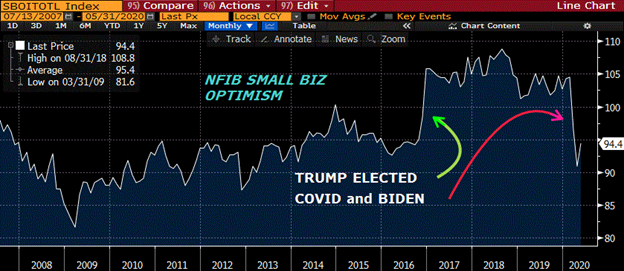
Today we have NFIB coming out expected 97.8 vs 94.4 last. I have become sort of fixated on this number because it correlates with Russell. It reached a low of 81.6 in 2009 and surged after Trumps election, hitting a high of 108.8 in 2018. Low for this cycle so far is 90.9 end of April, then a bounce to 94.4 for May…today’s data is for June. Small biz optimism shot up on Trump’s election because regulations were rolled back and the administration listened to business concerns. Biden will likely reimpose legislation and favor labor. I’m not saying that’s good or bad because I have the capability to be long or short. I am just saying that today’s data may be important, especially if it’s closer to 90 than 100.
Rates ended essentially unchanged, though there was modest pressure on the front end as we face tax day and settlement of last week’s auctions. Core yoy CPI expected +1.1% with month over month 0.1%.
“Earnings” season
July 13, 2020
–Friday saw a bounce in the curve with 2/10 up 2.4 bps to 48 bps, and red/gold pack spread up just over 5 to 45.25. Stocks continue to rise and are higher this morning as earnings season kicks off. JPM, Wells and Citi all report tomorrow. As Nasdaq soars to new all-time highs, with SPX about 6% from new highs, it’s somewhat interesting to look at how the banks stack up. JPM, down 32% from the year’s high. Citi about 36% off the high, Wells down 53%. The five-year treasury yield and 3m libor are within a few bps of each other, and both are under 30 bps. Bloomberg reports on a “…steady drumbeat of sad bankruptices.” COVID cases are increasing. In this environment, the investment grade bond etf LQD is making new all-time highs (thanks RL). While these bits of info might indicate a tough environment for financiers, banking doesn’t represent the ‘real’ economy. Silver does, and that’s at a new high this morning with SIU $19.52. GCQ0 is not quite at a new high, now $1813/oz.
–There’s an EU summit at the end of the week, apparently good feelings all around as differences are papered over.
–If I’m reading this right, the June monthly budget statement for the US gov’t is released today, expected at $863 billion deficit. That used to be on the high side for a YEAR. So we take that money and we buy stocks right? Well, not directly, we give it to people and THEY buy stocks. I don’t know what this world is going to look like in a year, but EDM’21 options have 336 days to go. The 9975 puts, which are 7 out of the money, trade 6. Whatever else happens, I guess we know with certainty that libor isn’t going above 31 bps.
With all the negative news about nursing homes and care facilities, here’s a good one:
https://www.the-sun.com/news/1127391/care-home-residents-recreate-album-covers/?utm_source=fark&utm_medium=website&utm_content=link
Signals
July 12, 2020
Many large investors have complained that the market is no longer sending out reliable signals, making it impossible to invest and generate consistent returns. More recently, attention has centered on “retail bros” upending sensible investing.
However, the market IS sending out signals. They’re just not the ones that many (myself included) want to hear. Interest rate futures and options are telegraphing government yield control. Moribund. Stagnant. Doomed. In spite of VIX still above 27, treasury vol is on historic lows, hovering around 3%. In the past month, one-year euro$ calendar spreads out to EDZ’22/EDZ’23 have had a range of 3.5 bps or less. To extract money from this type of market means taking on much larger positions than previously, either selling premium or playing curve roll (both nearly non-existent). Liquidity lessens, guaranteeing that the next blow-up becomes much larger than normal, and giving the Fed another opportunity to bring the firehose to a conflagration of its own making. Which is why we continue to see plays for negative yields in euro$ options and deferred FF contracts. (Peak FF contract is March’22 at 100.05 or negative 5 bps).
Some stocks are sending messages of pure insanity. TSLA? Here’s a quote from @charliebilello. “One year ago Tesla had a lower market cap than both GM and Ford. At $281 billion today, it now has a higher market cap than GM, Ford, Fiat Chrysler, Daimler, BMW, Ferrari, Honda and Hyundai… combined.” My guess is that VW’s ID.3 will take a big chunk of the mass electric car market, and the top end will be chipped away at by cooler producers like Lucid. But that’s of no consequence. Everyone can see that the flows are gushing into big tech, and big tech means world dominance. AAPL has a market cap of $1663 billion. At the end of Q2 2019 it was $875 billion. Future earnings discounted at 0%.
Here’s a chart with another market signal. Gold priced in USD (white line) and in CNY (amber line).

I have a friend who recently said, “Something really broke at the end of 2018.” Recall that at the beginning of Q4 ‘18 the Fed was still in a full-fledged tightening mode. At the start of October the Fed had ratcheted up Quantitative Tightening to $50b per month (paring the balance sheet) and on Oct 8 Powell said “we’re a long way from neutral”. *Rings bell with sledge hammer* From October 3 to Christmas Eve, SPX lost 20%. The Fed capitulated. Other central banks and governments followed suit. This message hasn’t been lost on gold. When priced in CNY it’s at a new all-time high. In USD it’s around $1800, not quite at the 2011 high of $1921. So what, right? Everyone knows that gold has been going up. The message though, is that of desperate capitulation with intent to debase fiat currency, accentuated by COVID but pre-dating it by a year.
Summer markets are typically thought to be uneventful, but in August 2015 China devalued. The same thing unofficially occurred in Aug 2019. At the end of July, the US $600/week benefit package is set to expire. Mnuchin says a new package will be less generous, though it still needs to pass a dithering Congress. The Fed’s balance sheet continues to decline as repo usage fell to zero last week, but if a new aid package is not passed, expect another rapid BS increase as stocks decline and social unrest flares up. It’s a little more nuanced than “stocks always go up”. It’s that the Fed has been beaten into a subservient role with respect to stocks. Lending to Illinois directly is a case in point. The Fed is not supposed to lend to junk credits. According to a spokesman for the state’s comptroller office, IL paid $167 million in late payment interest in 2019 (by state law accrues at 12% per year), but is paying other bills ahead of late interest payments this year. “I don’t pay interest on interest. That’s going to the back of the line.” [Comptroller Susana Mendoza] said. “I need to make sure that I’m either paying the front-line providers or I’m paying down the bills that are accruing late payment penalties at 12 percent. That’s the best use of taxpayer money.” Sounds pretty much like default to me. And that’s who the Fed lends to? At 3.83%? By the way, one of the companies who acts as intermediary by paying the state’s vendors at a discount and thus takes on the receivables while accruing the 12% penalty, features former governor Jim Edgar as a lead partner. Illinois Financing Partners. Of course, this guy wasn’t sent to jail, like many former IL guvs. Yet. He just skims a little off the top with an air of legitimacy…”helps the state sort its way through a difficult period.” No kidding. That quote is right off the IFP website. Sounds like Don Fanucci in Godfather 2 (thanks CD). “Tell your friends I don’t want a lot. Just enough to wet my beak.” The financial wizards in New Jersey like the sound of it and are also considering tapping the Fed’s muni facility.

As mentioned during the week, as the Fed hammers the real yield, with the ten-year inflation indexed note at negative 79 bps, both gold and Nasdaq benefit. The below chart puts the tip yield in white, sinking to the bottom right hand corner, and normalizes gold and Nasdaq to the beginning of the year…both up nearly 20%. Of course, the Shanghai Comp is up 20% since the beginning of June as the CCP shamelessly leads the cheerleading effort.

This week features NFIB confidence and CPI on Tuesday. Tax day, auction settlement on Wednesday, so there’s a possibility of some funding pressure. Fed releases Beige Book for the end of the month FOMC (only 2 FOMC meetings left before the election, assuming that it takes place). Retail Sales on Thursday and UofM sentiment and inflation expectations on Friday.
| 7/2/2020 | 7/10/2020 | chg | ||
| UST 2Y | 15.3 | 15.3 | 0.0 | |
| UST 5Y | 29.6 | 29.6 | 0.0 | |
| UST 10Y | 66.9 | 63.2 | -3.7 | |
| UST 30Y | 143.3 | 132.3 | -11.0 | |
| GERM 2Y | -68.0 | -68.9 | -0.9 | |
| GERM 10Y | -42.8 | -46.5 | -3.7 | |
| JPN 30Y | 64.1 | 55.6 | -8.5 | |
| EURO$ U0/U1 | -7.5 | -8.0 | -0.5 | |
| EURO$ U1/U2 | 5.0 | 5.5 | 0.5 | |
| EURO$ U2/U3 | 14.5 | 14.5 | 0.0 | |
| EUR | 112.30 | 113.01 | 0.71 | |
| CRUDE (active) | 40.65 | 40.55 | -0.10 | |
| SPX | 3130.01 | 3185.05 | 55.04 | 1.8% |
| VIX | 27.68 | 27.29 | -0.39 | |
It’s the weekend
July 10, 2020
–Stocks began to retreat on the Supreme Court ruling that paved the way for release of Trump’s tax returns. Russell led the way, Nasdaq is pretty much immune. Yields fell, nearing all-time lows. Tens fell 5 bps to 60.4, while twos ended at 14.9 and this morning are 14.3, a new historic low. The peak contract on the eurodollar curve shifted out to the third red, EDH2, which settled 9983.5, highest ever for an ED contract in that slot. Treasury vol is in the dirt, though bond vol firmed just slightly after a solid 30y auction at 1.33%. There was a new buyer of 30k 3EU 9962/9950/9937 put fly for 1.5; settled 1.25 vs 9966.5 in EDU’23. July midcurves expire today.
–Every eurodollar contract for the first three years is between 9970 and 9983.5. There is continued discussion about yield curve control, but it has already occurred. The Fed’s jawboning has accomplished the demise of the front end.
–PPI today expected 0.4 with Core 0.1. The big issue facing the economy is the new stimulus program. Mnuchin yesterday said the new package will not pay unemployed more than their old wages; the extra kick provided by the $600/week payment will fade. Mnuchin says he hopes the new package will be passed between July 20 and month-end when the original program ends. If that DOESN’T happen, watch out below. Russell is already seeking a safe space as smaller stocks appear vulnerable to the loss of Robinhood support. Fannie Mae’s mortgage forbearance was at least six months (CARES act) but that too will begin to fade toward the end of the year (thanks JF).
–Stock futures are a touch lower as of this writing. Chinese stocks took a profit-taking breather. Weekend risk remains, with Turkey and Egypt flexing in what for now are military “games” and the US ratcheting up naval pressure in the South Sea. As we’re often reminded, ‘We need to start worrying about what kind of world we are going to leave for Keith Richards.’
Silver > $19
July 9, 2020
–New high China stocks today and as of this writing spot silver has pierced $19 in what could be an upside breakout.
–Dull trading in rates yesterday with yields little changed as tens closed at 65.3 bps, essentially unch’d. The highest point on the euro$ curve is EDU’21 at 9983 or 17 bps. There was one large trade, a new buy of 36k 2EZ 9950 puts for 4.5 cov’d 9969 with 5 delta. Settled 4.0 vs 9974.5 in EDZ’22.
–Yesterday’s consumer credit report surprisingly indicated that credit cards were paid down in May, with revolving debt falling from 1019.9B in April to 995.6B in May. Perhaps people were paying credit cards instead of rent, as a survey from Apartment List was cited on CNBC that 19% hadn’t yet made their housing payment in July (mortgage or rent). An additional 13% only made a partial payment. 14.8% deposited funds in a Robinhood account. OK I made that last part up, but if approx 30% of people aren’t making housing payments, it’s not a sign of a vibrant economy.
–As @Rishisays notes (“They said supply can’t move bond yields anymore”), Canada bond yields jumped on a plan to sell new debt to cover a yawning deficit. Tens jumped to 57 bps from 51 yesterday and 30;s to 109 from around 102.6 before the announcement. Trudeau ought to have his central bank buy that stuff.
–Jobless Claims today expected 1.375m.